Occasional blogging, mostly of the long-form variety.
Showing posts with label MLK. Show all posts

Monday, January 20, 2020

"I could not be silent in the face of such cruel manipulation of the poor."

It's Martin Luther King Jr. Day, and given the recent and familiar saber-rattling we've been hearing, this time agitating for a war with Iran, it seems like a good time to visit King's speech, "Beyond Vietnam." He delivered it at Riverside Church in New York City on April 4, 1967, a year before he was assassinated. The Martin Luther King, Jr. Research and Education Institute has the text and audio, and it's nice to listen to his sonorous cadences. King took a significant risk in pushing back against concerns about political caution and instead spoke his conscience. Some of the references are very much tied to the era, but others remain all too timely.

I come to this platform tonight to make a passionate plea to my beloved nation. This speech is not addressed to Hanoi or to the National Liberation Front. It is not addressed to China or to Russia. Nor is it an attempt to overlook the ambiguity of the total situation and the need for a collective solution to the tragedy of Vietnam. Neither is it an attempt to make North Vietnam or the National Liberation Front paragons of virtue, nor to overlook the role they must play in the successful resolution of the problem. While they both may have justifiable reasons to be suspicious of the good faith of the United States, life and history give eloquent testimony to the fact that conflicts are never resolved without trustful give and take on both sides. Tonight, however, I wish not to speak with Hanoi and the National Liberation Front, but rather to my fellow Americans.

Since I am a preacher by calling, I suppose it is not surprising that I have seven major reasons for bringing Vietnam into the field of my moral vision. There is at the outset a very obvious and almost facile connection between the war in Vietnam and the struggle I and others have been waging in America. A few years ago there was a shining moment in that struggle. It seemed as if there was a real promise of hope for the poor, both black and white, through the poverty program. There were experiments, hopes, new beginnings. Then came the buildup in Vietnam, and I watched this program broken and eviscerated as if it were some idle political plaything on a society gone mad on war. And I knew that America would never invest the necessary funds or energies in rehabilitation of its poor so long as adventures like Vietnam continued to draw men and skills and money like some demonic, destructive suction tube. So I was increasingly compelled to see the war as an enemy of the poor and to attack it as such.

Perhaps a more tragic recognition of reality took place when it became clear to me that the war was doing far more than devastating the hopes of the poor at home. It was sending their sons and their brothers and their husbands to fight and to die in extraordinarily high proportions relative to the rest of the population. We were taking the black young men who had been crippled by our society and sending them eight thousand miles away to guarantee liberties in Southeast Asia which they had not found in southwest Georgia and East Harlem. So we have been repeatedly faced with the cruel irony of watching Negro and white boys on TV screens as they kill and die together for a nation that has been unable to seat them together in the same schools. So we watch them in brutal solidarity burning the huts of a poor village, but we realize that they would hardly live on the same block in Chicago. I could not be silent in the face of such cruel manipulation of the poor.

My third reason moves to an even deeper level of awareness, for it grows out of my experience in the ghettos of the North over the last three years, especially the last three summers. As I have walked among the desperate, rejected, and angry young men, I have told them that Molotov cocktails and rifles would not solve their problems. I have tried to offer them my deepest compassion while maintaining my conviction that social change comes most meaningfully through nonviolent action. But they asked, and rightly so, “What about Vietnam?” They asked if our own nation wasn’t using massive doses of violence to solve its problems, to bring about the changes it wanted. Their questions hit home, and I knew that I could never again raise my voice against the violence of the oppressed in the ghettos without having first spoken clearly to the greatest purveyor of violence in the world today: my own government. For the sake of those boys, for the sake of this government, for the sake of the hundreds of thousands trembling under our violence, I cannot be silent.

For those who ask the question, “Aren’t you a civil rights leader?” and thereby mean to exclude me from the movement for peace, I have this further answer. In 1957, when a group of us formed the Southern Christian Leadership Conference, we chose as our motto: “To save the soul of America.” We were convinced that we could not limit our vision to certain rights for black people, but instead affirmed the conviction that America would never be free or saved from itself until the descendants of its slaves were loosed completely from the shackles they still wear. In a way we were agreeing with Langston Hughes, that black bard of Harlem, who had written earlier:

O, yes, I say it plain, America never was America to me, And yet I swear this oath— America will be!


Now it should be incandescently clear that no one who has any concern for the integrity and life of America today can ignore the present war. If America’s soul becomes totally poisoned, part of the autopsy must read “Vietnam.” It can never be saved so long as it destroys the deepest hopes of men the world over. So it is that those of us who are yet determined that “America will be” are led down the path of protest and dissent, working for the health of our land.
Digby has featured this speech before, emphasizing other good passages – it's full of them. And The New Yorker has a good piece from 2017 giving more background on crafting the speech and the political costs King knew it would incur. (It also covers John Lewis' memories of the speech.)

I appreciate that King linked war, and basically imperialism, to issues of class, race and lost opportunities in America. He received backlash for the speech, even though some passages of it are simpatico with that noted political radical, Dwight Eisenhower, who in 1953 asserted that "Every gun that is made, every warship launched, every rocket fired signifies, in the final sense, a theft from those who hunger and are not fed, those who are cold and are not clothed. This world in arms is not spending money alone. It is spending the sweat of its laborers, the genius of its scientists, the hopes of its children." King emphasized race much more, of course, which surely made some of his white audience uncomfortable. And many of his points unfortunately remain all too pertinent.

In the questions for this election cycle's primary debates and in political chatter in general, we're essentially told that war, and all military spending, is free. According to conservatives, tax cuts and other giveaways to the rich and powerful are free as well or otherwise a national boon, and such largess will theoretically trickle down to we the peons. Apparently, it's only health care, and other domestic programs that could benefit the overwhelming majority of Americans, that cost money and need to be interrogated. Perhaps some wars are indeed necessary, yet the same people most likely to recklessly agitate for them typically argue against even the possibility of new or better social programs domestically. "I could not be silent in the face of such cruel manipulation of the poor," said King. He wasn't fully appreciated in his lifetime, and his willingness to link the civil rights struggle to challenging other pervasive, oppressive notions is still not fully acknowledged now. As Cornel West put it, we should resist the "Santa Claus-ification" of King; it would be vanity to suppose we've already learned all he has to teach us.

Monday, January 21, 2013

MLK Day 2013

This year, I wanted to pass on two thematically-appropriate pieces on the Civil War era.

The first is an intriguing story from Avis Thomas-Lester in The Washington Post, "Civil War Hero Robert Smalls Seized the Opportunity to Be Free":

He sat at the conference table next to Frederick Douglass as they tried to convince President Abraham Lincoln that African Americans should be allowed to fight for their own freedom. He served five terms in Congress. He ran a newspaper and helped found a state Republican Party.

But first, he had to win his freedom.

To do that, he conceived a plan that struck a blow against the Confederacy so significant that he was heralded across the nation. Carrying out his mission required bravery, intelligence and precision timing — attributes that many whites at that time thought blacks didn’t possess.

Robert Smalls proved them wrong and changed history in the doing.

Follow the link to read the rest.

Meanwhile, American Experience on PBS is showing a three part series on the Abolitionists. The first two parts can be viewed online, while the third will air this upcoming week. (Seeing Lincoln made me long for a good Frederick Douglass biopic, and PBS delivers a taste of that.)

For the words of Martin Luther King, Jr. himself, check out the MLK archive or a number of other blogs today.

Monday, January 16, 2012

MLK Day 2012

In previous years for Martin Luther King Day, I've featured King's words and other civil rights material (see the "MLK" category below). This year, I wanted to at least link a few pieces focused on MLK himself (along with the Guantanamo piece). It's sometimes startling to remember he was only 39 when he was assassinated.

Democracy Now ran "Dr. Martin Luther King, Jr. in His Own Words."

Rick Perlstein wrote a good piece back in 2008, "Conservatives and Martin Luther King." We've covered conservatives' attempt to appropriate King before, and it's especially amusing and shameless given their opposition to the actual man in his lifetime. As always, Perlstein provides some great details.

In a similar vein, Blue Texan has "Republicans and Martin Luther King, Jr. Day: A Reminder." (Voting records are pesky things.)

Finally, one of my local PBS stations re-ran a 2010 special, "In Performance at the White House: A Celebration of Music from the Civil Rights Movement." If you've got a soft spot for folk music, especially civil rights music, check it out. (I wasn't crazy about every performance, but some of the renditions are pretty good.)

Update: Roy Edroso: "Every MLK Day you get conservatives talking about how Martin Luther King was kind of a Rick Santorum type. At The Heritage Fondation this year, Matt Spalding drew the short straw..."

Monday, January 17, 2011

MLK Day 2011

Violence as a way of achieving racial justice is both impractical and immoral. It is impractical because it is a descending spiral ending in destruction for all. The old law of an eye for an eye leaves everyone blind. It is immoral because it seeks to humiliate the opponent rather than win his understanding. It seeks to annihilate rather than convert. Violence is immoral because it thrives on hatred rather than love. It destroys community and makes brotherhood impossible. It leave society in a monologue rather than dialogue. Violence ends by defeating itself. It creates bitterness in the survivors and brutality in the destroyers.

- Martin Luther King, Jr.


Update: Digby has an excellent post for the day.


Monday, January 18, 2010

MLK Day 2010: Letter From a Freedman

This year for Martin Luther King Day, I wanted to feature a letter written in 1865 by a former slave to his former master. I've linked it before elsewhere in honor of Juneteenth, but it's pretty extraordinary. This comes via Facing South (in turn via Ta-Nehisi Coates). Facing South describes it as a:

...letter by freedman Jourdon Anderson of Dayton, Ohio. He was writing in response to an invitation from Colonel P.H. Anderson of Big Springs, Tenn., his former enslaver, to return to as a laborer to the plantation where he was once held captive...

[The] document... is part of the online Digital History Archives at the University of Houston. The letter, dated Aug. 7, 1865, was published in the Cincinnati Commercial and later reprinted in the New York Tribune.


Here's the full text:

To My Old Master, Colonel P.H. Anderson, Big Spring, Tennessee

Sir: I got your letter and was glad to find you had not forgotten Jourdon, and that you wanted me to come back and live with you again, promising to do better for me than anybody else can. I have often felt uneasy about you. I thought the Yankees would have hung you long before this for harboring Rebs they found at your house. I suppose they never heard about your going to Col. Martin's to kill the Union soldier that was left by his company in their stable. Although you shot at me twice before I left you, I did not want to hear of your being hurt, and am glad you are still living. It would do me good to go back to the dear old home again and see Miss mary and Miss Martha and Allen, Esther, Green, and Lee. Give my love to them all, and tell them I hope we will meet in the better world, if not in this. I would have gone back to see you all when I was working in the Nashville hospital, but one of the neighbors told me Henry intended to shoot me if he ever got a chance.

I want to know particularly what the good chance is you propose to give me. I am doing tolerably well here; I get $25 a month, with victuals and clothing; have a comfortable home for Mandy (the folks here call her Mrs. Anderson), and the children, Milly, Jane and Grundy, go to school and are learning well; the teacher says grundy has a head for a preacher. They go to Sunday- School, and Mandy and me attend church regularly. We are kindly treated; sometimes we overhear others saying, "The colored people were slaves" down in Tennessee. The children feel hurt when they hear such remarks, but I tell them it was no disgrace in Tennessee to belong to Col. Anderson. Many darkies would have been proud, as I used to was, to call you master. Now, if you will write and say what wages you will give me, I will be better able to decide whether it would be to my advantage to move back again.

As to my freedom, which you say I can have, there is nothing to be gained on that score, as I got my free- papers in 1864 from the Provost- Marshal- General of the Department of Nashville. Mandy says she would be afraid to go back without some proof that you are sincerely disposed to treat us justly and kindly -- and we have concluded to test your sincerity by asking you to send us our wages for the time we served you. This will make us forget and forgive old scores, and rely on your justice and friendship in the future. I served you faithfully for thirty- two years and Mandy twenty years. At $25 a month for me, and $2 a week for Mandy, our earnings would amount to $11,680. Add to this the interest for the time our wages has been kept back and deduct what you paid for our clothing and three doctor's visits to me, and pulling a tooth for Mandy, and the balance will show what we are in justice entitled to. Please send the money by Adams Express, in care of V. Winters, esq, Dayton, Ohio. If you fail to pay us for faithful labors in the past we can have little faith in your promises in the future. We trust the good Maker has opened your eyes to the wrongs which you and your fathers have done to me and my fathers, in making us toil for you for generations without recompense. Here I draw my wages every Saturday night, but in Tennessee there was never any pay day for the Negroes any more than for the horses and cows. Surely there will be a day of reckoning for those who defraud the laborer of his hire.

In answering this letter please state if there would be any safety for my Milly and Jane, who are now grown up and both good- looking girls. You know how it was with Matilda and Catherine. I would rather stay here and starve and die if it comes to that than have my girls brought to shame by the violence and wickedness of their young masters. You will also please state if there has been any schools opened for the colored children in your neighborhood, the great desire of my life now is to give my children an education, and have them form virtuous habits. <>P.S. -- Say howdy to George Carter, and thank him for taking the pistol from you when you were shooting at me.

From your old servant,

Jourdon Anderson


Many of the lines - "As to my freedom, which you say I can have, there is nothing to be gained on that score," "what we are in justice entitled to," and "We trust the good Maker has opened your eyes to the wrongs which you and your fathers have done to me and my fathers," - are wry, thoughtful and moving. The post scriptum is in a class by itself, though.

MLK Day to me has always meant stopping to consider the dignity of all human beings, and to honor those who have fought for rights for all. It was a special day for history and reflection at the school where I taught. I continued to be dismayed by public figures casually endorsing torture. It's monstrous. However, there are so many smaller indignities in our culture and around the world, too. Fighting for basic civil or human rights isn't always in fashion, but it's one of the best fights there is.

Tavis Smiley has a special on Martin Luther King's speech against the Vietnam War that will be airing on March 31, 2010 on some PBS stations. In the meantime:

Monday, January 19, 2009

MLK Day 2009: I Am A Man


When Martin Luther King, Jr. went down to Memphis in 1968, it was to assist with a garbage worker's strike. Two workers had been slowly crushed to death in a garbage truck, an utterly horrible way to go. The workers moved to form a union, pushing for better wages but also some sort of safety or warning mechanism so no such accident could happen again. The mayor and other forces were, shall we say, less than accommodating.

The workers' strike is the subject of OyamO's play I Am A Man. Some background on OyamO and the play can be read here. Tavis Smiley's discussions with Memphis minister Rev. Samuel "Billy" Kyles and former sanitation worker Taylor Rogers also give important background (Kyles describes being there during King's last night).

The play was finished in 1992, and I saw one of the earlier major productions of it, an excellent one at Arena Stage in D.C. in 1995. King is a frequent presence in the play, but almost entirely as a voice coming over speakers, only briefly seen crossing the stage near the end (at least in the production I saw). The key figure is instead the head of the garbage workers, T.O. Jones, rivetingly played in the D.C . version (I'm afraid I currently can't confirm that actor's name). Despite the often serious subject matter, the play's full of humorous moments as well. I found it particularly fascinating to see all the infighting and resolutions between different groups, since, for instance, some parties wanted a more militant approach while others wanted no demonstrations at all. I saw it with a friend my age, and since we were too young to remember the actual events, it was very educational. However, this was not an 'eat-your-broccoli' piece - it was great theater, with some powerful moments.

OyamO describes Jones as:

40s, speaks with vocal, gestural and emotional ebullience. Beefy, but average height, very friendly, but also bullheaded about some things. Somewhat vulnerable, a bit fearful and not well educated, quit Memphis Public School in the 8th grade. But he's naturally intelligent – common street sense, a cajoling wit, a generous nature, a lot of heart.


The play script is written in dialect. Jones' wit and passion comes out in a confrontation at the city council, where to make a point, he points to the Memphis city seal (only low-res copies seem available, alas):


COUNCILMAN: Unacceptable! The city does not recognize that union and therefore will not entertain the showboat rantings of some so-called representative.

BLUESMAN: Rantin'! You wanna hear some rantin'? Let me tell you 'bout that city seal you got hanging over yo' head.

JONES: See dat steamboat? It brings slaves up and downriver for trading. The cotton boll? Dat's what da slaves pick ta make a few peepas rich. That oak leaf is where day tied the slave to beat him or where they hanged him. Used ta whip ya wit dem oak sticks too. Dat piece a machinery? Dat's the wheel of progress dat grine the slave up. Da Civil War ova, but we still fighting against slavery. Chop cotton for three dollas a dat or tote garbage for one dolla and sixty cents a hour. Da union come here ta finally stop slavery.


My favorite exchange is this one between Jones and Joshua Solomon, a white labor negotiator from New York:

SOLOMON: The press has got to be spoonfed. You can't ignore them when you're conducting a public strike. They'll nail you to the wall. Look, one question I have to ask. Why the hell did ya call a strike in February when garbage don't stink?

JONES: Garbage stink all the time, when you got ta carry it on yo' head.


Still, what's stuck with me the most years later is the following monologue. It was a stunner. The Arena's main stage is just that, an arena set-up, with the audience on all four sides. Throughout the play, a bluesman plays sort of a Greek chorus, making comments and playing music. Here, Jones has just gotten bad news. He's at his lowest point, even while the stakes are the highest. He's trying to rescue some scrap of dignity in the face of continual, crushing degradation. As you read through this speech, imagine it being delivered with great weight, each few sentences a separate point, with Jones slowly walking around all four sides, looking at the audience, almost imploring. The lights are low except for a spotlight on Jones. Imagine the bluesman wailing away on his harmonica in the background.

(The BLUESMAN strums a low, funky blues as the Lights and Images swift to a Beale St. Bar which he enters. JONES shortly stumbles in, now drunk. He, bottle in hand, stands swaying before the BLUESMAN. He begins dancing, slowly, dancing out of sorrow. The song's refrain goes as follows:]

BLUESMAN: THE GRAVEDIGGER IS YO' VERY BEST FRIEND
THE GRAVEDIGGER IS YO' VERY BEST FRIEND
HE ONLY LET YOU DOWN ONCE NO MATTER WHAT YOU BEEN

[JONES stops dancing, angrily hurls the bottle which breaks offstage. He speaks to no one in particular the following over the background instrumental accompaniment of the BLUESMAN:]

JONES: When I was toting garbage, I knowed every alcoholic in town, da ones live in da shacks and da ones what living high in the big houses. I knowed who was creepin' 'round some back doe on day husband or wife. I knowed who was taking high price drugstore drugs and street drugs. I run to the back of da house ta git da garbage and I seed all kinda womens in the window. Naked! Not a stitch on! Justa lookin' down at ole stinkin', black, empty-face me, and smilin' real big. I seed big impo'tent men in dis town beating on soft, little white womens in da back bedrooms. I heard dem womens scream and beg for mercy. I once seed a father touchin' his near 'bout growed up daughter, touchin' her where no fatha 'sposed to touch his daughter. One time I pulled a dead baby from the garbage, a little white baby, blood still fresh. Somebody throwed it in the garbage behine a fine mansion. And peepas treat me like I stink. Nothin' stinks worse den the da garbage dat da garbage man leave behine everyday.

[Jones staggers out.]


I'm sorry my description can't do it justice, but if you had seen this one performed, it'd have stuck with you years afterward, too. Jones has a later, bitter monologue after King is killed, remarking that all they got was an eight cent raise, "eight shiny pennies" and "not even thirty pieces of silver" for King. He finally puts on a brave face and urges the striking men to go back to work. When I think about I Am A Man, or King, I think about the importance of human dignity, and the cruel things we sometimes do to each other. It's a good day to remember how fostering simple kindness and connection isn't just essential — it's sometimes the most revolutionary act in the world.

(Cross-posted at Blue Herald)

Monday, January 21, 2008

MLK Day 2008


Civil rights are probably under greater assault now than they're been in a few decades. Glenn Greenwald reminds us the FISA fight isn't done. Director of National Intelligence Mike McConnell aims to create an Orwellian surveillance state, citing imaginary boogeymen and phantom evidence (The New Yorker article is not yet online, but will be eventually here). Eliminating habeas corpus and employing torture should never have occurred, but the scoundrels who perpetrated it are still in power, and their damage must be fixed. The basic concept of the rule of law and a sound justice system have been systematically attacked. Finally, a key Supreme Court case involving an Indiana Voter ID law is being decided — and I fear good law, common sense and basic decency will not prevail.

In previous years for MLK Day, I've posted the text of the famous "I Have a Dream" speech, and links to video of it. That speech never ceases to give me a chill, and is hard to top, so go here if you'd like to feel that inspiration again. It's a good reminder of what can, has and must be done.

This year, you might also want to check out Denzel Washington's new film, The Great Debaters. It's a little Hollywood, but it's very good within that and hard not to like, with strong performances by Washington and Forest Whitaker (no surprise), as well as very impressive turns by a group of young actors (that's not to mention several other superb supporting actors). With some frustratingly hackish blather on race recently on the national stage, The Great Debaters is also a good reminder of the reality of not-so distant history. It also embodies that idea that regardless of one's background, one of the best ways to stick it to the Man and effect positive change is to learn more about the world, to develop critical thinking skills, and to speak out! (I'll link some of Washington's excellent interviews at a later date as part of my annual film roundup).

To close, here's a poem by Afaa Michael Weaver I discovered last year. I think the last few lines are pretty extraordinary.

The Picnic, An Homage to Civil Rights

We spread torn quilts and blankets,
mashing the grass under us until it was hard,
piled the baskets of steamed crabs
by the trees in columns that hid the trunk,
put our coolers of soda pop
on the edges to mark the encampment,
like gypsies settling in for revelry
in a forest in Romania or pioneers
blazing through the land of the Sioux,
the Apache, and the Arapaho, looking guardedly
over our perimeters for poachers
or the curious noses of fat women
ambling past on the backs of their shoes.
The sun crashed through the trees,
rumbling down and splattering in shadows
on the baseball diamond like mashed bananas.
We hunted for wild animals in the clumps
of forests, fried hot dogs until the odor
turned solid in our nostrils like wood.
We were in the park.

One uncle talked incessantly, because he knew
the universe; another was the griot
who stomped his foot in syncopation
to call the details from the base of his mind;
another was a cynic who doubted everything,
toasting everyone around with gin.
The patriarchal council mumbled on,
while the women took the evening to tune
their hearts to the slow air and buzzing flies,
to hold their hands out so angels could stand
in their palms and give dispensation,
as we played a rough game of softball
in the diamond with borrowed gloves,
singing Chuck Berry and Chubby Checker,
diving in long lines into the public pool,
throwing empty peanut shells to the lion,
buying cotton candy in the aviary
of the old mansion, laughing at monkeys,
running open-mouthed and full in the heat
until our smell was pungent and natural,
while the sun made our fathers and uncles
fall down in naps on their wives' laps, and
we frolicked like wealthy children on an English estate,
as reluctant laws and bloodied heads
tacked God's theses on wooden doors,
guaranteed the canopy of the firmament above us.

— Afaa Michael Weaver

(Cross-posted at The Blue Herald)

Friday, September 29, 2006

Elegy (and Call to Arms) for the United States Constitution, 9/28/06

I tremble for my country when I reflect that God is just: that his justice cannot sleep forever.
—Thomas Jefferson, 1785, on slavery.

Against all logic, common sense, basic understanding of the United States Government, and morality, the Detainee/Military Trial Bill has passed.

The wounds inflicted upon America on 9/11/01 were deep and real; none of us alive and cognizant at that time will ever forget them. But those grave events were inflicted by a foreign enemy, Al-Qaeda. In tragic, horrific contrast, the wounds inflicted upon America and the United States Constitution today, 9/28/06, are self-inflicted. It's as if a mugging victim, shaken by his experience, decided the best way to prevent future harm to himself was to slit his own wrists.

The best way to avoid being prosecuted for war crimes is - don't commit war crimes.

Sadly, it seems this option has not been considered by the Bush administration and the Republican party, as evidenced by their move to legalize torture, eliminate habeas corpus, and undermine the 4th Amendment through warrantless surveillance. We can catch any bad guys without these measures, and these measures harm the very cause they claim to further. Violence, crime and terrorism are solved through a greater commitment to justice, not through violence towards the Geneva Conventions, the United States Constitution and core American values. The Nuremberg trials confronted true evil by upholding rather than undermining the rule of law and principles of basic human decency. There's a reason why so many military personnel, intelligence officials, and JAGs oppose Bush's measures. America should not torture, nor attempt to strip anyone of essential civil rights.

The best way to fight evil is with good.

As Glenn Greenwald observes, “it is not hyperbole to say that this is one of the most tyrannical and dangerous bills to be enacted in our nation’s history.” As Patrick Leahy (D-VT) said, “Why would we allow the terrorists to win by doing to ourselves what they could never do, and abandon the principles for which so many Americans today and through our history have fought and sacrificed?” As the line from Henry V goes, “Shame and eternal shame, nothing but shame!”

Lincoln must be rolling over in his grave. What is wrong with the Republican party? I cannot pretend to the moral authority or compassion to say, “forgive them, for they know what they do.” I am not inclined to forgive them. And I suspect they do know what they do. Cassandra’s curse was to know the future, and shout it out, but never to be believed. The difference here is that Cassandra, here played by liberals and all those conservatives and moderates who revere justice and the rule of law, have been heard, but still dismissed by those in power. It is not that those in power do not hear (and they may even believe); they just do not care. As the passage by Pastor Martin Niemöller goes:

When the Nazis came for the communists,
I remained silent;
I was not a communist.

When they locked up the social democrats,
I remained silent;
I was not a social democrat.

When they came for the trade unionists,
I did not speak out;
I was not a trade unionist.

When they came for me,
there was no one left to speak out.

The GOP either assumes no one will ever come for them — or fears it so much they are acting to prevent any legal repercussions for when it finally happens. I tend to think they simply cannot imagine the possibility that innocents will be arrested and harmed and soldiers endangered by their measures. Nor can they imagine not being in a position of power and privilege. Civil rights are a concern for the little people, not those sitting in the first-class seats.

To the GOP:

Are you so fearful of terrorists that you will betray the very same essential values that spurred the creation of America in the first place?

Are you so incompetent you cannot convict a real terrorist in a fair trial?

Are you so lazy you cannot get a warrant to pursue our enemies?

Are you so ignorant that you would needlessly throw out the United States Constitution?

Are you so selfish that the safety and well-being of American soldiers is less important to you than your own re-election and your party keeping power?

Are you so proud of your performance to date waging the wars in Iraq and Afghanistan, in investigating war profiteering, in general congressional oversight, in Katrina (and Iraq) reconstruction, in fiscal management and demonstrating unimpeachable ethical standards, that the Democrats cannot be trusted to continue your holy mission?

Are you so unpatriotic as to betray everything that has made America great?

America has been a great nation, despite its faults. Among its greatest shames are slavery, the treatment of Native Americans, the Japanese Internment Act, and the prolonged delay of civil rights for all Americans. But America has always been about pursuing the ideal, about evolving and progressing, about self-correcting. At its heart, at its best, it is a progressive nation. When Dr. Martin Luther King, Jr. spoke out against the injustice of his era, he spoke not of a new, radical revolution, but of America honoring its own ideals.

Our national honor has been horribly stained — in the name of our nation. It is time for all men and women of conscience to rescue America from the same false patriots who shriek so loudly that that the only way to protect America is to strip us all of our essential freedoms.

I’m reminded of two stirring, quintessentially American pieces. One is an elegy. The other serves as a call to arms.

The Elegy: Walt Whitman wrote “O Captain, my Captain” after the assassination of Abraham Lincoln in 1865:

O Captain! My Captain!

I. O Captain! my Captain! our fearful trip is done;
The ship has weather'd every rack, the prize we sought is won;
The port is near, the bells I hear, the people all exulting,
While follow eyes the steady keel, the vessel grim and daring.
But O heart! heart! heart!
O the bleeding drops of red!
Where on the deck my Captain lies,
Fallen cold and dead.

II. O captain! my Captain! rise up and hear the bells;
Rise up! For you the flag is flung, for you the bugle trills:
For you bouquets and ribboned wreaths, for you the shores a-crowding:
For you they call, the swaying mass, their eager faces turning.
O Captain! dear father!
This arm beneath your head;
It is some dream that on the deck,
You've fallen cold and dead.

III. My Captain does not answer, his lips are pale and still;
My father does not feel my arm, he has no pulse nor will;
The ship is anchor'd safe and sound, its voyage closed and done;
From fearful trip the victor ship comes in with object won!
Exult, O shores, and ring, O bells!
But I with mournful tread,
Walk the deck my Captain lies,
Fallen cold and dead.

The Call to Arms: Dr. Martin Luther King, Jr. delivered the following famous speech at the Lincoln Memorial on August 28th, 1963:

I am happy to join with you today in what will go down in history as the greatest demonstration for freedom in the history of our nation.

Five score years ago, a great American, in whose symbolic shadow we stand today, signed the Emancipation Proclamation. This momentous decree came as a great beacon light of hope to millions of Negro slaves who had been seared in the flames of withering injustice. It came as a joyous daybreak to end the long night of their captivity.

But one hundred years later, the Negro still is not free. One hundred years later, the life of the Negro is still sadly crippled by the manacles of segregation and the chains of discrimination. One hundred years later, the Negro lives on a lonely island of poverty in the midst of a vast ocean of material prosperity. One hundred years later, the Negro is still languished in the corners of American society and finds himself an exile in his own land. And so we've come here today to dramatize a shameful condition.

In a sense we've come to our nation's capital to cash a check. When the architects of our republic wrote the magnificent words of the Constitution and the Declaration of Independence, they were signing a promissory note to which every American was to fall heir. This note was a promise that all men, yes, black men as well as white men, would be guaranteed the "unalienable Rights" of "Life, Liberty and the pursuit of Happiness." It is obvious today that America has defaulted on this promissory note, insofar as her citizens of color are concerned. Instead of honoring this sacred obligation, America has given the Negro people a bad check, a check which has come back marked "insufficient funds."

But we refuse to believe that the bank of justice is bankrupt. We refuse to believe that there are insufficient funds in the great vaults of opportunity of this nation. And so, we've come to cash this check, a check that will give us upon demand the riches of freedom and the security of justice.

We have also come to this hallowed spot to remind America of the fierce urgency of Now. This is no time to engage in the luxury of cooling off or to take the tranquilizing drug of gradualism. Now is the time to make real the promises of democracy. Now is the time to rise from the dark and desolate valley of segregation to the sunlit path of racial justice. Now is the time to lift our nation from the quicksands of racial injustice to the solid rock of brotherhood. Now is the time to make justice a reality for all of God's children.

It would be fatal for the nation to overlook the urgency of the moment. This sweltering summer of the Negro's legitimate discontent will not pass until there is an invigorating autumn of freedom and equality. Nineteen sixty-three is not an end, but a beginning. And those who hope that the Negro needed to blow off steam and will now be content will have a rude awakening if the nation returns to business as usual. And there will be neither rest nor tranquility in America until the Negro is granted his citizenship rights. The whirlwinds of revolt will continue to shake the foundations of our nation until the bright day of justice emerges.

But there is something that I must say to my people, who stand on the warm threshold which leads into the palace of justice: In the process of gaining our rightful place, we must not be guilty of wrongful deeds. Let us not seek to satisfy our thirst for freedom by drinking from the cup of bitterness and hatred. We must forever conduct our struggle on the high plane of dignity and discipline. We must not allow our creative protest to degenerate into physical violence. Again and again, we must rise to the majestic heights of meeting physical force with soul force.

The marvelous new militancy which has engulfed the Negro community must not lead us to a distrust of all white people, for many of our white brothers, as evidenced by their presence here today, have come to realize that their destiny is tied up with our destiny. And they have come to realize that their freedom is inextricably bound to our freedom.

We cannot walk alone.

And as we walk, we must make the pledge that we shall always march ahead.

We cannot turn back.

There are those who are asking the devotees of civil rights, "When will you be satisfied?" We can never be satisfied as long as the Negro is the victim of the unspeakable horrors of police brutality. We can never be satisfied as long as our bodies, heavy with the fatigue of travel, cannot gain lodging in the motels of the highways and the hotels of the cities. We cannot be satisfied as long as a Negro in Mississippi cannot vote and a Negro in New York believes he has nothing for which to vote. No, no, we are not satisfied, and we will not be satisfied until "justice rolls down like waters, and righteousness like a mighty stream."

I am not unmindful that some of you have come here out of great trials and tribulations. Some of you have come fresh from narrow jail cells. And some of you have come from areas where your quest -- quest for freedom left you battered by the storms of persecution and staggered by the winds of police brutality. You have been the veterans of creative suffering. Continue to work with the faith that unearned suffering is redemptive. Go back to Mississippi, go back to Alabama, go back to South Carolina, go back to Georgia, go back to Louisiana, go back to the slums and ghettos of our northern cities, knowing that somehow this situation can and will be changed.

Let us not wallow in the valley of despair, I say to you today, my friends.

And so even though we face the difficulties of today and tomorrow, I still have a dream. It is a dream deeply rooted in the American dream.

I have a dream that one day this nation will rise up and live out the true meaning of its creed: "We hold these truths to be self-evident, that all men are created equal."

I have a dream that one day on the red hills of Georgia, the sons of former slaves and the sons of former slave owners will be able to sit down together at the table of brotherhood.

I have a dream that one day even the state of Mississippi, a state sweltering with the heat of injustice, sweltering with the heat of oppression, will be transformed into an oasis of freedom and justice.

I have a dream that my four little children will one day live in a nation where they will not be judged by the color of their skin but by the content of their character.

I have a dream today!

I have a dream that one day, down in Alabama, with its vicious racists, with its governor having his lips dripping with the words of "interposition" and "nullification" -- one day right there in Alabama little black boys and black girls will be able to join hands with little white boys and white girls as sisters and brothers.

I have a dream today!

I have a dream that one day every valley shall be exalted, and every hill and mountain shall be made low, the rough places will be made plain, and the crooked places will be made straight; "and the glory of the Lord shall be revealed and all flesh shall see it together."

This is our hope, and this is the faith that I go back to the South with.

With this faith, we will be able to hew out of the mountain of despair a stone of hope. With this faith, we will be able to transform the jangling discords of our nation into a beautiful symphony of brotherhood. With this faith, we will be able to work together, to pray together, to struggle together, to go to jail together, to stand up for freedom together, knowing that we will be free one day.

And this will be the day -- this will be the day when all of God's children will be able to sing with new meaning:

My country 'tis of thee, sweet land of liberty, of thee I sing.

Land where my fathers died, land of the Pilgrim's pride,

From every mountainside, let freedom ring!

And if America is to be a great nation, this must become true.

And so let freedom ring from the prodigious hilltops of New Hampshire.

Let freedom ring from the mighty mountains of New York.

Let freedom ring from the heightening Alleghenies of Pennsylvania.

Let freedom ring from the snow-capped Rockies of Colorado.

Let freedom ring from the curvaceous slopes of California.

But not only that:

Let freedom ring from Stone Mountain of Georgia.

Let freedom ring from Lookout Mountain of Tennessee.

Let freedom ring from every hill and molehill of Mississippi.

From every mountainside, let freedom ring.

And when this happens, when we allow freedom ring, when we let it ring from every village and every hamlet, from every state and every city, we will be able to speed up that day when all of God's children, black men and white men, Jews and Gentiles, Protestants and Catholics, will be able to join hands and sing in the words of the old Negro spiritual:

Free at last! Free at last!

Thank God Almighty, we are free at last!

Wednesday, September 20, 2006

~ QUESTIONING HUCK FINN ~

I realize I’ve been remiss in not writing more on one of the subjects most dear to my heart: education. Following is an essay I wrote to spur discussion in May 2001, back when I was teaching.

I. HUCK FINN

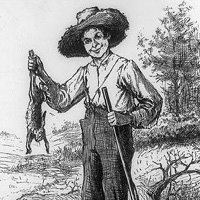
Of all the figures in American culture, the most enduring remains the rebel. The maverick, the entrepreneur, the explorer, the bold seeker of new, unexplored territories, the inventor, the cowboy, the slightly cocky, self-assured (but ultimately good-natured) pioneer... whether it be John Wayne as an obsessive cowboy in The Searchers , Thomas Alva Edison tinkering away with revolutionary ideas in his shop as the Wizard of Menlo Park, or Huck Finn saying ‘to hell with your rules!’ the rebel proves a key figure in the American psyche. Dorthea Dix, James Dean, Susan B. Anthony... the list goes on and on. There’s something still bold and exciting about reading those first daring lines penned by Jefferson in the Declaration of Independence that “all men are created equal” and the moral imperative to rebel against injustice. Jumping forward almost two hundred years, it’s hard not to be moved by the stirring words of Martin Luther King, Jr. in his famous “I have a dream” speech. King’s words speak of honoring a promise made by Jefferson and the other founding fathers — and while King’s words challenge us as a society, there’s something profoundly exciting — and hopeful — about his subtext: injustice exists; we can do better. The American hero is often that man or woman who blazes his or her own path (or perhaps reclaims a good path from accumulated debris).

When we speak of America in terms of novels, doubtless one of the most “American” is Mark Twain’s The Adventures of Huckleberry Finn. It boasts humour, adventure, drama, features issues of race, loyalty and friendship, and stars an anti-hero who bucks all the rules — and we love him for it. Just as the squabbling couples in Shakespeare’s comedies are far more interesting than the “perfect” couples of the same plays, (1) aspiring delinquent Huck Finn proves far more fascinating than Tom Sawyer.

Something profoundly American lies in Huck Finn saying to hell with school and going off with his friend Jim on the river. As the saying goes, “Never let your schooling interfere with your education.” Huck Finn seems to be saying something very similar — I’ll get a real education here on the river, thank you very much, and learn things far more valuable than I can in your schoolhouse. Sure enough, everything is quite peaceful for Huck and Jim on the river — it is only when they land and have to deal with the craziness of civilization that things go bad for them. Floating along with the natural flow of the river, the duo are allowed a separation from the everyday and can gain a new, fresh perspective.

Huckleberry Finn also features one of the great moments in American Literature. In chapter thirty-one, Huck wrestles with his conscience over whether to turn in Jim or not as a runaway slave. While the two hundred dollar reward is not a factor for Huck, everything his society has ever told him says he must turn Jim in: “The more I studied about this, the more my conscience went to grinding me, and the more wicked and low-down and ornery I got to feeling.” (2) Huck winds up writing a letter turning Jim in, and feels relieved for a while. But then he thinks back on his relationship with Jim and can feel nothing but deep warmth. He spies the letter:

It was a close place. I took it up, and held it in my hand. I was a trembling, because I’d got to decide, forever, betwixt two things, and I knowed it. I studied a minute, sort of holding my breath, and then says to myself:

“All right, then, I’ll go to hell” — and tore it up. (3)

This is no simple act on Huck Finn’s part. He feels horrible, even damned by his choice. Yet at the same time his choice is profoundly exciting. Similar to Hamlet when he remarks “Thus conscience does make cowards of us all” [3.1, 84], Huck mistakenly thinks he is going against his conscience when in fact he is following it. It is this startling boldness that makes Huck’s decision so very inspiring — almost everything he has ever been told tells him to do one thing, yet something deep inside himself, so deep he cannot come close to articulating it, compels him to act to save Jim.

Huck Finn is without question a rebel, yet he also reveals a deep moral core. He experiences an amazing moment of truth. However, he does so outside of the classroom. America has always had an anti-intellectual bent, which normally acts to our detriment as a culture. However, the journey of Huck Finn points to the positive path this impulse can take us if we are striving towards a deeper truth. The moral challenge for an uniquely American education is to provide students with the opportunity for these moments of conscientious rebellion, moments of truth, in the classroom. Huck Finn can and should continue to take journeys down the river in his life. But the classroom must provide a comparably meaningful experience. In America, this meaningful experience must come from nurturing the rebel spirit and guiding it in a positive direction.

Emerson, Thoreau, Rosseau, Dewey, and Freire have all said something similar. Huck Finn might well be a difficult student to have in class; these days he no doubt would be seen as rambunctious, unfocused, “ADD,” potentially a real handful — perhaps a younger version of McMurphy from One Flew Over the Cuckoo’s Nest. Still, Huck Finn’s spirit should not be smothered by relentless indoctrination, nor do we ever want to take part in an educational system that would perpetrate such an act. Education and life should never be at odds. Anyone teaching Huck Finn must be willing to embrace not only questioning his or her students in probing fashion, but also must welcome being questioned by them.

It is important to remember that Huck Finn already has the potential for moral choices before he steps in the classroom. However, he still lacks some of the tools to help him examine his life and the world around him. Huck will face other moral dilemmas as he grows older. Perhaps the greatest gift we can give Huck, then, is the capacity to name what is going on both around him and inside him, to aid him in walking his true path.

II. SOCRATES

Socrates, what have you done to me? I no longer know who I am!
— Alcibiades

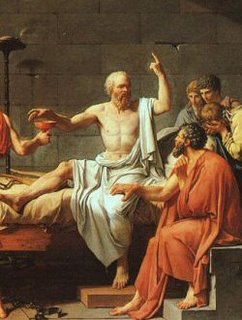
Alcibiades, one of Socrates’ most notable students, was a man who was very wont to “easily make many fine speeches to large audiences” (4) about topics such as virtue. The popular, charismatic Alcibiades would be quite well-received in the process, and think himself quite wise based on his accolades — until he offered the same arguments to Socrates. Suddenly, cross-examined through Socrates’ probing, thorough questioning, Alcibiades found that he no longer was sure of being right — indeed, he found himself as “perplexed and numb as the torpedo fish does” to its victims. (5)

Educator Mortimer J. Adler — an avid student of Socrates, Plato, and Aristotle — poses that “pain and work are irremovable and irreducible accompaniments of genuine learning.” (6) While pain might overstate the case somewhat, certainly when it comes to discomfort Adler is correct. How can one learn without being open to learning and questioning one’s views, and how can one be truly open without some element of risk? Yet American teachers are notorious for not letting students struggle — similar to overprotective parents, several studies have shown that American teachers tend to swoop in to save students from discomfort. The perceived trauma of not being able to arrive without struggle to the right answer in a math class is judged to be just too much for the fragile Huck Finns in our classrooms. However, such a rescue ultimately says more about our discomfort watching students’ struggle. While the impulse to save our students is certainly born in part out of compassion, it also sends a powerful implicit message to our students that they cannot handle the matter on their own. Many students, deep down if not consciously, are hungry for just such challenges — but while we often supply those challenges on the athletic field, we often rob them of the same experience when it comes to intellectual and spiritual growth. Thus, while we might not force him to drink hemlock, we force Socrates to remain mute if he is allowed in the classroom at all.

“Real Art has the capacity to make us nervous,” (7) challenges critic Susan Sontag. Similarly, Anatoly Smeliansky, the vice-rector of the famous Moscow Art Theater, once observed that “American Theater is like the sign on hotel rooms — Do Not Disturb.” (8) We can see the same impulse in education, where discomfort is often not allowed to enter. Alcibiades experiences extreme distress after being questioned by Socrates, to the point that he exclaims he no longer knows who he is. However, he also comes out of this experience a better person, as he later acknowledges in other Socratic tales — and looks on Socrates with not only respect, but affection. Socrates has given Alcibiades a moment of truth — and Alcibiades has grown as a result.

Meno, after seeing Socrates question a young boy, comes to a similar conclusion about the wisdom of Socrates’ approach.

Socrates: You realize, Meno, what point [the boy] has reached in his recollection. At first he did not know what the basic line of the eightfoot square was; even now he does not yet know, but [earlier] he thought he knew, and answered confidently as if he did know, and he did not think himself at a loss, but now does think himself at a loss, and as he does not know, neither does he think he knows.

Meno: That is true.

Socrates: So he is now in a better position with regard to the matter he does not know?

Meno: I agree with that too.

Socrates: Have we done him any harm by making him perplexed and numb as the torpedo fish does?

Meno: I do not think so.

Socrates: Indeed, we have probably achieved something relevant to finding out how matters stand, for now, as he does not know, he would be glad to find out, whereas before he thought he could easily make many fine speeches to large audiences about the square of double size and said it must have a base twice as long.

Meno: So it seems.

Socrates: Do you think that before he would have tried to find out that which he thought he knew though he did not, before he fell into perplexity and realized he did not know and longed to know?

Meno: I do not think so, Socrates.

Socrates: Has he then benefited from being numbed?

Meno: I think so. (9)

A popular quip states that “education is the process of moving from cocksure ignorance to thoughtful uncertainty.” The above exchange, repeated with variations throughout the Socratic dialogues, reveals the key to the Socratic ideal — that one must know one’ self, but most especially one most know the limits of one’s knowledge, of both one’s self and the world. Only then can true learning occur. While strong convictions can be wonderful, we must remember both MLK and Hitler possessed strong convictions. As the passage from Pope’s Essay on Criticism goes:

A little knowledge is a dangerous thing.
Drink deep, or taste not, the Pierian Spring:
There shallow draughts intoxicate the brain,
And drinking largely sober us again.

It must also be noted that Socrates is supportive of his students — and many of his “victims” come back to him. If he was merely harsh or cruel, such loyalty would be unlikely. Socrates can be sarcastic and cutting at times, puckish and playful, but ultimately he proves devoted to his students’ true well-being. Socrates is no sadist. After “numbing” the boy in front of Meno, Socrates moves to the next stage in his style of teaching. As Socrates tells Meno:

Look then how [the boy] will come out of his perplexity while searching along with me. I shall do nothing more than ask questions and not teach him. Watch whether you find me teaching and explaining thing to him instead of asking for his opinions. (10)

Nurturing and support play an essential role in good teaching. The actress Brenda Blethyn (from Mike Leigh’s film Secrets & Lies) once said that what she wanted most from a director was his trust, his support — “if he gives me that, I’m willing to go anywhere.” (11) Teaching works similarly — the student must trust the teacher to serve as a competent guide facilitating the search, and the teacher must pose good questions. And, as Neil Postman observes in his superb essay “Silent Questions,” the questions we ask almost always determine the answers we receive. (12) Notice also, however, that Socrates acts as a facilitator, not a dispenser of knowledge. The best teaching often seems almost invisible; Socrates’ technique forces his students to articulate their own thoughts, refine them, discard bad ideas, and eventually arrive at the answer themselves. True learning often proves a joyful process, but true learning embraces risk, especially the risk of discomfiture.

As Tennessee Williams once put it, “once you fully apprehend the vacuity of a life without struggle, you are equipped with the basic means of salvation.” A true education, one that touches the lives of its students and teachers, embodies this struggle. As teachers and parents we must ask hard, challenging questions of our students (and ourselves), not for the sole purpose of discomfort, but to pursue deeper truths. Deep down, the Huck Finns in our classrooms want nothing less.

III. CONNECTIONS

Where is the Life we have lost in living?
Where is the wisdom we have lost in knowledge?
Where is the knowledge we have lost in information?
— T.S. Eliot, Choruses From ‘The Rock’

A few months back I was riding in the car of a recent acquaintance who was very concerned about not having a cell phone. He possessed a surprising degree of anxiety about the issue, and said something about wanting to be “connected.” It’s a phrase tossed around these days with wild abandon, and I had to wonder — “connected” with what? Would this be a connection to a boss, a job, clients, to work obligations? A connection to friends, family, a significant other? Surely this would not be a connection to nature, to a tree, a stream, a mountain, a beach? Doubtless it would not be a connection to literature, to art, to deeper questions about his identity and his life?

I do not mean to be cavalier — e-mail is wonderful thing, and cell phones can be very useful if not invaluable. Yet, as T.S. Eliot suggests above, it is all too easy to speak while saying nothing, to communicate on a shallow level without saying anything of meaning. One can make fine speeches like Alcibiades, or never have a meaningful, honest conversation with one’s parents — one can speak “words, words, words” “full of sound and fury, / Signifying nothing.” (13)

It has been observed that if facts alone constituted knowledge, one could merely read an encyclopedia and possess all the education one could ever need. Similarly, the internet is a wonderful tool, but ultimately it is merely a tool — one still needs to learn how to sift through all that (often suspect) information, to pick and choose from various sources, to ask, like Socrates, the hard, probing questions.

One of Socrates’ most exciting lines is that “the truth about reality is always in our soul.” (14) Socrates is not merely clever, but wise — his questions are not merely parlor tricks, but push his students towards a deeper, spiritual truth. This is real connection. Socrates also inspires through his genuine hunger for learning — he does not want to rest on his laurels, but prefers to keep searching:

Meno: Somehow, Socrates, I think what you say is right.

Socrates: I think so too, Meno. I do not insist that my argument is right in all other respects, but I would contend at all costs both in word and deed as far as I could that we will be better men, braver and less idle, if we believe that one must search for the things one does not know, rather than if we believe that it is not possible to find out what we do not know and that we must not look for it. (15)

Even a seeming anti-intellectual such as Huck Finn could get excited by a teacher like this, who embraces the search, and honors the pioneering, maverick spirit. Because it is all too easy to slip into complacency and pick the easy familiar answer over the hard truth, to pursue the truth without limitations shall always be rebellious and revolutionary in the very best sense. The Zen Buddhist tradition pursues a similar goal to that of rebellious Socrates; Zen masters often give their students koans, riddles with no simple, rational answer. This forces the students to strive for a deeper truth beyond the familiar or obvious, and to achieve this, they must not only look more openly at the world about them, but also within themselves. Regardless of the tradition, questioning is key, but it must connect with something deeper versus dealing with the superficial.

IV. BETTER GLASSES

Perhaps the greatest scene in Spike Lee’s film Malcolm X occurs when Elijah Muhammad teaches Malcolm a principle by using two glasses. Muhammad first fills one glass with water and then dumps in ashes, so that the water is horribly filthy. He says that if that glass is all the people have, they’ll drink it, and drink it gladly. Muhammad next pours a glass of clear water — it looks wonderful, especially in contrast to the glass of ashes. Muhammad observes if people are offered the glass of clear water, they will pick it instead.

Malcolm shows a flash of concern, (16) as if to ask— what if people don’t pick the right glass? But as Elijah Muhammad explains it:

Here is a glass. Dirty. Water - Foul. You offer this to the people, they have no choice. They’ll drink from it. If they’re thirsty.

You offer them this glass and let ‘em make their own decision, they will choose the pure vessel.

Malcolm’s task is merely to offer the choice. If people but see the choice clearly, they will always pick the better glass.

Removing this lesson from the religious bent of the scene, (17) it remains a powerful metaphor. All people pick the path they feel is best, even if they find out they are mistaken later on. The trick is seeing this. Most every student I have questioned about his or her dreams possesses some sort of vision for him or herself. Deep down, that dream, while varying wildly from person to person, almost always involves giving back to others or leaving the world a better place. No one has ever had a vision of his or herself that has not involved other people in some fashion, whether it be a family, friends, or co-workers. This is another sort of dialogue, or connection. Martin Luther King, in a quotation used at the end of Spike Lee’s Do The Right Thing, speaks of the need for dialogue, versus monologue; violence is a monologue of power, and prohibits true dialogue. (18) In the same vein, Socratic teaching is opposed to indoctrination; indoctrination (like censorship) is violence.

We need our heroes. We need rebellious students and revolutionary teachers. There is also a necessary cost, a sacrifice to made in nurturing these heroes — as teachers we must be willing to suffer the discomfort of watching our students occasionally make poor choices, and learn for themselves. Good teaching will, per Malcolm X’s dictum, use almost “any means necessary.” One of these tools is engaging students in the Socratic dialogue. Another tool is tapping into that Huck Finn rebel spirit rather than squelching it. And still another is presenting students with a choice, but allowing them to choose. We must merely offer them better glasses to see.

Take a student; couple a healthy, restless curiosity with a sense of vision in that student, aid that student in developing the critical thought and expression to name what he or she sees and feels, honor and nurture the spirit that drives that vision — and we are close to what education should be. “I have a dream,” spoke King so powerfully not so very long ago. We must arm Huck Finn to articulate questions of himself and the world, asking him to keep us honest — if we do, perhaps he can grow up from being a Lord of the River to another King.


_______________________________________________

The two quotations from at the end of Do the Right Thing are:

Violence as a way of achieving racial justice is both impractical and immoral. It is impractical because it is a descending spiral ending in destruction for all. The old law of an eye for an eye leaves everyone blind. It is immoral because it seeks to humiliate the opponent rather than win his understanding. It seeks to annihilate rather than convert. Violence is immoral because it thrives on hatred rather than love. It destroys community and makes brotherhood impossible. It leave society in a monologue rather than dialogue. Violence ends by defeating itself. It creates bitterness in the survivors and brutality in the destroyers.

-MLK

I think there are plenty of good people in America, but there are also plenty of bad people in America and the bad ones are the one who seem to have all the power and be in the positions to block things that you and I need. Because this is the situation, you and I have to preserve the right to do what is necessary to bring an end to that situation, and that doesn’t mean I advocate violence, but at the same time I am not against using violence in self-defense. I don’t even call it violence when it’s self-defense, I call it intelligence.

-Malcolm X

Tuesday, July 04, 2006

The Great American, Patriotic Tradition of Dissent

E.J. Dionne wrote a great op-ed for Independence Day titled "A Dissident's Holiday." An excerpt:

...The true genius of America has always been its capacity for self-correction. I'd assert that this is a better argument for patriotism than any effort to pretend that the Almighty has marked us as the world's first flawless nation.

One need only point to the uses that Abraham Lincoln and Martin Luther King Jr. made of the core ideas of the Declaration of Independence against slavery and racial injustice to show how the intellectual and moral traditions of the United States operate in favor of continuous reform.

There is, moreover, a distinguished national tradition in which dissident voices identify with the revolutionary aspirations of the republic's founders.

There are those that who wish to retain their own power, or seize it, and there are those who work for the benefit of all to better honor the ideals of America. Dionne's op-ed reminded me of this exchange from the live debate during the final season of The West Wing:

Santos: I know you like to use that word "liberal" as if it were a crime.

Vinnick: No, I'm sorry. I know I shouldn't have used that word. I know Democrats think "liberal" is a bad word. So bad you had to change it, didn't you? What do you call yourselves now? Progressives? Is that it?

Santos: It's true. Republicans have tried to turn "liberal" into a bad word. Well, liberals ended slavery in this country.

Vinnick: A Republican president ended slavery.

Santos: Yes, a liberal Republican, Senator. What happened to them? They got run out of your party. What did liberals do that was so offensive to the liberal party?

I'll tell you what they did. Liberals got women the right to vote. Liberals got African Americans the right to vote. Liberals created Social Security and lifted millions of elderly people out of poverty. Liberals ended segregation. Liberals passed the Civil Rights Act, the Voting Rights Act. Liberals created Medicare. Liberals passed the Clean Air Act, the Clean Water Act.

What did conservatives do? They opposed every single one of those things. Every one. So when you try to hurl that label at my feet – "liberal" – as if it were something to be ashamed of, something dirty, something to run away from, it won't work Senator. Because I will pick up that label and I will wear it as a badge of honor.

Happy Independence Day!

Monday, January 16, 2006

MLK Day


Rather than writing about the obvious importance of Dr. Martin Luther King, Jr., I thought it best to post his most famous speech, from August 28th, 1963. It still gives me chills. You can hear and see it at the following excellent site , but the text is below:

I am happy to join with you today in what will go down in history as the greatest demonstration for freedom in the history of our nation.

Five score years ago, a great American, in whose symbolic shadow we stand today, signed the Emancipation Proclamation. This momentous decree came as a great beacon light of hope to millions of Negro slaves who had been seared in the flames of withering injustice. It came as a joyous daybreak to end the long night of their captivity.

But one hundred years later, the Negro still is not free. One hundred years later, the life of the Negro is still sadly crippled by the manacles of segregation and the chains of discrimination. One hundred years later, the Negro lives on a lonely island of poverty in the midst of a vast ocean of material prosperity. One hundred years later, the Negro is still languished in the corners of American society and finds himself an exile in his own land. And so we've come here today to dramatize a shameful condition.

In a sense we've come to our nation's capital to cash a check. When the architects of our republic wrote the magnificent words of the Constitution and the Declaration of Independence, they were signing a promissory note to which every American was to fall heir. This note was a promise that all men, yes, black men as well as white men, would be guaranteed the "unalienable Rights" of "Life, Liberty and the pursuit of Happiness." It is obvious today that America has defaulted on this promissory note, insofar as her citizens of color are concerned. Instead of honoring this sacred obligation, America has given the Negro people a bad check, a check which has come back marked "insufficient funds."

But we refuse to believe that the bank of justice is bankrupt. We refuse to believe that there are insufficient funds in the great vaults of opportunity of this nation. And so, we've come to cash this check, a check that will give us upon demand the riches of freedom and the security of justice.

We have also come to this hallowed spot to remind America of the fierce urgency of Now. This is no time to engage in the luxury of cooling off or to take the tranquilizing drug of gradualism. Now is the time to make real the promises of democracy. Now is the time to rise from the dark and desolate valley of segregation to the sunlit path of racial justice. Now is the time to lift our nation from the quicksands of racial injustice to the solid rock of brotherhood. Now is the time to make justice a reality for all of God's children.

It would be fatal for the nation to overlook the urgency of the moment. This sweltering summer of the Negro's legitimate discontent will not pass until there is an invigorating autumn of freedom and equality. Nineteen sixty-three is not an end, but a beginning. And those who hope that the Negro needed to blow off steam and will now be content will have a rude awakening if the nation returns to business as usual. And there will be neither rest nor tranquility in America until the Negro is granted his citizenship rights. The whirlwinds of revolt will continue to shake the foundations of our nation until the bright day of justice emerges.

But there is something that I must say to my people, who stand on the warm threshold which leads into the palace of justice: In the process of gaining our rightful place, we must not be guilty of wrongful deeds. Let us not seek to satisfy our thirst for freedom by drinking from the cup of bitterness and hatred. We must forever conduct our struggle on the high plane of dignity and discipline. We must not allow our creative protest to degenerate into physical violence. Again and again, we must rise to the majestic heights of meeting physical force with soul force.

The marvelous new militancy which has engulfed the Negro community must not lead us to a distrust of all white people, for many of our white brothers, as evidenced by their presence here today, have come to realize that their destiny is tied up with our destiny. And they have come to realize that their freedom is inextricably bound to our freedom.

We cannot walk alone.

And as we walk, we must make the pledge that we shall always march ahead.

We cannot turn back.

There are those who are asking the devotees of civil rights, "When will you be satisfied?" We can never be satisfied as long as the Negro is the victim of the unspeakable horrors of police brutality. We can never be satisfied as long as our bodies, heavy with the fatigue of travel, cannot gain lodging in the motels of the highways and the hotels of the cities. We cannot be satisfied as long as a Negro in Mississippi cannot vote and a Negro in New York believes he has nothing for which to vote. No, no, we are not satisfied, and we will not be satisfied until "justice rolls down like waters, and righteousness like a mighty stream."

I am not unmindful that some of you have come here out of great trials and tribulations. Some of you have come fresh from narrow jail cells. And some of you have come from areas where your quest -- quest for freedom left you battered by the storms of persecution and staggered by the winds of police brutality. You have been the veterans of creative suffering. Continue to work with the faith that unearned suffering is redemptive. Go back to Mississippi, go back to Alabama, go back to South Carolina, go back to Georgia, go back to Louisiana, go back to the slums and ghettos of our northern cities, knowing that somehow this situation can and will be changed.

Let us not wallow in the valley of despair, I say to you today, my friends.

And so even though we face the difficulties of today and tomorrow, I still have a dream. It is a dream deeply rooted in the American dream.

I have a dream that one day this nation will rise up and live out the true meaning of its creed: "We hold these truths to be self-evident, that all men are created equal."

I have a dream that one day on the red hills of Georgia, the sons of former slaves and the sons of former slave owners will be able to sit down together at the table of brotherhood.

I have a dream that one day even the state of Mississippi, a state sweltering with the heat of injustice, sweltering with the heat of oppression, will be transformed into an oasis of freedom and justice.

I have a dream that my four little children will one day live in a nation where they will not be judged by the color of their skin but by the content of their character.

I have a dream today!

I have a dream that one day, down in Alabama, with its vicious racists, with its governor having his lips dripping with the words of "interposition" and "nullification" -- one day right there in Alabama little black boys and black girls will be able to join hands with little white boys and white girls as sisters and brothers.

I have a dream today!

I have a dream that one day every valley shall be exalted, and every hill and mountain shall be made low, the rough places will be made plain, and the crooked places will be made straight; "and the glory of the Lord shall be revealed and all flesh shall see it together."

This is our hope, and this is the faith that I go back to the South with.

With this faith, we will be able to hew out of the mountain of despair a stone of hope. With this faith, we will be able to transform the jangling discords of our nation into a beautiful symphony of brotherhood. With this faith, we will be able to work together, to pray together, to struggle together, to go to jail together, to stand up for freedom together, knowing that we will be free one day.

And this will be the day -- this will be the day when all of God's children will be able to sing with new meaning:

My country 'tis of thee, sweet land of liberty, of thee I sing.

Land where my fathers died, land of the Pilgrim's pride,

From every mountainside, let freedom ring!

And if America is to be a great nation, this must become true.

And so let freedom ring from the prodigious hilltops of New Hampshire.

Let freedom ring from the mighty mountains of New York.

Let freedom ring from the heightening Alleghenies of Pennsylvania.

Let freedom ring from the snow-capped Rockies of Colorado.

Let freedom ring from the curvaceous slopes of California.

But not only that:

Let freedom ring from Stone Mountain of Georgia.

Let freedom ring from Lookout Mountain of Tennessee.

Let freedom ring from every hill and molehill of Mississippi.

From every mountainside, let freedom ring.

And when this happens, when we allow freedom ring, when we let it ring from every village and every hamlet, from every state and every city, we will be able to speed up that day when all of God's children, black men and white men, Jews and Gentiles, Protestants and Catholics, will be able to join hands and sing in the words of the old Negro spiritual:

Free at last! Free at last!

Thank God Almighty, we are free at last!