
Showing posts with label Shakespeare. Show all posts
Showing posts with label Shakespeare. Show all posts
Saturday, October 04, 2008
Stephen Colbert Compares the Candidates to Shakespeare
I really enjoyed this segment. Continuing the comparisons, we'll see how much like Prince Hal Barack Obama proves to be, and McCain also reminds me of Coriolanus, although without the military talent and personal honor.
(Inevitably, this makes me think of "The Knaves of the Bush Administration" again.)
(Cross-posted at The Blue Herald)


Tuesday, April 01, 2008
Fool's Day 2008

Happy Fool's Day! It's a good day to read or watch a comedy, or better still, a satire. We're always in need of Shakespearean fools who speak truth to power, especially given the idiots and knaves we have in high places. At the very least, please take a moment today to mock our preznit. Really, it's your duty as an American.
(Cross-posted at The Blue Herald)
Tuesday, February 05, 2008
Day of Shame

FOOL
We'll set thee to school to an ant, to teach thee
there's no labouring i' the winter. All that follow
their noses are led by their eyes but blind men; and
there's not a nose among twenty but can smell him
that's stinking.
[King Lear, 2.4, 66-71]
This post consists of three parts, all on Colin Powell's presentation to the United Nations five years ago about Iraq's supposed weapons of mass destruction. Please feel free to skip over any or all of it, as is your wont. Check out Day of Shame for more on this blogswarm. Thanks to VastLeft of Corrente for organizing this, and to Blue Gal for spreading the word.
I. Only a Frenchman Could Doubt Him
Despite a number of glaring problems with it, Colin Powell's presentation to the United Nations earned widespread praise in the mainstream media at the time. Sheldon Rampton and John Stauber of the Center for Media and Democracy/PR Watch have a book, The Best War Ever: Lies, Damned Lies and the Mess in Iraq (Sept. 2006), that offers a superb rundown of the reactions. From chapter three, "Big Impact":
Throughout the Joseph Wilson affair, the White House argued that the yellowcake forgery was only a small element in the portfolio of evidence it presented in its case for war. Its claim about the uranium from Niger, so it argued, was only part of the evidence showing that Iraq had a covert nuclear weapon program, which in turn was only part of the evidence that that Iraq already possessed an arsenal of banned chemical and biological weapons — the "weapons of mass destruction" that were the main reason for going to war. In Bush's 2003 State of the Union speech before the war, he was quite specific. Iraq, he said, possessed "over 25,000 liters of anthrax — enough doses to kill several million people"; "more than 38,ooo liters of botulism toxin — enough to subject millions of people to death by respiratory failure"; "as much as 500 tons of sarin, mustard and VX nerve agent"; and "upwards of 30,000 munitions capable of delivering chemical agents." [1]
Eight days later, Colin Powell addressed the United Nations and laid out the charges in further detail. Powell said his evidence came from multiple, corroborating sources: Iraqi defectors, informants, intercepted radio messages, satellite photographs, and interrogation of detainees seized in Afghanistan and elsewhere since September 11. As he spoke, Powell displayed drawings, photographs, and audiotapes. [2] The speech, unusual in its details and specificity, was almost universally praised the following day by U.S. newspapers and was seen by many as decisive in the public debate over whether to go to war. Gilbert Cranberg, the former editorial-page editor of the Des Moines Register, reviewed editorial comments in forty newspapers following the speech and found "unanimity as to Iraq's possession of weapons of mass destruction... Journalists are supposed to be professional skeptics, but nowhere in the commentary was there a smidgen of skepticism about the quality of Powell's evidence." [3]
• A New York Times editorial called the speech a "sober, factual case," and a separate news article described it as "a nearly encyclopedic catalog that reached further than many expected." [4] An analysis of the speech by Times reporter Michael Gordon stated that "it will be difficult for skeptics to argue that Washington's case against Iraq is based on groundless suspicions and not intelligence information."
• Senator Joseph R. Biden, Jr., the senior Democrat on the Foreign Relations Committee, called Powell's speech "powerful and irrefutable." A Washington Post editorial agreed, adding that "It is hard to imagine how anyone could doubt that Iraq possesses weapons of mass destruction." [6]
• The Los Angeles times editorialized that Powell had offered "solid evidence" and declared, "The United Nations risks irrelevance unless it promptly sets a date on which it will use military force against Iraq if that nation does not disarm." [7]
• "Mr. Powell eliminated all reasonable doubt," wrote the Washington Times in an editorial, adding, "In the wake of Mr. Powell's presentation, no reasonable person can doubt that Saddam is continuing his longstanding efforts to deceive the international community about his weapons programs." [8]
• "Only the blind could ignore Powell's evidence," wrote the Dallas Morning News editorial page, adding that Powell "did everything but perform cornea transplants on the countries that still claim to see no reason for forcibly disarming Iraq." [9]
• The San Francisco Chronicle called the speech "impressive in its breadth and eloquence." [10]
• The Denver Post said Powel had presented "not just one 'smoking gin' but a battery of them, more than sufficient to dispel any lingering doubts about the threat the Iraqi dictator poses." [11]
• California's San Jose Mercury News said Powell made his case "without resorting to exaggeration, a rhetorical tool he didn't need." [12]
What these editorials and analysis all had in common was their assumption that a major speech by the secretary of state could not possibly have been based on exaggeration or outright fabrications. As the Washington Times put it, the choice was to "concede" Powell's case "or be prepared to call Mr. Powell a liar." [13] No one was prepared to call Colin Powell a liar. Newspapers did not attempt to fact-check his presentation until months after it was delivered. The first notable critique appeared four months later, when U.S. News & World Report wrote about Powell's own incredulous reaction to the first reaction to the first draft of his speech — "I'm not reading this. This is bullshit!" [14] A couple of months later, Associated Press reporter Charles J. Hanley went through the speech, point by point, and wrote a devastating 2,500-word critique. [15] It would eventually become known that Powell's speech to the United Nations was riddled with statements that his own staff had flagged as "weak" and/or "not credible," but this fact did not emerge until later, after the United States had already gone to war, and the failure to find weapons in Iraq prompted congressional investigations and public scrutiny. [16]
White House claims about Iraq — and the failure of journalists to question those claims — were reflected in public opinion. Surveyed on July 2003, 70 percent of Americans said they believed Iraq had weapons of mass destruction before the war began. This belief died slowly. In January 2005, 54 percent still believed it — even though the Iraq Survey Group, the U.S. team charged with looking for WMDs, had by then completed its final report, in which it declared that it had found no evidence of weapons or even of significant weapons programs. [17]
"Know" Means "Know"
The Bush administration did not merely say it suspected that Iraq had weapons. It claimed to know for certain, and even to know where they were located. "We do know, with absolute certainty," said Dick Cheney, that Saddam Hussein "is using his procurement system to acquire the equipment he needs in order to enrich uranium to build a nuclear weapon." [18] In Colin Powell's speech to the United Nations, he said, "There can be no doubt that Saddam Hussein has biological weapons and the capability to rapidly produce more, many more." [19] President Bush made the same claim in his televised address to the nation announcing the start of war: "Intelligence gathered by this and other governments leaves no doubt that the Iraq regime continues to possess and conceal some of the most lethal weapons ever devised." [20]
The claim that Iraq possessed weapons of mass destruction was not just a component of the administration's case for war. It was its main argument...
(I haven't included the footnote information here, for readability. Contact me if you want/need any of the source details. Or buy the book!)
All these editorials and articles pale in comparison, though, to the hyperbole of Fox News and their pals, and several other pundits at supposedly "serious" outlets. Many pundits were positively falling over themselves to praise Powell or otherwise prove their manhood by proxy, urging for war, excoriating those damned skeptics. Perhaps the nadir was Richard Cohen, the day after Powell's presentation (emphasis added):
This is where Colin Powell brought us all yesterday. The evidence he presented to the United Nations -- some of it circumstantial, some of it absolutely bone-chilling in its detail -- had to prove to anyone that Iraq not only hasn't accounted for its weapons of mass destruction but without a doubt still retains them. Only a fool -- or possibly a Frenchman -- could conclude otherwise.
II. Powell's Culpability
It's worth remembering the situation Powell was in. Cheney and Rumsfeld were waging an all-out assault on Powell and the State Department for ideological, bureaucratic, and ferociously personal reasons. Bush allowed this to happen. See this Hilzoy post for more on the deep dysfunction of Bush's White House, and Powell's acceptance of the same. Powell was probably the most realistic and wise of the major players in the Bush administration, and he was indeed sidelined and marginalized, but he was far from blameless.
Powell's also since tried to rewrite his role. At the Aspen Ideas Festival last year, Powell claimed that he spent 2.5 hours "vainly trying to persuade President George W Bush not to invade Iraq." That directly contradicts his interviews with Bob Woodward, ABC, and other outlets, not to mention his interviews with Karen DeYoung for her book on him. In an extended excerpt for The Washington Post, DeYoung wrote,
In fact, Powell had never advised against the Iraq invasion, although he had warned Bush of the difficulties and counseled patience. He had no reason to resign over Iraq, he told questioners.
The entire article is well worth reading (and DeYoung discussed it with readers here). Even giving some semantic license to Powell, in all previous accounts (at least that I've seen), he emphasized how brief his conversation with Bush on the subject was: "You break it, you bought it," and so on.
There's far, far more. The blog A Tiny Revolution has closely followed Powell's claims over the past few years, and compared his public statements with what's since been discovered about what he knew and when. Jonathan Schwarz has kindly summarized and compiled that past work in "Lie After Lie: What Colin Powell Knew Five Years Ago Today, And What He Told The World." Do check it out.
It's important to note that not everyone got it wrong, either on the war, or reading Powell. The previously linked Glenn Greenwald post on Richard Cohen's blather also features Howard Dean's sober and on-target response to Powell and the Bush administration's case to war. Greenwald tackled similar issues in "Why is being right or wrong on Iraq so irrelevant?" There are many, many blog posts on the pundit hawks, why they were so wrong and why they too are culpable, but Harold Meyerson's "Their War, Too" is a nice overview.

III. Excessively Florid Personal Reflections Brimming O'er With Righteous Indignation
To my eyes, early on it was apparent that the Bush administration wanted to go to war. That alone was reason not to trust them. The simple truth that war should be avoided if at all possible, that it is a measure of last resort at best, was another, related reason. Bush offered reasons for going to war that made no sense, and did so in a highly misleading manner, such as saying that Hussein gassed his own people. That occurred back in the late 80s, before the "first Gulf War," when Hussein was our ally and before Rumsfeld (as famously photographed) met him to assure him he could count on American support. Why, if Bush's case was so good, and his cause so just, was he being so deceptive? The Bush administration and their allies practiced a "throw everything out and see what sticks" approach that was highly unconvincing and suspect. Throughout Bush's 2003 State of the Union speech, I kept asking, "Where's the evidence?" It'd didn't add up, and his tone and approach were cause for great concern. He appeared eager for a fight. Alarmist rhetoric should always be distrusted. War-mongering should always be distrusted. Salivating over violence should always be distrusted. Why was Iraq suddenly such a grave threat, seemingly out of nowhere? If what Cheney was saying was true, why the hell hadn't we heard about it earlier, and for years previously? Even if Iraq actually had WMD, was it necessarily an imminent threat? And even if Iraq actually had WMD, somehow wasn't contained and was a serious, imminent threat, why would weapons inspections not work? Why was an Authorization of Military Force possibly necessary before such inspections? Why the hell would anyone trust Bush or the other saber-rattlers?
I mention all this because I wasn't blogging at the time, although I had plenty of conversations about it, and I've been plotting a series of posts on war I expect to complete before the year is out. But to my eyes, it was clear Bush wanted war and was offering shoddy justification. To my alarm, the majority of pundits and politicians didn't seem bothered by this.
I also mention this because I remember Colin Powell's presentation. I remember I felt some relief he was going to deliver one, because at the time I trusted Powell, at least much more than other members of the Bush administration. I listened to his presentation willing to be convinced. Part of me might have even wanted to be convinced, because it seemed clear to me even before Bush's 2002 SOTU that we were likely to go to war with Iraq, and that troubling prospect was a bit more palatable if it was actually necessary. It is more comfortable to believe that our leaders can be trusted with such matters. It's a classic cognitive dissonance. It's a reasonable assumption — or at least, an understandable assumption — that surely the Vice President of the United States wouldn't lie about something so serious. Surely Secretary of State and former general Colin Powell, who understood the costs of war, wouldn't lie when lives hung in the balance.
The thing is… I wasn't convinced. I have friends, and know of plenty of public figures, who were convinced by Powell, or at least trusted him, the person, the figure, the soldier. My response to the United Nations was, "That's it? That's all there is?" and dismay. A few aerial photos of buildings and trucks, which could have been anything? Ambiguous intercepted conversations? I remember talking over it with a few people at the time who felt the same. It wasn't a pleasant feeling, knowing we were almost certainly going to war based on flimsy reasons.
Powell was used, and consented to be used, to sell the American public on the idea that Iraq possessed weapons of mass destruction, even though the Bush administration knew there was plenty of reason to doubt that was the case. Powell could have and should have refused to play along, or resigned, but he put personal loyalty and his own job prospects above his duty to the American people.
For all that, war still could have been averted. Even with the majority of power players claiming or thinking WMD existed, Bush could have let the weapons inspectors do their job. But that was never part of the plan for Bush, Cheney and the rest of the gang. Congress could have refused to go along with the AUMF or enacted any of several amendments to restrain Bush. They didn't. Powell alone doesn't let them off the hook, either.
Perhaps I should keep all this for my later series, but basically, I don't think opposing the invasion of Iraq required any special knowledge or insight. Regardless of the intelligence, even if WMD existed, weapons inspections could have worked. The only two things necessary to oppose invading Iraq was a decent bullshit detector and the simple, easily-obtained wisdom that war is hell and is to be avoided at all costs. Those that went along with the Bush line had too high a tolerance for bullshit, even on the most grave matters, and too low a threshold for supporting war, arguably the most consequential issue there is.
That's not to mention an apathetic or cowardly failure by the press to call Bush on obvious lies, as he tried to rewrite essential history mere months after the fact. And such atrocious mendacity (or rank incompetence) continues.
All of this is why, while I'm generally opposed to violence (except for comedic violence, or hitting my head against the wall), that opposition is sorely tested when I read the whining of still unrepentant hawks such as Michael O'Hanlon. He's expertly eviscerated here by Brad at Sadly, No!
I'm very sick of hearing hawks argue that if they were wrong, they were wrong for the right reasons, and those of us of who were right were right for the wrong reasons. Bullshit. I understand being a clueless imbecile brings with it the reflexive need to protect one's self with plenty of self-aggrandizing, ego-fluffing bullshit, but really, enough is enough. Hacks pretending to be wonks tend to be terribly prickly, but besides that, the whole deal of not saying "I told you so," to someone like O'Hanlon comes with an expectation. That expectation is that a halfway decent human being of average intelligence, who actually possessed the good will he claims to have had, would note his colossal error, not to mention the clusterfuck that is Iraq, bemoan the terrible devastation and loss of human life, feel horrible, and learn from it. O'Hanlon, and more "liberal" hawks than I care to mention, haven't fulfilled their side of that gentleman's agreement. (Decide for yourself whether the right-wing hawks who are still triumphantly unrepentant are better or worse, or merely deserving of a different circle in Dante's Inferno.) Who was right and who was wrong isn't quite as important if the folks who were wrong actually learn. When they don't (or perhaps even if they do), they shouldn't be allowed to make such decisions anymore. If they feel insulted, it's because they should be insulted, and insulted often, because their willful obtuseness is itself insulting, and dangerous. As Brad puts it:
The people responsible for pushing our country into its largest foreign policy disaster since Vietnam are well deserving of contempt. If anything, I wish Barack would show more public contempt for these clowns. If he were to, say, propose locking Ken Pollack up in stocks and providing his fellow citizens with an unlimited supply of vegetables, I bet he’d win in a damn landslide.
Let me spell it out, using O'Hanlon as an example. Had he been wise, he never would have held the views he did in the first place. Had he any intellectual integrity, he would have acknowledged his colossal error long ago. Had he any empathy, he would have had many sleepless nights, thinking of all those people dead, displaced or otherwise made miserable by his policies and positions. Had he any shame, he'd have left the public stage long ago, or at least shut up about how he's being picked on for getting such a clear moral issue as a war of choice so monumentally wrong (more on this in a later post). Sometimes it takes an awfully expensive education to make a man such a fucking moron. But I guarantee most Iraqi civilians, even before the invasion, wouldn't make O'Hanlon's mistake, not with the memory of the devastating Iran-Iraq war so fresh. I'm pretty sure more than a few junior high school students who have never experienced war directly wouldn't make the same mistake, either. The problem with O'Hanlon is, he'll keep on going, because he feels his reputation is at stake, which depends on him having been right, not on actually being right. It's nothing more than vanity, but more people could die as a result.
There's a famous conflict I'm sure Powell, O'Hanlon, Cohen and all the rest have studied to some extent. It's called World War I, but in its day, it was the Great War, and the War to End All Wars. Sadly, it wasn't the last. But one of the most striking aspects of WWI is that all the major nations fighting in it were eager to go to war. They had no idea what they were in for, and ignored the potential lessons of the American Civil War. They could have avoided the war, which was absolutely horrific. Invading Iraq was likewise completely avoidable, if only the will and wisdom were there.
The key, dire lesson of Colin Powell's day of shame is that more such days are bound to come, and they must be watched for and prevented if at all possible. Powell's always presented himself as the good soldier, the loyal Kent to Bush's Lear, but in truth, he and all the others are but rank knaves, and there's not a nose among twenty that will say, that's him that's stinking.
Powell's day of shame is ours, too, if we forget its lesson, or do anything less than fight to prevent another. Part of that fight is telling the truth, and hanging the albatross of unnecessary war around the neck of all such vain wretches as Powell, O'Hanlon, Cohen, Kristol and the rest. Let them be cautionary tales. Let the stench of their crime be apparent, and shock the senses of all they meet 'til it shocks their own consciences awake. The greatest trick for avoiding tragedy is never to mistake such villains for heroes.

A Doré engraving for The Rime of the Ancient Mariner.)
(Hey, I said it was excessively florid...)
(Update: I've corrected some typos and edited very slightly for clarity. A late night.)
(Cross-posted at The Blue Herald)
Tuesday, March 20, 2007
The Knaves of the Bush Administration
(Cross-posted at The Blue Herald)

(Nigel Hawthorne as Lear.)
Shankar Vedantam wrote a great piece for today’s Washington Post titled, “What the Bard and Lear Can Tell a Leader About Yes Men”:
It’s a great, short piece, worth reading in its entirety. This blog has explored the connections between Shakespeare and current events before, including the knaves of King Lear and (back in October 2005) the lack of fools and frank advisors to tell Bush the truth:
In King Lear, virtually every character is either a fool or a knave. However, these terms contain multiple layers. In Act 1, scene 1, Lear banishes his youngest daughter Cordelia and Kent for being honest. The loyal Kent returns to serve Lear disguised as Caius. In Act 2, scene 2, as Lear’s herald, Kent confronts the rude knave Oswald, who serves Lear’s eldest daughter, Goneril. After delivering one of the great torrents of insults in Shakespeare and tangling with Oswald, Kent is thrown in the stocks, a serious breach of etiquette, even after the tussle. The villainous Cornwall, husband of Lear’s second daughter Regan, remarks on Kent:
Shakespeare is being ironic here, because Cornwall, a knave, is calling Kent, who is a loyal fool, a knave — for being honest!
In Act 2, scene 4, Lear arrives, and is shocked to find Kent in the stocks. Their first exchange veers towards comedy:
Lear storms off to confront his daughters and their husbands. While he is gone, the Fool is left with Kent, and shares with him a highly ironic, multilayer lesson.
On the surface, the Fool is mocking Kent for being loyal to Lear when it’s obvious Lear's fortunes are falling. A clever, self-interested courtier will grab “a great wheel” such as Lear in good times and drop him in bad. But as the fool says, for this advice, he “would have none but knaves follow it, since a fool gives it.” The self-interested knave “who serves and seeks for gain” will abandon friends and lords in trouble, but the fool will “tarry” and “stay.” (The use of “wise man” in line 81 is extremely ironic.) As the Fool says, “The knave turns fool that runs away; / The fool no knave, perdy.” The seemingly clever and clearly selfish are idiots and scoundrels, while the honest and loyal, willing to weather out the storm together with those who are suffering, are anything but. The rest of the play acts out these important themes, as suffering rains on the just and unjust alike, and fools and knaves stand revealed.
The Fool speaks truth to power, but he gets away with it and doesn’t get thrown in the stocks because he’s so clever. He speaks in the form of jokes, jibes, and multilayered, cryptic statements, and knows his audiences expertly. Kent is a good man, but it’s the Fool who would make a highly skillful political operative for the good guys. The challenge for the honorable is to cultivate more of these people, principled but savvy.
In terms of King Lear’s fools and knaves, almost all pundits are knaves, certainly all the unrepentant war hawks. Not that Bush ever deserved a position of greatness, but many of the neocons abandoned him in the pages of Vanity Fair last fall before the midterm elections. Still, while most neocons have criticized Bush, they have not abandoned their mad, disastrous cause — these are ambitious knaves, heedless to what’s best for the country, viler than even Goneril, Regan, Cornwall and Oswald. They are adolescent, armchair Macbeths, “bloody, bold and resolute,” but only with other people’s lives and bodies.
Cheney is more like mad king Leontes in The Winter’s Tale, seeing enemies everywhere and ordering harm upon those who love the country, willing to slay his own child out of fear, rage and paranoia.
Libby is not a true fool. He is loyal to Cheney, it’s true, but a fool is both loyal and honest, and Libby has repeatedly lied in the service of evil men and evil causes. In addition to his starring role in Plamegate, he playing a key role in manipulating the pre-war intel and selling the war, to Judy Miller, to Colin Powell, and in a thousand other ways. Similarly, Rove has not told the truth to Bush, even if this has stemmed at times from self-delusion. Bush is not a fool; he is a idiot, and a selfish, knavish one at that (the GOP’s conceit that Bush was the best man to be President of the United States brings new meaning to the term “pathetic fallacy”). Lear’s tragedy is to banish those who, out of love for him, tell him the truth. Bush not only banishes those who tell him the truth, at times he seems not to recognize the truth on the rare occasions it’s spoken to him in the first place. An incurious, impatient man of the slenderest gifts, hopelessly in over his head, Bush is happy to be handled, and as Ron Suskind argues in The One Percent Doctrine, doesn’t want to know what’s going on. It seems unlikely that ever in his life he will achieve the self-realizations Lear does in Act 4, scene 6, when he reflects:
In the film The Madness of King George (based on Alan Bennett’s play The Madness of George III, and starring Nigel Hawthorne) Dr. Willis ponders how remarkable it is that any monarch should grow up sane, surrounded by people who always tell him how wonderful he is. The character Thurlow also captures this sentiment when he remarks, “It takes character to withstand the rigours of indolence.” Vedantam’s article touches on this when Dutch social psychologist Roos Vonk relates a Dutch proverb: “Powerful men and beautiful women never get to hear the truth.” It’s no surprise that The Madness of King George directly quotes King Lear. It’s also no surprise for those who love Shakespeare’s play to see how many parallels the Bush administration evokes. As Vedantam concludes:
Vedantam is correct to a point, but he might be holding back due to tact. Inflicted tragedy is not the same as self-induced, and in King Lear, suffering stems from human agency, not divine forces. Lear learns, at great personal cost and cost to the country, the depth of his folly, but only comes to these realizations because he undergoes the punishing trials of the storm. Bush’s bubble, constructed with his willing approval, has protected him from any possible storm, and “he hath ever but / slenderly known himself.” [1.1, 298-299] The tragedy of Bush, surrounded by knaves and yes-men, is that he has no interest in seeing the ‘true blank of his eye.’ He has banished all honest brokers; his bubble is Fool-proof.
(Edited slighty for clarity.)

(Nigel Hawthorne as Lear.)
Shankar Vedantam wrote a great piece for today’s Washington Post titled, “What the Bard and Lear Can Tell a Leader About Yes Men”:
In Shakespeare's "King Lear," a powerful man comes to a tragic end because he surrounds himself with flatterers and banishes the friends who will not varnish the truth to please him.
Several controversies in the past six years of the Bush administration -- including two in the news last week -- bring Lear to mind. From discrediting a covert CIA officer whose husband had criticized the invasion of Iraq to having the Justice Department find out which U.S. attorneys were "loyal Bushies," from sidelining a general who said more troops would be needed in Iraq to silencing government scientists who advocated action against global warming, from sniping at an actuary whose numbers didn't square with the administration's health-care cost projections to belittling those who warned against using inhumane techniques against detainees, the Bush administration has regularly evinced a with-me-or-against-me attitude to criticism.
[...]
There are two important differences, however, between ordinary people and the powerful. Kings, presidents and CEOs get to decide who surrounds them and what they will hear. Even those leaders who invite critics into their circle may not hear contrary views because the bravest of employees can find it difficult to tell their bosses things they do not wish to hear.
It’s a great, short piece, worth reading in its entirety. This blog has explored the connections between Shakespeare and current events before, including the knaves of King Lear and (back in October 2005) the lack of fools and frank advisors to tell Bush the truth:
Regardless, no one seems "foolish" enough to be an "honest broker" with Bush, who accounts depict as increasingly angry and frustrated, blaming everyone around him. No one has said to him what he has so sorely needed, something in the spirit of:
See better Lear, and let me still remain
The true blank of thine eye.
— Kent to Lear,
King Lear, 1.1, 161-162
In King Lear, virtually every character is either a fool or a knave. However, these terms contain multiple layers. In Act 1, scene 1, Lear banishes his youngest daughter Cordelia and Kent for being honest. The loyal Kent returns to serve Lear disguised as Caius. In Act 2, scene 2, as Lear’s herald, Kent confronts the rude knave Oswald, who serves Lear’s eldest daughter, Goneril. After delivering one of the great torrents of insults in Shakespeare and tangling with Oswald, Kent is thrown in the stocks, a serious breach of etiquette, even after the tussle. The villainous Cornwall, husband of Lear’s second daughter Regan, remarks on Kent:
CORNWALL
This is some fellow,
Who, having been praised for bluntness, doth affect
A saucy roughness, and constrains the garb
Quite from his nature: he cannot flatter, he,
An honest mind and plain, he must speak truth!
An they will take it, so; if not, he's plain.
These kind of knaves I know, which in this plainness
Harbour more craft and more corrupter ends
Than twenty silly ducking observants
That stretch their duties nicely. [2.2, 92-101]
Shakespeare is being ironic here, because Cornwall, a knave, is calling Kent, who is a loyal fool, a knave — for being honest!
In Act 2, scene 4, Lear arrives, and is shocked to find Kent in the stocks. Their first exchange veers towards comedy:
KING LEAR
What's he that hath so much thy place mistook
To set thee here?
KENT
It is both he and she;
Your son and daughter.
KING LEAR
No.
KENT
Yes.
KING LEAR
No, I say.
KENT
I say, yea.
KING LEAR
No, no, they would not.
KENT
Yes, they have.
KING LEAR
By Jupiter, I swear, no.
KENT
By Juno, I swear, ay. [2.4, 11-21]
Lear storms off to confront his daughters and their husbands. While he is gone, the Fool is left with Kent, and shares with him a highly ironic, multilayer lesson.
FOOL
We'll set thee to school to an ant, to teach thee
there's no labouring i' the winter. All that follow
their noses are led by their eyes but blind men; and
there's not a nose among twenty but can smell him
that's stinking. Let go thy hold when a great wheel
runs down a hill, lest it break thy neck with
following it: but the great one that goes up the
hill, let him draw thee after. When a wise man
gives thee better counsel, give me mine again: I
would have none but knaves follow it, since a fool gives it.That sir which serves and seeks for gain,
And follows but for form,
Will pack when it begins to rain,
And leave thee in the storm,
But I will tarry; the fool will stay,
And let the wise man fly:
The knave turns fool that runs away;
The fool no knave, perdy.
KENT
Where learned you this, fool?
FOOL
Not i' the stocks, fool. [2.4, 66-85]
On the surface, the Fool is mocking Kent for being loyal to Lear when it’s obvious Lear's fortunes are falling. A clever, self-interested courtier will grab “a great wheel” such as Lear in good times and drop him in bad. But as the fool says, for this advice, he “would have none but knaves follow it, since a fool gives it.” The self-interested knave “who serves and seeks for gain” will abandon friends and lords in trouble, but the fool will “tarry” and “stay.” (The use of “wise man” in line 81 is extremely ironic.) As the Fool says, “The knave turns fool that runs away; / The fool no knave, perdy.” The seemingly clever and clearly selfish are idiots and scoundrels, while the honest and loyal, willing to weather out the storm together with those who are suffering, are anything but. The rest of the play acts out these important themes, as suffering rains on the just and unjust alike, and fools and knaves stand revealed.
The Fool speaks truth to power, but he gets away with it and doesn’t get thrown in the stocks because he’s so clever. He speaks in the form of jokes, jibes, and multilayered, cryptic statements, and knows his audiences expertly. Kent is a good man, but it’s the Fool who would make a highly skillful political operative for the good guys. The challenge for the honorable is to cultivate more of these people, principled but savvy.
In terms of King Lear’s fools and knaves, almost all pundits are knaves, certainly all the unrepentant war hawks. Not that Bush ever deserved a position of greatness, but many of the neocons abandoned him in the pages of Vanity Fair last fall before the midterm elections. Still, while most neocons have criticized Bush, they have not abandoned their mad, disastrous cause — these are ambitious knaves, heedless to what’s best for the country, viler than even Goneril, Regan, Cornwall and Oswald. They are adolescent, armchair Macbeths, “bloody, bold and resolute,” but only with other people’s lives and bodies.
Cheney is more like mad king Leontes in The Winter’s Tale, seeing enemies everywhere and ordering harm upon those who love the country, willing to slay his own child out of fear, rage and paranoia.
Libby is not a true fool. He is loyal to Cheney, it’s true, but a fool is both loyal and honest, and Libby has repeatedly lied in the service of evil men and evil causes. In addition to his starring role in Plamegate, he playing a key role in manipulating the pre-war intel and selling the war, to Judy Miller, to Colin Powell, and in a thousand other ways. Similarly, Rove has not told the truth to Bush, even if this has stemmed at times from self-delusion. Bush is not a fool; he is a idiot, and a selfish, knavish one at that (the GOP’s conceit that Bush was the best man to be President of the United States brings new meaning to the term “pathetic fallacy”). Lear’s tragedy is to banish those who, out of love for him, tell him the truth. Bush not only banishes those who tell him the truth, at times he seems not to recognize the truth on the rare occasions it’s spoken to him in the first place. An incurious, impatient man of the slenderest gifts, hopelessly in over his head, Bush is happy to be handled, and as Ron Suskind argues in The One Percent Doctrine, doesn’t want to know what’s going on. It seems unlikely that ever in his life he will achieve the self-realizations Lear does in Act 4, scene 6, when he reflects:
They flattered
me like a dog; and told me I had white hairs in my
beard ere the black ones were there. To say 'ay'
and 'no' to every thing that I said!--'Ay' and 'no'
too was no good divinity. When the rain came to
wet me once, and the wind to make me chatter; when
the thunder would not peace at my bidding; there I
found 'em, there I smelt 'em out. Go to, they are
not men o' their words: they told me I was every
thing; 'tis a lie, I am not ague-proof. [4.6, 96-105]
In the film The Madness of King George (based on Alan Bennett’s play The Madness of George III, and starring Nigel Hawthorne) Dr. Willis ponders how remarkable it is that any monarch should grow up sane, surrounded by people who always tell him how wonderful he is. The character Thurlow also captures this sentiment when he remarks, “It takes character to withstand the rigours of indolence.” Vedantam’s article touches on this when Dutch social psychologist Roos Vonk relates a Dutch proverb: “Powerful men and beautiful women never get to hear the truth.” It’s no surprise that The Madness of King George directly quotes King Lear. It’s also no surprise for those who love Shakespeare’s play to see how many parallels the Bush administration evokes. As Vedantam concludes:
Greenstein said history would have to rank how Bush compares with other presidents in aversion to dissent, but said there is little doubt Bush has hurt himself by shutting out people who disagree with him -- as King Lear also did.
"Shakespeare is one of our great social scientists," Greenstein said.
There is another reason the Lear analogy may be particularly apposite. By the end of the play, with death and disaster all around, Shakespeare makes sure you understand that King Lear's tragedy was not just his own.
Vedantam is correct to a point, but he might be holding back due to tact. Inflicted tragedy is not the same as self-induced, and in King Lear, suffering stems from human agency, not divine forces. Lear learns, at great personal cost and cost to the country, the depth of his folly, but only comes to these realizations because he undergoes the punishing trials of the storm. Bush’s bubble, constructed with his willing approval, has protected him from any possible storm, and “he hath ever but / slenderly known himself.” [1.1, 298-299] The tragedy of Bush, surrounded by knaves and yes-men, is that he has no interest in seeing the ‘true blank of his eye.’ He has banished all honest brokers; his bubble is Fool-proof.
(Edited slighty for clarity.)
Thursday, March 15, 2007
Beware the Ides of March!
(Cross-posted at The Blue Herald)

Bush’s men are both fat and still hungry. As corrupt as these men and women get, they are never satiated. But they’ve been choking these past few weeks. Our boy-emperor need not fear plots with daggers — but subpoenas are another matter.
Libby has been found guilty. The FBI’s abuse of the Patriot Act and their lies about their activities have been revealed. Alberto Gonzales has been laid bare as the fraud and liar he is. George W. Bush and Dick Cheney are testing the limits of how low an approval rating can go. And Karl Rove, who is still accusing the Democrats of playing dirty politics, is watching more and more of his dirty tricks being exposed.
The more we learn about the Bush administration, the worse they look. And hallelujah, Congress is scrutinizing them, and the general public is seeing more of the truth.
A year ago, this U.S. attorney scandal, a mere fraction of the wrongdoing perpetrated by this administration, would have been furious fodder for liberal blogs, but little probably would have been done. This time, the liberal blogs were right as usual — and the mainstream media actually listened. Is this a dream? Not that all the coverage is fantastic, but isn’t this widespread furor over obvious misdeeds, incompetence and villainy exactly what’s supposed to happen? Not that everything is going well, but isn’t this cause for hope?
Did the divine inspiration and brilliant instincts of George W. Bush warn him of this? Has Dick Cheney’s unerring judgment fled to an undisclosed location? Did Karl Rove see this in the entrails of a crony, or have his powers of prognostication left him?
In Shakespeare’s Julius Caesar, Marc Antony says:
The truth always comes out eventually. But there’s now real hope that some of the evil can be dug out while the culprits are still alive, or even while they’re still in office. Every lie exposed and misdeed challenged is a small victory. And the permanent discrediting of these knaves and scoundrels is a matter of national security. There is providence in the fall of an attorney general. (Or something like that.)
Happy Ides of March!


Caesar: Antonius!
Antony: Caesar.
Caesar: Let me have men about me that are fat;
Sleek-headed men and such as sleep o' nights.
Yond Cassius has a lean and hungry look;
He thinks too much: such men are dangerous.
Antony: Fear him not, Caesar, he's not dangerous;
He is a noble Roman, and well given.
Caesar: Would he were fatter!
— Julius Caesar, 1.2, 190-198, William Shakespeare
Bush’s men are both fat and still hungry. As corrupt as these men and women get, they are never satiated. But they’ve been choking these past few weeks. Our boy-emperor need not fear plots with daggers — but subpoenas are another matter.
Libby has been found guilty. The FBI’s abuse of the Patriot Act and their lies about their activities have been revealed. Alberto Gonzales has been laid bare as the fraud and liar he is. George W. Bush and Dick Cheney are testing the limits of how low an approval rating can go. And Karl Rove, who is still accusing the Democrats of playing dirty politics, is watching more and more of his dirty tricks being exposed.
The more we learn about the Bush administration, the worse they look. And hallelujah, Congress is scrutinizing them, and the general public is seeing more of the truth.
A year ago, this U.S. attorney scandal, a mere fraction of the wrongdoing perpetrated by this administration, would have been furious fodder for liberal blogs, but little probably would have been done. This time, the liberal blogs were right as usual — and the mainstream media actually listened. Is this a dream? Not that all the coverage is fantastic, but isn’t this widespread furor over obvious misdeeds, incompetence and villainy exactly what’s supposed to happen? Not that everything is going well, but isn’t this cause for hope?
Did the divine inspiration and brilliant instincts of George W. Bush warn him of this? Has Dick Cheney’s unerring judgment fled to an undisclosed location? Did Karl Rove see this in the entrails of a crony, or have his powers of prognostication left him?
In Shakespeare’s Julius Caesar, Marc Antony says:
The evil that men do lives after them;
The good is oft interrèd with their bones.
The truth always comes out eventually. But there’s now real hope that some of the evil can be dug out while the culprits are still alive, or even while they’re still in office. Every lie exposed and misdeed challenged is a small victory. And the permanent discrediting of these knaves and scoundrels is a matter of national security. There is providence in the fall of an attorney general. (Or something like that.)
Happy Ides of March!

Tuesday, August 08, 2006
The Aryan Minstrel Show
I. The Aryan Minstrel Show
Such smiling rogues as these
Like rats oft bite the holy cords atwain
Which are too intrinse t’unloose; smooth every passion
That in the natures of their lords rebel,
Being oil to fire, snow to the colder moods;
Renege, affirm, and turn their halcyon beaks
With every gale and vary of their masters,
Knowing naught, like dogs, but following.
— Kent, about Oswald, in King Lear, 2.2, 70-77
Comedians take many forms. There’s the crass insult comic, the observational humourist, the reflective raconteur, and the incisive satirist. Perhaps the most sublime is the Shakespearean fool, who can tell truth to power in the form of a joke, imparting wisdom while still avoiding a beating (most of the time).
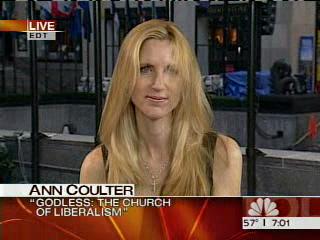
Many conservatives find Ann Coulter amusing. Most liberals (and many moderates) view her as a vile hatemonger. Regardless, she’s no fool. In King Lear’s terms, she’s instead a knave, sucking up to a dishonest ruling class. In modern terms, she’s no idiot since her act as right-wing attack dog makes her ever richer. The persona of deliberate provocateur she’s created could potentially work on stage at a comedy club (at least a right-wing one), but while Coulter and her fans think she’s funny, she consistently claims she wants to be taken seriously and not merely as an entertainer. She plays the role of “public intellectual” on TV. But this is just part of the act. Hers is a performance art of hatred, a vaudeville act built of bile. She is the modern, Aryan version of a minstrel performer.
Comedy possesses a very strong anti-establishment tradition of mocking those perceived to be in power. There’s something unseemly to most people, for instance, in mocking the poor simply because they’re poor. In comedy, women are more likely to triumph over men, children over adults, employees over bosses, mice over cats, and so on. There’s a long tradition in many cultures for some sort of “lord of misrule” that allows for the release of social tensions. In contrast, the minstrel performer reverses this comedic tradition and mocks those not in power. Alan Colmes recently suggested to Coulter that he had misjudged her, “I realize this is all comedic satire and that you're actually a liberal who's doing this to mock and parody the way conservatives think.” Coulter once again insisted she was serious and defended a few of her most outrageous statements. In Coulter’s minstrel show, she does not employ black face (or white face!) and rather than she herself playing some cartoonish version of a liberal, she instead plays, as Colmes suggests, what in civilized society would be the ugly caricature of a rabid conservative. Her performances nonetheless employ the same minstrel show techniques, throwing out a relentless array of insulting stereotypes to amuse her target audience and infuriate her critics. While the Shakespearean fool surreptitiously slips the king some important truth and ideally makes him think, the minstrel performer merely assures the audience of its superiority and reinforces long-standing prejudices. The battle lines are drawn and immutable. One can no more have a productive discussion with Coulter on politics than the NAACP could hold a conference on race relations at a KKK rally.
II. Calculated Provocation and Marketing Bile
Back in early February, Ann Coulter was a featured speaker at The Conservative Political Action Conference, one of the most important conservative gatherings of the year. She did not disappoint the faithful, stating "I think our motto should be post-9-11, ‘raghead talks tough, raghead faces consequences.’" Rather than gasps and boos, her rhetoric drew applause. A few prominent conservatives had the decency to condemn her afterwards, however reluctantly, while others conservatives remained silent, debated how bad her words really were, or blamed it all on the liberals. Why was condemning her a difficult decision at all? Don’t such words automatically prohibit someone from appearing on any media platforms in the civilized world until an apology is offered? But complaining that Ann Coulter has coarsened the public discourse is a bit like complaining that the Exxon Valdez oil spill spoiled the view. As Cenk Unyger points out through a series of Coulter’s most inflammatory comments, “In a World Where Ann Coulter has Credibility, Credibility Has No Meaning.”
Many writers have observed that if Coulter said about any minority group what she says about liberals, she would be overwhelmingly shunned. For her devoted fans, that’s a key selling point. They welcome every outrageous thing she says because they just know it will infuriate liberals. She may indeed say publicly what they’re thinking, but it’s that adolescent “piss-off-your-parents” angle that’s her chief appeal. It’s the thrill of the trangressive act, the excitement of combat, and the joyful release of finding and assaulting a scapegoat. This is precisely why she always tries to inflate the rhetoric and one-up other conservative “vaude-villains.” When junior hatemonger Melanie Morgan said she “would have no problem with [New York Times editor Bill Keller] being sent to the gas chamber,” Ann Coulter felt the need to do her one better and suggest a firing squad (she also approved of sending the New York Times anthrax). It's sort of a tag team version of the two-minute hate. (All of this is in perfect line with her earlier statement, sure to comfort victims’ families in Oklahoma, that her "only regret with Timothy McVeigh is he did not go to the New York Times Building.") When pressed on her ludicrous charge that Bill Clinton, the very man she’s long derided for being a “horny hick” with Monica Lewinsky and other women, was actually gay, rather than apologizing Coulter escalated matters by saying Al Gore was “a total fag.” True to form, Chris Matthews and the audience, in a familiar pattern, laughed rather than condemning her and Matthews even welcomed her back (only other performers responded to her appropriately.) Her goal is not to be thought-provoking, but only to provoke (and slip in a new sound bite to keep the spotlight on herself). The New Republic’s Michelle Cottle describes the underlying dynamic of Coulter’s shtick:
So what's an angry, frightened populace to do with all that pent-up desire to name-call and finger-point? Easy: Channel it at folks in the opposing political camp. For hard-right wing-nuts this means attributing every filthy characteristic imaginable to Democrats/Liberals/the left, ascribing venal motives to their every action, and blaming them for every misfortune to have befallen your beloved country over the past half century. Under the new rules of the game, you still can't deride Mexicans--but it's perfectly acceptable to deride liberals for pushing policies that allow Mexicans somehow to screw up your life. Ditto blacks, Asians, Eskimos, Episcopalians, and lesbians named Jackie. As a bonus, partyism can be rationalized as a more thoughtful brand of bigotry--since theoretically your hatred is an expression of political philosophy: You don't loathe liberals (or conservatives) for who they are but what they do. As practiced, of course, the phenomenon increasingly goes well beyond hating the sin into the realm of hating the sinner.
Viewed this way, Ann Coulter performs a valuable public service with her minstrel show. She offers her fans catharsis for their constipated rage. She’s the ex-lax of conservative punditry.
Speaking in September 2002 about selling the war in Iraq, then White House Chief of Staff Andy Card famously said, “From a marketing point of view, you don’t introduce new products in August.” Similarly, Ann Coulter is savvy calculating when to roll out her latest outrage. Back in late December 2005, when she had no book to sell, she offered Matt Lauer her usual baseless swipes at liberals but still managed, at moments, to resemble a human being. Contrast this with one of her most infamous statements to date as she promoted her latest, err, effort, Godless: The Church of Liberalism. Sitting down with Lauer again, she petulantly, stridently defended a section of her book that deals with the 9/11 widows known as the “Jersey Girls.” Lauer read from the book:
"These self-obsessed women seem genuinely unaware that 9-11 was an attack on our nation and acted like as if the terrorist attack only happened to them. They believe the entire country was required to marinate in their exquisite personal agony. Apparently, denouncing Bush was part of the closure process." And this part is the part I really need to talk to you about: "These broads are millionaires, lionized on TV and in articles about them, reveling in their status as celebrities and stalked by griefparrazies. I have never seen people enjoying their husband’s death so much."
Lauer did press her, but he was at an inherent disadvantage, because unlike Coulter, as a media host he is compelled to play by guidelines of civilized discourse. Still, as Peter Daou pointed out , Lauer should have said,
“There are two possible explanations for your statement. Either you believe it, in which case you're deranged. You don't believe it but said it for shock value, in which case you don't belong within a thousand miles of this network. Choose one.” (Daou’s most comprehensive Coulter post is well worth the read.)
Sadly, Coulter and her ilk are rarely challenged that forcefully, directly, and fairly. Certainly it never occurred in her flurry of subsequent appearances, on Tucker Carlson, Hannity & Colmes (where she claimed Jesus would approve of her attacks on liberals!) and finally on Jay Leno. Tellingly, having stirred up controversy to promote her book on the Today show, and after fanning the flames for a week, she toned it down for Leno. Conservative reaction to Coulter was again mixed. Some denounced her, while others defended her. Most went the route of Mary Matalin (always good at blaming the victim or claiming victim status) and said something to the effect of Matalin’s “I take her larger point.” (See, for example, O’Reilly and Cavuto.) If Matalin were honest and responsible, she’d say something like:
”Ann Coulter made a valid point in that it's very hard to debate someone that's been the victim of a tragedy. If you challenge them, you can wind up looking like a monster, regardless of the validity of your argument.
"However, what she said was artless at best and frankly, reprehensible. Saying that a widow is happy at her husband's death defies common sense and oversteps the bounds of all decency.
"This was not an off-the-cuff remark. She wrote this down. She thought of it beforehand. She had an editor look over this. And not only did she defend it on TV, even after she's been directly challenged on this, repeatedly, she still refuses to back down or apologize. Until she does so, I can't have any respect for her."
Of course, Coulter never apologized, and still will not, despite repeated opportunities to do so. An apology — admitting to being wrong — would make her appear weak to her rabid fans. It’s anathema to pundits, but especially to conservative commentators. Admitting error is one step removed from Dolchstosslegende and treachery for those who worship in a cult of authoritarian personality, namely social conservatives, social regressives, the neocons, and other belligerati. However, with Coulter the stakes are much higher. If she ever apologized, the mask would crack. She would break character and the suspension of disbelief. Her minstrel show is as fake as pro wrestling and her fights with supposed liberals similarly designed solely for entertainment (albeit for only half the national audience). Habitual liars and professional hacks will continue to lie even in the face of overwhelming evidence proving them wrong, but they always try to bluff their way through regardless. If Coulter acknowledged it was an act, the illusion would be shattered and her central appeal destroyed.


III. The “Scholarship” of Demagoguery
Many commentators (such as Al Franken and David Brock) have observed that Coulter’s core complaint about the 9/11 widows is that she can’t engage them in personal attacks — despite the fact that she does anyway! In a fair, moderated debate based on substance, a smart high student would eviscerate Coulter because all she has is ad hominem arguments. Coulter complains “we can’t respond” to victims, but of course any civilized person can. All that’s required is to say, “With all due respect to Mrs. Smith’s loss, I have to disagree with her on this policy point because...” However, this would require Coulter to observe, if not normal human compassion, at least basic civility, to refrain from demonizing others in time-honored propagandist tradition, and to actually possess a substantive argument. Of course, it’s easy to see how Coulter would quickly be on shaky ground if she was forced to argue, “A moderate, bipartisan committee engaging in a full and frank investigation of 9/11 would be bad for the country because...” Given Coulter's own modus operandi and history of politicizing 9/11, she's essentially arguing for the right to attack others while simultaneously excluding her targets from the dialogue. Not only does she coarsen the public discourse, she wants to control the terms of engagement and prevent anyone else from elevating the public discourse. She's an enfant terrible actively trying to squelch adult discussion in an audacious powerplay of shameless hypocrisy. On the few occasions Coulter has been challenged her response is to change the subject, offer another attack, flip her hair even more often, or literally shriek. In sharp contrast, the Jersey Girls, formally responding to Coulter’s attack, addressed her vileness in just a few sentences and then moved on to adult matters.
The biggest travesty of Coulter’s appearances is the compliments she receives about being smart or her book being well-researched. Nothing could be further from the truth. Even without the multiple charges of plagiarism, or her inflated and suspect legal acumen, Coulter defines slapdash, shoddy pseudo-scholarship. She’s sloppy with citation no doubt in part due to laziness. But additionally, she belongs to an ideological camp who feel no need for consistency or coherence of thought. An argument exists only to score points or draw blood and thus needs no real support. “Facts,” as dubious as they may be, are merely rounds of square shot to be feed into the machine gun aimed at heathen liberals.
If one tries to read the one hundred hastily-penned paragraphs that comprise the first chapter of Godless and rebut it point by point, it quickly becomes an exercise in masochism — it's just not worth the trouble (one brave soul undertook this for a previous Coulter book, Slander). Coulter said as much when she told Jay Leno, to deflect his question about her using the word "broads" versus "women," "If we're getting to that level of parsing my language, there will be no end to this." Coulter often employs a "blunderbuss" debate technique – namely, she rapidly shoots out a wide variety of outrageous statements, and if not all of them are rebutted, she will smugly declare herself the victor (not that she ever acknowledges error or defeat, anyway). She's repeatedly crowed that no liberal seems to have taken offense at her deliberately insulting title, Godless. But whether it's her title or one of its many variations in her book, how does one respond to such an obviously ludicrous claim as “liberals are godless”? “No, they’re not”? Coulter will just respond, “yes they are.” The starting point is not an adult conversation, and Coulter will fight against elevating it. It’s no coincidence that many a commentator has compared Coulter's rhetoric to schoolyard taunts. In a fair fight Coulter has no chance, but when it comes to mud-slinging she and her ilk typically have the edge. When one person is trying to play fair and the other isn’t, the dirty fighter has the advantage. The media as a whole is so afraid of being accused of liberal bias it will not play referee, fact-check, or book anyone on with Coulter who will dare call bullshit. Several researchers have shown that Coulter uses footnotes solely for the purpose of appearing scholarly, and many if not all of them do not support the assertions she makes. In fact, one researcher redacted all of Coulter’s unsupported assertions in chapter 2 of her book Slander and the result was a handful of sentences amidst pages of near solid-black. She’s repeated the same pattern with all her books, including her most recent one, Godless. While Coulter can fairly be called a liar for her intentional distortions, it’s more accurate to say she’s what Harry Frankfurt calls a bullshitter, because the truth of her assertions is completely irrelevant to her. But as Joe Conason puts it, “The likelihood is that Coulter's many avid fans are as conveniently ignorant of the past as she seems to be,” thus making her task much easier.
It's no surprise Coulter simply cannot support her assertions in person either, since little to no thought has gone into them. She will demonize liberals in a style of straw man rhetoric taken to the level of boogeyman. But she cannot name a single godless liberal to Alan Colmes, nor to Donnie Deutsch, nor explain why Darwin is wrong to Jeremy Paxman, nor with Chris Matthews can she name a single liberal leader who is actually a traitor. She will make a broad, insulting statement, and then attempts to use her very inability to point to a single example — as proof of her veracity! It's a faith-based punditocracy for Coulter.
One of her typical "I'm rubber-you're glue" gambits occurred when Matthews, in one of his periodic lucid interviews, actually challenged Coulter on the core statements of her then-recent book Treason: Liberal Treachery from the Cold War to the War on Terrorism. It’s an interview that warrants a significant look. Matthews starts by pushing Coulter on her charges that Presidents Truman and Kennedy were traitors, then presses her further on her use of the term “treason” since it is, of course, a capital offense:
MATTHEWS: Well, should they be prosecuted? Should anybody in the [Democratic] party be prosecuted either today, or should have been prosecuted in the past? I mean, it’s a criminal charge of treason. Should anybody be charged with it?
COULTER: I wish it were that easy a problem, but that trivializes the point...
MATTHEWS: No, it’s a crime.
Coulter trivializes "treason" and "terrorist," in slapping these labels on liberals, then claims Matthews is trivializing her overheated hyperbole when he asks her to back it up. Matthews relentlessly presses Coulter on a central hypocrisy of her book, thus exposing her rank partisanship:
MATTHEWS: Were the Republicans willing to oppose World War II before Pearl Harbor right? And they vigorously opposed getting involved in the war in Europe.
COULTER: As I describe in my book, they were wrong and I have to describe this...
MATTHEWS: The Republicans were wrong?
COULTER: Yes, they were.
MATTHEWS: Were they traitors?
COULTER: No. They came around...
MATTHEWS: But when liberals oppose wars, they are treasonists.
Leaving aside Matthews' odd favoring of the word "treasonist" over "traitor," Coulter simply cannot defend herself. It’s fine to accuse Harry Truman and JFK of treason in a book for her fans, who will lap it up, but Matthews will have none of it:
COULTER: I’ll give you my thesis again. My thesis is, that the entire Democratic Party cannot be trusted with the defense of the nation.
MATTHEWS: Start with a name, please.
COULTER: It is not to start trying a few individuals. I wouldn’t...
(CROSSTALK)
MATTHEWS: OK. We’re not getting anywhere here because you don’t want to give me any names.
COULTER: That is because I am talking about the Democratic Party. That is the name I am trying to give you.
MATTHEWS: Okay. Half the American people, roughly, in most elections averaged over the last 50 years have voted Democrat, let’s face it, for president. Those people who vote for Democratic candidates for president after hearing their case with regard to foreign policy, why would they vote for someone who you say is a traitor?
COULTER: Because this story has not been told, because I have what has been systemically excluded from history books in high school and college, and that is why I wrote this book, to prove to Democrats, as Joe McCarthy said...
MATTHEWS: But half the people in the U.S. Army are probably Democrats. You say they vote for Democrats out of treasonable reasons?
COULTER: I am saying, as Joe McCarthy said, the loyal Democrats of this party no longer-or of this country no longer have a party. This is a party that cannot defend America, that loses wars, that loses continents to communism-that nay say Ronald Reagan’s response to the Soviet Union, and then they keep turning around and say, oh, it was inevitable. No one lost China. Anyone would have lost Vietnam...
It’s hilarious that Matthews asks Coulter to 'name names' and she can’t, especially since her book praises Joe McCarthy! She also lies about her own thesis! To close the interview, Matthews asks her another passage that implied that Arabs smell bad (not the only time she's made such a statement). Coulter is cowardly enough to not explain her statement, but honest enough to state its purpose:
MATTHEWS: ...”The principal difference between fifth columnists and the cold war versus the war on terrorism is that you could sit next to a communist in a subway without asphyxiating.” What does that mean? I just want to know. What does that mean? I want to know.
(CROSSTALK)
COULTER: It means what it says. The second difference is, that in far more time the enemy that we’re up against now has killed far fewer people.
MATTHEWS: So, but the enemy smells. Is that your knock against Arabs? I mean, that’s your point here. You sit next to them and you are asphyxiated while sitting next to them.
COULTER: I’m just drawing the differences between the old war and the currents war.
MATTHEWS: Is that a way to win friends in the Arab and Islamic world by saying they stink.
COULTER: I think it is a way to get people...
MATTHEWS: Is that deep?
COULTER: ... to read my book, so I thank you.
As repulsive as Coulter’s bigotry is, that’s relatively easy to spot. It’s her simultaneous assertion and disavowal of her own thesis that’s so characteristic of the “public intellectual” Coulter, what she so typically gets away with, and the heart of why she is a complete fraud. In the Matthews interview, after being hammered on her use of “treason” and “traitor,” she says “My thesis is, that the entire Democratic Party cannot be trusted with the defense of the nation.” That’s still a tenuous assertion, but at least it’s in the realm of reality. However, she only offers it as a concession and distraction to Matthews. It is not her thesis, which is, “liberals are traitors.” Here’s the first paragraph of Treason: Liberal Treachery from the Cold War to the War on Terrorism :
Liberals have a preternatural gift for striking a position on the side of treason. You could be talking about Scrabble and they would instantly leap to the anti-American position. Everyone says liberals love American, too. No they don't. Whenever the nation is under attack, from within or without, liberals side with the enemy. This is their essence. The Left’s obsession with the crimes of the West and their Rousseauian respect for Third World savages all flow from this subversive goal. If anyone has the gaucherie to point out the left's nearly unblemished record of rooting against American, liberals turn around and scream "McCarthyism!
Lest one somehow think this is an isolated incident, Amazon allows one to read most of the first section (when its "look inside" function is working), and here’s a few of Right Wing News’ “Best Quotes From Ann Coulter's 'Treason'”
"While the form of treachery varies slightly from case to case, liberals always manage to take the position that most undermines American security." -- Ann Coulter, P. 203
"Only a war that serves no conceivable national interest gets the New York Time's endorsement. Liberals warm to the idea of American mothers weeping for their sons, but only if their deaths will not make America any safer." -- Ann Coulter, P. 212
"The portrayal of Senator Joe McCarthy as a wild-eyed demagogue destroying innocent lives is sheer liberal hobgoblinism. Liberals weren't cowering in fear during the McCarthy era. They were systematically undermining the nation's ability to defend itself while waging a bellicose campaign of lies to blacken McCarthy's name. Everything you think you know about McCarthy is a hegemonic lie. Liberals denounced McCarthy because they were afraid of getting caught, so they fought back like animals to hide their own collaboration with a regime as evil as the Nazis." -- Ann Coulter, P. 10
Ah, where would prime hyperbole be without some mention of Nazis? (Salon’s Joe Conason performs an excellent dissection of the lies and distortions of Treason.) Every Coulter “thesis” is essentially the same: liberals are bad, conservatives are good. Only the details change. Still, Matthews’ grilling confirms several factors. One is that, for Coulter, any politician’s position is superfluous. Only his or her partisan standing matters, and that and only that determines a position’s validity. More importantly, with Matthews, Coulter’s trademark pattern emerges. When questioned on her latest outrage du jour, she typically claims she stands by everything she’s written or said. However, in the rare event she is challenged on the substance of her assertions, she refuses to support them and will change the subject, make another quip, or, as with Matthews, change her thesis and hope no one notices. When Deutsch and Matthews refuse to accept her central, ludicrous assertions, she is thrown completely off her game. Coulter wishes to get full credit for saying “outrageous” things, but simultaneously fights against being held accountable for them. It’s a cowardly display.
Sadly, Matthews does not always grill Coulter as he did on Treason. And while Alan Colmes has challenged Coulter on occasion, he’s not allowed to go far off script; Hannity, the commercial breaks or Colmes’ paycheck will always save her. In a courtroom, proving someone definitively wrong is a virtue, but on talk shows, convention holds that would be — rude. Ultimately, the viewer should be allowed to decide for him or her self, but most viewers fairly expect networks to uphold some basic commitment to accuracy that allows for informed decision-making. If a guest’s preposterous statements or demagoguery are left unchallenged, the host abdicates an important responsibility and does the viewers a grave disservice. Unfortunately, while Coulter gives her opponents lots of rope to hang herself with, it rarely happens. Even Matthews and Deutsch butter Coulter up with nauseating compliments and never, for instance, directly state, “So your entire thesis has no basis in reality.” When Coulter makes a preposterous claim, such as her reply to Colmes that Jesus would indeed approve of her hateful rhetoric, everything should grind to a halt. She should be grilled on such a statement until she confesses it’s idiotic (although her preferred tactic these days is make an even more outrageous statement). Either it’s hyperbole, in which case she’s being irresponsible, or it’s a serious assertion, in which case she’s insane. The key method for dealing with overheated conservative rhetoric is to be a bulldog about a specific statement and force conservatives to either put up or shut up (as Bernie Ward demonstrates here). Every interview with Coulter should contain some variation on Peter Daou’s suggested response:
“There are two possible explanations for your statement. Either you believe it, in which case you're deranged. You don't believe it but said it for shock value, in which case you don't belong within a thousand miles of this network. Choose one.”
IV. Pay No Attention to the Bigot Behind the Curtain
Coulter's statements fail under the slightest scrutiny, but she also possess no internal consistency. Her hypocrisy is so vast it’s hard to chart. She claims liberals are “godless” and poses for her book cover wearing a low-cut top and a cross. Yet she is unknown at the church she claims to attend. Her brand of Christianity, such as it is, is odd if not unrecognizable. And, as the fictional, satirical Mrs. Betty Bowers muses, “After all, who wants to be lectured about not being Christian enough by an almost-50 year-old boozehound in a black leather miniskirt who has never been married? Count me as having a healthy skepticism over whether Miss Coulter has saved herself for marriage. Or anything, for that matter.”
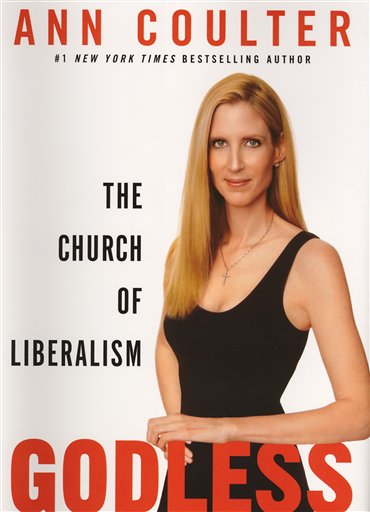
Coulter exhorts liberals for hating the military, but it’s clear she only respects the military who agree with her views. She refused to believe that Army Ranger Pat Tillman, who she had previously lionized, opposed the Iraq war and read Noam Chomsky. She insisted that Democratic Congressman and military veteran John Murtha was “the reason soldiers invented ‘fragging.’” In 1997, she told disabled Vietnam veteran Bobby Muller, a peace activist, "People like you caused us to lose that war." For that, she was fired by MSNBC. (Apparently her Murtha comment now passes for civilized, insightful analysis.) Even though Coulter shrieks about liberals giving aid and comfort to the enemy, after 9/11, she infamously wrote "We should invade their countries, kill their leaders and convert them to Christianity." Such xenophobic, imperialistic, anti-Muslim rhetoric surely gave Osama bin Laden more ammunition for his propaganda machine than anything any liberal has ever said. National Review editor Rich Lowry, to his credit, dropped Coulter after she wrote that column and she also aggressively defended it (as she has repeatedly done). Alas, rather than condemn Coulter, other conservatives chose to put her statement on T-shirts.
No sane, intelligent person who follows the news can pretend not to have a grasp of Coulter’s act by now. Her comments are occasionally so appalling that even some of her buddies at Fox News feel comfortable condemning her (even if they admire her somewhat), while other stalwarts such as the laughable David Horowitz will try to defend her but can’t even keep a straight face. But even when some Republicans and conservatives condemn Coulter, it’s mostly due not to disagreement, but only because they see one of her specific excrescences as bad public relations and harmful to their cause. As Digby points out, conservatives have been more than happy to let Coulter’s vile rants stand unchallenged when it suits them, and as Taylor March argues, Ann Coulter is the Republican Party. Some have labeled Ann Coulter as analogous to Michael Moore, but any objective survey of the punditocracy and blogosphere must conclude that hate speech and fantasies of violence are overwhelmingly the purview of the right. It’s mainstream for conservatives in a way it just isn’t for the left. Hilariously, Ann Coulter took offense to Bill O’Reilly’s suggestion that she was the right’s version of mild-mannered, fact-checking Al Franken. There is no liberal figure analogous to Ann Coulter, none. She is their minstrel show and theirs alone, even if she’s foisted on the rest of us.
Professor Geoffrey Nunberg compares Coulter’s shtick on political shows to the casting dynamics of sitcoms, sagely observing that “the drama of the political talk show is character-driven rather than plot-driven.” He also notes:
Coulter's celebrity is a good measure of what has become of political discussion. You'd scarcely describe her as a political thinker, no more than you'd describe Simon Cowell as an critic of the arts. But like Cowell, she has an unerring gift for media theatrics. It isn't just her penchant for making snarky or outrageous remarks. Plenty of people do that without being invited onto the Today Show, and in fact Coulter doesn't get a lot of national attention for her run-of-the-mill ruminations about giving rat poison to Justice Stevens or fragging John Murtha. But the remark about the 9/11 widows was irresistible for its brazen and gratuitous tastelessness and the obvious pleasure Coulter took in consternation she created.
Is Coulter is sincere about the things she says? That's a silly question, like asking whether schoolchildren are sincere in the taunts they throw at each other across the school yard. But that doesn't make her a satirist, as her defenders like to claim -- usually with the implication that her literal-minded liberal critics don't get the joke.
Satire depicts things as grotesque in order to make them seem ridiculous -- what Stephen Colbert does in his Bill O'Reilly persona or Christopher Buckley does with the pointed caricatures of Thank You For Smoking. But Coulter isn't actually sending anybody up -- not herself, certainly, and not the targets of her remarks. Her fans may enjoy hearing her talk about poisoning Justice Stevens or say that it's a pity Timothy McVeigh didn't park his truck next to the New York Times building. But that's not because the remarks make either Stevens or New York Times seem particularly ridiculous. It's because Coulter seems to be able to get away with unbridled aggression by presenting it as mere mischief, leaving her critics looking prim and humorless. ("Perhaps her book should have been called 'Heartless,'" said Hillary Clinton after Coulter's remarks about the widows, inviting the response, "Oh lighten up, girl.")
[...]
It's that underlying comic framework that creates the opportunity for political smut. However rude or offensive a remark might sound in the abstract, it's all in the spirit of entertainment. And as Coulter and other adepts of the genre understand, the ultimate effect is to aggravate the affront, not alleviate it. You not only get to offer an insult, but to discredit the anger or outrage it evokes as prim political correctness: "My, we're touchy, aren't we?"
The grand irony of Coulter is that she depends on the tolerance of others to preach intolerance. Were the media truly liberal, she would not be allowed a platform. The minstrel show long went out of fashion, but her brand of minstrelsy positively thrives. The “shed heat, not light” model of political discourse so famously skewered by Jon Stewart can help ratings, and above and beyond any liberal or conservative bias, media corporations possess a commercial bias. Also at work is the media’s love for a simplistic, reductive, "he said-she said" storyline that appeases conservatives by appearing balanced and obviates such time-consuming activities as fact-checking or making a judgment.
V. Media Platforms: Who Needs Talent When You Have a Good Promoter?
Ann Coulter of course has the right to say just about anything she wants, and it’s demagogues such as her that most sorely test the very same essential First Amendment rights she’d ferociously strip from others such as The New York Times. The question is, since she has no value whatsoever except as a provocateur, why the hell do the rest of us have to be subjected to her?
A common argument on liberal blogs is that liberals should just ignore Coulter. It’s a respectable position. However, it’s not really possible except on an individual level, and to cede the field to her and her ilk is dangerous. Once upon a time, for instance, ”liberal” was not a dirty word. Words and language matter, and we ignore abuse of them at our peril. Coulter only gets away with her shtick because she’s allowed to by the media outlets where she appears, and they grant her a legitimacy she simply does not deserve. She was just a crackpot and not particularly dangerous back when she was merely a “cable network sideshow,” as Joe Conason puts it, but now she’s a “full-fledged media star.” Even if her book sales are inflated through bulk purchases by organizations such as NewsMax, who will then offer her $28 book for only $5, she does well on bestseller lists (although interestingly, so do Al Franken and other liberals). Liberals are not buying her books, except perhaps to review them. Coulter is the screeching face of a significant portion of the modern Republican party.
Fox News will of course rarely call her on anything, but if she was contained there, with sanctions in place and a no-air-time zone enforced by other networks, it might be all right. However, legitimate outlets such as NBC and its associated networks continue to give her a platform! Dateline NBC will advertise a show on pornography by promoting salacious details while simultaneously pretending to condemn the content. Similarly, NBC and other outlets have promoted Coulter’s latest outrages with a “Don’t Miss What She Said This Time!” approach. Since her horrendous comments about the 9/11 widows — condemned by NBC news anchor Brian Williams — NBC’s associated networks have nonetheless had her on six or seven times! As Washington Post media critic Howard Kurtz observed [emphasis mine]:
But are news outlets being shameless in giving Coulter a platform for her inflammatory rhetoric, knowing it will boost ratings and circulation?
"She made news," says "Today" Executive Producer Jim Bell. "I think our audience is smart enough to figure it out and reach their own opinions. It's not our job to censor people." Besides, Bell says, "she's good television."
[...]
Coulter, who made the rounds at Fox, CNN and MSNBC last week, remains unabashed, telling Time: "I'd say my 'name calling' has been a smashing success." So when the staff of "Today" or any other program books Coulter, they know exactly what they're getting: a woman whose vituperation they can decry even as they milk it for market share.
Of course, since even bad publicity is still publicity, this column, too, will probably make the Coulter cash register ring a few more times.
Still, perhaps the most appalling promotion of Ann Coulter came from two pieces in Time magazine. As Eric Boehlert reports in his book Lapdogs (excerpt here):
The Time love-fest began in the April 18, 2005 issue when the weekly, compiling its list of the world’s most influential people, found room alongside past and present international leaders Ariel Sharon, Bill Clinton, Nelson Mandela, the Dalai Lama to include Coulter, a cable TV pundit. Time’s James Carney, who five months later was promoted to the magazine’s Washington Bureau Chief, did the honors, typing up the Coulter valentine, headlined "Gleefully Making the Left Squirm":
"In her books, Coulter can be erudite and persuasive, as when she exposes the left’s chronic softness on communism. But her signature is her gleeful willingness to taunt liberals and Democrats, to say out loud what some other conservatives dare only think–that Bill Clinton is a "horny hick," for example, and his wife "pond scum." It’s what makes Coulter irresistible and influential, whether you like it or not."
As Boehlert points out, if a liberal said the same about a conservative, it simply would not fly. What does this say about Carney and Time? However, worse still was the puff piece cover story she received from Time the following week. Time simply refused to fact-check Coulter and trumpeted her as a “public intellectual.” The piece’s author, Jack Cloud, actually wrote:
"Coulter has a reputation for carelessness with facts, and if you Google the words "Ann Coulter lies," you will drown in results. But I didn’t find many outright Coulter errors."
As Boehlert points out:
In order to print that, Time had to ignore not only the corrections Coulter’s own publisher had to make in subsequent editions of her books, but also the tens of thousands of words posted at blogs such as the Daily Howler, Spinsanity, Mediawhoresonline, American Prospect’s Tapped, and Scoobie Davis Online, just to name a few, that carefully chronicled the blatant misstatements by Coulter.
Indeed, The Daily Howler and Howard Kurtz, among others, dissected or critiqued the Time article in short order.
This matters a great deal because while serious news junkies may make fun of much of the coverage in Time and Newsweek, both magazines are widely-read and typically represent the conventional wisdom of the Beltway’s chattering class. Errors in these two newsweeklies will cause greater harm to the public understanding than will an error in an erudite journal (meanwhile, bad arguments in neoconservative publications such as The Weekly Standard cause greater harm to administration policy!). The average American simply does not expect a bigot and liar to be accorded such respect. NBC and Time pursue a short-term commercial gain by booking sideshow acts such as Coulter, but also sacrifice trust by doing so, because lending Coulter undeserved credibility damages their own. Evidently, they believe appealing to Coulter’s fans outweighs the harm it does to both their brand and the public discourse (as if the corporate heads give a damn about the latter!).
And this faux legitimacy causes real damage. Blogger Hume’s Ghost relates a key story on this point[emphasis mine]:
Not too long ago a friend of mine told me she was trying to become more politically informed. To do so, she continued, she had begun reading Ann Coulter's How to Talk to a Liberal (If You Must). Think about that for a moment. This was an individual who did not know much about politics, was a non-ideological independent and the first person she could think of to learn more about politics from was a hate-mongering hack. This should have never happened, because Coulter should have been exposed for the vile, bigoted, intellectually bankrupt propagandist that she is by journalists a long time ago. In this regard, my friend was failed by a mainstream media which is more interested in using Coulter as a figure to drive up ratings than they are in doing their jobs of promoting a responsible national discourse.
So yes, Ann Coulter needs to be condemned every time she says something foul. Prominent conservatives need to be condemned every time they fail to condemn Republican spokeswoman Ann Coulter for something foul. And media platforms that allow her to spew hatred need to be condemned until they stop giving her legitimacy and air time.
VI. The Future of Minstrelsy
There are essentially five responses to Coulter. Number one, ignoring her, is perfectly respectable but really only works for individuals. She’s far too ubiquitous to avoid. Number two is outright mockery, and may be the most effective and (ironically) fair approach. David Letterman, Robin Williams, and many an editorial cartoonist has employed this approach, and true satirists such as Jon Stewart and Stephen Colbert can often deliver scathing critiques while simultaneously making an audience laugh. Number three is scolding her for her tone and excessive rhetoric. Brian Williams and many a politician or public figure used this tact in response to her tasteless 9/11 widows statements (Keith Olbermann uses this approach as well, although laced with plenty of mockery and critiquing as well). Number four is to directly challenge Coulter on the substance of her statements, as in a serious debate, interview or book review. Joe Conason’s review of Treason was superb in this respect, Al Franken debunks her on the air all the time, and many a columnist or blogger has done the same. The problem is, much of this work will only reach those who are already clued in to Coulter’s game. She is, above all, a creature of television, spewing venomous sound bites, and there she is rarely substantially challenged. She’ll earn a perfunctory “tough” question, but will wriggle free in protean fashion because seldom will anyone pin her down. This is the most severe deficiency in the mainstream media’s treatment of Coulter, except perhaps for number five. Number five is to deny Coulter a media platform from whence to disgorge her hatred. It’s encouraging that newspapers continue to drop her column. But she still gets a free pass from too many news organizations. As with cigarettes, the children of America would be much better off if they didn’t have to see Ann Coulter on television.
Most accounts of the minstrel show report that the form started to die around 1910 but didn’t really disappear in America until the 1950s. Apparently, there was no audience anymore for it, due to changing tastes or outright shame at watching such a spectacle. With Coulter, it’s quite possible that she’ll merely be supplanted by some other figure who plies more of the same in search of the same notoriety and profit. Or, as Michelle Cottie predicts, many more Coulters may spawn as other types of bigotry become further socially unacceptable. It would be naive to believe that Coulter and her ilk will ever completely vanish. But hope remains that conscience, taste, and a common sense of decency may eventually push them to some venue in the boondocks and off center stage.
Subscribe to:
Posts (Atom)