Occasional blogging, mostly of the long-form variety.
Showing posts with label The Holocaust. Show all posts

Thursday, January 27, 2022

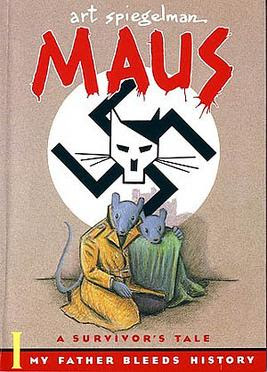
Maus Banned

Just in time for International Holocaust Remembrance Day, a Tennessee school district has banned Maus, an amazing, Pulitzer-winning graphic novel by Art Spiegelman about his family but especially his father, Vladek, who survived the Holocaust. The Associated Press reports that the ban was...

...due to "inappropriate language" and an illustration of a nude woman, according to minutes from a board meeting. . . .

In an interview, Spiegelman told CNBC he was "baffled" by the school board's decision and called the action "Orwellian."

"It's leaving me with my jaw open, like, 'What?'" he said.

The decision comes as conservative officials across the country have increasingly tried to limit the type of books that children are exposed to, including books that address structural racism and LGBTQ issues. The Republican governors in South Carolina and Texas have called on superintendents to perform a systemic review of "inappropriate" materials in their states' schools.

The minutes from the school board meeting indicate objections over some of the language used in "Maus." At first, Director of Schools Lee Parkison suggested redacting it "to get rid of the eight curse words and the picture of the woman that was objected to."

The nude woman is drawn as a mouse. In the graphic novel, Jews are drawn as mice and the Nazis are drawn as cats. . . .

Randi Weingarten, the president of the American Federation of Teachers, which does not play a role in McMinn County, noted the timing of the news on Twitter. Weingarten, who is Jewish, pointed out that Thursday is International Holocaust Remembrance Day.

"Yes it is uncomfortable to talk about genocide, but it is our history and educating about it helps us not repeat this horror," Weingarten said.

The U.S. Holocaust Museum tweeted that "Maus has played a vital role in educating about the Holocaust through sharing detailed and personal experiences of victims and survivors. . . .

"Teaching about the Holocaust using books like Maus can inspire students to think critically about the past and their own roles and responsibilities today."

The Tennessee school board emphasized in the minutes that they did not object to teaching about the Holocaust but some were concerned the work was not age-appropriate.


This is a stunningly bad if not entirely surprising decision. It sure seems to be yet another case of conservatives rejecting good art (and accurate history) out of prudishness and a desire to control their children. But such attempts, in addition to being harmful, rarely succeed in the long run.

As I've written before, Maus is a good introduction to the Holocaust. I used excerpts from it when I was teaching high school, at least one other colleague taught the entire series, and I knew some students read it on their own. I wouldn't give Maus to elementary school kids, but it's completely appropriate for high school students and many junior high students as well.

When I first saw the cover of Maus and heard the pitch – Jews as mice and Nazis as cats?!? – my concern was that it seemed like a cartoonish, oversimplified approach to the Holocaust. But I heard from several people who read Maus and assured me it was not simplistic, and was actually really good. That's all true, and the series is well worth checking out if you haven't yet.

Maus recounts, in detail, what happened to Art Spiegelman's father Vladek and how he survived in Nazi-occupied Poland and later Auschwitz, through luck but also ingenuity and courage. Spiegelman also depicts his fraught relationship with his father in the present day and Vladek's failings, as well as his own. Spiegelman even interrogates the creation of Maus itself and questions if depicting Jews, Nazis, and other groups as animals trivializes the Holocaust, and whether the series' success means he's exploiting a great tragedy. Maus is a complex, multilayered work, suitable for younger readers, and interesting and instructive as a Holocaust survivor's story, but it also raising some pretty significant questions about the nature of history, art, memory, and judgment. It's an engaging read, and can also be a bit emotionally exhausting, as pretty much any good, honest Holocaust tale is.

Something positive has come out of the ban, because a number of people – some famous, some not – are buying copying of Maus and donating them to Tennessee libraries. And the news stories about the ban is introducing new people to the existence of Maus. Maybe they'll check it out to see what all the fuss is about. Conservative attempts to ban something can backfire.

Years ago I lent my copies of Maus to my father, who had introduced me to comics, and he was impressed by the series as well. From where I'm sitting, I can glance over to a bookcase and see those same copies of Maus, sitting atop a copy of Primo Levi's The Drowned and the Saved. That's also an amazing work, but should only be read when someone's well-acquainted with the Holocaust already. Maus has a great track record in that regard, introducing people to the Holocaust. Let students read it, and may the efforts to provide more copies in Tennessee libraries and elsewhere flourish.

Wednesday, January 27, 2021

Camp Auschwitz

Today is International Holocaust Remembrance Day, which marks the anniversary of the liberation of Auschwitz.

During the insurrection at the U.S. Capitol on 1/6/21, a man later identified as Robert Keith Packer was photographed wearing a "Camp Auschwitz" t-shirt. The front also said "Work brings freedom," one translation of the infamous "Arbeit macht frei" slogan atop the entrance to Auschwitz and other concentration camps. The back of the shirt said "Staff."

Packer, a resident of Newport News, VA, who apparently has a history of extremism, was arrested, but later released without criminal charges or paying any fines. He was merely ordered to stay away from D.C. unless summoned there. Other insurrectionists also expressed pro-Nazi, pro-Holocaust, anti-Semitic, white supremacist or bigoted views.

Several people, including Austrian-born Arnold Schwarzenegger in a personal and moving statement, directly linked the hatred and violence of the insurrection at the U.S. Capitol to Kristallnacht, "the Night of Broken Glass" of 1938, when German Nazis smashed the windows of Jewish stores and synagogues.

One of the most powerful responses came from Andrew Brandt, who was following the story of Robert "Camp Auschwitz" Packer and posted a thread about a family photo:


The entire thread is worth reading. This is real history; these are human stories. And not only did Brandt never get to meet most of the people in his family photo, even some of their names are lost, because they were murdered by the Nazis.

I wonder if people like Packer and the rest of the Nazi contigent at the U.S. Capitol have more than a childish understanding of the Holocaust. Presumably, they know some basic events, probably from a bigoted source, and they approve of the genocide. But there's a leering, smug immaturity to many right-wing authoritarians in addition to their seething hatred. They want to provoke, to offend, to transgress tenets of basic respect and dignity. They aggressively deny the humanity of their chosen scapegoats. They willfully blind themselves with rage to broad swaths of the human experience. They could look at Andrew Brandt's family photo, hear his story, and not see anything, somehow not be moved.

We've seen and will continue to see excuses for and downplaying of the insurrection, for the failed attempted coup. And not every right-wing authoritarian, white supremacist or bigot proudly identifies him or herself as a Nazi. But we can't pretend that right-wing extremism doesn't exist in the United States and isn't a dangerous force. Many conservatives who don't identify as bigots or white nationalists have nonetheless supported their more extreme kindred or even voted them into office. And they continue to be enabled by a group of dogmatic centrists addicted to blaming "both sides" equally. As Rebecca Solnit observed in "On Not Meeting Nazis Halfway":

Nevertheless, we get this hopelessly naïve version of centrism, of the idea that if we’re nicer to the other side there will be no other side, just one big happy family. This inanity is also applied to the questions of belief and fact and principle, with some muddled cocktail of moral relativism and therapists’ “everyone’s feelings are valid” applied to everything. But the truth is not some compromise halfway between the truth and the lie, the fact and the delusion, the scientists and the propagandists. And the ethical is not halfway between white supremacists and human rights activists, rapists and feminists, synagogue massacrists and Jews, xenophobes and immigrants, delusional transphobes and trans people. Who the hell wants unity with Nazis until and unless they stop being Nazis? . . .

In the past four years too many members of the right have been emboldened to carry out those values as violence. One of the t-shirts at the #millionMAGAmarch this weekend: “Pinochet did nothing wrong.” Except stage a coup, torture and disappear tens of thousands of Chileans, and violate laws and rights. A right-wing conspiracy to overthrow the Michigan government and kidnap Governor Gretchen Whitmer was recently uncovered, racists shot some Black Lives Matter protestors and plowed their cars into a lot of protests this summer. The El Paso anti-immigrant massacre was only a year ago; the Pittsburgh synagogue massacre two years ago, the Charlottesville white-supremacist rally in which Heather Heyer was killed three years ago (and of course there have been innumerable smaller incidents all along). Do we need to bridge the divide between Nazis and non-Nazis? Because part of the problem is that we have an appeasement economy, a system that is supposed to be greased by being nice to the other side.


It's crucial to call out right-wing authoritarians and to hold them accountable. It's also important to excoriate any knee-jerk "both siders" who, intentionally or not, work to deny that accountability, or habitually attack honesty and accuracy in the name of politeness and civility. Finally, it's essential to remember our own humanity and to recognize the same in others fighting against right-wing authoritarianism, and to remember and honor the very human victims of its violence. Andrew Brandt's family photo and story remind me of a poem I've cited before, from Auschwitz survivor Charlotte Delbo:

Marie

Her father, her mother, her brothers and sisters were all gassed on arrival.
Her parents were too old, the children too young.
She says, "She was beautiful, my little sister.
You can't imagine how beautiful she was.
They mustn't have looked at her.
If they had, they would never have killed her.
They couldn't have."


Monday, January 27, 2020

International Holocaust Day 2020

Today is International Holocaust Remembrance Day, which marks the anniversary of the liberation of Auschwitz. It's the 75th anniversary this year.

Fresh Air's episode for the occasion features two good older interviews: a 2005 one with Laurence Rees on his book, Auschwitz: A New History, and an 1988 interview with Holocaust survivor and author Elie Wiesel, who died in 2016. The PBS NewsHour segment, "The lessons of Auschwitz, 75 years after its liberation," features some survivors revisiting the camp and some striking memories. The United States Holocaust Memorial Museum website has an excellent primer on Auschwitz and other resources. (Going through the museum's permanent exhibit is a powerful experience.)

Although a solely historical post might be appropriate today, it feels more pressing to note current events. Hate crimes are on the rise in some areas, and the number of high-profile hate crimes in recent years is troubling. The Anti-Defamation League (ADL) tracks anti-Semitic incidents. The Southern Poverty Law Center has a more general "hatewatch" page, and both organizations maintain "hate maps." FBI statistics for 2019 hate crimes aren't available yet, but the website has information from1995 through 2018, and as CNN summarizes, the 2018 report "collected data from 110 fewer agencies" but "found that 7,120 hate crime incidents were reported by law enforcement agencies to the FBI in 2018, just 55 fewer than had been reported in 2017. Between 2016 and 2017, the FBI found a 17% increase in reported incidents." Besides raw numbers, though, it's the overall efforts to intimidate marginalized groups that's disturbing.

A New York Times article from earlier this month reports that:

The number of anti-Semitic hate crimes recorded by authorities in Los Angeles has now doubled, thanks in part to those changes. But the rising numbers also mirror a trend seen in cities across the United States. A coming report from the Center for the Study of Hate and Extremism at California State University, San Bernardino, shows that anti-Semitic hate crimes in New York, Los Angeles and Chicago — the nation’s three largest cities — are poised to hit an 18-year peak.

"It is something not seen in many years," said Brian Levin, the report’s lead author, referring to the fact that Jews in those three cities are now targeted as frequently as gay men and African-Americans in hate crimes. The report, which uses the most recent official police data, found that Jews in all three cities are being targeted at the highest numbers seen since 2001. . . .

"A substantial proportion of these hate crimes involve brutal physical attacks on Orthodox Jews who are easily identifiable,” Mr. Levin said. “Today anti-Semitism and ignorance about the Holocaust has simply become broadly acceptable, and that is reflected in the increasing number of assaults and a diversity of offenders, who now also tend to be older." . . .

[During Hanukkah], a man was charged with a hate crime in the stabbing of five Jews in Monsey, N.Y., at the home of a rabbi, and a gun battle at a kosher market in Jersey City, N.J., left three people inside the store and a police officer dead.

Added to that picture of bigotry, the Trump administration tried several times to institute a "Muslim ban," a measure with dangerous historical precedents, and finally succeeded in June 2018. The ACLU, which has a good collection of personal stories of living with the Muslim ban, reports that the Trump administration is seeking to expand the Muslim ban, but also that Speaker of House Nancy Pelosi is introducing a "NO BAN Act" to reverse the Trump measures. (Not that the current, Republican-controlled Senate will approve the bill.) It's also worth revisiting Josh Marshall's July 2016 piece, "A Propagator of Race Hatred and Violence," about Trump falsely, grotesquely claiming that American Muslims cheered the 9/11 attacks and the World Trade Center falling. As Marshall notes, "authoritarian figures require violence and disorder," and Trump has made other statements that are "the kind of wild racist incitement that puts whole societies in danger."

Meanwhile, at the Southern border, asylum seekers are held in appalling conditions. The America Academy of Pediatrics has repeatedly called for ending the family separation policy and for providing better care for the imprisoned children, and every firsthand report has been chilling. The conditions have been compared to theinfamous Andersonville prison camp during the Civil War and to concentration camps, by numerous people qualified to judge, including Holocaust survivors. The term itself is less important than the general dynamics; as one expert has explained:

"What's required is a little bit of demystification of it," says Waitman Wade Beorn, a Holocaust and genocide studies historian and a lecturer at the University of Virginia. "Things can be concentration camps without being Dachau or Auschwitz. Concentration camps in general have always been designed—at the most basic level—to separate one group of people from another group. Usually, because the majority group, or the creators of the camp, deem the people they're putting in it to be dangerous or undesirable in some way."

The awful conditions in the camps are not accidental. Trump has a long history of racism and started his campaign with a racist tirade against Mexicans. At least one of his staffers, Senior Policy Advisor Stephen Miller, is an extreme bigot and a driving force on Trump's immigration policies. As Adam Serwer has observed of the Trump administration as a whole, the cruelty is the point.

Finally, who can forget the "Unite the Right" rally of neo-Nazis and other white supremacists in Charlottesville, VA in August 2017, an alarming demonstration that lead to the murder of counterprotester Heather Heyer? Trump initially condemned the rally, but he just couldn't stick to that script, and a mere one day later, went on to claim that "there's blame on both sides" and "very fine people on both sides." Later indignant claims by Trump and his supporters that he wasn't calling neo-Nazis and other white supremacists "very fine people" were far from convincing.

Trump, his administration and his supporters are far from the only problem. The United States has never been free of bigotry – slavery, as well as the killing and displacement of Native Americans, are central to our history. Institutionalized, systemic bigotry persists even without conscious, active support. But it does feel as if some of the progress of the past several decades has been rolled back, or at least that what had been underground is now increasingly out in the open. Barack Obama and his family were subjected to an alarming amount of despicable, racist attacks. And whatever Trump and his team think of themselves, black Americans overwhelmingly view Trump as racist and white supremacists think Trump is one of their own.

Most acts of evil don't rise to the level of genocide. But genocide always has precursors, none of which are ever positive and none of which should ever go unchallenged. Some Holocaust comparisons are appropriate. Most importantly, there's never a bad time to oppose bigotry and cruelty.

Update:: The New York Times reports that the Trump administration has issued press credentials to:

TruNews, a website aimed at conservative Christians whose founder, a pastor named Rick Wiles, recently described Trump’s impeachment as "a Jew coup" planned by "a Jewish cabal." . . .

TruNews, which Wiles founded as an online radio program in 1999 called America’s Hope, has a history of spreading conspiracy theories and proclaiming an imminent apocalypse. It drew more scrutiny in November after Wiles, in an online video, accused Jews of orchestrating Trump’s impeachment.

"That’s the way Jews work," Wiles said. "They are deceivers. They plot, they lie, they do whatever they have to do to accomplish their political agenda. This ‘Impeach Trump’ movement is a Jew coup, and the American people better wake up to it really fast."

Wiles also warned his listeners that "when Jews take over a country, they kill millions of Christians."

Afterward, Rep. Ted Deutch of Florida and Elaine Luria of Virginia wrote to the White House asking why TruNews had been allowed to attend presidential events. They did not receive a response.

In contrast, the Trump administration has banned CNN in the past and Trump's state department has recently banned NPR, most likely in an act of petulant retaliation. Apparently, the Trump administration views those organizations as a threat, but nominally Christian, far-right, anti-Semitic groups are welcome.

Sunday, January 27, 2019

International Holocaust Remembrance Day 2019

Today is International Holocaust Remembrance Day. Over at Crooks and Liars, I linked two pieces. First, at the Conversation, "The 1938 Kindertransport saved 10,000 children but it’s hard to describe it as purely a success":

One of the UK’s most significant child rescue efforts began on December 1, 1938: the Kindertransport.

Following the November pogrom of the same year – when SA paramilitary forces and German civilians perpetrated acts of state-sponsored violence against the Jewish population, their places of worship and property – pressure built on the UK to help Jewish citizens in the German Reich. In response, the British government decided to waive visa requirements for unaccompanied minors fleeing persecution.

Aid organisations both in the UK and on the continent leapt into action, and the first “Kindertransport” arrived in the country on December 2, bringing around 200 child refugees to the UK. Overall, approximately 10,000 children and young people arrived before the scheme ended with the outbreak of World War II.

Today, the legacy of the Kindertransport is frequently discussed as a positive example of the UK’s humanitarian attitude towards refugees in the past. However, in the last 20 years, extensive research has shown that the legacy of the 1938/39 Kindertransport should be seen in a more critical light. Yes, it was a visa waiver scheme initiated by the UK government, but financial and organisational support was largely provided by charities and volunteers. It also only allowed those under the age of 17 to find refuge in the UK. Adult refugees had to meet very restrictive criteria and most applications from adults were unsuccessful.


Second, at NPR, a rare positive story, "A Toy Monkey That Escaped Nazi Germany And Reunited A Family":

The monkey's fur is worn away. It's nearly a century old. A well-loved toy, it is barely 4 inches tall. It was packed away for long voyages, on an escape from Nazi Germany, to Sweden and America. And now, it's the key to a discovery that transformed my family.

The monkey belonged to my father, Gert Berliner, who as a boy in Berlin in the 1930s rode his bicycle around the city. Clipped to the handlebars was the toy monkey.

"I liked him," recalls my dad, who is now 94. "He was like a good luck piece."


Both pieces are worth checking out.

My longer, original posts on the Holocaust and related themes can be read here.

Saturday, January 27, 2018

Casual Inhumanity

Today is International Holocaust Remembrance Day, a date picked because of the liberation of the Auschwitz-Birkenau concentration camp in 1945. This year, I wanted to look again at the work of Primo Levi and his great Holocaust memoir, If This Is a Man (Se questo è un uomo), typically known in the U.S. as Survival in Auschwitz. (A 2010 post featured Levi's accounts of storytelling, human connection and the dread of an impending "selection" that might lead to execution.)

Chapter 10, "Chemical Examination," ends with what is probably Levi's most famous image, but it's more powerful with greater context. (The book is short and well worth a read.) Some background for those who haven't read it or are unfamiliar with life in the camps/Lagers: Levi, an Italian Jew, was a chemist, and explains that he was lucky (relatively) to be shipped to Auschwitz in 1944 when the Nazis decided to stop killing as many prisoners because they needed them for labor instead. "Kapos" were prisoners charged with overseeing the other prisoners, and were generally convicted criminals rather than political prisoners; they also tended to be cruel. At this point in the book, Levi has explained that the prisoners' work is physically grueling, they're fed far too little and live in horrible conditions. But a new assignment may be possible: certain prisoners will be interviewed to work as chemists' assistants, which could significantly increase their chances of survival. The key figures in this chapter are Primo Levi, Doktor Pannwitz and Alex the Kapo.

Kommando 98, called the Chemical Kommando, should have been a squad of skilled workers.

The day on which its formation was officially announced a meagre group of fifteen Häftlinge [prisoners] gathered in the grey of dawn around the new Kapo in the roll-call square.

This was the first disillusion: he was a ‘green triangle’, a professional delinquent, the Arbeitsdienst [Reich labor service] had not thought it necessary for the Kapo of the Chemical Kommando to be a chemist. It was pointless wasting one’s breath asking him questions; he would not have replied, or else he would have replied with kicks and shouts. On the other hand, his not very robust appearance and his smaller than average stature were reassuring.

He made a short speech in the foul German of the barracks, and the disillusion was confirmed. So these were the chemists: well, he was Alex, and if they thought they were entering paradise, they were mistaken. In the first place, until the day production began, Kommando 98 would be no more than an ordinary transport-Kommando attached to the magnesium chloride warehouse. Secondly, if they imagined, being Intelligenten, intellectuals, that they could make a fool of him, Alex, a Reichsdeutscher, well, Herrgottsacrament, he would show them, he would… (and with his fist clenched and index finger extended he cut across the air with the menacing gesture of the Germans); and finally, they should not imagine that they would fool anyone, if they had applied for the position without any qualifications – an examination, yes gentlemen, in the very near future; a chemistry examination, before the triumvirate of the Polymerization Department: Doktor Hagen, Doktor Probst and Doktor Ingenieur Pannwitz.

And with this, meine Herren, enough time had been lost, Kommandos 96 and 97 had already started, forward march, and to begin with, whosoever failed to walk in line and step would have to deal with him.

He was a Kapo like all the other Kapos.


Alex is established as a bully. Meanwhile, Levi and his fellows are anxious about the coming interview/examination. They're all underfed and not at their best. And what if this exercise is nothing but false hope?

With these empty faces of ours, with these sheared craniums, with these shameful clothes, to take a chemical examination. And obviously it will be in German; and we will have to go in front of some blond Aryan doctor hoping that we do not have to blow our noses, because perhaps he will not know that we do not have handkerchiefs, and it will certainly not be possible to explain it to him. And we will have our old comrade hunger with us, and we will hardly be able to stand still on our feet, and he will certainly smell our odour, to which we are by now accustomed, but which persecuted us during the first days, the odour of turnips and cabbages, raw, cooked and digested.

Exactly so, Clausner [a fellow prisoner] confirms. But have the Germans such great need of chemists? Or is it a new trick, a new machine ‘pour faire chier les Juifs? Are they aware of the grotesque and absurd test asked of us, of us who are no longer alive, of us who have already gone half-crazy in the dreary expectation of nothing?'


The examinations take place over three days. Levi's is delayed, until finally (emphasis mine):

Here is Alex. I am a chemist. What have I to do with this man Alex? He plants his feet in front of me, he roughly adjusts the collar of my jacket, he takes out my beret and slaps it on my head, then he steps backwards, eyes the result with a disgusted air, and turns his back, muttering: ‘Was für ein Muselmann Zugang.’ What a messy recruit! . . .

This time it really is my turn. Alex looks at me blackly on the doorstep; he feels himself in some way responsible for my miserable appearance. He dislikes me because I am Italian, because I am Jewish and because of all of us, I am the one furthest from his sergeants’ mess ideal of virility. By analogy, without understanding anything, and proud of this very ignorance, he shows a profound disbelief in my chances for the examination.

We have entered. There is only Doktor Pannwitz; Alex, beret in hand, speaks to him in an undertone: ‘…an Italian, has been here only three months, already half kaputt… Er sagt er ist Chemiker…” But he, Alex, apparently has his reservations on the subject.

Alex is briefly dismissed and put aside, and I feel like Oedipus in front of the Sphinx. My ideas are clear, and I am aware even at this moment that the position at stake is important; yet I feel a mad desire to disappear, not to take the test.

Pannwitz is tall, thin, blond; he has eyes, hair and nose as all Germans ought to have them, and sits formidably behind a complicated writing-table. I, Hafding 174517, stand in his office, which is a real office, shining, clean and ordered, and I feel that I would leave a dirty stain whatever I touched.

When he finished writing, he raised his eyes and looked at me.

From that day I have thought about Doktor Pannwitz many times and in many ways. I have asked myself how he really functioned as a man; how he filled his time, outside of the Polymerization and the Indo-Germanic conscience; above all when I was once more a free man, I wanted to meet him again, not from a spirit of revenge, but merely from a personal curiosity about the human soul.

Because that look was not one between two men; and if I had known how completely to explain the nature of that look, which came as if across the glass window of an aquarium between two beings who live in different worlds, I would also have explained the essence of the great insanity of the third Germany.

One felt in that moment, in an immediate manner, what we all thought and said of the Germans. The brain which governed those blue eyes and those manicured hands said: ‘This something in front of me belongs to a species which it is obviously opportune to suppress. In this particular case, one has to first make sure that it does not contain some utilizable element.’ And in my head, like seeds in an empty pumpkin: ‘Blue eyes and fair hair are essentially wicked. No communication possible. I am a specialist in mine chemistry. I am a specialist in organic syntheses. I am a specialist…’


Levi does well; his knowledge and intellect have saved him – for the moment, at least – because a man who does not view him as fully human has judged that he can be useful. And then it is time to return to the barracks (emphasis mine):

Here we are again on the steps. Alex flies down the stairs: he has leather shoes because he is not a Jew, he is as light on his feet as the devils of Malabolge. At the bottom he turns and looks at me sourly as I walk down hesitantly and noisily in my two enormous unpaired wooden shoes, clinging on to the rail like an old man.

It seems to have gone well, but I would be crazy to rely on it. I already know the Lager well enough to realize that one should never anticipate, especially optimistically. What is certain is that I have spent a day without working, so that tonight I will have a little less hunger, and this is a concrete advantage, not to be taken away.

To re-enter Bude, one has to cross a space cluttered up with piles of cross-beams and metal frames. The steel cable of a crane cuts across the road, and Alex catches hold of it to climb over: Donnerwetter, he looks at his hand black with thick grease. In the meanwhile I have joined him. Without hatred and without sneering, Alex wipes his hand on my shoulder, both the palm and the back of the hand, to clean it; he would be amazed, the poor brute Alex, if someone told him that today, on the basis of this action, I judge him and Pannwitz and the innumerable others like him, big and small, in Auschwitz and everywhere.


It's a striking image, all the more so because it's not intentionally, consciously cruel; Levi suffers this indignity because Alex is thoughtless and views Levi as a lesser being, obviously unworthy of basic respect, and thus can be treated like a disposable rag. It's a gesture of casual inhumanity. And Alex, brute though he is, is not that different from the educated Pannwitz and his dehumanizing gaze. (Levi's insights and reflections throughout the book make for memorable reading.)

Few injustices can compete with the Holocaust, but it's always worth remembering that cruelty and dehumanization exist on a spectrum and manifest in different forms, with varying degrees of toxicity. Most fall far short of genocide or even legalized discrimination, but nonetheless should be questioned and challenged.

Sometimes these impulses erupt as angry demonization and obvious bigotry. Other times it's as casual inhumanity. I'm reminded of the false belief that most poor people live in poverty because of a lack of moral character instead of misfortune. There's the self-serving notion that I and others of my chosen political tribe deserve government services but those other people not like us that I don't like are unworthy moochers. We've heard arguments that amount to: feeding children or providing them health care doesn't directly benefit me, so not only should a miniscule amount of my taxes not pay for such programs, but no one should be able to call me selfish or monstrous. And an entire set of beliefs endures holding that, due to race, gender, sexual orientation or ancestry, certain other people are inherently lesser and not worthy of basic respect or even legal rights. A whole range of cruel, punishment-minded or harmfully indifferent mindsets exist. The good news is their corrosive power can be countered with a little reflection and compassion, by fine teaching, human connection and sharing good stories. "Never forget" is a wise adage applying to the past; in the present, maybe that best translates to "never stop listening and learning."

Friday, January 27, 2017

Not Silent Bystanders

It's International Holocaust Remembrance Day (one of several such memorial days worldwide). Last year, I quoted a piece about remembering by Holocaust survivor Gene Klein. He wrote a timely piece about intervention last November that I wanted to feature this year:

In the time preceding our deportation from our home in Hungary, my family experienced many acts of anti-Semitism. A brick was thrown through our living room window. A man spoke at an assembly at my school, shouting that the Jews were responsible for all of the country’s troubles. My sister’s high school prom was ruined by a group of local hooligans who burst in shouting anti-Semitic slogans. The street became a gauntlet of threats and taunts.

All of our assailants felt empowered by the Nazi party influence in Hungary, but none of these actions were officially sanctioned by the government. They were the result of people inspired by racial rhetoric to take matters into their own hands.

I am reminded of these affronts to my family’s freedom and safety as I read the news about the dramatic increase in racial hate crimes since the election (as reported by the Southern Poverty Law Center and other groups). Some people now feel empowered to insult immigrants, African Americans and Muslims the way people in our town felt empowered to say hateful things to us. It felt terrible to be the target of such hatred, having done nothing to bring it about. And most of all, it felt incredibly lonely. The abuse that we experienced before we were deported took place in public, often in front of many onlookers. The failure of others to intervene—those who watched silently and then carried on with the business of their day—was socially isolating, and their silence dramatically increased our sense of fear and vulnerability.

It is critical in today’s climate that we not be silent bystanders who simply witness the victimization of others. Social psychologists have studied for decades the circumstances under which people will intervene when others need help. They find that three factors are critical. First, when we feel empathy for the victim, we are more likely to help. Second, when we feel that we have the ability to help, we will feel more confident about stepping in. And third, when we recognize that it is our responsibility to help, we are more likely to do so. When there are many onlookers, this responsibility can be diffused in a crowd: everyone thinks that someone else will help, and so no one does, and since no one is helping, it seems like the appropriate thing to do is just to watch or walk by.

What this means for all of us is that if we witness someone who is abused because of their race, ethnicity, religion, gender or sexual orientation, there are three things we can do:

1. Feel their pain. Imagine what it would feel like to be in their place. Even if you see that person as very different from you, we can all remember—or at least imagine—what it is like to be threatened, shouted at, or physically harmed. Act as if the victim is a family member or a close friend.

2. Feel confident, because it is not that hard to help. All you need is a few kind words for the victim. Simply walking up to the target of the attack and asking if he or she is okay can mean the world to that person, and this will likely encourage others to follow your example. Research on bystander intervention tells us that once one person helps, others follow. That first courageous helper sets the tone, makes clear that intervention is called for, and leads the way for others to join.

3. Recognize your responsibility. If you think that you can remain quiet because others will step up, the victim is likely to go unaided. Imagine you are the only witness—that unless you help, you are condemning someone else to suffer.


Klein provides a vivid example of this:

When my two sisters and my mother were in a concentration camp, they were marched through a German town every evening on their way to work the night shift in a munitions factory. They were often taunted by people on the street. Children would stick out their tongues. Passing soldiers would curse at them. On one occasion, Hitler youth wearing neatly pressed uniforms and ugly smiles shouted at them, and the women were surprised when an elderly German man shouted back at their persecutors: “Don’t laugh at them! There is nothing for them to be ashamed of. It is not their shame; it is our shame!” The boys stopped and stared at the old man, uncertain of what to do next, then straggled off. My sisters always remembered that German gentleman who stood out in contrast to the malice all around them.

My hope is that if a woman is yelled at today on the street of your hometown for wearing a headscarf, she will find herself surrounded by others defending her right to dress as she pleases, and the perpetrator will stand alone, shamed. I hope that if you see an immigrant being told to go back to where he came from, you will stand with him in support of his right to be here. We must all be ready, always, to demonstrate what this country truly stands for.


I normally avoid getting too topical with Holocaust posts, but the relevance of these issues is unavoidable. The sobering reality is that ugly incidents are unlikely to disappear anytime soon. As Klein notes, the Southern Poverty Law Center and other organizations have been tracking an increase in hate crimes. And the national news continues to be troubling.

Consider: President Trump lied about the size of his inauguration crowd (size insecurity) and then had two surrogates aggressively attack the press for fact-checking his obvious lie. Trump compared the CIA to Nazis and then blamed the media for depicting a "feud with the intelligence community" by Trump. These are bullying, authoritarian moves, amounting to 'suck up to me, agreed with my lies or I'll hurt you.' Candidate Trump called for a "total and complete shutdown" of Muslims entering the United States, lied about seeing thousands of American Muslims cheer the 9/11 attacks and has otherwise lied to incite racial tensions and violence (as Josh Marshall points out, "authoritarian figures require violence and disorder"). Candidate Trump repeatedly referred to Mexican immigrants as criminals, drug dealers and rapists and has vowed to go ahead with his crazy plan to build an expensive wall on the Mexican border. He's ordered that a weekly list of crimes by undocumented workers be published, which is sure to stoke further racial tensions. Trump has claimed, without a shred of proof, that 3 to 5 million illegal votes caused him to lose the popular vote to Hillary Clinton, has cited bizarre, illogical reasons for believing this and has announced he will investigate voter fraud, which is likely laying the groundwork for further conservative voter suppression efforts. Trump claims that he'll defer to Defense Secretary James Mattis and CIA Director Mike Pompeo on the issue of torture (officially, they don't endorse it), but he's a strong proponent of it, even though a mountain of evidence shows that torture is notoriously unreliable for producing accurate intelligence. This means Trump has accused Americans of being Nazis… while endorsing torture techniques used by the Nazis (among others). In terms of lessons learned from World War II and the Holocaust, so far Trump has shown he's learned all the wrong stuff. And Trump has only been president for a week. Things can get much, much worse.

Hatred and fear certainly don't need to reach the level of genocide to destroy a country, and many lives before that. We know how these stories can go. The United States has plenty of ugly history but also some great accomplishments. Right now, we're seeing shades of the same spiteful, hateful and fearful spirit that displaced and killed Native Americans, enslaved black people, held lynchings as public entertainment and perpetuated Jim Crow laws. We don't need to and dare not wait for those impulses to grow further to oppose them. Luckily, we're also seeing some of the same spirit that moved abolitionists, suffragettes and freedom riders and we can't encourage or support those impulses enough. As Klein says, we can "demonstrate what this country truly stands for." We don't need to be silent bystanders. The lessons to be learned from World War II and the Holocaust are many, but they include: The nation that held the Nazis accountable to the rule of law at Nuremberg should not throw away those principles every time some insecure bully with a megaphone shits his pants. Bigotry must be challenged. And we can empathize, intervene and support one another.

Wednesday, January 27, 2016

None Thought of Themselves as Monsters

Today is International Holocaust Remembrance Day, one of several such memorial days worldwide. Last year, The Guardian ran a short, excellent piece by Holocaust survivor Gene Klein, who urged the importance of remembering what happened, especially as the number of survivors dwindles. It's worth reading in full, but when I revisited it, one paragraph particularly leapt out:

It is terribly easy for one group to strike another group off the roster of humanity, to see others as vermin or pests, as an affliction that must be destroyed. It happens again and again. And once it does, people are capable of inflicting terrible hardship and pain on others and to feel they are righteous in doing so. None of the SS officers who ordered me – a starving teenager – to carry heavy steel rails up a hillside thought of themselves as monsters. They were adhering to their beliefs and they were serving their country. We must be constantly vigilant for the descent that takes us from self-righteous beliefs, to the dehumanization of others and into the sphere of violence.


The consequences of bigotry aren't always violent, and bigotry doesn't always get organized (thankfully), but it's always harmful in some fashion. We know how these stories can end.

It's a fashionable conceit in some circles that expressing bigotry, being "politically incorrect," is a badge of honor and somehow bold and courageous. It is instead an act of intellectual, moral and personal cowardice, an attempt to assert power and preemptively – lazily – shallowly – dismiss other human beings outright. Embracing bigotry may not be a natural path, but it's an easy one, not a sign of toughness (and certainly not reflection).

Klein moves on from "the sphere of violence":

While we are capable of all of this, we can also rise to amazing heights in the service of others. For two weeks I had the good fortune to have a respite from hard labor while I was assigned to work with a civilian German engineer who was surveying the landscape where future roads would be built. He saw the terrible conditions I was living under and decided to help. Everyday he hid food for me from the SS kitchen where he ate lunch. Chicken, milk, rice and cheese left under a bench in the back corner of a barracks. He cared, he took a risk and he saved my life. He deserves to be remembered too.

No one should be judged because of his or her nationality, religion or race. We were sent to the camps because propaganda was believed, individuality was erased and hate was rampant. When asked if I am angry with Germans, I think of the German engineer and know that individuals must be judged by their own personal actions. If I can hold this as a guiding principle after what happened to my family and me, then you can, too.


Last week was Martin Luther King, Jr. Day, and King often spoke about meeting hate with love. That may be too high a moral bar for some of us (or most of us) to reach with any regularity, but Klein's piece essentially suggests tackling dehumanization and bigotry with humanizing stories and tales of connection. And while hyperbolic, inaccurate invocations of the Holocaust definitely aren't helpful (and that's the real point of "Godwin's law"), some more serious comparisons prove valid, and a commitment to basic human rights remains valuable.

You can find several videos of Gene Klein online, and in this one, he speaks movingly of the German engineer he credits with saving his life. The engineer saw Klein as a fellow human being, and acted to alleviate his suffering. That story continues to be worth remembering.

Tuesday, January 27, 2015

Night Will Fall

Today is International Holocaust Remembrance Day, and a new documentary looks at some important old footage. The Los Angeles Times provides a good summary:

Seventy years ago, British, Soviet and American forces were unprepared for the atrocities they encountered when they liberated the Nazi concentration camps. Combat and newsreel cameramen recorded these harrowing discoveries at camps that included Bergen-Belsen, Dachau and Auschwitz.

In April 1945, the footage was to be turned into a film, "German Concentration Camps Factual Survey," and was supposed to be screened in Germany after the collapse of the Third Reich.

Despite having Alfred Hitchcock as a supervising director, the 1945 film was never completed. In 1952, London's Imperial War Museum inherited the rough cut of five of the six planned reels of the film, as well as 100 compilation reels of unedited footage, a script for voice-over commentary, and a detailed shot list for the completed film.

"Night Will Fall," a new HBO documentary airing Monday [1/26/15] on the cable network and then repeating on HBO2 on International Holocaust Remembrance Day on Tuesday, chronicles the making of "German Concentration Camps Factual Survey." The actual 1945 documentary, which has been restored and assembled by London's Imperial War Museum, will also screen Tuesday at the Museum of Tolerance in Los Angeles.


Here's a trailer for Night Will Fall:


(The New York Times also has a good write-up and Metro UK rounds up British viewers' powerful reactions.)

I haven't seen either film in entirety yet, but the footage from 1945 has featured in plenty of previous Holocaust pieces, and some completed segments from German Concentration Camps Factual Survey have been shown before, including sections demonstrating Alfred Hitchcock's approach of using wide shots, panning shots and long takes where possible. (He was sadly prescient about the possibility of Holocaust denial.) Some of the footage is indeed harrowing. An excellent Guardian piece on both documentaries recaps a segment from the 1945 film that's stuck with me for years:

In one piece of film, from Majdanek concentration camp, we see huge bags containing human hair. Collected from the murdered, it would have been carefully sorted and weighed. “Nothing was wasted,” says the narrator. “Even teeth were taken out of their mouth.” Bernstein’s film then cuts to a large pile of spectacles. “If one man in 10 wears spectacles,” we are asked, “how many does this heap represent?”


The United States Holocaust Memorial Museum in Washington, D.C. features something similar – 4000 shoes, which make a lasting impression on visitors:

US Holocaust Memorial Museum


The focus of the day has always been on (horrific) historical events but also on the general idea of human rights. Auschwitz survivor Viktor Frankl observed that there are limitations to comparing suffering, because it is like a gas filling a room, and "suffering completely fills the human soul and conscious mind, no matter whether the suffering is great or little." Meanwhile, Akira Kurosawa once said that "The role of the artist is not to look away," and that's certainly true of great documentary filmmakers, good historians, and really anyone who bears witness to injustice. (The documentary The Act of Killing is also well worth a look.) Injustices may vary in scale, but here in the United States, I can't help but think of indefinite detention without charges in the present, the U.S. torture regime in the recent past (and efforts to keep it unexamined), the oppression of Jim Crow laws and internment camps in living memory, and slavery and the treatment of Native Americans in the more distant past. Of course, not everyone wants to look at those events in our own nation's history, some vehemently deny them (in part or in whole) and the effects of those events are hardly limited to the past. Personally, I plan to see both Holocaust documentaries, but I suspect they serve as reminders not only of essential historical events but our own sadly enduring capacity for inhumanity. (Where we go from there is the big question.)

(A version of this piece is posted at Hullabaloo.)

Monday, January 27, 2014

International Holocaust Remembrance Day 2014

How to remember and teach the Holocaust have always been issues of debate, further complicated by the passage of time and the dwindling number of survivors. The Shoah Foundation started by Steven Spielberg has done an admirable job of capturing survivors' stories. The United States Holocaust Memorial Museum remains an extraordinary resource. For high school students and younger, the Facing History and Ourselves curriculum has proven useful. And in past posts in this category, we've discussed some of the many books, films and other works that grapple effectively with the Holocaust.

If it's offered again, I'd also recommend the Coursera MOOC The Holocaust. (If it's not, I hope the video lectures are put online for public access.) I went through it last year, and it was one of the best Coursera classes I've taken. For those already familiar with the subject matter, there are still new details and stories to discover. (For instance, a fascinating guest lecture focused on various Holocaust memorials around the world and the thinking behind them.) For those new to the subject, the course introduces basic key history, major themes and some notable stories.

A brief aside on MOOCs (massive open online courses). They're great for lifelong learners interested in studying something new or revisiting a beloved subject. They're also good for students with limited educational opportunities otherwise. They're not, however, a substitute for a solid overall education or good classroom instruction. (They're definitely not a good reason to fire teachers or pay them less.) MOOCs with written assignments use peer review. It's a necessity given the number of students normally involved, but it's the weakest element and (in my experience) ranges from adequate to maddening. (Critical thinking and advanced writing can't really be taught with a blunderbuss approach.)

Anyway, here's the course's blurb:

This online course grows out of the "on-campus" version that has been co-taught by Murray Baumgarten, Distinguished Professor of English and Comparative Literature (Literature Department), and Peter Kenez, Professor Emeritus (History Department) for over 20 years, and has been aptly dubbed a “Legacy Course.”

The cross-listed and interdisciplinary nature of this course is its very force. Murray and Peter locate the theoretical stakes of the Holocaust at the nexus between history and literature. To this end, students will be asked to explore memoirs, historical documents, poetry, documentary footage, filmic representations, novels, and many other forms that attempt to convey the multiplicity and variety of human experience.

By the end of the course, students will have expanded their knowledge of Eastern and Western Jewish communities, the origins and development of antisemitism, the formation and operation of concentration camps, resistance movements, and the Holocaust as a problem for world-history. Additionally, students will have engaged with the problematics of representation, memory, "the memorial", and witnessing.

The assignments consisted of three short essays based on the lectures and readings. The essays were then peer reviewed.

Peter Kenez is a Holocaust survivor and Murray Baumgarten's family fled Europe before he was born. Kenez would lose his train of thought occasionally when lecturing, but he's a thoughtful man and knows the subject extremely well. Baumgarten's the more sardonic of the two and the more entertaining lecturer, but the two play off each other well, filling in important points for each other and pointing out areas of dispute between them (mostly semantic). They also have great warmth for one other. This is a class taught by two old friends who know their stuff. No doubt the real class is much better, and I doubt most of the online students went through all the materials (I still need to finish some myself). Still, given the limitations of MOOCs and the weightiness of the subject matter, I thought it was well done (helped immensely by a great teaching assistant who was very active on the discussion forums). This is material I think I know to some extent, care deeply about, and have a little experience teaching. This course and others like it could be another valuable option for teaching the Holocaust to new audiences.

Besides the lectures and some essays, these were the core materials:

Suggested Texts

Appelfeld, Aaron. Badenheim 1939
Arieti, Silvano. The Parnas
Bauer, Yehuda. A History of the Holocaust
Borowski, Tadeusz. This Way for the Gas, Ladies & Gentlemen
Browning, Christopher. Ordinary Men
Fink, Ida. A Scrap of Time
Levi, Primo. Survival in Auschwitz
Kertész, Imre. Fateless
Schwarz-Bart, André. The Last of the Just
Tec, Nehama. Dry Tears
Wiesel, Elie. Night

Related Films

Image Before My Eyes Everything Is Illuminated
Shoah (excerpts)
Night & Fog
Europa, Europa
Partisans of Vilna
Divided We Fall
The Wannsee Conference
The Pianist
Shop On Main Street

Primo Levi's Survival in Auschwitz, also known as If this is a man, is probably my favorite piece listed above (I wrote about in a previous year), along with Alain Resnais' short but powerful documentary, Night and Fog. Anyway, it's a good list of recommendations. (Feel free to pass on any other favorites in the comments.)

Sunday, January 27, 2013

International Holocaust Remembrance Day 2013: Train

Last year, we looked at the Nazi-era board game Juden Raus, so it seemed appropriate this year to look at Brenda Brathwaite's unconventional game, Train.

The Wall Street Journal gives a very good introduction with its 2009 video and interview, "The Board Game No One Wants to Play More Than Once":

The entire interview is short and worth reading in its entirety, but here are some key sections:

Not all players have the same experiences. I understand that someone who played the game compared it to “Halo”?

Yes, that has happened only once, and it was incredibly surprising to me, to the other players and to the people watching. It is not a common experience. The woman later told me she felt guilty about it, though. I think her callousness was an incredible learning opportunity for all of us. Some people approach the game and see it for what it is immediately, and their reaction is no less visceral than those who play the game. There are those who play all the way until the end and then realize where the trains were going – and it is such a steep drop. People become nauseated. Their faces flush. People have cried. There is always a one-hour period of discussion after (or two hours at MIT).

With that singular “Halo” exception, no one has ever wanted to play again. There is then the second experience, one of watching the game being played. I have watched it dozens of times now, and it still nauseates me when people put the passengers in the cars. I am fascinated when one player figures it out – puts it together – and suddenly stops his or her progression toward the end and instead works diligently to thwart everyone else. This player will often immediately request the rules wondering how he or she can subvert the system to save everyone. The dynamics of the experience are fascinating, moving and emotional for everyone, me included.

[…]

Why do you think games are a good medium for approaching difficult periods of history such as the Holocaust? I’d imagine some could argue that making a game trivializes the subject matter.

They could and have argued that, but it doesn’t. It makes it extremely powerful, and I haven’t shown the subject any disrespect. I’ve created an experience through interactivity, much like museums have created an experience through the use of image and sound and space. I think games are a good medium for approaching any subject, particularly difficult ones, because by their very nature, they are abstract, invite interaction and allow us to confront and question things… particularly rules that we may blindly follow.

A game is all I know. I don’t work in another medium. I saw the power that it had when I used a game to teach my daughter about the Middle Passage. So I don’t see it as something that trivializes. Rather, I see it as the medium finally reaching a new potential.

Do you think the public has a narrow definition for the term “game”? I’d assume most people associate the term with having fun.

We’ve learned that game = fun. So, yes, we have a narrow definition for it, but I believe that definition is expanding. As an artist working in this medium, I want it to expand. Imagine if someone said all books or movies or paintings had to be fun? A game is an interactive experience which has goals, a clear end and a set of rules. I think anyone who considers the systems that are presented in my series will see the full potential of games to explore the human experience. If you consider something like Risk seriously, how fun is that? It’s only fun because we’re able to abstract the domination and destruction. In Train, that’s nearly impossible.

As a note, I never once refer to Train as a game in the rules, and I also never refer to the participants as players.

This TED video doesn't have much on Train itself, but explains a great deal about its genesis and Brathwaite's mindset:

She also discusses Train starting about 27 minutes into this hour-long talk at the Game Designers Conference, including her conversations with a rabbi, and the positive and negative reactions to Train. (The whole talk relates to the game, though, and is worth watching.) As she mentions, Train is intentionally designed to allow "rules-lawyering," so that the players have choices, and can also become complicit.

The Board Game Geek entry has a little more, Sande Chen shares her interesting reflections on the game, and Ben Crair at The Daily Beast also wrote on it. Brathwaite has presented her work at the Games for Change Festival, among other venues.

It's very important that the board game component is always followed by a discussion (usually up to an hour, although the MIT session was two hours). The discussion is an essential part of the experience. "Playing the game" can stir up some uncomfortable feelings (some participants cry), and it would be irresponsible not to allow the participants a chance to process and reflect on it all. (In several ways, Train reminds me of the Milgram experiments.)

I've read a few criticisms of the game, for instance that it doesn't capture the mindset of Germans sending Jews and other Holocaust victims (political opponents, homosexuals, gypsies/Roma, etc.) to the death camps, in that key Germans weren't unaware of what was going on. That's true, but I'd also suggest that that reaction misreads the intent of the game. I haven't "played" Train, and if I did, couldn't do so from a point of innocence. Still, I can imagine one's natural competitive instincts turning to horror. Given the iconography of the game, I suspect I'd guess the references; Brathwaite has recounted that some people get it at first glance, and furthermore, that even an explicit refusal to "play" on that basis actually does constitute "playing" the game. The object of certain artists is to jar the audience out of their everyday thinking (Beckett and Brecht come to mind). Train is aiming to do just that, and has apparently been fairly successful at it.

Consider the genesis of the game, and Brathwaite's story about her young daughter talking about the Middle Passage without really understanding it. The point of it all isn't about capturing the German mindset; it's about jarring the participants out of theirs, to shock them out of blithely recounting events without really thinking or feeling about them. If during the debriefing, a group of participants and observers choose to discuss (among other things), the mindset of Germans, they're perfectly free to do so. The explicit rules of Train and its game mechanics are intentionally simple, but how the participants actually play the game, and what they choose to discuss afterward, both allow for a great deal of freedom (again, intentionally).

The Middle Passage game improvised by Brathwaite made her daughter personalize the playing pieces and families; similarly, the excellent Holocaust museum in D.C. asks each visitor to the permanent exhibit to take a card that contains a name, photo, and biography of a real person who lived during the Holocaust. Visitors carry the card throughout the exhibit, and can research more about their person afterward. Meanwhile, Art Spiegelman's Maus uses both a distancing effect and meta-narrative techniques in recounting the tale of his father, a Holocaust survivor. At one point, Spiegelman prints a photo of his father in his concentration camp uniform, and it's intentionally and effectively jarring to see this photo of a real human being who has been heretofore presented to us as a cartoon mouse. It makes us think, it makes us reconsider all we've read with a greater weight. It's probably pointless to try to "rank" Train against other Holocaust art and pedagogical materials, but it seems to be in very good company in being thought-provoking in an beneficial way.

(Thanks to reader Ursus for the initial tip.)

Friday, January 27, 2012

International Holocaust Remembrance Day 2012: Jew-Hunting Fun for the Whole Family


(Photos from BoardGameGeek of the board game "Juden Raus!")

This year for International Holocaust Remembrance Day, I wanted to look at a Nazi-era board game titled Juden Raus! (Jews Out!) It was not made or marketed by the Nazis themselves, but the game company thought it would sell well in the climate of the time. The Wiener Library for the Study of the Holocaust & Genocide in London has a copy, and its director, Ben Barkow, has discussed it with a couple of media outlets. If you head over to the BBC site, you can see a short video that gives the best look at the board game's design and game play. The BBC's Mario Cacciottolo explains:

It requires the players to roll dice and move smiling, brightly-coloured figures about a village, picking up conical yellow figures - depicting Jews with grotesque faces - which fit on their heads.

The writing on the board declares that whoever carries six Jews out of their shops and properties and out of the village is the winner. It is a well-made, brightly coloured creation, and serves as a depressing reminder of man's ability to be fiendishly creative in his inhumanity to others.

Mr Barkow points out that the game was not produced by the Nazi party but was an opportunistic business venture by a German company, which simply seized upon the political mood of the country in the 1930s.

In the game, the collected Jews would then be shipped off to Palestine.


(The game pieces. The smiling figures are the player-controlled (presumably good) Germans. The conical "hats" with caricatured faces they are wearing are the Jews "captured" in the course of game play. Photo from BoardGameGeek.)

Juden Raus! was also featured on PRI's The World in December 2011. (Follow the link to listen to the audio.) Barkow and host Lisa Mullins discussed the climate in Germany in 1936 when the game came out, and the heavy proliferation of anti-Semitic materials, including those aimed at young children.

Barkow describes the game as "a considerable commercial success" and that "possibly up to a million copies" were sold, but there's some dispute about this. BoardGameGeek has an entry on the game, and Andrew Morris-Friedman and Ulrich Schädler wrote an article about it for the journal Board Games Studies. Their abstract is:

Board games can be used by cultural historians to gain insights into the values of different cultures. Many modern games have been based on the theme of teaching moral values of the cultures that produce them. One game of moral values however, stands out as the most infamous board game of all time. The game from Germany, “Juden Raus!” (Jews Out!) depicts the policy of racial hatred that defines the Nazi era. It was designed as a family board game that simulates the start of the persecution against the Jewish people of that era. As to the surprise of the producer of the game he had miscalculated: heavily criticized by the Nazis, the announced “bestseller” flopped, even before it was properly marketed.


Martin Solomon provides some quotations from the full article, including a negative review the game received in an SS newspaper. Apparently, the Nazis felt that Juden Raus! trivialized the "measures we have undertaken to fend off the Jewish rabble of murderers." In their minds, their cause was noble and the threat was dire, so it incensed them to see all that reduced to a:

…parlor game, where tiny little figures of Jews are slowly but surely deported to Palestine by the help of the dice cup. The political slogan “Jews Out” is exploited here as a big seller for all toy shops and trivialized to an amusing pastime for little children!

This invention (DRGM. Nr. 1 446 399!) is almost a punishable idea, perfectly suitable as grist to the mills of hate of the international Jewish journaille, who would show around such a piece of mischief as a proof for the childish efforts of the nazistic Jews-haters with a diabolic smirk, if it would appear before her crooked nose.

We do not slave ourselves away with the solution of the Jewish question, to relieve able manufacturers of toys of their worries about a great big seller or to help children with an amusing little game. We don’t push out the black Jews, and how often has it to be said, to make room for the not less dubious thirst for action of the white Jews. Let this be told to the Fabricius Company, before it dedicates itself to the realization of its somewhat rash dream to publish its completely unwelcome big seller for Großdeutschland at the forthcoming fairs in spring!

Jews out! yes of course, but also rapidly out of the toy-boxes of our children, before they are led into the dreadful error that political problems are solved with the dice cup.


The insistence of the zealot (the zealously, violently bigoted in this case) that their cause is deadly serious is striking but not surprising. The idea that "the political slogan “Jews Out” is [being] exploited here" is particularly astounding, and about as darkly ironic as one can get. So, too, is the indignation of a Nazi complaining that "We do not slave ourselves away with the solution of the Jewish question…" given the horrors of the slave labor and death camps instigated by the Nazis later on. (I wonder how common this word choice/metaphor was, and if there are any idiomatic translation issues, since I can't recall other instances of it, although the persecuted bully complex certainly is familiar.) I'm further fascinated by the hateful projection of sneering onto "the international Jewish journaille." This is a staple of authoritarianism, bigotry, and right-wing "literature": Those Other People? They're laughing at you. (There are a few exchanges in the excellent film Conspiracy that touch on these dynamics as well.)

The article's authors conclude:

…“Juden Raus!” is not a “Nazi board game” as it is sometimes called. There is no Nazi symbolism used in the game design and the article published in Das Schwarze Korps shows that the game was disdained – at least officially – in a major publication of the most important Nazi organization. But its true history may never be known for certain and many unsubstantiated rumors about the game exist.

What insights are achieved from “Juden Raus!” about Nazi culture? It is hard to imagine a family sitting at a table playing a game that taught racial hatred. Yet it seems there were people like Rudolf Fabricius who imagined that some families would do just that. Fabricius was one of those mere supporters who thought to make some profit by following in the wake of Nazi anti-Semitic propaganda. Today most people react with disbelief or disgust when informed of the game’s existence. “Juden Raus!” shows that after decades of propaganda, anti-Semitism was so deeply rooted in German society in the 1930s, that someone thought it would be a good subject for a children’s game. Racism is present in many board games, but “Juden Raus!” is unique in its portrayal of how racism manifests itself in society and is a terrifying example of the banality of evil.


If the board game was not a big success, that may be slightly comforting, but the anti-Semitism of Nazi Germany obviously remains undeniable (even if the precise details continue to be studied). The Nazis really only objected to the style of anti-Semitism in the board game, as well the medium inculcating the bigotry. They did not object to anti-Semitic children's books, for example, where presumably their message could be finely calibrated for their intended audience. That the game company thought that Juden Raus! would sell at all – let alone well – remains disturbing. Similarly, it's instructive to look at the propaganda films the Nazis produced to try to sell the idea of "mercy killings" to the population (the subject of a 2008 post). The Nazis were not entirely successful in this, but their intent and techniques are important to study along with the public's reaction.

Casual, unconscious bigotry can be the hardest to fight. Studying U.S. history, it's informative to look at racial slurs in place names, products, and pop culture (and they were hardly limited to the South). Attitudes change, but the people in a given era and area might never give such things a second thought. This doesn't always mean they are (practicing) bigots (Jay Smooth's advice is pertinent), but it does illustrate how prejudice can become entrenched and the accepted norm. Unconscious does not mean unimportant… or innocuous. In addition to the many concrete, staggering crimes and explicit hate speech perpetrated by the Nazis, it's worth remembering and studying the more subtle forms of dehumanization, and their gradual (and terrible) acceptance. Juden Raus! is a striking case in point, in that its bigotry is taken as natural, a given and justified – so much so that its bigotry isn't just a regrettable and unnecessary flaw in an otherwise decent game; the bigotry drives the central game mechanic. Someone could make a game with similar game play but without bigotry, of course, but anti-Semitism – and making money off of it – were Juden Raus' entire reasons for being.

Cruelty and dehumanization exist on a continuum; such mindsets are not born overnight. Outright hatred from someone in a position of power is probably the most frightening form of bigotry, but treating hatred as a game is both absurd and appalling. There are other disturbing variations, too.

One of the most memorable passages in Primo Levi's memoir If This Is a Man (better known in the U.S. as Survival in Auschwitz, and the focus of a 2010 post) involves a kapo (guard), whose hands are dirty, and sees Levi merely as a rag:

Without hatred and without sneering, Alex wipes his hand on my shoulder, both the palm and the back of his hand, to clean it; he would be amazed, the poor brute Alex, if someone told him that today, on that basis of this action, I judge him... and the innumerable others like him, big and small, in Auschwitz and everywhere.


If we're discussing the banality of evil, this certainly qualifies. Perversely, demonizing one's perceived foes at least grants them some value, although negative; the zealot longs for the clash of battle, and this requires an adversary who may be seen as inferior, but at least dangerous enough to compel combat, and thus grant honor to his conqueror. (Fear-mongering requires a threat, however illusory.) The demagogue wants in some sense to be hated and feared by his chosen enemies, and the immoral opportunist wants to make money off of such hatred. Kapo Alex is too unreflective to get even that far. He would have to have these concepts explained to him first before he could even reject them. He does not hate Levi per se – he simply does not value him at all as a human being. Prejudice has completely subsumed him as the unquestioned natural order of things. It is this unthinking, unquestioning dehumanization, the casual dismissal of that which is most precious, that can be the most chilling and discouraging. The SS felt their anti-Semitic agenda was far too critical to be represented by a mere "parlor game," Juden Raus! – but in a sense, for unreflective, "poor brute Alex," the stakes do not even rise that high; human dignity is not even as important as a board game.

Thursday, January 27, 2011

Seed of Sarah


This year for International Holocaust Remembrance Day, I wanted to take a look at Seed of Sarah: Memoirs of a Survivor by Judith Magyar Isaacson. It may not be the best known Holocaust memoir, but it's well-written, and I heard Isaacson give a talk several years ago and spoke with her briefly afterwards. She makes an impression. Apparently, she has a second book coming out (although there's not an English edition, at least yet).

Isaacson had rarely talked of her experiences until 1976, when she spoke in an informal discussion after a screening of Night and Fog at Bowdoin College. As students asked her questions – some very personal – she began to tell her tale, and wound up speaking past midnight. It prompted her to write Seed of Sarah and revisit her experiences.

Among other things, Judith Magyar Isaacson served as the Dean of Students at Bates College in Maine. I imagine it's not a coincidence that Bates got Elie Wiesel to be their featured speaker for a big college anniversary. I hear him speak then, and heard Isaacson at a later event. What struck me the most about both of them was a certain energy, a spiritual maturity - grace. That quality is all the more remarkable after hearing their life experiences surviving the Holocaust. Or maybe it's more explicable. I have heard at least one survivor speak who was extremely angry, not that one can blame him - that's lifetime pass territory – although I was more surprised to hear him harshly criticize other survivors, including authors like Viktor Frankl, whose work I value. However, Isaacson's internal path took her in a different direction. The prologue for her book is called, "How Can You Smile?" and I remember her as smiling often, with a grounded but very optimistic demeanor.

She was born in Kaposvár, Hungary in 1925, and thus a schoolgirl when Hitler began his rise to power. The Hungarian National Socialists used the arrowcross as their symbol. Hungary passed a series of anti-Semitic laws following the German model starting in 1938. Forced mass deportations of Jews and other victims to concentration camps didn't start in Hungary until 1944, much later than in Germany and Poland, but they were done with ruthless efficiency. Exact estimates differ, especially depending on what regions are included, but over 430,000 Jews were deported, and the total death toll exceeded 600,000.

Beyond Issacson's story of survival in the camps, what's most stuck with me is her tales of her schoolyard days, her reflections on forgiveness and her demeanor. Here's a few excerpts – but it's worth reading the whole book.

The year is 1938, and young Judith Magyar is 13, a bright student with a special love of poetry. Dr. Biczó, one of the most admired teachers at her school, picks her to recite a poem for the upcoming March Fifteenth Festival, a big event. She's nervous but excited. From chapter 1, "The Hidden Crowd":

I learned my poem by heart and rehearsed it for hours each night. Unfortunately it was a patriotically contrived ode, trite and childish. "Don't exaggerate that awful rhythm," mother coached, "you're rocking me to sleep. Tone it down. And make your voice resonant: like silver bells in the wind." But camouflaging the rhymes and rhythm wasn't easy. Even while I practiced diligently, I couldn't help but laugh at the poem, so amateurish compared to an Ady or a Babits. I complained to my aunt Madga. "It smacks of the principal," she jeered with the patronizing air of the recently graduated. "I'm sure Dr. Biczó didn't choose it." But as the weeks passed, the poem grew on me, and as I declaimed to mother, I waxed so emotional that tears collected on my lashes. Hadn't my great-grandfather Weiss volunteered in the revolution? Hadn't my father and my paternal uncles fought in the World War? Secretly, I prayed for another upheaval and the chance to risk my own life for my country.

A few days before the festival, Dr. Biczó listened to me recite the poem in its entirety. He nodded his bald head with satisfaction: "Just think what you could do with a great poet like Ady."


Before the festival, however, Hitler invades nearby Austria. Judith's parents become very worried. The atmosphere in town is getting nastier, and there's even the question of whether Judith, as a Jew, will still be allowed to deliver the poem. But Dr. Biczó says there will be no change. The big day comes:

Today, our classes were celebration, and the whole day was spent with history, poetry, and son. In the evening I arrived at school in Marika's splendid costume, jumping with excitement. Among the participants, I was the only child. Our art instructor made up my face with the concentration of a true artist. She held me at arm's length: "You look lovely, Magyar: the picture of a little Hungarian girl." She thinks I don't look Jewish, I figured, and skipped off, foolishly taking it for a compliment.

My poem was second in the program. All through the Bartók-Kodály choirs, I trembled behind the heavy, plush curtains, waiting for Dr. Biczó's cue. At the stroke of his plump finger, I parted the crimson drapes and stomped on stage. Mother had warned me of this terrifying moment: "Just pretend that all those heads are cabbages." But unfortunately there were no heads for me to see. Only darkness, threatening darkness. Under the dazzling light, I stood isolated, vulnerable. I curtsied, lifting the embroidered silk skirt with two fingers, and heard my voice choke up as I announced the title and author. Breathlessly, childishly, I began:

Magyar Iáyok, tudjátok-e
Micsoda nap van ma?
A Magyar nép dicsösétgét
E nagy naptól kapta.

Hungarian girls, say,
What day is today?
Magyar people's glory
Stems for this day.


"Shut up, Jewess!" a belligerent voice thundered from the void. Coarse shouts startled me from terribly near: "Dirty Jew!" "Away with the Kike!" Shrill, mocking whistles sprang up from all directions, hissing their hatred and spite. I shivered, terrified. Our friendly auditorium, where I had so often played and exercised, was transformed into an enemy den. Unseeing, I faced a nightmare. My knees shook above my white knee socks and my teeth chattered audibly. All my instincts propelled me backstage. But I would not give in.

I took a deep breath and dug my nails deep into my palms. My eyes had become accustomed to the spotlights, and I forced them to stare into the void. I gave another curtsy, this time low, unhurried, formal – just as I had learned in folk dance. Proud of my newfound courage, I smiled involuntarily.

Applause sprang from the dark hall, first sporadically, then solidly from all directions. Here and there, a mocking whistle soared above the clapping, but no one shouted anymore.

I decided to recite my poem from the start:

Hungarian girls, say,
What day is today?


My voice surprised me. It was fuller, stronger than before, almost adult. The large hall echoed it encouragingly, and there were no more interruptions until the final din of applause. One more curtsy, and I backed offstage, exhausted but exhilarated.

"Well done," smiled Dr. Biczó, and I ran to change into my navy dress uniform with the tricolor corsage.

It was with some trepidation that I went to Dr. Biczó's study the next morning to return the book containing my poem. What would he say about the Nazi interference? Could he possibly understand how terrifying it had been?

He received me kindly. "Excellent performance! Your voice is well suited to a large auditorium." Not a word about the demonstrators.

"The whistles..." I mumbled.

"Oh, yes!" he interrupted. "Some lunatic fringe, no doubt. Do you know, Magyar, how many Nyilasok - Arrowcross – there are in all of Kaposvár? No more than a hundred, surely. In a population of thirty-five thousand." He rapped his pencil against the desk for emphasis. "They pose no danger. I hope they did not frighten you."

"Oh, no..." I hung my head."

"have you ever read Plato, Judit Magyar?"

I hardly knew who Plato was. "We haven't had him, professor, sir."

Dr. Biczó stepped to the nearest bookshelf and slowly, with great formality, extracted a thin, worn volume and handed it to me. "You may take it home, Magyar, but please, be careful. I don't make a habit of lending my books to students. Note the dialogue Gorgias, and remember, Magyar, what Socrates teaches us: 'It is better to suffer an injustice than to commit one.'"

I held the frayed book as if in prayer. "Thank you, professor, sir," I curtsied. Down in the courtyard, a willful March wind bent the shivering poplars. I watched through Dr. Biczó's window as one of the young trees bowed humbly to the ground and stood upright again.


That's a lovely image. Dr. Biczó was probably seeking to reassure her. Along with a portrait of young courage, this story shows the influence of a supportive teacher. Similarly, Judith Magyar is very close with her mother and young aunt Madga, and it's those bonds that help them all survive later.

Most of the teachers at her school are decent people, but one, Köváry, nicknamed "Adam's Apple" by the girls, is a horrible anti-Semite, and he begins to show it after the first "Jewish Laws" are passed in Hungary. Using a revisionist, anti-Semitic history book, Köváry takes a perverse pleasure in forcing the Jewish girls in class to read the most bigoted passages. In Chapter 2, "Grandfather Escapes," Köváry is bullying his favorite target, a shy Jewish girl named Böde, who falters and falls silent in the middle of reading aloud an anti-Semitic passage. This does not go over well:

"Cow's udder between bull's horns!" Köváry bellowed. Thirty-night uniformed young ladies dipped pens into inkwells and copied "Cow's udder between bull's horns" into their notebooks. We loved to spread Köváry's novel vulgarities during recess. Böde clutched her desk and closed her eyes; two tears slid down her inflamed cheeks. But her tormentor hadn't finished. "Tell me, you offspring of blushing idiots, where did those worthless Jews come from? Stay mum another minute and I'll flunk you out of here without another chance. One less Jewish intellectual to worry about! Go, hide yourself in your father's grocery shop!"

That did it. Böde hated helping in her father's store. Burly peasants filled it on market days, and she was much too shy to take their good-natured pleasantries. Quickly, she quoted from our textbook: "During the Middle Ages, the Jews infiltrated Hungary, mostly from Poland, Galicia, and Rumania..." She hesitated, emitted a half-choked sob, then switched to the text we had three year previously: "But the Israelites in western Hungary are descendants of the Kazars!" We Jews of Somogy county prided ourselves on our "Aryan" ancestry: prejudice is contagious, and imperceptibly we had absorbed the media's bias. In self-irony, we often paraphrased Hitler's slogan "Herause mit den Juden! – Out with the Jews!" to "Heraus mit uns! – Out with us!"

"You improvising donkey with an elephant's trunk!" Köváry sputtered. A shocked sigh sprang from the class. This was just too much – even from Adam's Apple.

Ági Torony stuck up both hands, waving them insistently. The daughter of a prominent gentile doctor, she would not be ignored. "Toronyi," Köváry nodded.

Ági took her time, for the stage was clearly hers. With an exaggerated poise, she smoothed down her pleated skirt and threw back her head. Instead of her boyish voice, she sounded resonant and calm, almost grown-up. "Professor, sir, we learned about the Kazars in first form. They were a nomad tribe who adopted Judaism before they joined the Magyars in the occupation of present-day Hungary."

"Who is teaching whom?" Köváry bellowed. "Jewish horsemen! Bahhh! Legends of the past. The Kazars are gone. Wiped out! There isn't even any mention of them in your textbook."

Évi Kárpárti couldn't take it anymore: her right arm waving like a flag, she cried out passionately: "They weren't lost for a thousand years! We still had them in first form!"

There was a peal of appreciative laughter, underscored by the bells for recess. Köváry grabbed his book and left the room, followed by a surge of my classmates.


Köváry's behavior is utterly appalling. On the other hand, I love this portrait of young civil disobedience against indoctrination. Teenagers and even younger kids often get what's going on much better than adults give them credit for. There's a dark undercurrent here, though, because as readers we know what the students don't fully grasp yet – that the situation in Hungary will grow far worse. Mocking petty authority and bigotry, satisfying and praiseworthy though it is, will prove insufficient for the scale of cruelty to come.

Still, this reminds me of another tale. During one of my brief teaching stints, I covered a unit on the Holocaust. One of the students had grandparents who were survivors, and had fought in the Dutch resistance. His grandfather had been interviewed by a local public television station in Atlanta, and we watched part of it in class, with the student teaching. His grandfather said something about sitting in on classes today and being struck by the way students challenged their teachers. And rather than scolding this behavior - he thought it was great. He said that as a schoolboy, he and his classmates had been taught to be obedient, and this made them – here he paused – "ill-equipped" to resist Hitler and the fascists.

Judith Magyar continues her schoolwork, but her dreams of attending the Sorbonne are denied - she is 19 when she is sent to Auschwitz-Birkenau. She's later shuttled to the Hessisch-Lichtenau work camp in Germany. The middle chapters center on her family's struggle to survive under grueling, cruel conditions. Chapter 8, "Stay Together!" recounts the challenges for Judith, her mother Rozsa and aunt Madga to remain intact as a group in the face of Nazi selections. Those efforts sometimes increases their peril, but their family bonds remain essential. Judith also lives with a well-founded fear of rape in the camps. It's a perspective and experience that's not found in all Holocaust memoirs. (I won't try to summarize every event – it's better to read the book for one's self.)

In the 80s, Judith Magyar Issacson and her husband Ike return to the sites of the camps, partially so she can do research. She later attends some reunions in Europe and gives some talks. This last chapter, "A Time to Forgive?" is very thoughtful, and features some memorable incidents:

I spotted the intricate little railroad station from a distance, looking like an illustration for a Grimm Brothers' fairytale. "This station hasn't changed at all," I told Ike, "it gives me the creeps." Closing my eyes, I could see our trainload of decrepit women swarming by the half-timbered building, bent and skeptical.

Getting out of the car, I faced a stout, neatly dressed woman about my age, waiting on the platform for a train. "Pardon me," I addressed her in my rusty German, "can you tell us the way to the munitions factory?"

"Why go up there?" she asked, and I explained briefly. "Oh, yes, I remember you women," she said in the local dialect.

"You do?" I whispered, awed to find a witness.

"Of course," she shrugged. "We used to watch you file past the grocery store, where I worked as a girl. You'd trudge by in rows of five, accompanied by guards and dogs. Yes?"

"Yes," I nodded.

"Ah, I remember you well," she droned on, eyeing my tailored dress. "You arrived ragged, barefoot, shaven to the scalp... What were you, criminals?" she blurted with sudden interest. "Or prostitutes?"

"Neither," I shook my head. "One thousand Hungarian Jewish women."

Her face, puffy with years of fat, grew indifferent, and we left her behind, staring at us, expressionless.


It's a remarkable interchange. Stories like this aren't uncommon in Holocaust accounts. It's about as stark an example of cognitive dissonance as you can find. Some citizen sees a group of prisoners, who have clearly been treated poorly – so poorly it's genuinely shocking. Naturally, the citizen asks, "Why? What's going on here?" Faced with the sight of Nazis (or their collaborators) commanding these ragged prisoners, or perhaps after witnessing actual abuse, the answer the citizen often arrives at is, "Those people must have done something really terrible to deserve that treatment." The alternative realization - that they don't deserve it, that these people in power are abusing it - and thus the same thing could happen to me - is truly terrifying. (I've covered some of these dynamics in earlier pieces; more, perhaps, in later posts.)

This brings us to forgiveness. When I heard her speak, Isaacson shared a story that wasn't in the book (at least my edition), so my details may be off. On one of her trips to Europe, after giving a talk, she was approached afterwards by a man. He said he had driven some of the deportation trains. He said something to the effect of: I didn't completely know what was going on, but I partially knew, or suspected, and didn't really want to know. Can you forgive me?

Forgiveness exists on at least two levels. There's the historical, collective level. And there's a far more personal one. Survivor Primo Levi delves very deeply into both the treachery of memory and the issue of forgiveness in The Drowned and the Saved. Levi writes that he and his fellows didn't blame those without power much; but blame grew the further one went up the ladder. He also spends a great deal of time considering the lies people tell to protect themselves. He examines this in Nazi perpetrators, the tales they make up to exonerate themselves and in some cases convince themselves to be true. Yet even the capos and other dull brutes he describes knew, however dimly, they were being cruel. Meanwhile, he also recounts the tale of the family of a fellow prisoner who almost certainly died. When Levi visits them to give them the news, they stop him – and tell him a story they've heard that the man escaped to France, or elsewhere. The story changes a bit over time. They simply cannot bear to face the loss of their loved one directly. (More on this dynamic, too, in an earlier post.)

In Isaacson's case – yes, she could and did forgive the man. It was a remarkable gesture, one of tremendous grace, and it was moving to hear. One response to evil is to say, forgive but never forget, but on the individual level, forgiveness must remain an intensely personal matter. Forgiveness cannot be forced, and in some cases may never be earned or deserved. But despite that, an individual may still choose to forgive, for his or her own sense of peace, or dignity, or something else altogether. After her talk, I asked Isaacson a question, because she seemed so serene. It was something like – apart from having family members back, would you change your life if you could? She smiled and said no. In her talk, she had spoken of her beloved husband, whom she met after the camps, and of course she wouldn't change that - but all of her experiences, including the Holocaust, made her who she was. She appreciated her life very much, and felt she was lucky.

The nobility and grace of a victim's perseverance does not excuse the crime. On the historical, collective level, "forgiveness" generally can only follow after the law and justice have had their way. The perpetrators may not regret their actions, and there's also the great danger of revisionism and whitewashing. The point is to prevent such abuses from happening again. Consequently, history must be reported accurately. That said, on the personal level, I found much to admire in Judith Magyar Isaacson's compassion, serenity and wisdom. It's not surprising she went into education, and I imagine she was exceptional at it.

At the end of "A Time to Forgive?" she writes about the chapter title:

The question mark is meant for those who haven't come to terms with forgiveness, especially my fellow former victims. As for me, my recent trips to Germany have taught me to distinguish between the culprits and the innocents, the enemies and the friends.

As the prophet Micah said some three thousand years ago:

What does the Lord require of Thee?
To do justly,
To love mercy,
And to walk humbly with thy God.


(Here's the VS Holocaust archive.)