Occasional blogging, mostly of the long-form variety.
Showing posts with label Film. Show all posts

Saturday, March 21, 2026

The Oscars for the Films of 2025

I didn't see that many films in 2025, but if nothing else, the Oscars are a good way to get viewing recommendations. I also always enjoy seeing people who have done good work for a long time get recognition, and the victory of underdogs and the not-as-well-known.

I like Conan O'Brien as the Oscars host and thought he did a great job again. He's always been willing to be goofy and off-beat, which means some jokes might not land, but it makes for a less predictable and more lively show. The cold open was a fun bit with him made up as Amy Madigan's creepy character Gladys from the film Monsters, chased by kids through several of the nominated films, with perhaps the funniest being a slow, somber interlude with him speaking Norwegian with Stellan Skarsgård. His opening monologue was strong. (His post-credits sequence was pretty dark, and a spoiler if you hadn't seen One Battle After Another.)

Several other prepared bits were strong. An ad for fake company "Ventura Crossroads," cropping classic movies for a vertical format to create recuts such as Two Angry Men, was funny and also disturbing for cutting too close to the truth. Conan also did a funny, painful bit trying to summarize Casablanca for younger viewers. (The relentless real ads for Burger King during the broadcast were much less welcome.)

I'm not a fan of individual tributes for nominees, because they typically drag and get way too gushy. But it made some sense when awarding the first Oscar for casting, because the general audience wouldn't be familiar with the nominees (all women) and what their job entails, so it was an effective way to honor them all.

The montage of death/memoriam segment was much less effective than usual because it used text too small to read on a TV screen, and probably too small in the actual theater as well. It made sense to single out Robert Redford for special recognition (by Barbra Streisand), because in addition to being a movie star actor and quite a good director, he founded the Sundance Institute and Film Festival, which have launched many careers and leave an impressive, ongoing legacy. I thought Robert Duvall, one of the best actors of his generation, should have gotten a little more time. Rachel McAdams gave a nice, brief tribute to her costar Diane Keaton, and also mentioned Claudia Cardinale, Diane Ladd and fellow Canadian Catherine O'Hara.

The best awards presenters were probably Kumail Nanjiani for best live action short, who joked about shortening various movies (It's a Wonderful Month, No Country for Old Man, Some of That Jazz, etc.) and gracefully handling a rare tie. Adrian Brody wisely mocked his interminable, self-indulgent acceptance speech from the previous year. The Bridesmaids cast were funny presenting the awards for Best Score and Best Sound, even if they did go on a bit long.

It was nice to see Amy Madigan win Best Supporting Actress for Weapons – she's been good for a long time, and she's unrecognizable and memorably creepy in the film. I was rooting for Delroy Lindo to win Best Supporting Actor for Sinners, but winner Sean Penn was admittedly fantastic in One Battle After Another. Michael B. Jordan gave a gracious speech for winning Best Actor for Sinners, and Irish actress Jessie Buckley was charmingly overwhelmed for winning Best Actress for Hamnet. Joachim Trier , who won Best International Feature Film for Sentimental Value gave the usual thanks to his family, but also celebrated his cast, crew, and fellow international nominees. (He also quoted James Baldwin, "who makes us remember that all adults are responsible for all children, and let's not vote for politicians who don't take this seriously into account.") Autumn Durald Arkapaw, who won Best Cinematography for Sinners, became the first woman and first woman of color to win the category, and celebrated all the women in the industry for their support and example. Ludwig Göransson won his third Oscar for his score for Sinners, and gave a short and generous speech. The score and soundtrack for the film were superb and easily the best of the year.

Relatedly, the show had performances for only two of the nominated Best Songs. I preferred the blues tune "I Lied to You" from Sinners, and the show recreated a key sequence from the film on stage. But there was little doubt that ubiquitous tune "Golden" from KPop Demon Hunters was going to win, and the winners were thrilled.

The show wasn't too political, apart from some of Conan O'Brien's quips, remarks for Best Documentary Feature winner Mr. Nobody Against Putin, Joachim Trier's diplomatic remarks about talking care of children, and Javier Bardem say "no to war" and "free Palestine."

The best moments were probably a salute to Los Angeles firefighters and first responders (who justifiably received a standing ovation) and a tribute to Rob and Michele Reiner led by long-time friend and collaborator Billy Crystal, who was joined by many other Reiner actors and actresses on stage.

The big contest of the night was between One Battle After Another and Sinners. I thought both were excellent and would have been happy with either winning Best Picture. Appropriately, they won the two screenplay awards for Best Adapted and Best Original Screenplay, respectively. (The screenplay awards often go to the actual best film of the year even if it doesn't win Best Picture.) I thought One Battle After Another was a bit better and more timely, and Paul Thomas Anderson has made several excellent films over a few decades, so I was glad to see him win. (He joked that the Academy really makes you work for an Oscar.) Anderson also gave nice recognition for veteran first assistant director Adam Somner, who died late in 2024 and posthumously shared in the Best Picture Oscar; One Battle After Another was dedicated to him.

As for the other films, I intend to watch Sentimental Value, Train Dreams, and The Secret Agent, as well as Hamnet after I read the book, although I know the real life story behind it. I did see Frankenstein, Superman and The Fantastic Four: First Steps. Writer-director Guillermo del Toro loves Frankenstein and owns several originals of Bernie Wrightson's stellar illustrations for the book, which del Toro homages in the film. The movie has some great moments, but some of del Toro's choices seem bad and inexplicable. A slavish adaptation would have had problems, but in several spots, he would have had a stronger film if he just followed the essence of the book more closely instead of inventing weaker substitutes. If nothing else, he needed more scenes between Victor and the Creature to show how the relationship progressed – when Victor hears the Creature speak for the first time, he doesn't even show surprise or wonder, just disdain. Superman was fun, especially because he wasn't invincible as in some other films, and an interview scene between Superman/Clark and Lois that goes on and off the record was wonderfully written, directed, and performed, telling us about the characters, their relationship, and setting up the stakes of the film, all while being funny. The Fantastic Four: First Steps is the best film of the quartet to date, although that's a low bar to hurdle. I thought setting the film in the 60s when the first comics came out was a good choice. I really wished Pedro Pascal had shaved his moustache to play Reed Richards, though. I did appreciate the recognition for Jack Kirby, who created the characters. The movie ends with a quotation from him, there's a character representing him briefly shown in the film, and "Earth-828" is a reference to his birthday. (And his family was invited to the premiere.)

I still need to catch up on my films from 2025, and 2026 had a number of tentpole movies. Happy viewing.

Saturday, March 08, 2025

The Oscars for the Films of 2024

The Oscars for the films of 2024 were a fun affair. Host Conan O'Brien was in fine form, with sharp writing and some clever ad-libbing, and plenty of the goofy silliness of his most enjoyable work. I rarely see movies in the theaters anymore since the closing of the much missed Arclight Cinemas in Los Angeles and elsewhere. The Arclight theaters didn't run ads, prized good projection and sound systems, and encouraged respectful audiences. The remaining venues run tons of ads and it's sadly common for people to be on their phones at full brightness throughout a movie. So this year, rather than rooting for specific films, I mainly used the Oscars to add films to my viewing list, which includes Flow, Anora, The Brutalist, Conclave, Sing Sing, I'm Still Here, A Complete Unknown, Nickel Boys, No Other Land, and of course Wallace & Gromit: Vengeance Most Fowl.

Conan O'Brien started with a funny riff on The Substance, seeming to crawl out Demi Moore's collapsed body and then dive back in to get his lost shoe. It was an amusing bit, but O'Brien wanted to do a more extensive parody of the nominees similar to some of Billy Crystal's segments at past ceremonies. Alas, the Academy vetoed that and other good ideas ('Oscar cannot be horizontal and cannot be clothed'), so credit to O'Brien and his writers for coming up with good material despite the silly restrictions against fun.

Out here in Los Angeles, the two most welcome moments were O'Brien thanking the below-the-line crew, and the salute to Los Angeles area firefighters for their heroic work earlier this year in battling multiple huge, devastating fires.

On the international front, it was neat to see Latvia win its first Oscar for its animated feature Flow, Iranian filmmakers Hossein Molayemi and Shirin Sohani manage to just barely get to the Oscars in time to accept Best Animated Short for In the Shadow of the Cypress, and veteran Brazilian filmmaker Walter Salles win Best International Feature Film for I'm Still Here. They all gave heartfelt speeches, as did the Palestinian and Israeli filmmakers accepting the Best Documentary Feature award for No Other Land, speaking against bigotry and for peace.

The Latvian win allowed Conan to ad-lib, "Your move, Estonia," which he repeated nonsensically later in the broadcast in the best silly Conan O'Brien tradition. My favorite lead-in was him introducing Amy Poehler presenting the screenwriting awards, by saying something like, 'She plays Joy in Inside Out, and she's here to present Joy's opposite – screenwriting.' (As usual Poehler was sharp, dryly quipping, "I believe it was William Shakespeare who said, writing is a bitch.") My favorite visual gag, though, was the Dune sandworm playing the piano and later the harp, a costume designed by O'Brien's longtime collaborator Scott Cronick. It was vintage Conan, reminiscent of his NBC show recycling a bizarre beige costume at least half a dozen times, as everything from Jabba the Hut to a croissant.

The ceremony featured individual tributes to costume design and cinematography nominees, an approach that in the past has been limited to the acting categories. I'm not a big fan of the approach in general, because it slows down the ceremony, dreadfully so the first time it was done, but more smoothly since. On the positive side, it does give all the nominees and not just the eventual winner more recognition. And if the Academy is going to stick with that approach, it's nice if some non-actors get some love. (I presume different non-acting categories will get the special treatment next year, if the Academy sticks with the format.)

Ben Stiller continued his tradition of funny presentations. In the past, he's appeared in a green screen suit for visual effects and as a Na'vi from Avatar (although he can milk the gags too long). This time, he struggled with a stage lift that kept going up and down, and the bit worked well.

The montage of death was much better than in some recent years, with the producers wisely opting for classical music (Mozart's haunting Requiem) instead of dancers or a solo singer. Although it's never possible to include everyone, Alain Delon was a notable omission, and it would have been nice to include Tony Todd as well. (The annual TCM Remembers segment is always worth watching.)

Sean Baker cleaned up as a writer, editor, director, and producer (Best Picture) for Anora, a remarkable feat, all the more so because he said the film cost only about 6 million dollars. That does come with a significant caveat, however; some industry groups reported that Sean Baker fought against the crew unionizing, which affected their eligibility for important health care benefits. (The story was later picked up by The Hollywood Reporter.) It also would be nice to see more films give "points" or deferred wages to the crew, so that if a lower-budget project does become a big success, the crew and not just the above-the-line players could get a small piece of the profits.

I like Adrien Brody as an actor, and his speech started out well, with him remarking that "acting is a very fragile profession" and urging that we "not let hate go unchallenged." But Brody's speech became long, halting, and very self-indulgent. Oscar winners are given 45 seconds, although especially for the bigger awards, they're almost always given leeway. At four minutes into Brody's speech, the conductor started playing the exit music, and Brody asked him to stop, claiming he would be brief. He was not. Instead of wrapping up, he rambled on for another minute and thirty-seven seconds. (Just prepare a speech, dude, time it, and try to stick roughly to it.) I did not see Emilia Pérez, which originally received a fair amount of acclaim and then much backlash, mostly when past bigoted comments surfaced from star Karla Sofía Gascón. But Zoe Saldaña was electric in the clips I saw, so I was happy to see her emotional win. The Academy should crack down on abuse of the supporting role nominations, though. Kieran Culkin won Best Supporting Actor and gave a funny speech, but he's one of the two leads in A Real Pain, not a supporting actor. Likewise, Daniel Kaluuya won Best Supporting Actor for the 2021 film Judas and the Black Messiah despite being one of the two leads and the title character. The same criticism may apply to Saldaña, who's second on the billing for Emilia Pérez, but I haven't seen it yet.

Anyway, here's to cinema, catching up on some good 2024 releases, and may 2025 be a good year for film.

Saturday, March 16, 2024

Oscars and the Year in Review 2023

2023 had some notable films. Since the pandemic, I rarely go to movie theaters anymore, but did see Indiana Jones and the Dial of Destiny and Godzilla Minus One. At home I saw the twin juggernauts, Oppenheimer and Barbie, as well as Killers of the Flower Moon and Asteroid City. I was glad to see both documentary winners, 20 Days in Mariupol (feature) and The Last Repair Shop (short). More summer-ish fare included Guardians of the Galaxy Vol. 3, Ant-Man and the Wasp: Quantumania,Dungeons & Dragons: Honor Among Thieves, Gran Turismo and The Creator. Later this year I intend to see Poor Things, The Holdovers, Anatomy of a Fall, The Zone of Interest, American Fiction, Maestro, The Boy and the Heron and Spider-Man: Across the Spider-Verse.

The Oscars show was memorable and fun this year, although it had some misses as well. It started on a good note, though, with Jimmy Kimmel thanking the crew for supporting the WGA and SAG strikes, and pledging support for future negotiations by other unions. He was joined on stage by the Oscars crew, and they all received a standing ovation.

I was not happy to see the Oscars bring back individual tributes to each of the acting nominees by past nominees. The tributes did move along quicker than last time, and the approach does honor each nominee rather than just the winner. But only the actors get this special treatment, and it slows down the ceremony. Yes, actors are the most recognizable nominees to the public, but filmmaking is a collaborative effort, and I'd like to see that emphasized and thespian narcissism discouraged.

The acceptance speeches had several good moments. Robert Downey, Jr. gave a sweet thank you to his wife. I'm always fond of the writers, and Justine Triet and Arthur Harari were charmingly French accepting Best Original Screenplay for Anatomy of a Fall. Cord Jefferson, winning Best Adapted Screenplay for American Fiction, gave probably my favorite speech of the night:

I’ve been talking a lot about how many people passed on this movie, and I worry that sometimes sounds vindictive. I don’t want to be vindictive, I’m not a vindictive person anymore and I’ve worked very hard to not be vindictive anymore. It's more a plea to acknowledge and recognize that there are so many people out there who want the opportunity that I was given. . . . I understand that this is a risk-averse industry, I get it. But $200 million movies are also a risk. And it doesn’t always work out, but you take the risk anyway. Instead of making one $200 million movie, try making 20 $10 million movies. Or 50 $4 million movies. There are so many people, I just feel so much joy being here, I felt so much joy making this movie, and I want other people to experience that joy, and they are out there, I promise you. The next Martin Scorsese, the next Greta, both Gretas, the next Christopher Nolan, I promise you. They just want a shot, and we can give them one, and this has changed my life. Thank you all who worked on this movie, for trusting a 40-year-old black guy who had never directed before, it has changed my life.


The Godzilla team, winning for Best Visual Effects, all came on stage holding Godzilla figures (and I later learned, wearing Godzilla-themed shoes). Hoyte van Hoytema, winning Best Cinematography for Oppenheimer, extoled the virtues of shooting on film. Although I still haven't seen and heard The Zone of Interest yet – it's one of the 2023 films I'm most eager to experience – I caught some interviews with its sound designer and heard some his innovative work, and cheered out loud when it won for Best Sound.

Mstyslav Chernov, winning Best Documentary Feature Film for 20 Days in Mariupol, which chronicles Russia's siege of the Ukrainian port city of Mariupol, gave a touching speech saying he wished his film didn't need to be made, and wishing for the return of hostages and for peace. (The film is on PBS' Frontline and can be seen if you have PBS Passport or possibly in reruns.)

I was happy to see The Last Repair Shop win Best Documentary Short Film, and director Kris Bowers gave a nice speech about the value of the arts and public schools. It's a lovely, moving film that received decent local coverage. Los Angeles County is one of the few school systems in the U.S. that still doesn't charge students for musical instruments, and inevitably, instruments have to be repaired. The film alternates between short interviews with students, many who would not be able to afford instruments on their own, and longer interviews with several employees at the shop, who all have extraordinary personal stories and clearly view their work fixing instruments for students as a higher calling. It's also got a sweet ending. Check it out if you can.

Of the presenters, John Cena did a funny nude bit. Melissa McCarthy has been hilarious in past ceremonies, but her bit with Octavia Spencer was disappointingly stiff. Kate McKinnon and America Ferrera were funny presenting the documentary awards, with Steven Spielberg in the audience part of the bit as well, as Ferrara explained to McKinnon that the Jurassic Park movies were not, in fact, documentaries. Emily Blunt and Ryan Gosling were great bantering, introducing a salute to stunt teams. (They're appearing together in a film version of the The Fall Guy later this year.) Ariana Grande pulled the impressive feat of performing on Saturday Night Live in New York City on Saturday night and then presenting at the Oscars in Los Angeles on Sunday... in a down comforter. John Mulaney gave the funniest individual speech of the night introducing Best Sound, started by talking about the history of sound in film and then shifting into a lengthy digression about the plot of Field Of Dreams and the rules of "ghost baseball." It was vintage Mulaney, thoughtful, geeky and hilarious.

The montage of death was particularly disappointing this year, the worst I can remember. The music was all right, Andrea Bocelli and his son Matteo singing, "Time to Say Goodbye," although classical instrumental music, dialed down, works better if the montage features any audio. Regardless, having dancers, and cutting to them for most of the segment, was an awful decision. Viewers should see the images of the people who died, and that was barely possible except for a dozen or so. The segment even ended with a wide shot listing a long list of names of people not pictured in the montage, and it was completely illegible for viewers at home, and probably for the attendees in the theater as well.

I was not a fan of Billie Eilish being given a Bond song because it's really not her style, her Oscar win notwithstanding. But I thought her Best Original Song winner this time for Barbie, the existential "What Was I Made For?" was great – hushed and wistful, right in her wheelhouse, and a song that works decently outside of the movie but extremely well inside the movie. It had a bad mix at the show, though, and I remain baffled that such occurrences happen so frequently at the Oscars.

"I'm Just Ken" from Barbie was not the best song, but was easily the best performance, with Ryan Gosling and a large cast going completely over the top the way only a comedy song or a Bollywood musical number can pull off. In an homage to Marilyn Monroe in Gentlemen Prefer Blondes, Gosling dressed in flaming pink, hammed it up and was joined by songwriter Mark Ronson, plus Simu Liu, Kingsley Ben-Adir, Ncuti Gatwa, Scott Evans and an entourage of other Kens. Taking the number all the way to 11, Slash appeared on stage, playing blazing guitar riffs. Apparently Gosling, the crew and most of the cast started rehearsals four weeks out, and Gosling made sure the steadicam operator Sean Flannery was cool with being pulled on stage and having his hand kissed. You can see the number here.

2023 seemed to have a number of genuinely good films. Here's to a good 2024 in cinema.

Monday, May 29, 2023

All Quiet on the Western Front (2022)

The 2022 version of All Quiet on the Western Front is a decent war film. I just wish it wasn't called All Quiet on the Western Front, because it keeps only the basic framework of the novel and makes significant changes that weaken the core story. That's a shame, because this is the first German film version of the justly famous German war novel by Erich Maria Remarque, and I was intrigued to see it.

Directed by Edward Berger and cowritten by Berger, Lesley Paterson and Ian Stokell, the story still centers on Paul Bäumer, a German teenager who is inspired to volunteer for the army along with several of his classmates because of the patriotic speeches of one of their teachers. Their idealism is quickly crushed by the brutal realities of the conflict that came to be known as The Great War and later World War I. Paul and his friends do find a bit of luck in being looked after by an older, veteran soldier, Stanislaus Katczinsky, nicknamed "Kat," who has an uncanny knack for finding food in a war zone and has a host of useful survival tips. Paul and the others experience the terror of trench warfare and bombings, charging across no man's land against machine guns, awful and scant food, rats, cold weather, and the wounding, maiming or even death of their friends and comrades.

All Quiet on the Western Front is well-shot, with some memorable, haunting images. The score is mostly avant-garde, minimalist, and not period, but its main, three-note riff is effectively disconcerting, and earned composer Volker Bertelmann (a.k.a. Hauschka) an Oscar. One of the key sequences from the book, Paul faced with the prospect of killing a man to preserve his own life, is nicely done, capturing the fear and regret of the whole encounter. Multiple harrowing incidents and gruesome deaths leave no doubt that war is not glorious. (Some of the war scenes are quite effective, but I did find myself pulled out by others. 'How can he still be walking after that wound?' 'Why do those tanks have no support?' and so on.) The standouts in the cast are Felix Kammerer as Paul, Albrecht Schuch as Kat, and Daniel Brühl as Matthias Erzberger, a German politician (and real person).

The filmmakers often opt for spectacle and shock rather than more subtle human experiences. For instance, a character who in the novel is struggling to imagine life after the war with a missing limb dies in a nasty way instead. Taken on its own, the shock is effective, but we get plenty other similar moments in the movie, and lose a different color that could have deepened the story.

The novel stays focuses on Paul and his comrades, but this version shows German officials (most notably Erzberger) negotiating with the French for peace, and shows a German general hell-bent on seizing territory in the last hours before the armistice takes effect. The French are mostly depicted as cruel bastards at the negotiating table and on the battlefield. (And arguably in civilian encounters, too.) The scenes are interesting in that they're invented by the German filmmakers and postulate the roots of World War II, suggesting that the more right-wing German elements, especially in the military, blamed the German politicians and the intractable French for Germany's disgrace. Such attitudes certainly did exist at the time – shortly after the war, Erzberger was assassinated by a right-wing group, and Hitler and others enflamed their followers with the stab-in-the-back myth, or Dolchstoßlegende. So getting a contemporary German perspective on these past events was intriguing, but the film really seems to lay it on thick in villainizing the French. Likewise, the filmmakers' choices in changing the ending seem problematic symbolically. (I would hope the symbolism was unintentional, but if so, why didn't it occur to them?)

The ultimate fate of key characters in this film version versus the book remain the same even if the particulars differ, and the general idea that war is often pointless and full of needless suffering does come through. The exact ending of the novel is also admittedly somewhat difficult to convey on film, although the 1930 adaptation does a pretty good job of devising a visual and emotional equivalent. Still, some of the particulars of the original ending are arguably rather important. The filmmakers opt to convey the idea that violence and hatred are cyclical, and passed down, which is all well and good, if an add-on. But much of the strength of the novel, and 1930 film, hinges on the bond between Paul and Kat. We do spend time with them in this film, but we really get to know and like them in the novel and the 1930 film. That gives the older movie much more emotional heft. One of the cardinal rules of good adaptation is that, if you change something, make it better. Perhaps you need to translate a moment into the new medium (as, for instance, The Lord of the Rings trilogy often does). The 2022 version of All Quiet on the Western Front strays from the central story to make other commentary, which would be fine in another film, or perhaps a better adaptation could have handled both elements. But here, the significant changes feel like unforced errors and a waste of stronger and more compelling source material.

U.S. and U.K. critics generally liked the film; it was nominated for nine Oscars and won four, including Best International Feature Film, and was nominated for 14 BAFTAs, winning seven. German critics were less kind, feeling it was deliberate Oscar-bait, historically inaccurate and did a disservice to the novel, a staple of many German school curricula. The most scathing critique probably came from Hubert Wetzel, who said "you have to ask yourself whether director Berger has even read Remarque’s novel." I'm guessing he read it but didn't understand the heart of the story. This version definitely feels like it's capitalizing on the famous title to make a different film. I do think that different film is still worth a look with appropriately lowered expectations, but given the title and the hype, I was hoping for better.

It's been years since I read the novel and saw the 1930 film (I haven't seen the 1979 TV adaptation), so I decided to watch it again. Directed by Lewis Milestone, it won him Best Director and Best Picture at the Oscars. It holds up fairly well and is a pretty faithful adaptation. The talkies era was still relatively new, and microphones not great. Some of the acting is theatrical and dated. Other moments, especially silent facial expressions, are quite effective. Many of the shots, including a wide shot of a town and the battle scenes, are very technically impressive for the era. About 50 minutes in, there's a roughly 10-minute sequence of an attack on the trenches and a counterattack, with long dolly shots moving one way and then back, with machine guns sputtering away and men charging and falling, that remains a marvel of storytelling and technique. It is harrowing, it is shocking, it is relentless, it is moving. (Steven Spielberg reportedly watched every war movie he could find before making Saving Private Ryan, and he definitely watched the 1930 version of All Quiet on the Western Front.) There's a bit in the novel about Paul's group of soldiers talking about taking their dying friend's nice boots, which might seem ghoulish to those back home, but they reason that someone else would just steal them and he'd have preferred that one of his buddies get them instead. In the 1930 film, this bit is rendered as a scene and a short, wordless montage. Read the passage and then see the movie sequence and you'll recognize it as a fine piece of adaptation and cinematic storytelling. The film's biggest strength is its emotional core, which depends not just on the combat scenes but the human relationships. Katz, played by Louis Wolheim, rather than being the tough-as-nails veteran scolding the new guys that we've seen in countless movies, is disarmingly compassionate, even when a greenhorn soils his pants in fear. We really get to like Katz, Lew Ayres as Paul, and some of the rest of the squad. I admired and appreciated some of the scenes in the 2022 film. But I was honestly much more moved by the 1930 film. There's no reason you can't watch both (and read the novel as well), but unless you can't stand old movies, if you could see only one version, I'd go with the 1930 one. (The Universal Blu-ray is a nice transfer, and it's remarkable to think that the film is almost 100 years old.)

Saturday, March 18, 2023

The Oscars for the Films of 2022

The pandemic has certainly changed movie-going, at least for me. I used to see 20 to 30 films a year in the theater (more in earlier decades), but in 2022, didn't see any. I did catch several Oscar nominees via streaming services or on disc.

This year's Oscar recipients included at least two comeback winners and another two long-time stalwarts finally getting recognized, making for a pleasant night.

Jimmy Kimmel delivered a decent opening monologue. Despite a hoarse voice, Elizabeth Banks was funny copresenting the Visual Effects award with an actor in a bear costume, a nod to her recent film, Cocaine Bear.

Charlie Mackesy and Matthew Freud were charming and Britishly self-effacing while accepting their win for Best Animated Short, "The Boy, the Mole, the Fox and the Horse." (I haven't seen it yet, but it's got a cool, lovely style in the clips.) Freud started by saying, "I know the protocol is to say 'thank you' a lot, but I'm British, so I'm more comfortable saying 'sorry.' "

Ke Huy Quan opened the night on a strong note with an emotional, grateful speech for winning Best Supporting Actor. Viewers of a certain age may remember Quan fondly from 80s films Indiana Jones and the Temple of Doom and The Goonies, and he gives a memorable, affecting performance in Everything Everywhere All at Once. It makes for a nice comeback story. Meanwhile, one of his costars, Jamie Lee Curtis, who's been working and good for ages, gave a gracious speech thanking her crew and everyone with the refrain, "We won an Oscar."

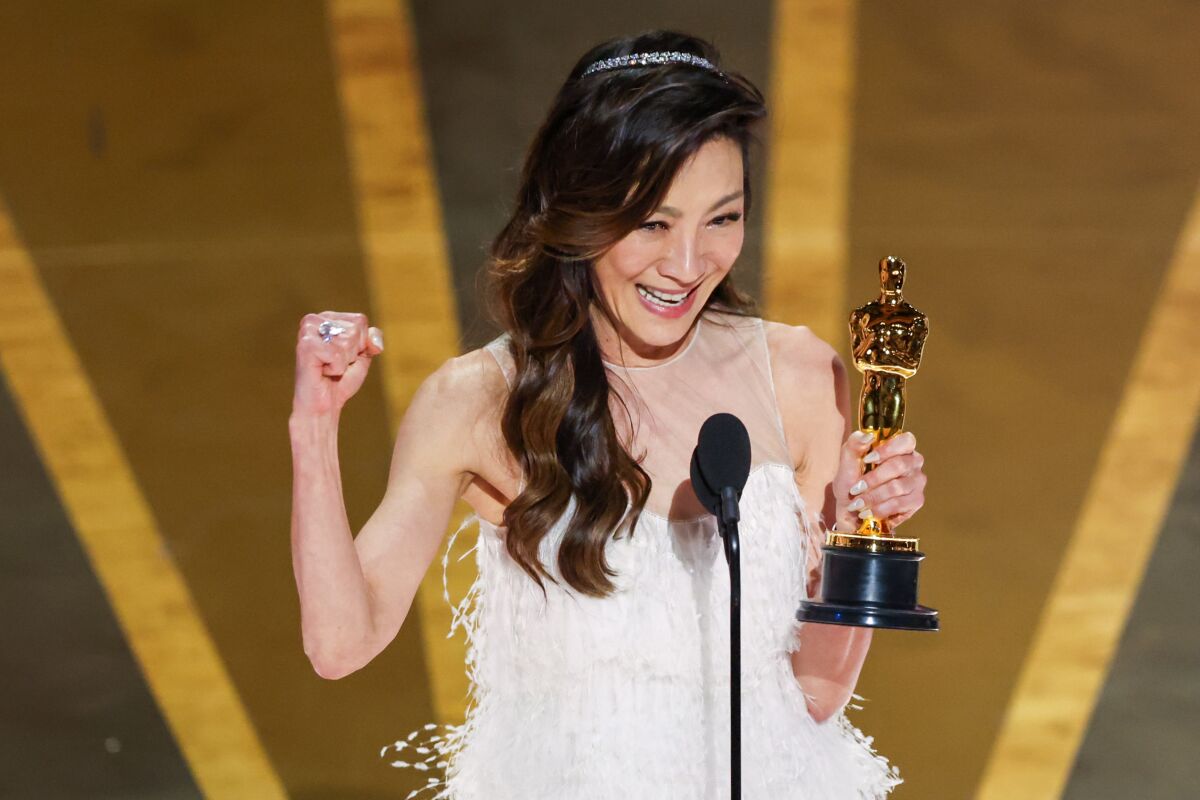
Rounding out the acting categories, Brendan Fraser gave a moving, emotional speech about his career and how thankful he was for its resurgence. Fraser's acting chops were probably somewhat overlooked in his earlier, bohunk days, but he's always been solid, and particularly memorable in Gods and Monsters, the fun and eminently watchable The Mummy and a great episode arc on the TV show Scrubs. I was happy to see him win. As a long-time fan of Michelle Yeoh, I was likewise glad to see her win and hear her speech, thanking parents, speaking to "all the little boys and girls who look like me," and saying, "Ladies, don't let anyone tell you you are ever past your prime."

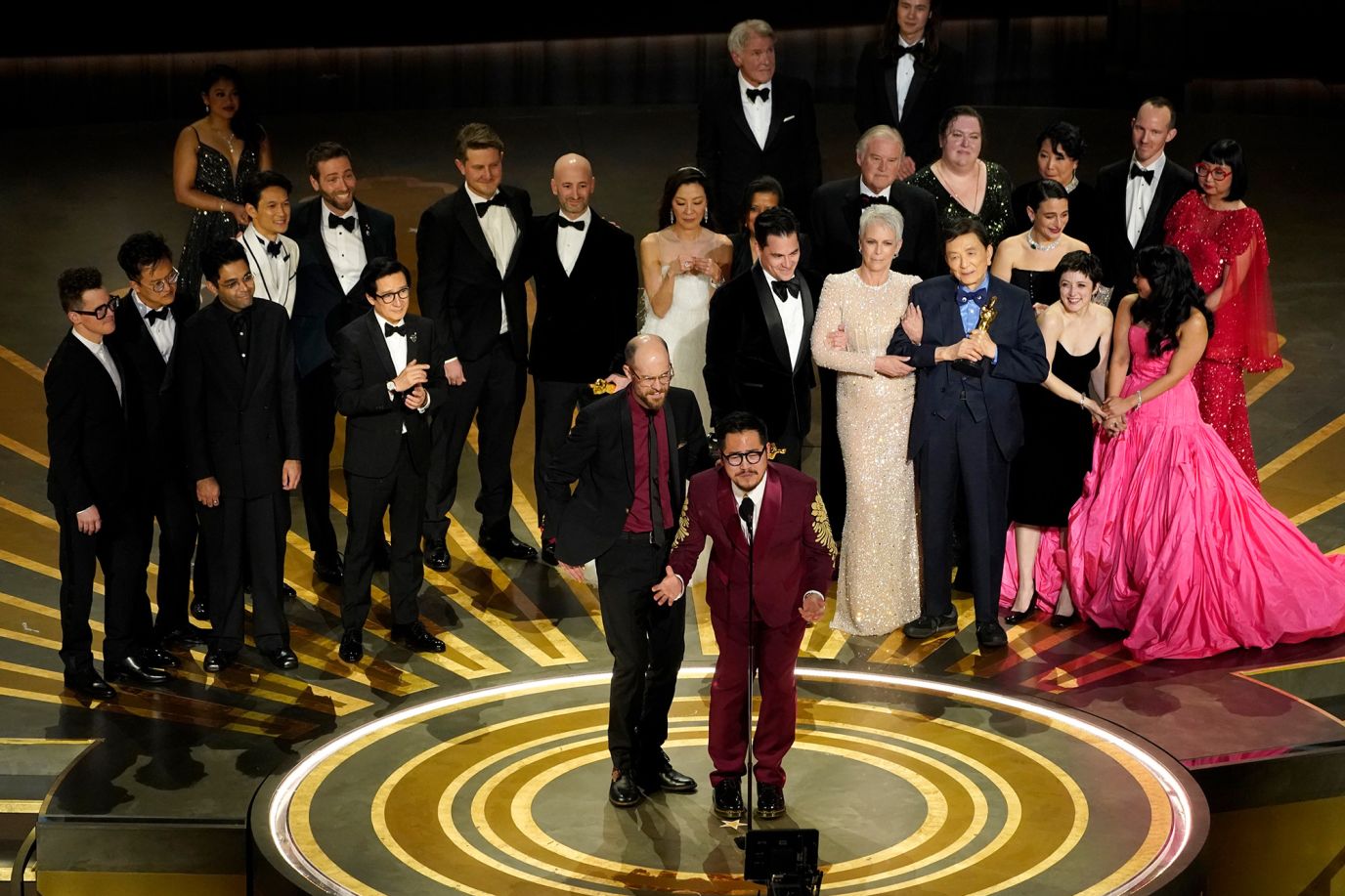
Daniel Kwan and Daniel Scheinert ("the Daniels") took the stage three times, first for Best Original Screenplay , giving a warm shout-out to teachers. The second time was for Directing, and the speeches thanked parents, film crews, and expressed support for LGBT kids and immigrants. The third time was with the rest of the cast and crew for Everything Everywhere All at Once winning Best Picture. I need to see the film again, but I liked it overall. I thought it went on a bit long and became somewhat repetitive, but I appreciated its originality, energy, and willingness to be silly, bizarre and sometimes flat-out bonkers. It was also enjoyable to see 94-year-old cast member James Hong making the awards circuit, getting a Hollywood star, and talking about how much things have changed for the better for Asian actors in Hollywood.

Sarah Polley gave an eloquent speech accepting the Oscar for Best Adapted Screenplay. Besides thanking her cast, crew, and loved ones, she said, "Miriam Toews wrote an essential novel about a radical act of democracy in which people who don’t agree on every single issue manage to sit together in a room and carve out a way forward together free of violence. They do so not just by talking but also by listening." I've liked Polley since her days as a child actress in the The Adventures of Baron Munchausen, liked her performances as a young adult in Go and The Sweet Hereafter (also her singing in that one), and I've been glad to see her become successful as a writer and director.

The Oscars' montage game is typically strong, and this year featured a nice one celebrating Warner Brothers 100th anniversary. Disney was celebrating 100 years, too, but unfortunately chose to use its time to hawk its live-action remake of The Little Mermaid instead.

Musically, David Byrne and Lady Gaga both started surprisingly off during their best nominated song performances, with Byrne being off-key and Gaga sounding pretty rough, although both seemed to recover. I thought the best nominated song was "Lift Me Up" from Black Panther: Wakanda Forever, cowritten and performed by Rihanna, and Danai Gurai gave the song a nice introduction honoring Chadwick Boseman, gone too soon. Still, it was neat to see a Bollywood nominee win, "Naatu Naatu," and its team gave a rousing performance during the Oscars. Meanwhile, Lenny Kravitz did a lovely job performing "Calling All Angels" during the Montage of Death.

All in all, it was one of the more enjoyable Oscar ceremonies of recent years. I like seeing good work recognized and people whose work I like getting awards. This year, I was particularly pleased to see that one of the honorary Oscars went to Australian director Peter Weir. It's well worth checking out Jeff Bridges' introduction and Peter Weir's speech, because they can speak for 10 to 15 minutes and tell some great stories. You could also check out some of Weir's superb movies, including Galipoli, Witness, The Year of Living Dangerously, Dead Poets Society, Fearless, and Master and Commander: The Far Side of the World.

No epic film roundup this year, but I might post some film reviews later and link them here. It can be harder to see more independent fare on streaming services, and I still order discs, but the 2022 films I saw were Everything Everywhere All at Once, The Fabelmans, Women Talking, All Quiet on the Western Front, Death on the Nile, Glass Onion, Black Panther: Wakanda Forever, Doctor Strange in the Multiverse of Madness, Thor: Love and Thunder, Prey, and Weird: The Al Yankovic Story. I'll be seeing Living later this year and probably Triangle of Sadness. Feel free to pass on any film recommendations.

Saturday, April 02, 2022

2021 Film Roundup: The Oscars and the Year in Review

I was able to see a handful of the nominees this year, but still not that many. Going to the movies is safer than it was before a COVID-19 vaccine was available, but it's still a bit daunting. Many of the nominees are not on disc yet and some of them are only available on a single streaming service. I did see Dune on the big screen, and it definitely benefits from it. I also managed to see Belfast, The Power of the Dog, Don't Look Up and No Time to Die. I expect to see Licorice Pizza, Encanto, West Side Story, Spider-Man: No Way Home and Shang-Chi and The Legend of the Ten Rings later this year. I also hope to see Coda, The Tragedy of Macbeth, Drive My Car, The Worst Person in the World, Parallel Mothers, The Lost Daughter, Being the Ricardos, Summer of Soul, Flee, tick, tick..BOOM! and Raya and the Last Dragon, among others.

The Oscars this year had two big scandals. The first was the decision not to include several "craft" awards during the live broadcast, and instead record them earlier and edit the footage into the live show. The decision was widely criticized by industry professionals, and led to some Academy members resigning. The slighted awards were the three short film categories, film editing, music (original score), sound, production design, and makeup and hairstyling, as well as all the honorary Oscars. The segments were at least edited in fairly well, but excluding the categories from the live event was a horrible choice. It showed a lack of respect for the art and craft of filmmaking. And the Academy once again chose to fruitlessly chase a larger audience while alienating the core audience of film lovers. The show could have been made shorter by not adding an un-nominated Encanto musical number, for example, but it's a Disney film and Disney owns ABC. The ratings did jump up significantly from the previous year, but given the pandemic, that's hardly surprising; ratings were still the second-worst ever.

The second scandal, which obviously got much more attention, was Will Smith storming the stage and smacking comedian Chris Rock over a joke: "Jada, love ya – G.I. Jane 2, can't wait to see it." The joke fell flat in the room and it took me a minute to figure out what the intended gag was – a reference to Jada's bald head. (G.I. Jane came out way back in 1997, and pop-culture-wise, it's mostly known for Demi Moore shaving her head.) Like the audience in the theater, when Will Smith went on stage, I thought it was a planned bit, until the audio cut out and the camera showed Smith angrily yelling without sound. (You can see the footage here.) I've seen umpteen takes on this, and at least one sympathetically condemns Smith's actions while contextualizing it within his tough, even abusive upbringing, and theorizing that Smith still needs to come to terms with it. I thought Smith's actions set a horrible precedent – assaulting a comedian because you don't like a joke, or any performer because you don't like their act. I also thought it completely undercut what should have been Smith's biggest night, because he was the favorite to win Best Actor, and did indeed win it. I understand the audience being shocked and not sure what to do, but I thought it was gutless to give Smith a standing ovation after what he did. There's some disagreement over whether Smith was asked to leave and whether he refused, or if he was told to stay. Although Smith's PR team put out a well-written, contrite statement the next day, Smith himself was partying that night as if nothing had happened. He's since resigned his Academy membership and been banned from attending the Oscars for 10 years.

I can't say I'm a big Will Smith fan but don't dislike him, either – I think he's become a pretty good actor and was quite good in The Pursuit of Happyness. And his reputation had been getting steadily better over the years. I understand getting upset over a personal joke against one's self or a family member, but it's par for the course for these events, public figures should be used to it, the joke was pretty tame, and it fell flat with the audience. No one was really laughing at Jada Pinkett Smith, and most viewers probably thought, like me, that she had shaved her head and didn't know she had alopecia. The Oscar after-parties can get pretty wild, but many attendees also show up drunk or high before the ceremony, and I have to wonder if that contributed to Will Smith's astonishingly poor judgment and lack of restraint and maturity. The way to deal with a joke you don't like is to talk to the comedian afterward, or make a joke back, or to call it out in the press as a cheap shot, not assault and battery on live television… especially when you're a featured guest favored to get a big award. My sympathies are strongly with the performers for all such incidents.

Although Will Smith's actions overshadowed most of the night, it's worth checking out some of the award speeches if you missed them, particularly Ariana DeBose for Best Supporting Actress, who gave a shout-out to queer youth and the power of the arts, and Troy Kotsur for Best Supporting Actor, who hailed the deaf community. I was also personally happy to see the multitalented Kenneth Branagh finally win an Oscar, in this case for Best Original Screenplay. As for the rest of the ceremony, I thought the triple hosts of Regina Hall, Amy Schumer and Wanda Sykes were pretty good. The song-and-dance number during the Montage of Death was rousing and fine on its own merits, but a pretty bad choice in context, because it completely distracted from the images of the deceased.

In any case, I'm going to try to see all the films mentioned earlier, and I hope 2022 turns out to be a good year for film.

Wednesday, April 28, 2021

2020 Film Roundup: The Oscars

This is the first year since I started watching the Oscars that I hadn't seen any of the nominees. (I probably started watching at five years old, not that I was allowed to stay up for the whole event.) Normally this post is also "The Year in Review," linking my reviews of all the films I've seen for the year in question. Because of the pandemic, I didn't see many films in theaters before everything closed in March 2020, and I didn't spring for specific streaming services or pay-per-view screenings. I did watch a ton of movies and TV shows on disc.

I thought some of the speeches were nice, although this year none of the winners were played off and some tended to go on too long. The most charming speech for me was from 73-year-old, South Korean Yuh-Jung Youn, who won Best Supporting Actress for her performance in Minari. (This article gives some good background on her, but does give away a key plot point of the movie.)

Harrison Ford had a funny bit presenting the Oscar for Best Editing, reading negative feedback from screenings of Blade Runner. (He almost certainly skipped rehearsal, though, because he read from a crinkly paper and all that text could have been fed into the teleprompter instead.)

The montage of death (in memoriam segment) is normally very well done, and a moving highlight of the ceremony. This year, it was the most rushed I can remember – each person was shown for only one single second (I counted) until the montage finally slowed down a bit at the end. Perhaps, due to the pandemic, more people died and have to be included in this installment. Or because the audience was smaller than usual, the usual applause wasn't going to be audible, so the show producers opted for this approach. But I thought it was a shame.

I was particularly appalled that Best Actress and Best Actor were the last categories presented, after Best Picture. (I would also keep Best Directing as the penultimate award presented.) The leading theory is that the show producers thought that popular actor Chadwick Boseman, who died tragically last year, was going to win Best Actor and that would end the night on a high note. If so, that choice was full of hubris and stupidity; there's no sure thing, as Oscars nights of recent years have repeatedly shown. (Winner Anthony Hopkins didn't attend, making the night even more anticlimactic, but recorded a gracious thank you from Wales, including a nice mention of Boseman.)

Regardless of whether Boseman played a role in the producers changing the order of the categories, it remained a really dumb decision. Why highlight individual performances over the best films of the year? It reminded me of the 2012 Screen Actors Guild Awards, which ran some self-congratulatory ads that boasted it was "The only award show where every award goes to an actor." Because who cares about the other, little people who make movies? Some actors are lovely people in real life, but as a group… they do deserve their reputation as the vainest, most self-absorbed people in the film business (even if some directors and producers come close). For the love of cinema, it's a horrible idea to encourage the mentality that actors are more important than the movie itself. Filmmaking is about more than who's on camera, and although a great performance can make a film and should be celebrated, that's rarely been a problem; actors already get more recognition than everyone else involved. The best films are team efforts. In this specific case, switching the order also stole attention from a pretty remarkable story: Nomadland won Best Picture, and its director, Chloé Zhao, became only the second woman to win an Oscar for Best Directing and the first woman of color. She was born in Beijing but was mostly educated in the U.S. and lives here now, and coverage of her and Nomadland has been partially censored by the Chinese government. That's quite interesting stuff. So it's possible that Steven Soderbergh and the other Oscar producers were trying to manufacture a big moment and undercut some good, organic ones instead. I had mixed feelings about the two sound awards being combined into one. On the one hand, sound editing and sound mixing are different jobs. On the other hand, Oscar voters repeatedly did not understand the difference between the categories and even entertainment reporters would explain them incorrectly. (Most simply, the editing is the sound effects, including ambience and Foley work, and the mixing creates the overall soundscape of elements, balancing dialogue, effects, and music.) I would also say the voters botched their choices repeatedly – the nominees, which are determined by a smaller group of sound people, have been consistently good, but the majority of Oscar voters are actors and would often give best mixing to the best editing job and vice versa, or give both awards to the same film, normally the one with the most conspicuous music or loudest noises, not necessarily the best job.

The problem is that most good sound jobs are unobtrusive and not meant to be noticed; nonprofessionals will notice the grandeur of the score and spectacular sound effects for a film like Star Wars, but typically not pick up on more subtle work. It's pretty rare that a film ever won a sound Oscar for a bad sound job – as my sound mentor explained, Jaws (1975) won despite not having great dialogue work, but the award at the time was "Best Sound" and was understood to be for best use of sound, and Jaws was highly memorable on that count. Likewise, for films in 2018, I wrote that "Bohemian Rhapsody [which won both awards] featured some great sound work (I've included links with my review), but I would have given Best Sound Editing to First Man for the tension-ratcheting sounds of its space program and Best Sound Mixing to Roma for its lovely (and occasionally disturbing) soundscapes." I think First Man and Roma did their jobs so well nonprofessionals didn't notice the quality of the work, but Bohemian Rhapsody was a worthy winner in both categories nonetheless.

In any case, the new category seems to have expanded the nominee limit; it seems to be five now, versus three before, so the key members of the sound team can share the win, as they did this year for Sound of Metal. This Hollywood Reporter article summarizes the sound community's reaction well, and I agree the category might be better named as Best Sound Design.

I thought all five Best Original Song nominees were pretty good, which is often not the case. The winner, "Fight for You" by H.E.R., Dernst Emile II and Tiara Thomas, was a solid pick. Leslie Odom Jr. did a lovely job singing on "Speak Now," which he cowrote; "Hear My Voice" has a neat vibe; "Io sì (Seen)" is a fairly typical Diane Warren ballad, albeit in Italian (and with too much reverb for my tastes), but it's nice enough; and Molly Sandén shows off some amazing pipes on "Husavik (My Home Town)."

Anyway, if nothing else the Oscars nominations and winners make a nice list of viewing recommendations. I'm planning to see Nomadland, Judas and the Black Messiah, Sound of Metal, Minari, Promising Young Woman, One Night in Miami, Ma Rainey's Black Bottom, The Trial of the Chicago 7, The Father, Onward, Soul, Wolfwalkers, The United States vs. Billie Holiday, the Borat sequel, and Mank.

Wednesday, March 31, 2021

Kurosawa's Birthday 2021

(On the set of Red Beard. From right to left, Akira Kurosawa, Toshiro Mifune, Reiko Dan, and Yoshio Tsuchiya.)

Akira Kurosawa's birthday was March 23rd. It would have been his eleventy-first, as Bilbo Baggins would put it. For the occasion, I decided to watch two Kurosawa films I hadn't seen yet over two nights, Drunken Angel (1948) and Red Beard (1965). They make an interesting pair because both have doctors as main characters, and they're Toshiro Mifune's first and last films with Kurosawa; they made 16 together.

The title character in Drunken Angel is played by Takashi Shimura, another Kurosawa regular, as a crotchety but civic-minded, unshaven, alcoholic doctor named Sanada working in a slum near swampy water. He yells at the neighborhood kids not to play near the water or they'll get typhus; they yell back at him but momentarily comply. He still follows up with one of them about a medical condition he treated and is gruff but dedicated to his other patients. His assistant, Miyo (Chieko Nakakita), tries to keep him out of trouble and he's likewise protective of her – she used to be the girlfriend of a possessive gangster, Okada (Reizaburô Yamamoto), and wants to stay clear of him. One night, the gangster Matsunaga (Toshiro Mifune) seeks medical treatment from Sanada. He claims he injured his hand in an accident, but Sanada fishes out a bullet. He also discovers Matsunaga has tuberculosis and urges him to get an X-ray of his lungs to confirm its severity. Matsunaga is dismissive and violent, but does eventually comply and return to Sanada for treatment. The two often fight, and although Matsunaga tries to follow Sanada's medical advice to help his lungs heal (no booze or sex, among other things), he's pulled astray by his sometime girlfriend and performer at the dance hall, Nanae (Michiyo Kogure). He also feels pressure to live it up in front of Okada, his old mentor, who's been released from prison and is eager to get his old turf back, as well as Miyo (not that he's sticking to one woman). Matsunaga likes to boast about how he's Yakuza and they have a code of honor, but as his health worsens, he discovers limits to the loyalty of his fellow gangsters.

(Takashi Shimura and Toshiro Mifune.)

Shimura is good as always. In his book Something Like an Autobiography, Kurosawa explains how he and cowriter Keinosuke Uekusa originally tried to write the story as a contrast between the doctor, a model citizen, and the gangster, who was anything but. But essentially the doctor character was too boring and they couldn't get the story to work. When they rewrote him as flawed, based on a real, grizzled, imperious and boozing doctor they met, everything flowed. That approach certainly gives Shimura more to play with – Sanada is a bit of a mess, and often intemperate, but devoted to the well-being of his patients nonetheless. It's particularly interesting to see Mifune, who was 28 when the film came out. As Matsunaga, he's mostly clean-shaven, sometimes dapper, sometimes bedraggled and ill, and looks significantly different from his appearances in other roles for Kurosawa, even though Rashomon came out just two years later. Regardless, Mifune's energy and charisma shine through. This was only his third film; in his first, Snow Trail (1947), he and Shimura play bank robbers on the run in snowy mountains. (Kurosawa did not direct it, but wrote the screenplay.) Shimura and Mifune became friends on that film, with Shimura, who was 15 years older, supposedly becoming something of a mentor to Mifune. The two definitely have good screen chemistry.

I wouldn't rank Drunken Angel with Kurosawa's best, but it's a solid film and well worth a look if you're a fan of Kurosawa, Mifune or Shimura. Miyo oddly disappears near the end of the film, although two other minor but significant female characters feature in the ending. As usual, Kurosawa's social commentary flows from his humanism and interest in the characters themselves and their situation. It's less visually flashy than some of his films, with a notable exception – the climatic confrontation centering on Matsunaga (Mifune) is a gripping, vertiginous, bravura piece of camerawork and filmmaking. In his book Something Like an Autobiography, Kurosawa explains that Drunken Angel came about because Toho Studios had built a large street set for a film by Kurosawa's mentor, Yamamoto Kajiro, and wanted to get more use of it. (Kurosawa worked on over a dozen films for Yamamoto, mostly as an assistant director.) Given that genesis, it's a fairly interesting project.

A few pages later in Something Like an Autobiography, Kurosawa describes seeing Toshiro Mifune for the first time:

On the day of the interviews and screen tests I was in the middle of the shooting of No Regrets for Our Youth, so I couldn't participate in the judging. But during lunch break I stepped off the set and was immediately accosted by actress Takamine Hideko, who had been the star of Yamamoto Kajiro's Horses when I was chief assistant director. "There's one who's really fantastic. But he's something of a redneck, so he just barely passed. Won't you come have a look?" I bolted my lunch and went to the studio where the tests were being given. I opened the door and stopped dead in amazement.

A young man was reeling around the room in a violent frenzy. It was as frightening as watching a wounded or trapped savage beast trying to break loose. I stood transfixed. But it turned out that this young man was not really in a rage, but had drawn "anger" as the emotion he had to express for his screen test. He was acting. When he finished his performance, he regained his chair with an exhausted demeanor, flopped down and began to glare menacingly at the judges. Now, I knew very well that this kind of behavior was a cover for shyness, but the jury seemed to be interpreting it as disrespect.

I found this young man strangely attractive, and concern over the judges' decision began to distract me from my work. I returned to my set and wrapped up the shooting early. Then I proceeded to look in on the room where the jury was deliberating. Despite Yama-san's strong recommendation of the young man, the voting was against him. Suddenly I heard myself shouting, "Please wait a minute."

p. 160


Kurosawa and Yamamoto carry the day and Mifune joins the film company. Kurosawa continues:

After joining the company, Mifune appeared in Sen-chan's To the End of the Silver Mountains [also known as Snow Trail] as the roughest and most violent of the three bank robbers who were the villains of the story. He playing with amazing energy. Right after that he had the role of a gangster boss in Yama-san's New Age of Fools [also known as These Foolish Times and These Foolish Times II], and here he played with an opposite kind of cruel refinement. I became deeply fascinated by the acting abilities Mifune showed in these two films, and decided I wanted him to play the lead in Drunken Angel. I realize that many people think I discovered Mifune and taught him how to act. That is not the case. As can be seen from the sequence of events I just described, it was Yama-san who discovered the raw material that was Mifune Toshiro. From that raw material it was Sen-chan and Yama-san who fashioned the actor Mifune Toshiro. All I did was see what they had done, take Mifune's acting talent and show it off to its fullest in Drunken Angel.

Mifune had a kind of talent I had never encountered before in the Japanese film world. It was, above all, the spped with which he expressed himself that was astounding. The ordinary Japanese actor might need ten feet of film to get across an impression. Mifune needed only three feet. The speed of his movements was such that he said in a single action what took ordinary actors three separate movements to express. He put forth everything directly and boldly, and his sense of timing was the keenest I had ever seen in a Japanese actor. And yet for all his quickness, he also had surprisingly fine sensibilities.

I know it sounds as if I am overpraising Mifune, but everything I am saying is true. If pressed to find a defect in him as an actor, I could say his voice is a little rough, and when it's recorded through a microphone it has a tendency to become difficult to understand. Anyway, I'm a person who is rarely impressed by actors, but in the case of Mifune, I was completely overwhelmed.

p. 161


(In 35 mm film, 10 feet is a little under 7 seconds and 3 feet is 2 seconds.)

The one other problem with Mifune, according to Kurosawa, is that he was so strong a presence he could overpower his partners and unbalance a film. Kurosawa explains, "The drunken-doctor performance Shimura gave was a superb 90 percent, but because his adversary, Mifune, turned in 120 percent, I had to feel a little sorry for him." Shimura is just fine, but Mifune has the flashier role and supposedly Drunken Angel made him a star. IMDb lists 185 acting credits for him.

Meanwhile, Red Beard (1965) is a superb film, even a masterpiece. As with Drunken Angel, the title character is a doctor who serves the poor, but this time, it's Mifune who plays the doctor. He was 45 at the time the film came out but is made to look older, helped by some makeup but also a full, bushy beard. It's the 19th century, and a young doctor, Noboru Yasumoto (Yûzô Kayama), has studied with Dutch doctors in Japan. Through family connections, he believes he can become the personal doctor to the Shogun, really the flashiest medical position possible. Instead, he's assigned to a public clinic in the countryside serving poor patients. The head of the clinic is Kyojō Niide (Mifune), also known as "Red Beard." Yasumoto chafes at his position, refuses to wear the clinic robes and generally acts immaturely, but his experiences gradually and profoundly change him. He witnesses death up close. He assists with a bloody operation and faints. He confronts the limitations of his schooling and his many erroneous assumptions. He comes to care for the patients in a human and not just medical sense, most of all an abused young girl, Otoyo (Terumi Niki), an almost feral orphan adopted and mistreated by a brothel madam; Niide rescues Otoyo and puts her in Yasumoto's care (and vice versa, as you'll see). Red Beard is just over three hours, and in that time it convincingly shows us Yasumoto's growth, but also provides a number of engrossing side stories and vignettes. Some characters appear for only a scene or two, yet still are affecting and memorable. At the center of it all Niide/Red Beard, and Mifune radiates gravitas and wisdom throughout, another strong mentor character in a Kurosawa film.

(Dr. Noboru Yasumoto brooding, played by Yûzô Kayama.)

Visually, Red Beard isn't as kinetic with its camerawork as, say, Seven Samurai or Yojimbo. Kurosawa opts more for masterful compositions – you'll frequently see someone reclining on the floor, sometimes with another character standing, the vertical contrasting the horizontal. (If you want to see cool diagonal compositions, check out Kurosawa's version of The Lower Depths.) Kurosawa does employ some artful dolly work, not as intricate as in his film High and Low, but some really nice staging for the camera as we tour the clinic or Niide and Yasumoto walk and talk, crossing paths, turning, continuing, and forming new compositions. Most of this is subtly done, not drawing attention to itself. Surprisingly, Red Beard does have two fights, both with a funny side. Both had me howling with amazed enjoyment – the first has some intricate, lightning-fast stunt work and is beautifully staged, and the second is more about solidarity. (I don't want to spoil anything.) There's also a haunting, stunning scene where the calls of women echo as the camera plunges into a well. And of course Kurosawa includes shots of rain. He mostly opts for a restrained, stately style in Red Beard, but picks good moments for bravura flashes. It's an approach that serves him well for most of his later films, including Dersu Uzala, Kagemusha, Ran and Dreams.

Kurosawa films tend to center on male characters, and although Red Beard has two male leads, it notably presents a number of female characters, some of whom only appear briefly but nonetheless leave a powerful impression. Okuni (Akemi Negishi) is the daughter of a patient who only really appears in one scene, but delivers a heart-wrenching story to Niide. Niide's compassionate response opens Yasumoto's eyes, and it's a fine, moving performance by Negishi. Kyôko Kagawa plays a character known as "The Mantis"; she's confined to a small house because she's supposedly dangerous, and tells an arresting tale of being abused by a series of men that pulls on our sympathies, although she proves to be a complex figure. We see Onaka (Miyuki Kuwano) in the flashback tale of a dying patient, who explains their complicated love story. Osugi (Reiko Dan) is a kind-hearted servant at the clinic who nurses a secret love for Doctor Handayû Mori (Yoshio Tsuchiya) – but not secret enough, because her female colleagues are fond of teasing her about it. The key female character, though, is the orphan Otoyo, and young actress Terumi Niki is captivating as she portrays Otoyo's transformation from a traumatized child who won't speak and lashes out into a conscientious, kind soul. Her scenes with Choji (Yoshitaka Zushi), a street urchin boy, are particularly memorable, and Kurosawa coaxes fine performances from his child actors as well as the rest of the cast. Although Kurosawa adapted Red Beard from a collection of short stories by Shūgorō Yamamoto, Kurosawa claimed his film was significantly different. The Otoyo storyline, for example, was inspired by a novel by one of Kurosawa's favorite authors, Dostoevsky, Humiliated and Insulted. Regardless, the final mix is highly effective.

(Terumi Niki at Otoyo and Yoshitaka Zushi as Chôji.)

Unfortunately, Red Beard caused Mifune and Kurosawa to have a serious falling out; reportedly, they eventually reconciled decades later. As film historian Donald Richie explains in a piece on Red Beard, it took nearly two years to film, in part because Kurosawa got sick twice and Mifune and Kayama both got sick once. I've read that Mifune became frustrated because the full, natural beard he grew meant he couldn't act in other films during the period. It's a shame, though, because the Kurosawa-Mifune collaboration is one of the great ones in the history of cinema and yielded much of the best work either would do. And whatever pains it took to make, Red Beard is an excellent film, a fine accomplishment for Kurosawa, Mifune and everyone else involved. (It's also nice to see Takashi Shimura in a small role, essentially a cameo.)

While watching Red Beard, I enjoyed it so much I occasionally felt regret I hadn't seen it yet and wondered why, although I had heard of it of course, I hadn't seen it get the acclaim of other Kurosawa films. But not seeing it before wasn't entirely accidental. I had held off on watching Red Beard because I was waiting for Criterion to put out a Blu-ray and also because I sometimes put aside well-regarded movies I haven't seen yet for special occasions. There's also a special thrill in having artists you like and seeing something else from them for the first time, and a slight pang of loss at the prospect of such experiences ending. I received DVDs of High and Low and The Bad Sleep Well as birthday presents in separate years, and held off on watching them for a while because I wanted to savor the experience and my list of "Kurosawa films I haven't seen yet" was dwindling. Delaying is somewhat silly in that I enjoy rewatching movies, and good movies yield more with repeated viewings. But not knowing the outcome of scenes or the whole movie does change the viewing dynamics, and I do think there's much to be said for planning to give certain movies special and more focused attention.

Although I love many directors and actors, Kurosawa and Mifune are among my all-time favorites and hold a special place for me. I think I was nine years old when my dad took me and my siblings to see Yojimbo and Sanjuro in a double feature at the much-missed Biograph Theater in Washington, D.C. Over the next few years, I saw Yojimbo again, as well as Throne of Blood, The Hidden Fortress and Seven Samurai for the first times. I saw Ran when it was released in theaters in 1985; it definitely benefits from repeated viewings. One of the virtues of our current age is it's easier to find older movies on disc or streaming services, including foreign films.

In any case, I can recommend both Drunken Angel and Red Beard. At 185 minutes, Red Beard is more of a time commitment and yields more subtle rewards than some of Kurosawa's other films (think Ikiru more than Seven Samurai or Yojimbo), but it's a fine piece of work.

(My most extensive post on Kurosawa is this one from 2008.)

References
(other than the linked ones)

Kurosawa, Akira. Something Like an Autobiography. Vintage Books, New York, 1982.

(A still from Red Beard's haunting well shot.)

Tuesday, July 07, 2020

Ennio Morricone (1929–2020)

The great film composer Maestro Ennio Morricone has died. He was prolific, with 520 composing credits on IMDb. Here are obituaries from The Washington Post, The New York Times, the Associated Press, the Hollywood Reporter and The Guardian.

My favorite film score (after Alexander Nevsky) is Morricone's score for Sergio Leone's film, Once Upon a Time in the West. It's probably my favorite western and I've listened to the score countless times. Similar to Sergei Prokofiev and Sergei Eisenstein's great collaboration on Nevsky, Morricone's music matches Leone's images so well that hearing it instantly conjures scenes from the five westerns and six films total they collaborated on, and it's all but impossible to imagine Leone's movies without Morricone's music. Morricone had range, too. He wrote some stunningly lovely pieces, but could also deliver menace, express grief or create creeping unease. His iconic main theme for The Good, the Bad and the Ugly let us know we were in for a fun ride. I used to look through used and bargain film score CDs and I'd buy anything by Morricone, even if I didn't like the movie, or hadn't seen it, or hadn't even heard of it. (That's how I discovered State of Grace below, which I eventually saw.) Ennio Morricone's music elevated the material and was transformative.

Nothing speaks better for Morricone than his own music. Here's the main theme from Once Upon a Time in the West, which is mostly closely related to the character Jill (Claudia Cardinale), who gets a more subdued version in "Jill's America":


The other major theme is "The Man with a Harmonica," which appears in several versions. It's haunting, unsettling and used to great effect in the climactic scene:


"As a Judgment" is a subtly menacing piece. I had a friend who particularly liked the build from 1:26 to 1:47, which hangs unresolved in delicious tension until the horns come in, methodical and somber:


All the five main characters have a theme of sorts, with "The Man with a Harmonica" really a blend of riffs for Harmonica and Frank, which is appropriate if you've seen the movie. "Farewell To Cheyenne" is the more casual, slightly comical-but-not-really theme for Jason Robards' character. It's used to more ominous effect in a track called "First Tavern" for Cheyenne's entrance.


(I do have a "remastered" CD of the score where some idiotic mixer added a fade through the ending of this track starting before the false stop, which just stuns me. It's the equivalent of fading out before a key dialogue exchange, obscuring a critical moment. How could anyone be so comatose as to miss what the cue sounds like in the movie and why the music pauses? How could anyone think, "Morricone clearly made a mistake here – I know better and I'll fix it"?)

Sticking with westerns, here's the iconic and rollicking main theme from The Good, the Bad and Ugly:


Here's Morricone conducting the score's other signature piece, "The Ecstasy of Gold":


If you want to see Morricone's music in context, here's the film's finale, which of course you've seen before:


I think Morricone's score for The Mission is his second best. The music for "Gabriel's Oboe" may be the prettiest thing he ever wrote and is one of the loveliest pieces I've ever heard:


Here's Morricone conducting a suite of The Mission, which is quite moving:


Morricone also wrote the music for Leone's film, Once Upon a Time in America. The prettiest piece is "Deborah's Theme":


Here's the wistful theme theme from Malena:


The State of Grace main theme is moody and unsettling:


To close things out, here's music from Cinema Paradiso:


Finally, let's hear from Yo-Ya Ma, who recorded a CD of Morricone music:


Thanks for all the lovely and evocative music, Maestro.