Occasional blogging, mostly of the long-form variety.

Wednesday, September 28, 2005

Murrow vs. McCarthy


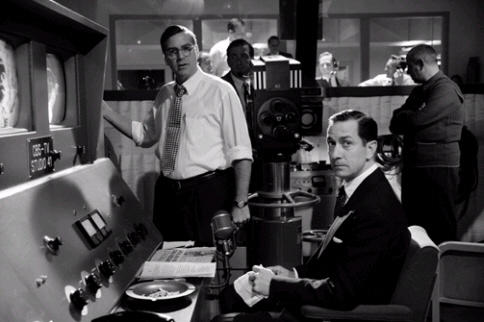
A still from Good Night, and Good Luck

It appears we’ll finally have a good film that deals with Joe McCarthy. Guilty By Suspicion, focusing more specifically on the Hollywood blacklist, was well-intentioned but uneven at best. Meanwhile, George Clooney’s Good Night, and Good Luck, while apparently not a classic for the ages, is quite a worthwhile film, reportedly with the added virtue of being accurate.

(I’ve always been somewhat ashamed that Joe McCarthy came from my birth state, Wisconsin. Other than mediocre beer, only good things should come from Wisconsin, like cheese, OshKosh jeans, and the Green Bay Packers.)

Clooney claims that every scene is verified by at least two sources, and in one of the more interesting choices, Joe McCarthy effectively plays himself — all his appearances are archival footage. Clooney takes the smaller role of Fred Friendly, while the always superb David Strathairn plays legendary broadcaster Edward R. Murrow.
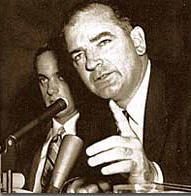

Joseph McCarthy

It’s striking but perhaps not surprising that so few kids today know of McCarthy (to the point Clooney’s been asked, who’s the actor playing McCarthy? Clooney, ever the prankster, has thought of taking out “For Your Consideration” ads for his villain). I remember when studying McCarthy I was surprised to discover he had a relatively short reign, roughly 1950 to 1954, while the Hollywood blacklist in fact far outlasted him. Also, in addition to the harm caused by rumors and slander, there was indeed a physical blacklist (in 1997, PBS’ NewsHour piece interviewed two victims of the blacklist).

Some scholars point to Spartacus as the film that definitively broke the blacklist, because one of the Hollywood Ten, the great screenwriter Dalton Trumbo, was prominently credited (amazingly, he penned two Oscar-winning screenplays under fronts during the blacklist!). Spartacus, however, didn’t come out until 1960, when McCarthy had been dead for three years. It’s hard to imagine how much people were terrified of the Dread Red Menace and terrorized by Joe McCarthy, with only a few people like Murrow and the great cartoonist Walt Kelly having the guts to take him on.

Kelly’s depiction of McCarthy as Simple J. Malarkey from Pogo

There are a number of articles on the film and Clooney. You can read The Los Angeles Times’ one here, The New York Times one here, Salon’s here (if you can stand navigating their site), The Guardian’s here, and if a remarkably cranky one here by a reviewer who professes his hatred for such similarly crappy fare as All the President’s Men and Quiz Show (sounds like a ringing endorsement!).

Clooney apparently closes the film with these lines from a famous speech by Murrow in 1958 to his fellow broadcasters:

"To those who say people wouldn't look; they wouldn't be interested; they're too complacent, indifferent and insulated, I can only reply: there is, in one reporter's opinion, considerable evidence against that contention. But even if they are right, what have they got to lose?

"Because if they are right, and this instrument is good for nothing but to entertain, amuse and insulate, then the tube is flickering now and we will soon see that the whole struggle is lost.

"This instrument can teach, it can illuminate; yes, and it can even inspire. But it can do so only to the extent that humans are determined to use it to those ends. Otherwise, it is merely wires and lights in a box."

Dylan Update


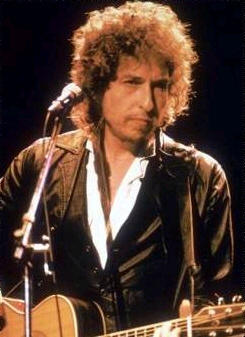
Arlo Guthrie once mused that there’s no way Bob Dylan could have written that many good songs in such a short time... he must have just taken a pen and transcribed them as they floated by in front of him.

Not surprisingly, with the release of No Direction Home, there’s a rush of new Dylan articles. The Washington Post’s Jefferson Morley has a new World News Roundup blog and for 9/26/05 supplied links to three British papers:
The Guardian has an editorial about how the once-skeptical culture has come to embrace the unpredictable singer-songwriter. The Times has a perceptive piece on his melding of high and low culture. The Independent has the best package of articles, "Dylan: A Special Celebration," including an excerpt from his nomination for a Nobel prize: "In words and music Dr Dylan has created an almost unlimited universe of art which has permeated the globe and, in fact, changed the history of the world."

The Guardian now has a number of other links, including past articles on Dylan.

Meanwhile, Slate’s David Greenberg has a good article pondering why nearly everyone seems to focus on Dylan’s early career and completely overlooks such masterworks as Blood On the Tracks and Time Out of Mind (I would add World Gone Wrong, although it is an album of covers by Dylan, but stunning none the less, especially his version of “Delia”). The short answer: boomer nostalgia. Dylan for me is one of those musicians like Willie Nelson or Neil Young who’s never content to rest on his laurels. While I might not like all of their material, new or old, it’s impossible not to respect them, as well as their right to keep exploring musically.

Finally, I stand corrected... While Slate’s content can be good, it is also prone to the cranky, curmudgeonly, contrarian and contrarian-wannabe statements that can easily get out of hand on many a website or blog (this one included). I tend to get turned off by sweeping regal pronouncements such as the astoundingly stupid one that men should not wear shorts (it’s the tone more than the content). In the article I linked below, Slate’s David Yaffe complained about Liam Clancy, observing that “We sit in Manhattan's White Horse Tavern with Liam Clancy, an insufferably melodramatic Irish folkie perched in front of a pint of ale that does not seem like his first of the night.” Having fond memories of seeing Liam Clancy and Tommy Makem perform, I took issue with this. While the Clancys and Makem can be caricatured, they remain very good folk musicians with a lasting positive influence. However, I must concede that in the Dylan doc, Liam Clancy really does come off at times as a drunken blowhard versus the charming wry folk poet I’m more accustomed to.

(As part of my penance, I am hunting down a copy of the stupidest, most obtuse article on Dylan I have ever read, in this case from the usually superb Atlantic in the late 90s. The boomer author pronounces Dylan’s career a failure that ended all promise in 1967, which must surely come as a surprise to Dylan... not to mention every fan and every professional musician who’s bothered to listen to him in the 38 years since then! Wait, I'm getting cranky here...)

In the meantime, I’m breaking out Time Out of Mind again.

Tuesday, September 27, 2005

Banned Books Week


I was just reminded that it’s Banned Books Week, a great tradition from the American Library Association to celebrate the many great works that have been attacked over the years. Much more information is available at their site here.

During my last year teaching high school, I was pleased to notice that without any conscious design, every single grade level was reading at least one banned book (proof we were doing at least something right).

Incidentally, my favorite challenge remains the one to Dr. Seuss’ The Lorax on the grounds that it was essentially pro-environmental propaganda. I tell you, can’t we have a children’s book advocating clear-cutting old growth forests and killing off endangered species for equal time? It’s those damn hippies that are ruining this country!

Monday, September 26, 2005

New Dylan Doc By Scorsese


No Direction Home will air on most PBS stations in two parts on Monday, September 26th and Tuesday the 27th. Although most reviewers have noted that it whitewashes Dylan’s drug use somewhat, and apparently the DVD extras are stingy, most everyone expresses excitement and gratitude over the entire affair. Scorsese of course filmed Dylan once before as part of The Last Waltz, the seminal rock doc on The Band, who backed Dylan for many years (Robbie Robertson of The Band was also Scorsese’s roommate at one time!)

If you’re interested, The Washington Post offered some background on the doc here and a review of it here. PBS has its write-up with some nice background material here, while Slate offers it perspective here (although it wouldn’t be a typical Slate review without one asinine comment, here pertaining to legendary Irish folkie Liam Clancy).

Friday, September 23, 2005

TV: Gervais Interview


A brief interview from NPR, with a brilliantly painful clip from his new show:
'The Office' Star Ricky Gervais Back with 'Extras'
Day to Day, September 22, 2005 · Madeleine Brand talks
with actor Ricky Gervais about his new HBO comedy
Extras, in which he plays a struggling actor. Gervais
is best known as the annoying boss on the acclaimed
BBC series The Office.

Sunday, September 18, 2005

Judge Roberts' Important Views... on Film


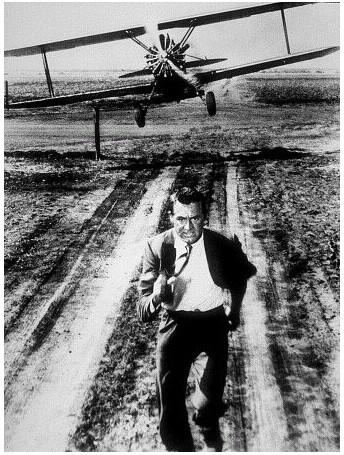
Unable to pin down John Roberts on abortion rights and other important issues, a frustrated Joe Biden chases him down in a crop duster (AP).

Forget about all the other issues, abortion, stare decisis, and whether or not a 12-year old's Constitutional rights were violated when arrested for eating a single french fry in the DC metro - it is the firm position of this blog that one's tastes in film serve as a window unto the soul.

Considering George H.W. Bush screened Chuck Norris movies at the White House, how can one not be excited that John Roberts named as his favorite films Doctor Zhivago and North By Northwest?

Hitchcock gave Cary Grant's character Roger Thornhill in North By Northwest the middle initial "O," suggesting to some a big mysterious zero. Similarly, John Roberts begins as a cipher. Perhaps, though, like Thornhill thrust into the role of heroic spy, Roberts can grow into the role of Chief Justice and make us all proud (although granted, Scalia's legs are not as beguiling as Eva Marie Saint's).

Surely a man who loves Zhivago, which shows a sensitive, intelligent man beset by an oppressive regime, could not throw away privacy rights and be a complete toadie to the state. Nor would he favor the state seizing private property without compensation. However, his views on extramartial affairs in a snowbound dacha remain a mystery.

(If Roberts has written poetry addressed to a woman named Lara, he deserves confirmation, in my opinion. I'll settle for it being to his wife. Even if it's really bad poetry. In fact, that would be more endearing.)

Still, since Roberts has refused to answer many legal questions, perhaps some much more revealing cinematic ones can be offered:

Doctor Zhivago

1) Do you see yourself more as a hard-line Stalinist or a Trotskyite?
2) What's up with all those flower shots?
3) Does the framing device, inventing a daughter and brother not appearing in Pasternak's book, manufacture a false sense of hope that betrays the depth of the source material, or does this choice respectfully underline Pasternak's intent?

North By Northwest

1) As great as the crop duster sequence is, does it make sense for the pilot to crash his plane into an oil truck? (Was this a last murder attempt, or was he just a former Delta pilot?)
2) Do you find it plausible that anyone would grab a dagger out of a man's back, then stand there looking at it versus calling for help?
3) When you face Southerly, do you know a hawk from a handsaw?
4) Do you agree with the Freudian interpretation of that last shot of the honeymoon train entering the tunnel, or are we all just too smutty?

Bonus question: Explain the term mise-en-scene as it applies to the Abu Gharib photos featuring Lynndie England.

Monday, September 12, 2005

David Brooks and The Thoughtful Conservative

While I skew liberal, I’ve voted for Republicans and Independents, and overall my stance is pro-accountability, pro-honesty/transparency, and pro-competence. I’m willing to take on folks of any political stripe, but with the vast majority of talk shows belonging to the right wing and all three branches of government in Republican hands, the balance of power and the bulk of the microphones belong to conservatives. Thus, they get the bulk of attention from those of us in the “reality-based community” who actually want to discuss matters. Additionally, I would argue that the conservative views we hear on radio and TV are actually further to the right of most American conservatives (certainly a greater percentage of Republican congressmen are fiercely pro-life than one finds in the party as a whole). I suspect this is because the typical conservative talk show host offers a simple solution of what’s right and wrong, and that moral certainty is comforting, even when the person is talking from his ass. It’s also more dramatic and entertaining and thus sells better (even some liberals will concede that Rush Limbaugh, while vile and an established liar, has perfected a successful format for his show). Honesty, I hear liberals engaging in hyperbole (Randi Rhodes) and declining to engage in true debate (I heard a show where Mike Malloy needlessly yelled down a caller), but unlike the right wing, I have not heard many of them outright lie. Nor have I heard from the left anything approaching the hatred and venom that seems unfortunately de rigueur of right-wing pundits. My plea is first for more balance. Most liberal talk show hosts are pretty moderate – if we have so many far right-wing pundits, can’t we have at least one or two true commies for balance? But the more important plea is that, in addition to having a more even representation of liberals and conservatives on the air, could we please jettison the bulk of the right wing nut-jobs and let the more mainstream, moderate Republicans take over their slots? (And could we have more honest discussion, the type that sheds light versus the heat favored by programmers?)

This brings me to David Brooks, who will be familiar to anyone who reads The New York Times or watches The News Hour on PBS. While he is definitely a conservative (he’s a die-hard small government man) and I do not always agree with him, he has shown a willingness to offer thoughtful, genuine responses, break with the party line, and to engage in true discussion and debate. In this sense he reminds me of William F. Buckley, Jr. Buckley was at times a blowhard, but generally a charming one. When he was full of crap you got the sense he knew it, and if there was any doubt his grin confirmed it. However, when I was a teenager, I watched and taped several of the debates Buckley sponsored and broadcast on PBS, on subjects from drug decriminalization to flag-burning to the death penalty. Buckley had the wit to throw in a bon mot and score a quick point, but when it came down to it, he was always willing to get down to business and actually discuss the matter. We need less of the rabid right-wingers and more conservatives in this vein. (Not to mention, where do we see two hours of formal debate on an important issue of the day anymore?)

While many on the right such as Limbaugh have been berating the poor of New Orleans for not being able to afford a car to evacuate Hurricane Katrina, David Brooks offered two very thoughtful op-eds. The first is about victims and scapegoating during natural disasters, while the second is about the opportunity to rebuild New Orleans better than before, especially in regards to the poor and disenfranchised. I believe this is the compassionate conservatism our President once assured us he espoused.

Katrina News and Editorials

Thankfully, there is some good news regarding Hurricane Katrina at this point. The most encouraging is that the overall death toll is likely much lower than originally feared. The city of Houston, Wal-Mart and chefs in the Mexican army are among those who have contributed some much needed assistance.

There’s a good — well, I hesitate to call it “good” — summing up of the governmental breakdown here.

There are a number of interesting editorials on Hurricane Katrina out there. One of the best I’ve read is Eugene Robinson’s here, dealing intelligently with, among other things, class and race. Colbert King offers a fantastic line advocating honest interaction in his op-ed: “Moreover, the federal government's reconstruction and resettlement czar must not be afraid to be in the company of frustrated and angry black people.” The same paper, The Washington Post, also published what’s overall a rather loathsome piece of intellectual chicanery from Charles Krauthammer. Among other things, he equates those who persecuted Jews and burned witches in past centuries with those who would dare blame George Bush for Katrina. I was so intrigued by his use of faulty argument patterns, straight from a philosophy textbook (when he wasn’t outright lying), I was going to take him on point by point. However, as is the nature of the blogosphere, someone beat me to it and did quite a good job of it. You can read The Poor Man Institute’s critique here.

Meanwhile, if you’ve got the stomach for it, you can see and hear some real hateful commentary from Clear Channel’s Glenn Beck here and the real doozy, talk show host Mark Williams discussing race and Katrina on of all things, ShowBiz Tonight (the link will be changing but can be found under the 9/9 heading). It says something when you can be more hateful than Limbaugh. When will principled conservatives condemn and disown these assholes? The biggest problem is Beck and Williams are not adults, with any sort of intelligence or reflection, yet they are given a standing equivalent to people willing to think and discuss. Somehow, I don’t think Socrates would have tolerated temperamental screaming children or cranky curmudgeons with irritable bowel syndrome in his debates. As Jon Stewart pleaded on Crossfire, let’s elevate the discussion. The first step is not to invite the idiots.

Sunday, September 11, 2005

9/11/05

Last year, on 9/10/04, I saw a brief ad featuring Laura Bush wherein she announced that tomorrow was 9/11, “now known as — Patriot Day.” It hit me hard, it alarmed me. When was that decided? Who voted on that? I knew I hadn’t been consulted! I knew there had been some debate about whether or not to make 9/11 a national holiday, and what to call it, with “Patriot Day” being pushed by some folks, and the much more appropriate “Remembrance Day” offered by others. Still, I hadn’t heard of any vote, and had to wonder if asserting “Patriot Day” in the ad was an end-around the discussion.

I learned just this past week that in December of 2001, the U.S. Congress actually passed a bill proclaiming 9/11 “Patriot Day.” There’s a White House photo of Bush on 9/11/04 and a link to his brief speech here.

Now, whatever I may think of President George Bush, I do believe that 9/11 struck him to the core and gave him pause, as it did for may of us. I also have no doubt that Laura Bush’s announcement was made out of sincerity.

This still troubles me. This is serious stuff. Even though I knew 9/11 would become politicized, it still wounds me deeply that this happened. It was just too important an event to be cheapened or distorted. And “patriot” is such a charged word, unfortunately often used as a weapon, not as a uniter. The undoubtedly American practice of dissent is often attacked as “unpatriotic.” “Patriotic” is typically used to describe a feeling of nationalistic fervor, when one of the amazing aspects of 9/11 was the outpouring of international support and sympathy towards us. After 9/11, the French proclaimed, “We are all Americans.”

Everyone grieves in their own way. Everyone feels whatever they feel, be it anger, sorrow, shock... or something completely different. I have no problem with a citizen wanting to call 9/11 “patriot day” if that speaks to them. I remain uncomfortable with the term as an official designation. I do not want to be told what to feel. I do not want to be told that 9/11 meant a particular thing. It is too late to wish that it will not be politicized. It is not too late to remember the astounding degree of personal connection within our country and the international good will that flourished after the horrible events of that day.

Official pronouncements aside, the American public calls things whatever it wishes. Even though the turn of the millennium was actually January 1st, 2001, in the public imagination the date was January 1st, 2000, and that’s when it was celebrated. Similarly but with better judgment, I would argue, “Patriot Day” has never really caught on. I hope it never will. To most everyone, 9/11 will always be just that, “9/11.” This is as it should be. 9/11 means many things to many different people, and while many of us hold the day sacred, it seems to me that honoring individual responses to it is also a sacred duty. The magic of the days and weeks after 9/11 was about bringing the best parts of our private lives into the public arena; surely it was not about public policy intruding on the intensely private and personal.

What are the responses to 9/11? The Washington Post’s lead editorial notes that young people of a certain age on 9/11/01 have become more intent on community service, social work, voting, and what might be called a general engagement. With Hurricane Katrina’s devastation, this trend could not be more welcome.

Meanwhile, I can’t imagine ever not treating 9/11 as a day of reflection, and I know many folks who feel the same way. Below are the reflections I sent out in previous years. Have a good day — no, have your day however you wish. But I hope it will be a good one.

The Thrush and the Starfish

(I wrote this about two weeks after 9/11. I was teaching at a boarding school at the time and sent it to some folks.)
____________________________________

Back in ’94 or ‘95, I was fortunate enough to hear Elie Wiesel give a
talk at Bates College in Maine. Wiesel, author of Night and many other
books, is a survivor of Auschwitz, as well as a noted advocate for human
rights. At one point he related a story that's stuck in my mind ever since.
Reworked in my head somewhat over time, it goes something like this:
_____________________________________

Once there was a Sage, a man of great knowledge and wisdom, who lived in a land ruled by a cruel and domineering King. Tales of the Sage’s learning reached the King, who decided to test the man, and had his men search him out.

Scant days later, the simply-dressed Sage appeared before the King.
Resplendently-garbed and sitting on an ornate throne, the King told the
Sage that he had heard of his great knowledge, and inquired that if it
was true. The Sage replied humbly, saying he knew very little, in fact.

The King kept pressing him about his vast wisdom, but each time the Sage
would defer, humbly. None of this satisfied the King – if anything, he grew more angry.

He told the Sage he was going to test his wisdom, and went over to a
gilded birdcage near his throne. He reached inside and grasped a small
thrush in his hand. It struggled, but it was caught fast in the King's
strong hand. The Sage looked on with concern. The King turned his
back to the Sage so that the Sage could not see for a moment, then turned to
face him once more with his hands behind his back. “The bird is my
hand,” he said, with a threatening tint to his voice. “Now, you are a very
wise man -- tell me, if you can – is the bird alive or dead?”

The Sage was at a momentary loss. The King’s tone not only threatened
the thrush, but also implied a threat towards the Sage – it seemed
likely his own life might depend on his answer. More immediately, though, the Sage found his mind racing back to the thrush and its peril. The King
was the sort of man who would kill the thrush. But he could not bring a
dead thrush back to life. Thus, the thrush was probably alive, but if the
Sage said so, the King would almost undoubtedly kill it for spite, and to
prove the Sage wrong. So should the Sage tell the King the thrush was dead
(even though it probably wasn’t), so that the King, for spite, would
show him the thrush alive? But what then about the Sage’s fate?

“Well?” Said the King, looking not just a little smug. “What is your
answer? Is the bird alive or dead?” The Sage gazed at the King for a
moment, and then replied simply, “The answer is in your hands.”
_____________________________________

Another tale, fairly well-known, involves a man on the beach.

The beach is strewn with starfish, many of them cooking under the hot sun. As the man walks along the beach, he sees a second man, who stops to pick up a starfish, and chucks it back into the ocean. This second man then comes to the next starfish, and throws that one in too. The first man comes up to the second man and greets him.

"What are you doing?" he asks.

"Throwing starfish back into the ocean," replied the second man.

"But there must be hundreds of them along this beach." observed the first
man. "Yup," replied the second, picking up another starfish. "But even if
you spent the whole day doing this -- there are hundreds of them -- it
couldn't possibly make a difference."

The second man looked at the first one and said, "It does to this one," and chucked the starfish into the ocean.

_____________________________________

There have been times in these past two weeks that I've felt a slow, weary weight growing on my shoulders. I felt the same feeling when I went through the Holocaust Museum in DC years ago, slowly taking in everything over five hours or so. I've felt a similar feeling this past year while watching a 60 Minutes special; it involved interviewing Timothy McVeigh and showed the memorial and museum in Oklahoma honoring the victims of that horrible incident. I've felt a similar emotional exhaustion, a feeling of being overwhelmed, while attending funerals and other tragedies.

Elie Wiesel, when I saw him, radiated what I can best describe as an
aura of spiritual maturity. Here was a man I wanted to study under, a sage
in his own way, perhaps. Another thing he said that stuck in my mind was
this — "You wonder how to respond," he said, addressing the audience.
Yes, we did, many of us nodding our heads — he had been discussing the
Holocaust and other horrible affronts to human rights and the human
spirit — how does respond to such daunting things? "You respond...
responsibly," said Wiesel.

Thse words might seem simple or trite or evasive — reading them on
the page right now -- but Wiesel went on to speak to the idea that any
response, if guided by conscience, was a worthy act. His words, his
meaning, resonated. Last week's events still loom too huge for me to
grasp in their entirety — certainly on an emotional level. So how
does one respond?

To return to the stories of the Thrush and the Starfish, I find that,
as with the Sage, some things (evil or otherwise) are truly beyond my
control. And, similar to the man on the beach, other things are quite
within my ability to alter. Shades of the Serenity Prayer, I
suppose... Perhaps, like the Sage, or the man on the beach, I can make just one person aware of the power they hold in their hands to do good or
evil... Perhaps, the response is merely *to* respond, to do one good act, to
make one human connection -- and we can all build from there.