Occasional blogging, mostly of the long-form variety.
Showing posts with label Hypocrisy. Show all posts

Wednesday, May 23, 2007

The Vain Leading the Stupid

(Cross-posted at The Blue Herald)

After the growing disaster that is the Bush presidency, we really need good leadership in the White House. Who will answer the call? Who will work tirelessly for a better America for average citizens and not just for corporations and the rich? Who can rise above partisan politics to be a uniter, not a divider?

Gingrich Slams Current Election Politics

By MIKE BAKER, Associated Press Writer
Thursday 5/17/07

RALEIGH, N.C. - Former House Speaker Newt Gingrich says the 2008 White House candidates are "demeaning the presidency" by focusing on the race rather than ideas.

"We have shrunk our political process to this pathetic dance in which people spend an entire year raising money in order to offer nonanswers, so they can memorize what their consultants and focus groups said would work," Gingrich said.

In a speech to the John Locke Foundation, a conservative think tank, the prospective Republican candidate said he will not consider running until he has created a wave of reform.

He plans to spend the next several months preparing for a series of workshops that he will coordinate. They begin Sept. 27, exactly 13 years after he and other GOP leaders released the "Contract With America" that helped their party regain control of the House. Ten Republicans and eight Democrats have declared their candidacy for president. Gingrich took particular issue with how they have presented their ideas in crowded debates.

"This idea of demeaning the presidency by reducing it to being a game show contest ... is wrong for America, and I would never participate in it," he said.

Gingrich told reporters there is room for a him in the race.

"There's a tremendous vacuum of leadership willing to stand up and talk to the country in clear ways about what we have to get done to create a generation of opportunity and what we have to do to avoid a generation for bureaucracy and problems," Gingrich said.


Hahaahahaahahaa. No, seriously.

It's amusing how Gingrich's mammoth ego and ambition surge through even in such a short piece. He would like us to believe there's some groundswell of support for him. He would like us to believe he's a man of principles and ideas. In between the reign of Lee Atwater and Rove/Cheney, Gingrich was probably the single most partisan, divisive, underhanded hack around, bringing new levels of toxicity to American politics in the modern era. In case you're wondering, Gingrich might announce a run for the presidency come November. In the meantime, he's playing coy, perhaps counting on how pathetic the announced Republican candidates look.

Leave aside Gingrich's hypocrisy in leading impeachment hearings against Clinton — against the will of the people — while he was cheating on his second wife. Leave aside the petty vindictiveness that also fueled Gingrich's move. Leave aside his deliberate attempts to use deceptive language and pre-empt honest debate. Leave aside what an awful human being he is (ever hear the tale of his first and second divorces?). Taking just his behavior of the past few months, that still leaves us his desire to keep the rabble out of the public discourse, his bigoted pandering to xenophobia, his willingness to lie about leading Democrats (with a massive dose of hypocrisy, no less), his warning that free speech should be curtailed for national security, and his contemptible keenness to blame the Virginia Tech shootings on liberalism. He can't go a month if even a week without saying something inaccurate, partisan and stupid. Just this past weekend, Gingrich warned Liberty University graduates about "radical secularism," told them how persecuted Christians were in America, and chided that “This anti-religious bias must end." (See takes on this by Melissa McEwan and Norbizness. I also covered some of the underlying issues here.)

Every time I hear Gingrich, or read his assertions, or see him on TV, I have the same reaction: who the hell cares? Why the hell are they wasting time with this vile man? He occasionally spouts sense, but never says anything someone else couldn't say. I agree with Robert J. Elisberg when he relates:

I have a friend who keeps trying to convince me how smart Newt Gingrich is. He doesn't agree with Gingrich's politics - it's just that he keeps saying, "But you have to admit, he's a brilliant guy, the smartest politician out there."

My answer is always the same. No, I don't.

Gingrich is on because he's an eager pundit, and TV needs talking heads. He's known. Were TV bookings decided solely by merit, he'd rarely be on. However, the same is true of many conservative pundits, and media outlets need to book somebody, I suppose. (Of course, having more sane, insightful voices on TV would be a good thing but would put much of the old guard out of business.)

There is not a situation in America or the world that Gingrich would not make worse. He's smarter than Bush, of course, but that's setting the bar awfully low, and he shares quite a bit in common with Cheney and Rove. For the past few years he's roamed about trying to sell a veneer of respectability, but not everyone is stupid enough to buy it. Gingrich is a force driven by towering personal ambition and destructive partisanship, not some thoughtful scholar or public intellectual. Putting Gingrich into any position of political power would be akin to putting an unreformed arsonist in charge of the Fire Safety Board.

There's one good thing I can say about Gingrich, and that's based on his analysis of the 2006 November midterm elections on 11/28/07:

I’ve been talking all week about the “four Cs” – competence, candor, corruption and consultants. They are the four reasons Republicans lost so overwhelmingly in the midterm elections. Today we will focus on corruption.

Hmm, forget anything? Gingrich isn't the only Republican who's wary of discussing Iraq if not outright blind to its importance to the American people. But if all of Gingrich's "ideas" are this brilliantly obtuse, it can only help the Democrats in 2008, and I must echo the wish of Digby and many other liberal bloggers in saying: Run, Newt, run.

Friday, September 15, 2006

Hypocrite-in-Chief

(crossposted at The Blue Herald)

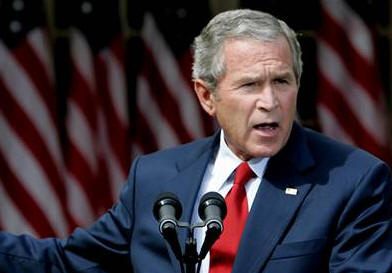
(photo: Ron Edmonds / AP)

President George W. Bush 's speech employed his usual army of dancing straw men. His latest disingenuous and questionable assertions deserve greater, more detailed attention, as they're sure to form the basis for the latest GOP talking points deployed on political talk shows this weekend and in the weeks to come. But two blazing hypocrisies deserve immediate highlighting.

President Bush simply cannot get through a single news conference without contradicting himself. Already, within the course of a couple weeks, he's presented Osama bin Laden (who he let escape at Tora Bora and still has not captured) as a dread menace and then someone not to worry about. (Huh? Think Progress also notes that "Bush Rewrites History on Zarqawi Statements.") But in addition to trotting out some of his "greatest hits," within this single news conference, Bush simultaneously excoriates a journalist for dabbling in "hypotheticals," but then employs hypothetical situations himself for further fear-mongering. He also lambasts the United Nations for waiting for an invitation to enter Sudan to stop the killing there, but then justifies not hunting down bin Laden because the United States needs an invitation first from Pakistan, our supposed ally in the "War on Terror."

The Washington Post has a transcript here. (It's a short conference worth reading in its entirety, but I've quoted at length here to provide full context for Bush's remarks.)

Bush first gets extremely testy with David Gregory of NBC news for questioning him about the potential danger to U.S. troops if the Geneva Convention is undermined. Rather than address this very relevant, core question, Bush lashes out at it as an irrelevant "hypothetical":

(emphasis mine)

QUESTION: Thank you very much.

Mr. President, critics of your proposed bill on interrogation rules say there's another important test. These critics include John McCain, who you've mentioned several times this morning.

And that test is this: If a CIA officer, paramilitary or special operations soldier from the United States were captured in Iran or North Korea and they were roughed up and those governments said, "Well, they were interrogated in accordance with our interpretation of the Geneva Conventions," and then they were put on trial and they were convicted based on secret evidence that they were not able to see, how would you react to that as commander in chief?


BUSH: My reaction is, is that if the nations such as those you name adopted the standards within the Detainee Detention Act, the world would be better. That's my reaction.
We're trying to clarify law. We're trying to set high standards, not ambiguous standards.

And let me just repeat: We can debate this issue all we want, but the practical matter is, if our professionals don't have clear standards in the law, the program is not going to go forward.

You cannot ask a young intelligence officer to violate the law. And they're not going to. They -- let me finish please -- they will not violate the law.

You can ask this question all you want, but the bottom line is -- and the American people have got to understand this -- that this program won't go forward if there's vague standards applied like those in Common Article 3 of the Geneva Convention. It's just not going to go forward.

BUSH: You can't ask a young professional on the front line of protecting this country to violate law.

Now, I know they say they're not going to prosecute them. Think about that, you know. "Go ahead and violate it, we won't prosecute you." These people aren't going to do that.

Now, we can justify anything you want and bring up this example or that example. I'm just telling you the bottom line. And that's why this debate is important and it's a vital debate.

Now, perhaps, some in Congress don't think the program is important. That's fine. I don't know if they do or don't.

I think it's vital and I have the obligation to make sure that our professionals who I would ask to go conduct interrogations to find out what might be happening or who might be coming to this country -- I got to give them the tools they need, and that is clear law.

QUESTION: This is an important point, and I think it...

BUSH: The point I just made is the most important point, and that is the program is not going forward.

You can give a hypothetical about North Korea or any other country. The point is that the program is not going to go forward if our professionals do not have clarity in the law.

BUSH: And the best way to provide clarity in the law is to make sure the Detainee Treatment Act is the crux of the law. That's how we define Common Article 3. And it sets a good standard for the countries that you just talked about.

Next man?

QUESTION: But wait a second. I think this is an important point.

BUSH: I know you think it's an important point.

QUESTION: But, sir, with respect, if other countries interpret the Geneva Conventions as they see fit, as they see fit, you're saying that you'd be OK with that?

BUSH: I am saying that I would hope that they would adopt the same standards we adopt; and that by clarifying Article 3 we make it stronger, we make it clearer, we make it definite.

And I will tell you again, you can ask every hypothetical you want, but the American people have got to know the facts.

And the bottom line is simple: If Congress passes a law that does not clarify the rules -- if they do not do that, the program's not going forward.

QUESTION: This will not endanger U.S. troops in your...

BUSH: Next man?

QUESTION: This will not endanger...

BUSH: David, next man please. Thank you.

Took you a long time to unravel, and it took you a long time to ask your question.

Bush refuses to address the central concerns about his proposed legislation. While torture is immoral, illegal, and ineffective, the chief objection Powell, McCain, Warner, Graham, many Democrats, and many JAGs have recently advanced is that throwing out this important element of the Geneva Convention will endanger our troops because then any other nation can also ignore the same rules.

But while Bush dismisses this as a "hypothetical," he is more than happy to indulge in hypothetical scenarios himself when it means stoking more fear. In response to a later question, he says:

(emphasis mine)

I said the other night in a speech this is like the ideological war of the 21st century, and I believe it. And I believe that if we leave that region, if we don't help democracy prevail, then our children and grandchildren will be faced with an unbelievable, chaotic and dangerous situation in the Middle East.

Imagine an enemy that can't stand what we believe in getting ahold of oil resources and taking a bunch of oil off the market in order to have an economic punishment. In other words, "You go ahead and do this, and if you don't, we'll punish you economically."

BUSH: Or imagine a Middle East with an Iran with a nuclear weapon threatening free nations and trying to promote their vision of extremism through Hezbollah.


I find it interesting that young democracies are being challenged by extremists. I also take great hope in the fact that by far the vast majority of people want normalcy and want peace, including in Iraq; that there is a deep desire for people to, you know, raise their children in a peaceful world; a desire for mothers to have the best for their child.

That has not -- this isn't -- you know, Americans, you've got to understand, this is universal. And the idea of just saying, "Well, you know, that's not important for us, to me or the future of the country" is just not acceptable.

Bush of course slips in one of his beloved straw men near the end. No major critic of Bush's foreign policy is saying the future of Iraq, or compassion for those who are suffering, is unimportant. In fact, for many Bush critics, it's compassion for our troops and for ordinary Iraqis, currently dying at a rate of roughly 100 per day, that motivates their criticism of Bush's unwavering, ineffective policies.

Bush then uses a question about the United Nations to lambast it for its foot-dragging on Darfur, implying it lacks the resolve and the, y'know, manly courage it takes to invade a nation:

(emphasis mine)

QUESTION: Mr. President, as you prepare to go up to the United Nations next week to address the General Assembly, Secretary Kofi Annan has been critical of some U.S. policies, particularly in Afghanistan, lately.

How would you characterize the relationship between the United States and the United Nations at this point?

BUSH: First of all, my personal relationship with Kofi Annan is good. I like him. We've got a good personal relationship.

I think a lot of Americans are frustrated with the United Nations, to be frank with you.

Take, for example, Darfur. I'm frustrated with the United Nations in regards to Darfur. I have said, and this government has said, there's genocide taking place in Sudan.

BUSH: And it breaks our collective hearts to know that.

We believe that the best way to solve the problem is for there to be a political track as well as a security track.

And part of the security track was for there initially to be African Union forces, supported by the international community, hopefully to protect innocent lives from militia.

And the A.U. force is there. But it's not robust enough. It needs to be bigger. It needs to be more viable.

And so the strategy was then to go to the United Nations and pass a resolution enabling the A.U. force to become blue-helmeted -- that means become a United Nations peacekeeping force -- with additional support from around the world.

And I suggested that there also be, you know, help from NATO nations in logistics and support in order to make the security effective enough so that a political process could go forward to save lives.

The problem is, is that the United Nations hasn't acted.

BUSH: And so, I can understand why those who are concerned about Darfur are frustrated. I am.

I'd like to see more robust United Nations action. What you'll hear is, "Well, the government of Sudan must invite the United Nations in for us to act."

Well, there are other alternatives, like passing a resolution saying, "We're coming in with a U.N. force in order to save lives."


I'm proud of our country's support for those who suffer. We provided by far the vast majority food and aid.

I'm troubled by reports I hear about escalating violence. I can understand the desperation people feel for women being pulled out of these refugees centers and raped. And now is the time for the U.N. to act.

So you asked of levels of frustration. There's a particular level of frustration.

I also believe that the United Nations can do a better job spending the taxpayer -- our taxpayers' money. I think there needs to be better management structures in place, better accountability in the organization.

BUSH: I hope the United Nations still strongly stands for liberty. I hope they would support my call to end tyranny in the 21st century.

So I'm looking forward to going up there. It's always an interesting experience for a West Texas fellow to speak to the United Nations. And I'm going to have a strong message; one that's hope -- based upon hope, and my belief that the civilized world must stand with moderate, reformist-minded people and help them realize their dreams. I believe that's the call of the 21st century.

So Bush states there's something lacking in the United Nations in waiting for an invitation to enter the Sudan (assuming that is even a fair characterization to begin with).

Yet in a later question, asking about why bin Laden has not been caught, he says:

(emphasis mine)

QUESTION: Thank you, Mr. President.

Earlier this week, you told a group of journalists that you thought the idea of sending special forces to Pakistan to hunt down bin Laden was a strategy that would not work.

BUSH: Yes.

QUESTION: Now recently, you've also...

BUSH: Because, first of all, Pakistan is a sovereign nation.

QUESTION: Well, recently, you've also described bin Laden as a sort of modern day Hitler or Mussolini. And I'm wondering why, if you can explain, why you think it's a bad idea to send more resources to hunt down bin Laden wherever he is.

BUSH: We are, Richard. Thank you. Thanks for asking the question.

They were asking me about -- somebody report -- well, you know, your special forces here. Pakistan -- if he is in Pakistan, which this person thought he might be who was asking me the question -- Pakistan's a sovereign nation. In order for us to send thousands of troops into a sovereign nation, we've got to be invited by the government of Pakistan.

BUSH: Secondly, the best way to find somebody who is hiding is to enhance your intelligence and to spend the resources necessary to do that. And then when you find him, you bring him to justice.

And, you know, there is a kind of an urban myth here in Washington about how this administration hasn't stayed focused on Osama bin Laden. Forget it. It's convenient throw-away lines, you know, when people say that.

We have been on the hunt, and we'll stay on the hunt until we bring him to justice. And we're doing it in a smart fashion, Richard, we are.

And I'll look forward to talking to President Musharraf.

Look, he doesn't like Al Qaida. They tried to kill him. And we've had a good record of bringing people to justice inside of Pakistan, because the Paks are in the lead. They know the stakes about dealing with a, you know, a violent form of ideological extremists.

BUSH: So we will continue on the hunt, and we've been effective about bringing to justice most of those who planned and plotted the 9/11 attacks, and we still got a lot of pressure on them.

The best way to protect the homeland is to stay on the offense and keep pressure on them.

Last question.

Pakistan is supposed to be our ally in Bush's "War on Terror." Bush even claims the President Musharraf wants us to catch bin Laden. But despite this, Bush is somehow not able to send in troops to catch bin Laden? Huh? Where's his cowboy swagger now? Not only does Bush's answer possess no internal logic, or stand up to common sense, it contradicts his earlier assertion about the United Nations! (Not to mention, The Washington Post reports that the trail for bin Laden is "stone cold," and while Tony Snow protests that is inaccurate, it's safe to say Pulitzer-winner Dana Priest has much more credibility on the subject. Might the real issue be the Bush administration's lousy track record on the matter, and that he can't blame the United Nations for that? )

Bush and his administration lie, distort and obfuscate so often, so virulently, the biggest challenge for the legitimate, responsible media is deciding which flimsy assertion to examine. Kudos to those reporters who asked Bush tough questions, and for those that supported their fellow reporters. It's time for all of us to keep the pressure on.

Monday, June 26, 2006

Lee Siegel Puts Them Uppity Bloggers in their Place

The New Republic’s Lee Siegel has posted two ludicrous pieces deriding bloggers as angry, infantile fascists (6/22/06’s “Blog This” and 6/23/06’s “The Origins of Blogofascism”). It’s pointless for me to skewer his overall arguments (such as they are) since James Wolcott and Digby have done such a thorough and entertaining job of it already (hat-tip to guest poster Watertiger at Firedoglake for the Wolcott link and many other great ones in the same post).

Instead, I wanted to highlight a shocking failure of logic perpetrated by Siegel in his second post, “The Origins of Blogofascism.” In it, he quotes at length from a short profile of Markos Moulitsas Zuniga, better known as “Kos,” that appeared in the San Francisco Chronicle on 1/15/04. In it, Moulitsas explains:

"I believe in government. I was in El Salvador in the late '70s during the civil war and I saw government as a life-and-death situation," he said. "There was no one to root for. The government was a corrupt plutocracy and the rebels were Maoists. The concept of government is important."

He remembers bullets flying in the marketplace and watching on television as government soldiers executed guerrillas. He also remembers watching footage of the Solidarity movement in Poland.

He was 9, and he asked his father what that was all about. His father, a furniture salesman, said, "It's just politics."

The future blogger said, "Tell me all about it."

Siegel's interpretation immediately follows:

So he loves government, but hates politics. There's something chilling about that. I wonder, does Zuniga consider the Solidarity movement disgusting, compromising, venal politics, too? And was there really no one to root for during the Salvadoran civil war? It's hard to believe the usually inflexibly partisan Zuniga actually said that. The rebels may have been "Maoist"--whatever that meant to them in Central America at the time--but their goal of overthrowing a brutal, rapacious regime might well be something that a passionate political idealist and reformer like Zuniga, looking back at it in 2004, would sympathize with. Or so you would think.

Siegel’s interpretation defies common sense. How can one possibly take that passage and conclude that Moulitsas (incorrectly referred to as Zuniga by Siegel) “loves government, but hates politics?”

Let’s leave aside the ludicrous assumption that a nine-year old should form a nuanced understanding of the Polish Solidarity movement and the Salvadoran civil war, and in the case of Solidarity, to do so upon first encounter. The author of the Chronicle piece does not print anything to indicate what Moulitsas thinks of these movements now, if indeed he even asked him. While Moulitsas starts speaking about the past in the present tense, the bulk of the passage is about his perceptions when he was nine years old. For Siegel to extrapolate Moulitsas’ present views on these matters from such a scant passage is intellectually dishonest, poor reasoning or sloppy journalism. I view it as a deliberate misrepresentation, creating a straw man (or “chilling” snow man, in this case).

But more to the point, the actual passage describes a nine-year old whose father dismisses or minimizes the complexity of the Solidarity movement, for whatever reason (perhaps he thought it too complex or upsetting for his son, or he himself was not that interested, who knows? The article does not say). To which the boy responds, “Tell me all about it.” The boy, young Moulitsas, presses his father to explain to him about politics (and some rather complex politics at that!). How does this passage possibly indicate that Moulitsas “hates politics?”

Of course, it doesn’t. It shows exactly the opposite. The anecdote is used in the original Chronicle piece to indicate how Moulitsas became interested and engaged in politics at a young age. Considering his is the most popular political site on the web, and the fact that he worked for Howard Dean, to say that Moulitsas “loves government, but hates politics” is laughable.

"There's something chilling about that," opines Siegel. It's utterly craven to misrepresent Moulitsas' beliefs and then express shock and horror over them! Furthermore, where does Moulitsas use the terms "disgusting, compromising, venal" that Siegel attributes to him? It's not in the Chronicle piece. It's not in any linked post. Where's the research, where's the evidence? Did Siegel just make this up as well, as he telepathically divines Moulitsas' true intent?

I suspect Siegel was trying to paint Moulitsas as an idealist who loves the ideal of good government but cannot grasp the complexity of political realities. I’m probably being overly generous, since every mention of Moulitsas or bloggers is pejorative. At best Siegel’s being dense, but I feel he’s being disingenuous. My take is that he set out to slam Moulitsas, and then tried to gather his stones without doing a very good job. He earlier states that “Two other traits of fascism are its hatred of the processes of politics, and the knockabout origins of its adherents.” In order to paint Moulitsas as a representative “blogofacist,” which is the entire point of the piece, he needs to somehow establish that Moulitsas “hates politics” and that he’s ruthless or “knockabout” (New Republic writer Zengerle’s much-dissected posts about Moulitsas cover his supposed ruthless, dictatorial nature). Considering that in the paragraph immediately after Siegel slams Moulitsas for 'hating politics,' he slams three bloggers for using aliases when all three have their real names publicly displayed on their sites, it’s hard to avoid the conclusion that Siegel is just plain sloppy.

While I don’t want to pick too much on Siegel — and he’d no doubt be amused that a lowly blogger is parsing his, um, superior prose — two points remain inescapable. 1) His thesis is ludicrous. 2) He can’t support it (not surprising, given #1). In fact, one of his key pieces of evidence proves the opposite point! There's something unseemly about a man with a national platform decrying bloggers for not being able to tolerate Siegel when he doth "conscientiously criticize, in the form of a real argument" when he apparently cannot form a valid or sound argument himself.

(As a point of minor interest, Siegel slams bloggers but only features a single link in his five most recent posts, and that’s to another New Republic writer’s post, Zengerle's. Perhaps Siegel lacks the know-how to link the articles he cites, or he chooses not to because that would sully his status as a real writer.)

As reader "jfabermit" observes in the comments for “The Origins of Blogofascism”:

Honestly, the discussion threads here and elsewhere were much more reasonable than either post of his. If you want to see some actual intelligent commentary on the blogosphere, try the comment thread to the previous post, and ignore this drivel.

Well said.

(I should point out that I am not a regular DailyKos reader, and have left less than 6 comments on that site to date. DailyKos seems to have some very intelligent posters, great links, and makes great finds. It won Best Commenter (Georgia10) and Best Community last year from the 2005 Koufax Awards . However, I find that there’s a large amount of “venting” such as “Bush sucks” etc. and more conspiracy-minded material to wade through in the comments at both DailyKos and Atrios’ site Eschaton. I find the comments at Crooks & Liars, Glenn Greenwald’s Unclaimed Territory, and TPM Cafe to be more thoughtful on the whole. My point is that I am not a “Kossack,” but regardless of my feelings about the site or Moulitsas, both deserve to be criticized on their merits.)