Occasional blogging, mostly of the long-form variety.
Showing posts with label Congress. Show all posts

Friday, December 07, 2012

Why We Can't Have Nice Things

Political battles do not occur in a vacuum, and the current scrum features several highly familiar elements. If you've been following the "austerity bomb" / "austerity crisis" news (better terms than "the fiscal cliff"), one of many striking features is the colossal bad faith of the Republicans. Steve Benen devised the nifty chart shown above breaking down how lopsided the current "deal" is. He also notes that some conservatives are complaining that this deal, despite being both bad policy and massively skewed toward the losers of our recent huge election, doesn't go far enough in conservatives' favor. From "The plan the right is pretending not to like":

So, as far as the right-wing GOP base is concerned, a debt-reduction deal in which Republicans make no concessions at all represents an enormous sellout.

Except, in this case, I don't really believe the base is sincere.

We'll probably never know for sure what leading far-right activists are thinking, but by complaining about a deal in which GOP gives up nothing, they seem to be engaged in some political theater.

In other words, the Koch brothers' operation and the Heritage Foundation's lobbying wing are trying to offer some cover for House Speaker John Boehner and the Republican leadership -- if the left and right both claim to oppose the GOP's so-called "counteroffer," then maybe it's the moderate solution between two extremes.

As for the "merits" of the latest offer from John Boehner and the Republicans, Greg Sargent provides a good summary of the latest exercise in Republican magic math in "Magical thinking in new GOP fiscal cliff plan":

So yesterday, House GOP leaders offered up their own fiscal cliff proposal. In exchange for substantial spending cuts, the big concession Republicans would make is that they would agree to $800 billion in new revenues. They would not raise tax rates, they would lower rates through tax reform, and produce the new revenues by closing unspecified loopholes and deductions, to be worked out later.

Is this even possible?

The plan is too lacking in detail to say for sure whether the numbers can even be made to work, according to a tax expert I spoke to this morning. He added that based on what we know now, it would require the elimination of so many loopholes and deductions as to be extremely impractical, and probably politically impossible, though the GOP goal is theoretically attainable under certain very narrow conditions.

Republicans have said that the $800 billion in new revenues would come from eliminating loopholes and deductions in a way that only targets those over $250,000. That way, Republicans can argue that their plan doesn’t hit the middle class, only the rich.

The problem, though, is that you’d have to eliminate virtually every significant loophole and deduction that benefits the wealthy to make this possible, according to Roberton Williams, a senior fellow at the nonpartisan Tax Policy Center. Worse, if you also want to lower tax rates, as Republicans say they do, it would become even harder.

“If the tax rates are going to be lowered significantly, it’s harder and harder to hit that revenue target,” Williams told me, adding that until Republicans specified what sort of rate cuts they have in mind, it’s impossible to say whether this is even doable.

Williams added that to come within the ballpark of raising $800 billion in new revenues in this fashion, you’d probably have to pare back substantially or eliminate an enormous range of deductions, from the write-offs for employee provided health insurance, interest from municipal bonds, and money invested in retirement plans, to itemized deductions for charitable contributions, state and local taxes, and mortgage interest payments.

Good luck waiting for Congress to eliminate all of those.

Not that any of this is new, but this latest political battle shows once again that:

1. Republicans do not care about good policy or responsible governance.

2. Republicans do not care about public opinion. (Numerous polls show that the public supports raising taxes on the rich.)

3. Republicans do not care about election results (unless they win).

4. Republicans do not believe in fair dealing and good faith.

5. The media will not report political disputes accurately if doing so means criticizing one party significantly more.

A country cannot function well given this state of affairs, but as usual, the corporate media will not assess blame accurately or fairly, and the Beltway "solutions" offered are tend to be plutocrat-friendly measures that screw over the middle class. (Not to mention the poor. Remember them?)

We'll consider other aspects shortly, but more good pieces on this whole affair, see:

Ezra Klein's Wonkblog: "The White House reveals their tax math," "Boehner’s latest tax offer is $150 billion less than he offered in 2011" and "Yesterday’s tax revenues can’t support tomorrow’s America."

Jonathan Bernstein: "Boehner’s offer: A start, but it’s still unclear whether it’s real."

Paul Krugman: "Fighting Fiscal Phantoms," "Class Wars of 2012," "What Defines A Serious Deficit Proposal?" "The Full McConnell," "Operation Rolling Tantrum," "It’s Health Care Costs, Stupid" and "Why People Are Confused About the Fiscal Cliff"

Josh Barrow at Bloomberg: "What's Wrong With the Republican Fiscal Cliff Counteroffer"

Jonathan Cohn: "The Fiscal Cliff Is Better than Boehner's Lousy Offer"

Digby on the so-called grand bargain and fiscal cliff (and don't forget David Dayen).

Meanwhile, it's worthwhile to look at some of the other overarching dynamics.

Republican Sabotage

Republicans decided from the very beginning they would try to sabotage Obama's presidency. Despite their whining and accusations that Obama rebuffed them, they have always been acting in bad faith. Dan Balz provided one of the best accounts back in September in a Washington Post feature. It's worth reading in full, but this section in particularly sticks with me (emphasis added):

Newt Gingrich, the former House speaker who fought with and compromised with President Bill Clinton in the 1990s, believed the country was hungry for an end to political conflict and was invested in the success of the nation’s first African American president. On Inauguration Day, Gingrich said recently, he told his wife, Callista, that if Obama followed through on what he had said throughout the campaign, “he will be Eisenhower and he will split the Republican Party.”

Later that evening, Gingrich joined a dozen or so other Republicans for a dinner at the Caucus Room restaurant. Their conversation about how to plot a comeback was described in some detail by author Robert Draper in his book “Do Not Ask What Good We Do.”

When Gingrich left the dinner, he told his colleagues, “You’ll remember this as the day the seeds of 2012 were sown.”

Asked recently to reconcile his feelings on the afternoon of the inauguration and his conclusions after the dinner, Gingrich’s response encapsulated both the promise of the Obama presidency and the obstacles he would encounter trying to fulfill it.

“Our job was to design the optimum GOP strategy,” Gingrich said. “Obama’s job was to govern so our strategy would fail.”

Said Axelrod, “If on inaugural night, leaders of the Republican Party are meeting to talk about how they could thwart the president, it belies the notion that they are waiting patiently by their phones for a call from the president to see if they could work together.”

Balz (and Draper, in his book) go into far more detail, but the evidence is damning, and several elements are notable here. One, Gingrich was and remains one of the people most responsible for "political conflict" and hyper-partisanship in America. He's still despicable, and given his pandering racism during his presidential run, he certainly wasn't "invested in the success of the nation’s first African American president." Two, the Republicans are acting in bad faith even by the degraded standards of this account; despite being beaten, despite the failure of their "strategy," they're still opposing Obama… and good policy, and the will of the people. Three – Gingrich doesn't seem to realize how incriminatory this account is. In a corrupted D.C., perhaps it's nothing too shocking, but this story is further proof of the Republican Party, of movement conservatives, putting their party before their country. It is unpatriotic. It is sabotage. It may not be treason in the technical, legal sense, but it is (or comes close) in the everyday sense. It is contemptible to harm one's country, to screw over one's own constituents, all to try to acquire more political power. Sincere conservatives exist who champion polices I strongly disagree with, but I don't doubt their basic patriotism, that they're working for what they believe to be their country's best interest. That is not the case with this breed of conservatives, and they are dominant in the Republican Party. (Consider all the conservatives who attacked anyone who dared to question an unnecessary war under Bush as a traitor. Bush certainly had his detractors, and earned many more, but congressional Democrats worked with him, and liberals and moderates generally wished him well in office, because, contrary to Rush Limbaugh, the country can't really do well if the president doesn't.)

Norquist Victory

Ezra Klein makes an excellent point in "Grover Norquist is winning"

Don’t take Norquist’s pledge at face value. It’s an absurdity. From a budgetary standpoint, it’s an obscenity. And everyone — Norquist included, because he is very, very smart — knew it would eventually fall. It’s how it falls that matters. And right now, it’s falling exactly according to plan.

For decades now, Norquist has asked lawmakers to pledge to oppose any and all taxes. That’s a ridiculous pledge. Ronald Reagan, a president Norquist considers such a conservative inspiration that he’s embarked on a quest to name every airport and park bench in the country after him, raised taxes time and time again.

But that’s the point. The severity, even extremism, of the commitment demanded by the pledge has helped entrench a public impression that tax increases are a no-man’s land for conservatives. As recently as Reagan’s day, it was pretty much a given that cutting the deficit meant, in part, increasing taxes, even for Republicans. Today, Republicans who believe the debt is the greatest threat our nation faces — the new “red menace,” in the words of Indiana Gov. Mitch Daniels — get plaudits just for being willing to consider the idea of a tax increase, no matter how small.

Norquist and his pledge changed more than the conversation. They changed American politics. The question isn’t how we’ll increase taxes and by how much. It’s whether we’ll increase taxes. For a Republican to simply consider a tax increase is considered a massive concession. That helps them ultimately agree to less in taxes, as having conceded so much philosophically and politically, they’re expected to do less as a matter of policy.

The true test of Norquist’s pledge wasn’t whether a Republican ever voted for another tax increase. It was whether it held tax revenues below where they’d otherwise be. It’s whether it increased the political cost of raising taxes. And today, you can see how well his pledge has worked.

I've made this basic point before, that the Norquist framework falls far short of sense. Streamlining tax returns would be a good idea, but we should debating how much we should raise taxes on the rich, how many brackets we should add and at what level and rate, not debating whether or not to raise taxes on the rich at all. Norquist is an excellent, dark example of an Overton window success story. (And while Obama and congressional Democrats certainly have their faults, and some awful "Grand Bargain" is still a threat, Romney would have moved the taxes issues significantly further to the right.)

(It turns out that Bill Moyers' show tonight has two segments dealing with Republican intransigence on taxes and the Norquist pledge.)

Media Complicity

Michael Grunwald recently wrote a fantastic piece that violates the code of silence among Beltway reporters, titled "Fiscal Cliff Fictions: Let’s All Agree to Pretend the GOP Isn’t Full of It":

It’s really amazing to see political reporters dutifully passing along Republican complaints that President Obama’s opening offer in the fiscal cliff talks is just a recycled version of his old plan, when those same reporters spent the last year dutifully passing along Republican complaints that Obama had no plan. It’s even more amazing to see them pass along Republican outrage that Obama isn’t cutting Medicare enough, in the same matter-of-fact tone they used during the campaign to pass along Republican outrage that Obama was cutting Medicare.

This isn’t just cognitive dissonance. It’s irresponsible reporting. Mainstream media outlets don’t want to look partisan, so they ignore the BS hidden in plain sight, the hypocrisy and dishonesty that defines the modern Republican Party. I’m old enough to remember when Republicans insisted that anyone who said they wanted to cut Medicare was a demagogue, because I’m more than three weeks old.

I’ve written a lot about the GOP’s defiance of reality–its denial of climate science, its simultaneous denunciations of Medicare cuts and government health care, its insistence that debt-exploding tax cuts will somehow reduce the debt—so I often get accused of partisanship. But it’s simply a fact that Republicans controlled Washington during the fiscally irresponsible era when President Clinton’s budget surpluses were transformed into the trillion-dollar deficit that President Bush bequeathed to President Obama. (The deficit is now shrinking.) It’s simply a fact that the fiscal cliff was created in response to GOP threats to force the U.S. government to default on its obligations. The press can’t figure out how to weave those facts into the current narrative without sounding like it’s taking sides, so it simply pretends that yesterday never happened.

The next fight is likely to involve the $200 billion worth of stimulus that Obama included in his recycled fiscal cliff plan that somehow didn’t exist before Election Day. I’ve taken a rather keen interest in the topic of stimulus, so I’ll be interested to see how this is covered. Keynesian stimulus used to be uncontroversial in Washington; every 2008 presidential candidate had a stimulus plan, and Mitt Romney’s was the largest. But in early 2009, when Obama began pushing his $787 billion stimulus plan, the GOP began describing stimulus as an assault on free enterprise—even though House Republicans (including Paul Ryan) voted for a $715 billion stimulus alternative that was virtually indistinguishable from Obama’s socialist version. The current Republican position seems to be that the fiscal cliff’s instant austerity would destroy the economy, which is odd after four years of Republican clamoring for austerity, and that the cliff’s military spending cuts in particular would kill jobs, which is even odder after four years of Republican insistence that government spending can’t create jobs.

I guess it’s finally true that we all are Keynesians now. Republicans don’t even seem to be arguing that more stimulus wouldn’t boost the economy; they’ve suggested that Obama needs to give up “goodies” like extending unemployment insurance (which benefits laid-off workers) and payroll tax cuts (which benefit everyone) to show that he’s negotiating in good faith. At the same time, though, they also want Obama to propose bigger Medicare cuts, even though they spent the last campaign slamming Obama’s Medicare cuts and denying their interest in Medicare cuts. I live in Florida, so I had the pleasure of hearing a radio ad from Allen West, hero of the Tea Party, vowing to protect Medicare.

Whatever. I realize that the GOP’s up-is-downism puts news reporters in an awkward position. It would seem tendentious to point out Republican hypocrisy on deficits and Medicare and stimulus every time it comes up, because these days it comes up almost every time a Republican leader opens his mouth. But we’re not supposed to be stenographers. As long as the media let an entire political party invent a new reality every day, it will keep on doing it. Every day.

While these general insights aren't new in the liberal blogosphere, it's a well-written piece… yet what's really striking and depressing about it is that such subjects are rarely written about by Beltway reporters. In the corporate media, pointing out the outrageous bad faith of the Republican Party (or the actual consequences of their policies) is considered terribly uncivil and "partisan." (Despite their faults, the Democrats simply aren't remotely as bad.) It's as if the so-called liberal media had been forced to swear an oath of omertà to movement conservatives not to give the game away.

Political scrums do not occur in a vacuum. It's hard to get anything productive done when honest. accurate discussion is precluded on the national stage. (For some political players, that's certainly by design; in other cases, it's laziness.) It's a radical thought, but maybe we could discuss the actual merits of policy (without Beltway class bias dominating), uphold the results of elections, and insist on responsible governance and fair dealing from all sides. Contrary to the Beltway conventional wisdom, which is almost invariably wrong, America isn't suffering from a lack of compromise – it's suffering from idiocy, corruption and cowardice.

(For previous posts on Republican extremism, American plutocracy, and the preponderance of bullshit in political coverage, see "Extremism in Defense of Nihilism Is a Vice," "The Four Types of Conservatives," "Attack of the Plutocrats" and "Partisanship, Policy and Bullshit.")

Tuesday, August 03, 2010

Our Dysfunctional Senate

Covering all the problems with our current political mechanisms – or even the Senate alone – would require a longer post, but George Packer's article "The Empty Chamber" gives some useful history and a good overview of how dysfunctional the U.S. Senate currently is.

A 2008 post by Norm Ornstein provides this handy chart, which helps show how unprecedented the current obstructionism is:


Jon Perr has several more charts on the same theme.

Meanwhile, this chart from the Center for American Progress shows the percentage of judicial nominees confirmed under recent presidents:


If that's democracy in action, it sure ain't pretty.


Friday, June 20, 2008

Hey, Democratic Party Leadership


The graphic is adapted from a cartoon by the brilliant John Sherffius.

The line comes from Mike.

I might get one of these made up.

Update: I might substitute another line (not mine, either): "That's okay - I wasn't using my civil rights, anyway."

(Cross-posted at The Blue Herald)

Tuesday, February 12, 2008

Petition the House on Telecom Amnesty


I don't know about anyone else, but the Senate vote to grant telecoms immunity today is the most depressing vote I've seen since the Military Commissions Act of 2006 stripping habeas corpus, and before that, the Authorization for Use of Military Force against Iraq in 2002. Not that any of them were terribly surprising, and it's probably a good thing to still have the capacity to feel disgusted, but none of that changes how repulsive such an immoral, unnecessary and unconstitutional act this was.

Wouldn't it be nice to know who Cheney was spying on?

Glenn Greenwald has his characteristic comprehensive rundown, and I'm sure will continue to follow this. Two key quotations:

Isn't that the very definition of a police state: that companies should do whatever the government asks, even if they know it's illegal?

— Dan Froomkin

While one can't discount legalized bribery campaign dollars entirely, I do think too often we assume they're the reason lawmakers do the "wrong thing" when the simpler explanation that they believe the wrong thing is in fact the right thing is the answer.

Too many Democrats simply don't have the values we imagine they do, and it lets them off the hook too much to assume they're simply craven people who need to get re-elected instead of bad people who don't share our values.

— Atrios


They're not all gutless. Some are just scoundrels.

That's why it's all the more essential to Petition the House to Stand Firm Behind the RESTORE Act, the House's far superior version of the same bill.

The authoritarians conjure spectres of evil terrorists, but the real horror is Cheney's wet dream: an unaccountable, Orwellian police state of proven malice.

(Cross-posted at The Blue Herald)

Wednesday, August 08, 2007

That's Okay, I Wasn't Using My Civil Rights, Anyway


Unsurprisingly, Dan Froomkin has a splendid round-up of editorials, articles and blog posts on the recent, horrendous FISA bill. (Click any of the cartoons for a larger view. All the cartoons were linked by Froomkin, except the last one, which I've meaning to use for a while now.)

Crooks and Liars has video of Glenn Greenwald and Marjorie Cohn discussing these issues here with Amy Goodman on Democracy Now! The full show is here.

It's also no surprise Greenwald has been blogging up a storm on this matter. Here's "Democrats' responsibility for Bush radicalism," "Chris Dodd on FISA, habeas corpus and Democratic capitulation," "The strong and tough Democrats," and "Attention Democrats: GOP fear-mongering does not work."


Balkinization also has a series of excellent posts on these issues. On the FISA bill, they start around Saturday, August 5th, but there are related posts further back in July. (I'm sure the other major legally-oriented blogs have good entries as well.)


As long as we're discussing police states and Orwellian subjects, Froomkin's post also links a good piece by the ever-insightful Dahlia Lithwick on torture and Jane Mayer's New Yorker feature, "The Black Sites: A rare look inside the C.I.A.’s secret interrogation program," a harrowing piece that's getting increased attention, and deservedly so.


(The cartoons are by Telnaes, Babin, Oliphant and O'Farrell, respectively.)

(Cross-posted at The Blue Herald)

Thursday, September 28, 2006

"No Excuse" for Detainee Bill

The Specter-Levin amendment to the Military Commissions Act of 2006 (the "Detainee Bill") to preserve the Great Writ of habeas corpus failed by three votes, with the vote splitting almost completely along party lines. You can see the scoundrels and their vote breakdown here.

It's all over but the shouting. Not only have the GOP gutted the United States Constitution, they've assaulted the essential values that caused us to start the American Revolution in the first place - core principles that go back to the Magna Carta in 1215. Such is the awesome leadership, moral clarity and unerring judgment of President George W. Bush. Such is the fear that drives the GOP – not so much of terrorists, but of not getting re-elected, and losing party dominance.

I'll have to research which level of hell in Dante's Inferno this merits them ( Aha. I'm going with the Eighth Circle).

Dan Froomkin supplies another splendid entry that round-up most of the best commentary on the bill itself (the amendment vote had not occurred yet):

From today's New York Times editorial: "Here's what happens when this irresponsible Congress railroads a profoundly important bill to serve the mindless politics of a midterm election: The Bush administration uses Republicans' fear of losing their majority to push through ghastly ideas about antiterrorism that will make American troops less safe and do lasting damage to our 217-year-old nation of laws -- while actually doing nothing to protect the nation from terrorists. Democrats betray their principles to avoid last-minute attack ads. Our democracy is the big loser. . . .

"Americans of the future won't remember the pragmatic arguments for caving in to the administration.

"They'll know that in 2006, Congress passed a tyrannical law that will be ranked with the low points in American democracy, our generation's version of the Alien and Sedition Acts."

Mark Benjamin and Walter Shapiro write in Salon: "Despite the far-reaching implications of the legislation, the Senate galleries were virtually empty throughout the day, while most news coverage treated the congressional debate as of far more transient importance than the recent television confrontation between Bill Clinton and Fox TV host Chris Wallace. Many legislators had only a shaky understanding of what was in the Senate bill since its provisions were still being revised, after consultation with the White House, Tuesday night. As California Democratic Sen. Dianne Feinstein complained in a Tuesday interview, 'I don't understand this rush other than to make it very political. This is a huge thing that our people are going to have to live by . . . It is important not only that it works, but that it also be just.'"

Dahlia Lithwick, writing in Slate, marvels that senators working in avowed ignorance of what precisely the administration has been doing are now approving legislation that they themselves don't understand.

"For the five years since 9/11, we have been in the dark in this country. This president has held detainees in secret prisons and had them secretly tortured using secret legal justifications. Those held in secret at Guantanamo Bay include innocent men, as do those who have been secretly shipped off to foreign countries and brutally tortured there. That was a shame on this president.

"But passage of the new detainee legislation will be a different sort of watershed. Now we are affirmatively asking to be left in the dark. Instead of torture we were unaware of, we are sanctioning torture we'll never hear about. Instead of detainees we didn't care about, we are authorizing detentions we'll never know about. Instead of being misled by the president, we will be blind and powerless by our own choice. And that is a shame on us all."

I found one more commentator, Andrew Cohen, at his Washington Post legal blog Bench Conference, who also really nailed it. Here's his comments, in full. Here's the link to the original page, as well as the comments.

This Time, Congress Has No Excuse

Of all the stupid, lazy, short-sighted, hasty, ill-conceived, partisan-inspired, damage-inflicting, dangerous and offensive things this Congress has done (or not done) in its past few recent miserable terms, the looming passage of the terror detainee bill takes the cake. At least when Congress voted to authorize the Iraq War legislators can point to the fact that they were deceived by Administration officials. But what's Congress' excuse now for agreeing to sign off on a law that would give the executive branch even more unfettered power over the rest of us than it already has?

It just keeps getting worse. This morning, esteemed Yale Law professor Bruce Ackerman published this fine essay in the Los Angeles Times. His lead? "Buried in the complex Senate compromise on detainee treatment is a real shocker, reaching far beyond the legal struggles about foreign terrorist suspects in the Guantanamo Bay fortress. The compromise legislation, which is racing toward the White House, authorizes the president to seize American citizens as enemy combatants, even if they have never left the United States. And once thrown into military prison, they cannot expect a trial by their peers or any other of the normal protections of the Bill of Rights.

"This dangerous compromise," Professor Ackerman continued, "not only authorizes the president to seize and hold terrorists who have fought against our troops 'during an armed conflict,' it also allows him to seize anybody who has 'purposefully and materially supported hostilities against the United States.' This grants the president enormous power over citizens and legal residents. They can be designated as enemy combatants if they have contributed money to a Middle Eastern charity, and they can be held indefinitely in a military prison."

Scary enough for you? But wait, there is more. The legislation also appears to allow illegally-obtained evidence-- from overseas or right here at home-- to be used against enemy combatants (which gives you an idea of where this Congress really stands on the National Security Agency's domestic spying program). And wait, there is this: the Administration's horrible track record when it comes to identifying "enemy combatants" and then detaining them here in the States. Two of the most famous ones, Yaser Hamdi and Jose Padilla, both ended up having the highest courts in our land back up their legal claims, which is why the government had to release Hamdi outright and then turn Padilla over to the regular civilian courts (where he is a defendant in a weak case against him).

Do you believe the Administration has over the past five years earned the colossal expanse of trust the Congress is about to give it in the name of fighting terrorism? Do you believe that Administration officials will be able to accurately and adequately identify so-called "enemy combatants" here at home so as to separate out the truly bad guys from the guys who just happen to be in the wrong place at the wrong time? Did you want your legislative branch to abdicate so completely its responsibility to ensure that there are adequate checks and balances upon executive power even in a time of terror? You might have answered "no" to all three questions. But your answer doesn't matter. And neither does mine. To Congress, the answer is "yes, sir." Our Congress is about to make yet another needless mistake in the war on terror and this time the folks making it won't be able to say that the White House tricked them into it.

It's hard to believe this is still America.

Friday, September 22, 2006

What's A Gutting of Essential Human Rights Between Friends?

(crossposted at The Blue Herald)

As predicted, the GOP “dissidents” have reached an accord with the White House. They’ve now proved their independence to their constituents back home, but will join forces again to screw the Democrats and the U.S. Constitution before November. Perhaps that analysis is too cynical, and perhaps some shred of conscience will flicker to light and burst into glorious reality. Perhaps the law is actually an improvement on existing conditions — some of its provisions actually seem to be good. But if the typical GOP trend continues, basic human rights and justice will instead be drowned in a bathtub.

The big question is – what about habeas corpus? Currently we only have early reports, so perhaps later versions of these stories, or follow-up pieces will delve into this. But how can this be missed? The AP story doesn’t mention it. The usually excellent Washington Post doesn’t mention it. And The New York Times only touches on it at the end:

Still, Senator Carl Levin of Michigan, the senior Democrat on the Armed Services Committee, said he would press to change a provision in the proposal that would deny detainees a right to challenge their captivity in court.

Over at Hullabaloo, Digby is all over this with ”Punked” and " Tough and Smart", and Tristero contributes "Outrage and Shame".

Here’s the link they provide for supporting the Specter-Levin amendment protecting habeas corpus. The current GOP move is get this passed before Congress recesses. This demands action, and if the amendment fails, a filibuster. It’s time to write everyone with a shred of conscience and feed that flame.

Wednesday, June 28, 2006

Pay No Attention to the Incompetents Behind the Curtain


Not content with their assaults on the Fourth Amendment, the Bush administration has ratcheted up their attacks on the First. The idea that a newspaper can only print what the government allows it to is fascist and antithetical to the founding principles of America. Yet frighteningly, this idea is no longer solely the fringe belief it should always remain. It is being trumpeted by many prominent conservative voices, who seem to be jockeying to see who can demonstrate the most rabid zeal for rooting out those traitors in the press.

I touched on some of this in a recent post on recent revelations about the global banking surveillance program. But make no mistake. This is:

1) An outright assault on the First Amendment.
2) An intimidation move that attempts to silence administration critics.
3) An attempt not only to win a single argument, but rather to hijack the very means for making an argument.
4) A further attempt to remove all oversight of the Executive Branch.
5) A further attempt to deny the American public (and Congress!) meaningful knowledge of what the government is doing.
6) An attempt to shift the national conversation from subjects such as Iraq by focusing ire on that familiar conservative villain, the media.
7) An attempt to distract from the staggering incompetence of the folks behind the curtain, the Bush administration.

Several excellent articles and posts delve into these issues. To be charitable, it’s a respectable position to hold that The New York Times and other papers were irresponsible to reveal the global banking surveillance program. But as Dan Froomkin observes, "It's a monstrous charge for the White House to suggest that the press is essentially aiding and abetting the enemy." I have yet to hear any conservative critic say anything approaching, “I will defend to the death The New York Times’ right to print this story or any story, but I feel they were irresponsible to do so in this case.” It’s also no surprise (as I noted in the earlier post) that all the conservatives are bashing The New York Times but not The Wall Street Journal for its coverage of the same program.

Conservative tooth-gnashing notwithstanding, there was a pressing need to report this story. Although the program's been in place since 2001, the Bush administration only briefed key members of Congress after it knew the story was going to break. Yet again, the Bush administration sought to circumvent the oversight of the legislative and judicial branches. And upholding their usual pattern, the Bush administration only did the right thing reluctantly, when forced to at gunpoint. (Considering Republicans control all three branches of government, and Congress has been little more than a rubber stamp for the Bush administration, it really says something that most of the time they don’t even trust their own party to agree with their actions!) Times Executive Editor Bill Keller did a good job overall explaining the paper’s reasons for making the difficult decision to publish.

The uniformity of the conservative response — essentially, “Traitors! Prosecute them!” — leaves little doubt that this assault is coordinated through the latest round of GOP talking points. Such furor is also meant to distract from an obvious question – why the hell is Congress yet again only learning of this because of newspapers?

And why is there such a mad rush from anyone to trust anything the Bush administration says or does, especially after they’ve repeatedly lied? For Republican politicians, of course there’s a strong impulse to retain political power. But in a good post Arthur Silber examines a deeper psychology at work:

...People exhibit one of two basic perspectives toward government (including a particular administration that holds power), and toward authority in general...

...One group, composed of people some might consider skeptics but whom I regard as realists, consistently questions and challenges any concentration of power...

...The second group is made up of people who are eager to let others make the decisions that shape their lives.

Silber also dissects an asinine article by Michael Barone. Silber eviscerates Barone’s tone, technique, and assumptions, most notably his ludicrous claim that The New York Times hates America. Meanwhile, blogger BooMan also dissects Barone, but specifically takes on his premise that terrorists “hate our freedom,” when in fact they hate our foreign policy.

We should be able to expect better from Barone, who’s worked as a legitimate journalist. It’s less of a surprise from a third-rate conservative radio talk show host like Houston’s Chris Baker, who’s absolutely schooled here by San Francisco radio host Bernie Ward (this Crooks & Liars clip has quickly become a favorite in the liberal blogosphere). Typical of his ilk, Baker cannot handle a fair discussion in a venue where he’s not in control, and storms off after being unable to answer Ward’s persistent, central question: Should the government be able to tell newspapers what to publish?

In ”Over the Top Times-Bashing” Howard Kurtz remarks, “Man, I have never seen this kind of Times-bashing before. “ Kurtz offers a good round-up of the conservative rancor (he’s yet to uncover much of the liberal response, but it’s early in the week yet). He also observes:

Some of the outside commentary is so over the top that I think those folks would repeal the First Amendment tomorrow if they could. And most of those proclaiming horror at the leaking of classified info were willing to give the White House a pass for the outing of the covert Valerie Plame.

The most extreme conservatives want to see The New York Times prosecuted under espionage statutes.

As usual, Dan Froomkin zeros in on the most salient points of this entire story:

Terrorists already knew the government was trying to track them down through their finances, their phone calls and their e-mails. Within days of the Sept. 11 attacks, for instance, Bush publicly declared open season on terrorist financing.

As far as I can tell, all these disclosures do is alert the American public to the fact that all this stuff is going on without the requisite oversight, checks and balances.

How does it possibly matter to a terrorist whether the government got a court order or not? Or whether Congress was able to exercise any oversight? The White House won't say. In fact, it can't say.

By contrast, it does matter to us.

This column has documented, again and again, that when faced with a potentially damaging political problem, White House strategist Karl Rove's response is not to defend, but to attack.

The potentially damaging political problem here is that the evidence continues to grow that the Bush White House's exercise of unchecked authority in the war on terror poses a serious threat to American civil liberties and privacy rights. It wasn't that long ago, after all, that an American president used the mechanisms of national security to spy on his political enemies.

The sum total of the administration's defense against this charge appears to be: Trust us. Trust that we're only spying on terrorists, and not anyone else.

But what if the trust isn't there? And what if they're breaking the law?

That's why it's better to attack. It makes for great soundbites. It motivates the base. And perhaps most significantly, it takes attention away from Bush's own behavior.

Glenn Greenwald does his usual scholarly, thorough job to absolutely demolish every conservative complaint. In his piece "The Bush lynch mob against the nation's free press," he establishes four key points:

(1) There is not a single sentence in the Times banking report that could even arguably "help the terrorists."

(2) The reason there is "no evidence of abuse" is precisely because the administration exercises these powers in total secrecy.

(3) The Founders unequivocally opted for excess disclosures by the media over excess government secrecy and restraints on the press.

(4) How can any rational person believe that the reporters and editors of The New York Times want to help terrorists attack the U.S.?

Always good for a quip, James Wolcott observes:

It'll be interesting to see if the controversy builds or fades over the next few days, and whether or not the Times-bashers will be compelled to call their own bluff. In the meantime, whatever one thinks of the Times's performance leading up to Iraq and the Judith Miller debacle, the ugly threatmongering and barking ("For the Times to release information about secret operations and methods is treasonous”) of Peter King shouldn't go unchallenged. Let him climb the Empire State Building if he wants to work off steam.

In an update, Wolcott also notes his prediction about the "Fox All-Stars" came true: "Fox News All Star and full-time schmendrick Mort Kondracke said, more in anger than sorrow, "I think they [The New York Times] has forgotten that New York is the place 9/11 happened." Only a Beltway coward could be that obtuse."

And of course there’s a double standard. IOKIYAR: “It’s Okay If You’re a Republican.” Jane Hamsher, back blogging atFiredoglake, has a fiery post about how the same conservatives screaming bloody murder about the Times benefit from the same freedom they wish to strip from others, and how really, this tone is nothing new:

They have consistently preached authoritarian cultism; their hostility to any kind of check or balance that would impede Bush’s assertion of the unitary executive has always existed at a fever pitch. One wonders if they’ve ever read the Constitution.

But much like the profound irony of Ole 60 Grit O’Beirne demanding rights for herself won on her behalf by the feminists she bashes even as she earns her living denying them to other women, so the NRO exists as part of a free press it would very much like to see dismantled.

It makes me wonder if someone's going to propose loyalty oaths next!

Some of the most rabid responses are predictably from the National Review online and Powerline. They’re quoted and linked in the pieces above, and deserve a look. However, I did want to touch briefly on Glenn Reynolds’ broadside. Kurtz reminds us that “Instapundit” Reynolds is a law professor, but I’m not sure how that is relevant to Reynolds’ argument, except perhaps to highlight that those in higher education may still produce ludicrous opinions. I found his argument to be among the least convincing and most disingenuous I read from the right, all the more so because he purports to be both a political moderate and a serious writer. Rather than spewing raw hatred towards the Times (although he does heap great disdain on them), he attempts to invoke deeper principles of the First Amendment, but falls badly off the mark. (Certainly he shows no knowledge of Jefferson’s views on freedom of the press, or deliberately ignores them.)

In an impressive act of projection, Reynolds leads with “BILL KELLER ISN'T VERY BRIGHT, or else he thinks you aren't.” Reynolds' central argument is that “The founders gave freedom of the press to the people, they didn't give freedom to the press.” He also complains (as does virtually everyone in the Republican echo chamber) of Keller’s “hubris” and arrogance. It boggles the mind that Reynolds does not view the Bush administration in the same way, and his selective scorn is telling.

I could dissect Reynolds' post at length, but Roy at Alicublog hits the key point nicely:

I may just be missing whatever point the Perfesser's trying to make. Is he trying to say that reporters are not in fact "people"? Or maybe he thinks newsmen have fewer, or less inclusive, First Amendment rights than reg'lar folks.

Because, otherwise, it doesn't matter if Bill Keller and all the Times staff walk around in ermine capes and call each other Majesty. They and we either have the right or they/we don't. There are no shitty-attitude exemptions in the Bill of Rights.

This guy is a law professor. Think about that.

While many factors are at play in this story, my take is that there are three key ones. One is that conservatives are waging a sustained war against the First Amendment and "Freedom of the Press." The second is that fighting oversight and accountability is not sufficient for this administration; they wish to silence all serious public discussion of their actions as well. The third is that, while this censorship effort is very real and dangerous, its immediate goal is to distract the media and the general populace from other issues, most notably Iraq. The incompetence of the Bush administration is hard to ignore, so conservative critics are eager to try to change the storyline with attacks on those demon liberals. It's up to persons of conscience to keep the light shining on these scurrilous gambits.

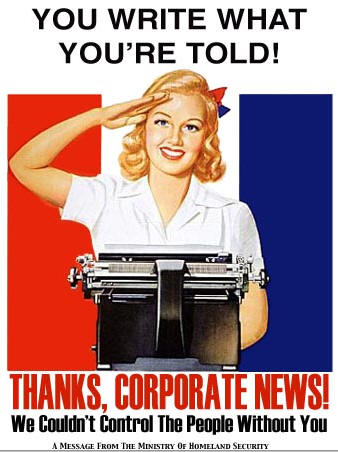
(The fantastic graphic at the top of this entry comes from the wonderful Propaganda Remix Project. This particular poster is one of my favorites from them. Interestingly, Michelle Malkin’s readers have done some (mostly crude) photoshop work on the Remix material for their own purposes. Glenn Greewald’s post provides the links.)

Thursday, May 25, 2006

Specter May Enforce the Law

(Really, it's a sad post title, isn't it? Such are the times we live in... )

In a recent post I wrote about a chilling, infuriating move by GOP lawmakers to obstruct judicial review of the illegal NSA eavesdropping program. However, with a new bill co-sponsored with Senator Diane Feinstein (D-CA), it appears Arlen Specter (R-PA) may have regained his soul after all by enforcing existing FISA law. This is extremely heartening. As with the previous post, I’m drawing on the invaluable work of Glenn Greenwald, who reports this latest development here. As Greenwald notes in his updates, Specter characteristically equivocates in his statements about the bill, which really merely reinforces existing law. The real test for Specter (as for many a politician) is always his actions.

While this new bill is merely common sense, and enforcing a sensible and successful law should never be a radical move, Specter deserves immense credit if he does the right thing and fights for its passage. This should not be a partisan issue. It’s possible that even if the bill becomes law, Bush will continues to break it, thus forcing the Constitutional showdown he’s been working to avoid (the showdown may come sooner than that anyway, with other challenges in the works). It's important in such a showdown that Congress chooses the right side: The Constitution over any political party.

Tuesday, May 16, 2006

Republicans Move to Obstruct Judicial Review of NSA Program

Glenn Greenwald links to an article from The Hill that reports:

Senate Judiciary Committee Chairman Arlen Specter (R-Pa.) and conservative members of his panel have reached agreement on legislation that may determine the legality of the National Security Agency’s (NSA) surveillance program, GOP sources say.

Specter has mollified conservative opposition to his bill by agreeing to drop the requirement that the Bush administration seek a legal judgment on the program from a special court set up by the Foreign Intelligence Surveillance Act (FISA) of 1978.

Instead, Specter agreed to allow the administration to retain an important legal defense by allowing the court, which holds its hearings in secret, to review the program only by hearing a challenge from a plaintiff with legal standing, said a person familiar with the text of language agreed to by Specter and committee conservatives.

Glenn's post on this is one of the most chilling, dismaying things I've read in a long time. As bad as the systematic attack on civil liberties by the Bush administration has been, I had wanted to believe that when push came to shove, Congress would stand up for the Constitution. One absolutely infuriating paragraph reports:

Conservative Republicans who pushed for the change say that it will help quell concerns about the measure’s constitutionality and allow the White House to retain a basic legal defense.

BULLSHIT. The change does not help quell "concerns about the measure's constitutionality." It avoids them. This is unconscionable. If this move succeeds, it will cause lasting, serious harm to the Constitution and our country. How the hell can anyone who serves in Congress believe for a second that this move is either moral or responsible? This move is so transparently vile civility cannot stand. As The Hill reports:

An expert in constitutional law and national security, however, said that the change would allow the administration to throw up huge obstacles to anyone seeking to challenge the program’s legality.

The Hill article goes on to quote this expert, "Mary Cheh, a law professor at George Washington University who specializes in constitutional law" at some length over the serious problems this move creates.

As Glenn Greenwald points out yet again:

Could anything be more obvious at this point than the fact that the Bush administration deeply fears having the legality of its eavesdropping activities adjudicated by a federal court? They have engaged in one maneuver after the next to prevent that adjudication.

One would think that if they really believed that they had the clear-cut legal justification for warrantless eavesdropping which they claim to have, they would be eager to have a court rule on this issue so that this unpleasant controversy -- with all of these mean-spirited and utterly baseless allegations of lawbreaking -- can finally be put to rest. And yet, time and again, they do precisely the opposite: they desperately invoke every available measure to prevent any judicial ruling as to the legality of their behavior.

Specter has sold out the American people and apparently his own conscience. Despite all his talk of oversight, of scrutinizing the NSA program, or grilling Bush's nominee to head the CIA, General Michael Hayden, when the time for meaningful action comes, Specter backs down. This is the man who refused to put Attorney General Alberto Gonzales under oath even after Gonzales had clearly lied to Congress. If Jack Cafferty's right that Specter "might be all that stands between us and a full blown dictatorship in this country," we are in deep trouble.

No reasonable person objects to hunting down terrorists. And there may be some far right politicians who truly believe the currently illegal NSA programs should be legal. This move has nothing to do with that, however, because it seeks to avoid having that discussion in the courts. This move is about avoiding accountability and protecting political power, nothing more. The politicians pushing for this are trying to avoid a greater scandal, greater public backlash, and personal embarrassment. Ironically, in their attempt not to look bad, they're revealed themselves as utterly craven. They're conducting a fundamental assault on American democracy for short-term political gain. The danger of this cannot be overestimated and no rhetoric opposing it can be too alarmist. The center cannot hold. It has been ransacked by the right.

The Hill article reports that more than 20 cases are "in the pipeline" that could challenge the NSA program, although if this GOP legislation passes, those cases will face an uphill battle. Let's hope Specter and other key Republicans rediscover their souls before then. In the meantime, it's time for some progressive activism.

Thursday, May 11, 2006

Laws? We Don’t Need No Stinkin’ Laws!

One of the most important stories of the past two weeks is Charlie Savage’s Sunday feature from 4/30/06 in The Boston Globe about the systematic disregard for the law by President Bush, who has disregarded no fewer than 750 U.S. laws. The news about the secret and illegal NSA call-tracking program makes the article all the more relevant. If you missed it, here it is. Here’s the first three paragraphs:

WASHINGTON -- President Bush has quietly claimed the authority to disobey more than 750 laws enacted since he took office, asserting that he has the power to set aside any statute passed by Congress when it conflicts with his interpretation of the Constitution.

Among the laws Bush said he can ignore are military rules and regulations, affirmative-action provisions, requirements that Congress be told about immigration services problems, ''whistle-blower" protections for nuclear regulatory officials, and safeguards against political interference in federally funded research.

Legal scholars say the scope and aggression of Bush's assertions that he can bypass laws represent a concerted effort to expand his power at the expense of Congress, upsetting the balance between the branches of government. The Constitution is clear in assigning to Congress the power to write the laws and to the president a duty ''to take care that the laws be faithfully executed." Bush, however, has repeatedly declared that he does not need to ''execute" a law he believes is unconstitutional.

The disregard for whistle-blower protection and due process statutes are particularly troubling. But the article clearly shows that the NSA call-tracking program is perfectly in line with the Bush ideology, although not the law.

Tuesday, February 07, 2006

Liveblogging Gonzales

Gonzales' opening statement can be read here. Meanwhile, several bloggers covered the hearings. Glenn Greenwald, who has consistently written fantastic posts on the NSA wiretaps, weighs in here. He's sure to expand on it tomorrow. You can also see part of his brief C-Span interview here (courtesy of Crooks and Liars). ReddHedd of Firedoglake covered Gonzales in four entertaining and insightful parts; you can read #1 here, then scroll up (She also has some good comments on Greenwald's appearance right below). John Aravosis of Americablog also liveblogged the event, and the original Wonkette Ana Maria Cox stopped by her old blog to offer some snark here.

Mattthew Yglesias at The American Prospect and Digby at Hullabaloo had the same reaction I did, although they go into more detail - why the hell are these Repulican Senators handing away their power? They're choosing not even party solidarity, but unswerving loyalty to George Bush... and putting Bush not only ahead of their own constituents, but their own constitutional authority. This is unusual. Still, I suppose it's impressive in one sense that our duly-elected can be both self-denying and unpatriotic at the same time.

Dibgy also has a good post invoking both Rove and Nixon. Digby nicely lays out what many of us have known: this is an old battle, and the illegal NSA wiretaps are just more of the same. On a similar note, Dan Froomkin compiles a few "History Lessons" on clashes involving Rumsfeld, Cheney, and George H.W. Bush within the Ford administration. Of course, back then the Republican president choose to check his own power in regard to wiretaps.

But we all know Ford was a commie.

Monday, February 06, 2006

Gonzales Not Under Oath

This is shameful, gutless, and unconscionable on the part of Specter and the Republicans. Baseball players must be under oath, but not energy execs, or the Attorney General, even when he has already lied under oath?!!? Where's the Republican with some backbone to dissent? Kudos to the Democrats for raising the issue. May they continue to hammer it home. Typically, Congress has been very defensive about protecting its own powers... but the Judiciary Committee Republicans appear largely bought and paid for. I'm absolutely disgusted.

Crooks and Liars has the video of this sorry state of affairs. Specter of course does not offer a compelling argument - come to think of it, really any argument - for not putting Gonzales under oath. Gonzales himself claims he has no objection to going under oath - of course, an oath didn't stop him from lying before. And now, with Specter's move now he can claim it wasn't up to him. Convenient. At least he's getting some grilling...

One of the best lines in Syriana comes at a barbeque when one character explains to his client, "we need the appearance of due diligence." Until Republicans start grilling the President and the Attorney General for willfully breaking the law, they have no credibility. As Pat Roberts continues to stonewall on intelligence investigations and the Abramoff scandal grows, the Republicans remain the party of cosmetic fixes. The Constitution be damned; they will sacrifice the rule of law and civil liberties in order to retain power. Some Republicans, including far-right fanatics like Grover Norquist, oppose warrantless wiretaps. Congress possesses quite a few Republicans who have spoken out on this as well... but they need to either become more vocal, or get on more committees! It's very clear now that the opposition party must have subpoena power.

Monday, November 28, 2005

Who Voted for Torture?

Congratulations yet again to John McCain and the vast majority of Republicans in the Senate who voted against torture (every Democrat did). If you're like me, you wondered, who were the nine senators for voted according to Cheney's wishes to allow torture? Here's the list... all Republican, and some heavy hitters.

The bill is of course not out of the woods yet, with the Pentagon, the House, and Cheney all making new moves... all of which really deserves greater scrutiny than this meager and belated post. However, when politicians do the right thing, we need to applaud them, to encourage them to do it again. So bravo. Keep it up, Senate... you give us hope. Maybe next you'll repeal those tax cuts to the rich versus cutting aid to the poor.

Monday, October 24, 2005

Behind the Curtain of Bad Government Decisions

A trio of good articles illuminate the process of some really bad decisions and bad government.

First up, from The Wall Street Journal’s free opinion site, John Fund explains why the vetting of Harriet Miers and her subsequent selection by George Bush as his Supreme Court nominee was so very poor. He paints a picture that will be familiar to anyone who read about Paul O’Neill’s stint in the Bush administration in The Price of Loyalty, and other accounts... This is a place where dissent is seen as disloyalty and speaking truth to power is difficult if not outright discouraged. Beyond matters of ideology, the question of competence continually reappears in all in-depth accounts of the Bush administration (in order to make good decisions, one must first set up a system that encourages rather than discourages accurate information).

Meanwhile, The Washington Monthly’s cover story is a fascinating (and chilling) portrait of Patrick McHenry, a young Republican congressman from North Carolina. The article gives great insight into the crucial role the College Republicans play in the GOP as well as offering a rather scathing view of McHenry. Author Benjamin Wallace-Wells notes:

Like most of the post-Gingrich generation, McHenry's ultimate loyalty is less to principle or ideology than to the machine itself.

One of the most striking passages in the article reports that:

McHenry's credit union bill, a high priority for the banking lobby, has received strong backing from DeLay. The Republican leadership awarded McHenry a seat on the House Financial Services Committee upon his arrival in Washington. “Most people would say it's the most plum assignment you can get,” one conservative lobbyist told me, “because you can leverage it to do so much in fundraising.” But first you have to prove yourself. Asking McHenry to author a bill that undermines the interest of half his constituents is the political equivalent of demanding a young Mafia enforcer kill his cousin as a test of loyalty. “It's a bill that a lot of us are watching,” a conservative activist from Mecklenberg County who has been skeptical about McHenry told me. “It's pretty clear that here McHenry is picking Washington over his district, and we're interested to see if he pays any price for it.”

Subsequent paragraphs describe how McHenry lies to his constituents (say “he deliberately misleads them” if you like, but I call it lying). His campaign tactic, twice, consists purely of claiming he’s the more conservative candidate, even when he’s not, while offering no real policy.

The resulting portrait is of a young man who is all slogan and no substance, who views power as a goal unto itself, and who feels his constituents serve him, not the other way around. He is precisely that sort of politician who gives politicians a bad name.

Still, McHenry’s self-serving moves are as nothing compared to the master machinations of The Hammer and his buddies. A long but rewarding article from The Washington Post by Susan Schmidt and James V. Grimaldi explains how fellow “indictees” Jack Abramoff, Tom Delay and David Safavian worked to kill an anti-gambling bill in the House in 2000. Essentially they falsely portrayed the bill as pro-gambling to the conservative Christian groups that supported it, and also used intimidation and a series of bribes or “donations” to grease things along. Delay in particular comes off as someone who preaches social conservatism (anti-gambling) while his true loyalty lies with selected businesses (online gambling company eLottery, for one). Abramoff of course was taking money from Indian tribes to lobby for them even as he actually lobbied against them. Tony C. Rudy, a senior aide to Delay who later worked for Abramoff, served as a crucial link, and his actions provide a compelling picture for how Abramoff and Delay were simpatico and how the ol’ boy network works when it comes to money and legislation. Also implicated, of course is:

Ralph Reed, former head of the Christian Coalition, and the Rev. Louis P. Sheldon of the Traditional Values Coalition. Both kept in close contact with Abramoff about the arrangement, e-mails show. Abramoff also turned to prominent anti-tax conservative Grover Norquist, arranging to route some of eLottery's money for Reed through Norquist's group, Americans for Tax Reform.

(Norquist, of course, is close friends with Karl Rove, Rove’s secretary used to work for Norquist, and supposedly Norquist advised her as to which phone calls Rove should take. Rove has not been drawn into the Abramoff or Delay scandals as of yet, and has his own glaring problems right now... but I mention him to show this old boy social network is very real.)

Honestly, I find it’s hard to untangle all the stories of Abramoff’s villainy, so I’ve been waiting for the court cases to get under way and the eventual postmortem to make sense of it all. In-depth features like this, though, serve an invaluable function by explaining not only why these men are scoundrels but how they achieve their skullduggery.