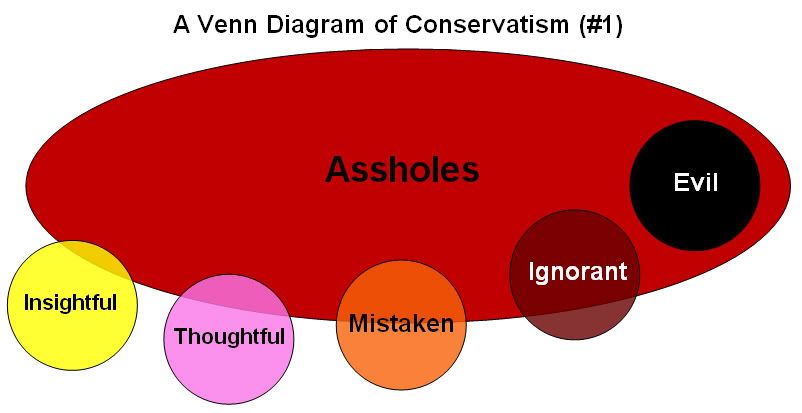
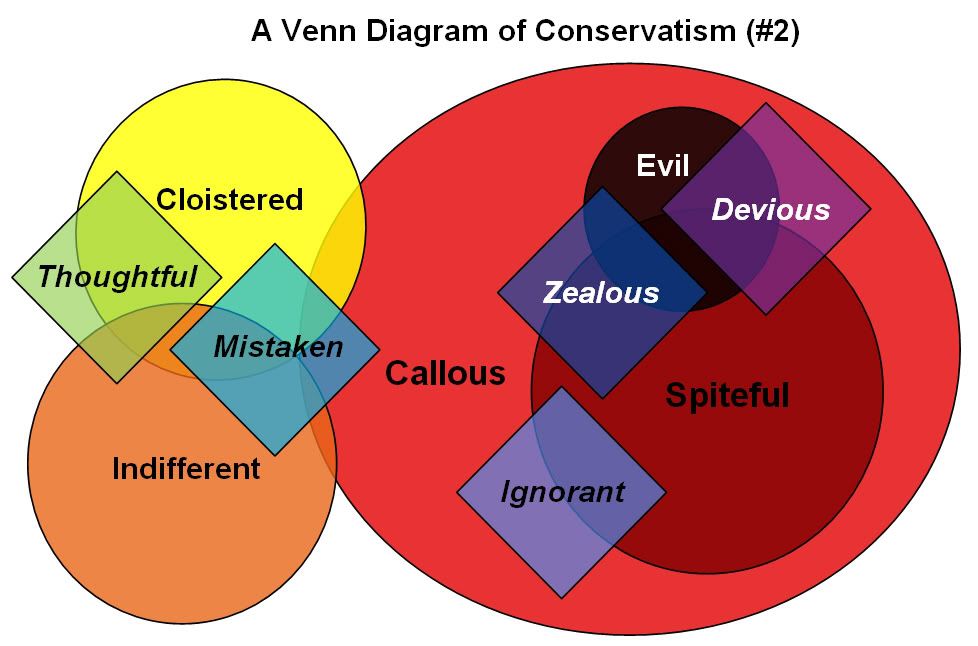
All these diagrams are experiments in trying to conceptualize and dissect the competing forces in American politics. The diagrams have their limitations, and anyone's welcome to try to make a better set. If one or more of these actually proves to be a helpful tool, great. Otherwise, don't mind me doodling...
Democrats and Republicans
Most political reporting views every story through a Democratic-Republican dichotomy. Given that those are the two major parties, and in most cases, they'll be deciding what's actually done (or not done) on an issue, it makes sense. However, it can be a very limiting approach.
If we look at the two parties on a continuum of liberalism to conservatism, we wind up with something like this:

(Click for a larger view, or go here.)
One can argue about the parties' exact placement, and there are certainly outliers, such as genuinely liberal politicians. However, for some time now, officials in both parties have tended to be more conservative than their constituents. The Democrats as a whole are not particularly liberal, and the United States, unlike a number of other industrialized democracies, does not have a major socialist party. It makes the screaming about socialism from idiots and shills all the more ludicrous. By the standards of current Republican talking points, Eisenhower, Nixon, and even Saint Ronnie Reagan were flaming socialists. Media stories that treat the "socialism" propaganda as a serious critique deny their audience important context, and can wind up being quite deceptive. It's the same for many national political "debates." Corporate media accounts are all too often uncritical of the veracity of claims, and in America, the Overton window has been pushed ever further to the right.
As Off-Center and other books have shown, Bill Clinton sought consensus building among moderates and centrists, while the Bush administration used a 50+1 strategy for both campaigning and governing – courting the far right conservative base rather than the political middle. Party dynamics have further shifted. McCain unsuccessfully attempted a strategy similar to Bush's in the 2008 general election. Yet in response to the 2008 losses, rather than rethinking their approach to appeal to the political middle, right-wingers (e.g. Limbaugh, Fox News, RedState) decided the GOP failed due to a lack of ideological purity. They've tried to purge the party of all those who doubt the divinity of Sarah Palin or practice the triple heresies of moderation, bipartisanship, and practicality. Lost in all their furor is any recognition of not only voters' widespread rejection of conservative policies, but how disastrous those policies themselves have been. Several analysts have noted that the GOP is increasingly becoming a regional party rather than a national one. Yet despite all this, David Broder and his ilk will continue to pen op-eds fetishizing a conservative-dominated "bipartisanship" regardless of elections, the soundness and popularity of policies, and the lack of good faith by some of the players.
Discussing the liberal-conservative continuum above can be valuable, but it's one-dimensional, conflating economic and social issues. It can be more useful to look at two dimensions, something like this:

If we look at the major political parties on this chart, I think we get something like this:

Again, one can argue about the exact placement of the parties, and this chart is more accurate for elected officials than for the American population as a whole. However, many elected Democrats won't challenge the massive tax cuts for the rich instituted under Reagan - and pushed even further by George W. Bush - even though the data show that the country fares better overall under a more progressive tax rate (and under Democratic presidents). Nor do Democrats tend to oppose corporate welfare. Some Democrats do push to raise the minimum wage and also to improve living standards for average Americans in small ways, while the Republicans almost never do. But both parties are fairly economically conservative, certainly in terms of challenging oligarchs and representing average citizens, as we can see on Wall Street accountability, health care reform, and a host of other issues. I'd further argue that most elected Republicans aren't supporting "conservative" economic policies that preserve the status quo – they're pushing regressive policies that increase the already grossly imbalanced inequity of wealth and power in America. The Democratic Party is more socially tolerant overall, although some self-described conservatives and Republicans are fairly socially tolerant, and even support gay marriage. Socially conservative Democrats exist as well, but the truly rabid social conservatives – and economic conservatives – tend to be Republican.
While the mainstream media's stories on social issues can be quite superficial, they tend to be better than their pieces on economic matters, which generally are told from a rich, corporate angle. Some of the problem is simply who's reporting. It's not an accident that ABC's millionaire Charlie Gibson, during the 2008 primary debates, thought $200,000 was a middle class income for a married couple, and repeated debunked claims about capital gains taxes that affect the rich the most. Nor is it surprising that during ABC's town hall with Obama on health care this June, Gibson and Diane Sawyer asked most of their questions from a "Shouldn't we be scared?" insurance industry perspective that ignored major problems with the status quo. They also weren't about to compare America's much higher health costs to those of other industrialized nations, or hammer Obama to justify why it wouldn't be wiser just to go straight to a single-payer system.
Regardless, it's pretty rare for mainstream coverage simply to break down who will benefit from a policy, and how much, compared to everyone else. You're much more likely to read a piece concern trolling about Social Security and Medicare than you are to read a piece about the massive wealth inequity in America (and how it's increased over the past 30-some years). You'll hear about the need to cut spending on education, social services and the arts, but you're less likely to hear about profligate defense spending, corporate welfare and tax breaks to buy yachts. (I'd sorta like to break down stats on this dynamic, actually.)
The Democrat-Republican dichotomy also fits perfectly into the "he said-she said" stories the press adores. For the press, such stories are appealing because they're easy, quick, and can avoid charges of partisanship. Fact-checking statements takes more time, and who wants to do critical analysis of policies or examine a politician's record in detail? However, even "he said-she said" pieces tend to be more informative than a related type of story, beloved of certain journalists in the Village of Washington, D.C. This type of story always winds up with the same conclusion, facts be damned:

Or, "The Bullshit that Launched a Thousand Digby-Somerby-Greenwald Posts"… and many a post throughout the liberal blogosphere.
(A 2007 post, "Color Commentary," further diagrams the media's love of "splitting the middle" between Democrats and Republicans and how this leads to a deceptive picture.)
While the conservative framing often used by the media is a perennial subject of liberal blogs, the key liberal critique of High Broderism and the corporate media in general has always been that it's shallow and inaccurate. Back in 1987, Molly Ivins, riffing on Russell Baker, captured this problem beautifully (emphasis mine):
The American press has always had a tendency to assume the truth must lie exactly halfway between any two opposing points of view. Thus, if the press present the man who says Hitler is an ogre and the man who says Hitler is a prince, it believes it has done the full measure of its duty.
This tendency has been aggravated in recent years by a noticeable trend to substitute people who speak from a right-wing ideological perspective for those who know something about a given subject. Thus we see, night after night, on MacNeil/Lehrer or Nightline, people who don't know jack-shit about Iran or Nicarauga or arms control, but who are ready to tear up the peapatrch in defense of the proposition that Ronald Reagan is a Great Leader beset by com-symps. They have nothing to off in the way of facts or insight; they are presented as a way of keeping the networks from being charged with bias by people who are themselves replete with bias and resistant to fact. The justification for putting them on the air is that "they represent a point of view."
The odd thing about these television discussions designed to "get all sides of the issue" is that they do not feature a spectrum of people with different views on reality:
Rather, they frequently give us a face-off between those who see reality and those who have missed it entirely. In the name of objectivity, we are getting fantasyland.
Ivins at her best was very sharp, and this leads us nicely to our next model.
Wonks, Hacks and Zealots
Framing everything as a battle between Democrats and Republicans often obscures more fundamental underlying tensions:

Bruce Reed described the core conflict in an entertaining 2004 piece, "Bush's War Against Wonks":
Strip away the job titles and party labels, and you will find two kinds of people in Washington: political hacks and policy wonks. Hacks come to Washington because anywhere else they'd be bored to death. Wonks come here because nowhere else could we bore so many to death. These divisions extend far beyond the hack havens of political campaigns and consulting firms and the wonk ghettos of think tanks on Dupont Circle. Some journalists are wonks, but most are hacks. Some columnists are hacks, but most are wonks. All members of Congress pass themselves off as wonks, but many got elected as hacks. Lobbyists are hacks who make money pretending to be wonks. The Washington Monthly, The New Republic, and the entire political blogosphere consist largely of wonks pretending to be hacks. "The Hotline" is for hacks; National Journal is for wonks. "The West Wing" is for wonks; "K Street" was for hacks.
After two decades in Washington as a wonk working among hacks, I have come to the conclusion that the gap between Republicans and Democrats is as nothing compared to the one between these two tribes. We wonks think we're smarter than hacks. Hacks think that if being smart makes someone a wonk, they'd rather be stupid. Wonks think all hacks are creatures from another planet, like James Carville. Hacks share Paul Begala's view that wonks are all "propeller heads," like Elroy on "The Jetsons." Wonks think the differences between hacks and wonks are as irreconcilable as the Hutus and the Tutsis. Hacks think it's just like wonks to bring up the Hutus and the Tutsis.
In every administration, wonks and hacks fight it out. The measure of a great president is his ability to make sense of them both. A president must know the real problems on Americans' minds. For that he needs hacks. But ultimately, he needs policies that will actually solve those problems. For that he needs wonks.
I'd disagree somewhat with Reed on his placement, since I'd put most TV pundits and conservative columnists in the hack category. Still, it's a funny and useful framework, and his piece dovetails nicely with Ron Suskind's work on the "Mayberry Machiavellis" of the Bush administration who opposed "the reality-based community."
The diagram above adds a third group, zealots. I'm using ideology here as a pejorative, defining it as a set of notions held without much reflection or factual basis, as opposed to philosophy. I'll add ignorance in with ideology.
The wonks aren't always right, and a great deal of them aren't ignorant about politics, although many wonks retain the capacity to be stunned by really atrocious hackdom. However, the wonks tend to arrive at good policy answers more often than hacks because that's their aim. Obviously some political power, whether through elected office or a citizen movement, is necessary to enact good policies. And sometimes, the smart political move is also good policy, hence the overlap between the circles in the diagram. Still, pure hacks see power and political gamesmanship as their own ends, and their efforts often oppose good policy. Meanwhile, the zealots occasionally stumble upon a good policy, but they're far more likely to take a side in a power struggle framed by the hacks.
For example, like most advanced hacks, Newt Gingrich has always been fond of selling a slogan versus debating the merits of a policy. "Small government" isn't so bad as a general principle, if it equates to "the government should be as large as it needs to be, but should be as small as possible." That's never been Gingrich's true stance, though. In Congress, he attacked important regulation and oversight, and since leaving, his "new" ideas have mostly been recycled conservative positions that amount to a massive giveaway to rich individuals and corporations. Bill Scher has made the point that the debate between "small government" and "big government" is a false one. The key questions to ask are whether government is effective, responsible and representative. Furthermore, what's the best solution for this or that specific problem? That's a more nuanced and common sense framework, requiring actual evidence and qualitative judgment for a given situation. It's silly to thunder about "small government" if the FDA needs more employees to handle the increase in drug applications, or if the government needs more people working on cybersecurity to keep up with the times and "private" industry standards. Rick Perlstein's term E. Coli Conservatism refers to the conservative zeal for cutting essential food safety regulations and oversight. Of course, that attitude goes much further, as evidenced by the lack of checks on Wall Street's misconduct. It also never made good sense to cut government jobs and then hire the same people (or a new set) as private contractors at higher rates, and without government-mandated audits and oversight. KBR electrocuting American troops overseas, serving them contaminated food, and then massively overcharging the taxpayers for the privilege ain't exactly progress, either.
Case by case, qualitative evaluations are not what hacks want, though. Characteristically, they argue from a conclusion backwards. A good slogan can help sell a good policy, but the pure, anti-wonk hack wants to avoid any realistic discussion of policy on the merits. "Drill Baby Drill" and "You're either with us, or the terrorists" are slogans wielded to try to shut down critical thought, not invite it. The smarter hacks know the game, whereas their allied zealots often really believe the false talking points. (Don't make John McCain explain on camera that Obama's not really a Muslim, ma'am.) Others simply don't care that much about whether the latest battle-cry is bullshit or not - like the most vicious of hacks, they're in it mostly for the blood.
In American politics, I think the wonk-hack-zealot divide often plays out more like this:

It's a bit tongue-in-cheek, but I still think it’s roughly accurate. Meanwhile, in terms of the political parties, I think the breakdown looks something like this:

The Democrats certainly can be corporate toadies, but it's not a secret that the Republicans are the party of the rich and powerful. And while the Republicans don't have a monopoly on batshit crazy zealots, they have a strooong advantage. (If you doubt it, follow the links in the "Breakdown" section of the Diagrams on Conservatism post.) Authoritarianism also adds a natural inclination for ideological rigidity.
Greedy hacks and crazy zealots are bad enough, but it's the intersection of the two that's really dangerous. Neocons and members of "the Family" certainly qualify, but Grover Norquist is also a prime example. An ally of Gingrich, Norquist is most infamous for his line that his goal is to get government "down to the size where we can drown it in the bathtub." As Will Bunch chronicles in Tear Down this Myth: How the Reagan Legacy Has Distorted Our Politics and Haunts Our Future, Norquist was a leading force in the movement to cement a mythical version of Reagan into American culture. Norquist's own views are basically a far-right, caricature version of Reagan's – Norquist always wants to cut taxes and eliminate federal regulatory agencies (well, really most agencies). It would be one thing to have a general principle that income taxes should be as low are possible, but Norquist's stance of no new taxes - ever - under any circumstances - is absolutely insane, allowing no adjustment for the realities of a situation. That is, if one wants to govern responsibly. Refusing to ever raise taxes makes some sense if one wants to "starve the beast," give more money to the rich and powerful, and one is privileged enough to avoid the ensuing damage and suffering. Were Norquist merely a fringe crackpot, it wouldn't matter so much, but while he's not well known to the general public, he is extremely influential in Republican circles. When Republican officials who should be doing their jobs are seeking permission from Norquist even to slightly deviate from his "no tax hikes" pledge, even in the face of looming disaster, we've got problems. Norquist is a diehard zealot, but he's also a hack. It's also not as if he and his good friend Karl Rove, still intent on building a permanent conservative majority, are interested in either honest policy discussions or civil politics. It's utter folly to pretend these are honorable people.
Using the wonk-hack-zealot model, the biggest problems of the mainstream media are its failures to discuss policy, and that it gives undeserved respectability to hacks and zealots and not just wonks. It doesn't fact-check, traffics in false equivalencies, and shies away from calling bullshit. Not long ago Paul Krugman caught the Heritage Foundation being grossly deceptive - yet again. That's the rule rather than the exception for conservative think tanks, yet they are treated seriously and rarely thoroughly fact-checked by most news outlets. Meanwhile, on some subjects, such as going to war and health care reform, the mainstream media actively excludes wonks – or at least the accurate set. (Sometimes it's not clear whether someone's more a hack versus a dumb wonk or idiotic zealot). In fact, being disastrously wrong on weighty subjects such as going to war often leads to greater financial success than being right. Oddly, repeating the same old discredited crap generally isn't discouraged, either. But for this crowd, respectability, seriousness, wisdom and truth itself are determined socially, not empirically, and track records are pesky things. After all, if the pundit circuit were a meritocracy, most of the current twits would be out of jobs.
The Beltway crowd admires raw power and "winners," and don't care much who gets abused in the process, as long as it's not them. They love McCain, because he offers good stories and also shares their disdains. Let's return once more to the Bush-Rove 50+1 strategy, in contrast with the more typical "appeal to the middle" approach of Clinton. Villagers Mark Halperin and John Harris wrote a 2006 book about this, The Way to Win: Taking the White House in 2008. It'd be one thing to write a good descriptive book that avoids prescription. However, Halperin in particular admires Karl Rove and has never shown much concern that governing from a far right position (30+1, perhaps) didn't just disenfranchise the majority of the country, the actual policies used by the Bushies led to catastrophe. That's even leaving aside that Rove is one of the most ruthless and vicious political operatives ever. None of those factors has lead to Rove being ostracized. So it's really not surprising that a set of journalist hacks wouldn't understand or care to cover wonks. And Beltway zealots make it worse, with their fixation on conservative-dominated "bipartisanship," their eternal fear of Dirty Fucking Hippies, and insistence on not holding officials accountable – assuming they've committed war crimes and other gross abuses versus a getting a blow job, of course. It's a failure of character and conscience as well as intellect. But it's not shocking that a privileged class wouldn't care about the negative consequence of policies on most of the country, and that shallow people would treat politics mainly as entertainment.
Most political coverage centers on the power and politics side of the wonk-hack-zealot diagram, and doesn't even do a particularly good job with that. Politics themselves should center on bread to the citizens, but to the chattering class, it's only ever about circuses.
The wonk-hack-zealot model is the sort I prefer to use with that rare breed of honest, thoughtful conservative willing to have a discussion in good faith. There's one more model I think may be useful, though, and we'll look at that next – after a detour.
A Detour on Ideology, Dogma, Perspective and Power
It's beyond the scope of this post to delve into all the variations of socialism and capitalism, where they intersect, where they conflict, and what's considered wise and the norm around the world (and throughout history). I did want to detour briefly on "isms" and dogma, though. This diagram comes from a 2007 post on religion in society that focused on theocrats:

(Click for a larger view, or go here.)
My main point was that while a group's ideology isn't irrelevant, it's secondary to the power structure it seek to impose. Furthermore, even if the ideology of a group happens to be decent, and its leaders are trustworthy people, the power structure itself remains unfair and oppressive. In the post, my point was that American Christian theocrats are not seeking Freedom of Religion, which they already have - nor are they seeking to persuade, as they already can - they are seeking a position of power over others. Upholding the separation of church and state isn't anti-religious, it's religion-neutral (some even view it as pro-religious), which is why many other Christians oppose the theocrats. Opposing theocracy has little to do with a theocrat's religious beliefs – it's about opposing their attempted power grab and their desire to impose their beliefs on others. Our current system works much better. Incidentally, they're not trustworthy (leaders of such groups never are), but even if they were, with unchecked power, that old rule of power corrupting and absolute power corrupting absolutely would kick in. In terms of the previous model, these people tend to be both hacks and zealots, with the more hackishly-oriented higher up the ladder.
The rhetoric and tenets of an ideology can be very important, but often much less important than what the ideologues actually do. When Gorbachev was seeking reform in the Soviet Union, he was opposed by some of the old guard. The same dynamic has played out with other reformers in Russia since. When this has happened, some American conservatives have insisted that the old guard are "left-wingers." Okay, there's some basis for that. Still, it's a bit shallow (and an attempt to equate communism with American liberalism). The key dynamic has been one of reformers versus the establishment, not left versus right. Ideology often isn't as important as the actual power dynamics, from the usual personal politics to the larger power structure in the country. People in power generally try to keep it. The real bastards fight for it even if it means everyone and everything around them burns as a result. Regardless of their economic views, a high-ranking, communist bureaucrat can have a great deal in common with a Goldman Sachs executive.
With these caveats in mind, on to the third model.
Classic Liberalism and Other "Isms"

(Click for a larger view, or go here.)
We'll go into detail on the overlaps in a bit. But "classic" liberalism is the notion that everyone is created equal and deserves equal rights under the law. There may be many disagreements about specific goals and methods within this group, but essentially, this philosophy represents Enlightenment ideals, and attempts to look to objective general principles for guidance. In contrast, authoritarianism looks to a chosen authority figure and group identity to determine morality. The example I keep returning to is torture – authoritarians will argue it's wrong when done to members of their group, but right when done to others. I'm using "Feudalism" as a catch-all for feudal ideas about monarchs, lords, clergy, merchants and serfs, but also for similar attitudes in the present day. The key notion is that everyone is not created equal, and there is a natural order or socioeconomic hierarchy, determined by deities or nature. Finally, establishmentarianism centers on defending what's currently in place. Of course, what's actually "in place" will vary from country to country and era to era, as will the scope of the debates among classic liberals. Consequently, the actual politics will vary somewhat, but while they're not irrelevant, we're talking mostly about general underlying attitudes, approaches, world views, philosophies and all that.
If we look at the same diagram in terms of the two big political parties in America, we get something like this:

(Click for a larger view, or go here.)
It's not drawn to scale, of course, but while the two parties overlap somewhat, the Republican party is more conservative. Authoritarianism is conservative in nature, conservatives are more accepting of inequality and inclined to believe in a natural hierarchy (feudalism in our diagram), and obviously, conservatives are eager to defend the establishment against the Dirty Friggin' Hippies. Dude.
Here's where I think we get more interesting, though:

(Click for a larger view, or go here.)
We've already gone through general definitions for the four circles, but now it's time for more specific distinctions about the intersections.
As with the previous model of wonks-hacks-zealots, there's always room for self-deception, ignorance and disingenuous shilling. I'm less interested in where people would think they fall on this diagram (or claim to) than where they actually do. For instance, someone who's protesting to give even more money to the rich and powerful is not fighting for equality and fairness, no matter how much they holler about teabagging.
#1 – People in this group believe that everyone is created equal and deserves equal rights. They're concerned with a fair society. Unlike some of their neighbors in the diagram, they don't believe that equality or fairness has been achieved yet in one or more major areas. FDR was denounced as a traitor to his class for joining this group, and MLK and other social justice activists certainly belong. Most members of this group support competition, just of the healthy variety, with a level playing field and equal opportunity. They're more likely to support cooperative paradigms on top of that, whereas authoritarians prefer cutthroat systems. There can be a considerable range of views in this group, and other groups may speak of fairness and equality as well. However, in contemporary America, this philosophy is most embodied by liberal activists and those bleeding hearts, the Dirty Friggin' Hippies. [Reformers, Liberal Activists]
#2 – This group is normally called centrist – at least in the Democratic party. They believe in many of the same ideals as group #1, but they either believe that basic equality and fairness have been achieved, or they're hesitant about changing things too quickly, without bipartisanship, etc. They will work to reform things, but normally incrementally, or need to be pushed, because the weight of their foot tends to be with the establishment. At their best, they are pragmatic, but at their worst, they're more afraid of conflict than they are incensed by corruption and exploitation. Rule-of-law conservatives also tend to fall into this category. In contrast, authoritarian conservatives will break the law if so ordered, or if they desire it. [Centrists]
#3 – This group is obsessed with power, wealth, and influence, and is almost completely amoral. They're populous on Wall Street and in lobbying firms. They may doubt that the socioeconomic hierarchy is god-given, but they have no doubts that one exists and they want to be atop it. They have no interest in reforming the established order apart from better exploiting it and improving their own status. They're fond of rhetoric about the "survival of the fittest," even if they prefer the corporate version to that of Mad Max and Thunderdome. Other groups can share many of these traits, and certainly their characteristic arrogance, but members of group #3 are less likely to slap on the moral sheen of righteousness of, say, a conservative evangelical leader. This group is represented by Gordon Gekko and the pre-conscience Nick Naylor. The only checks on their ambition are threats of public disgrace or prison – and sometimes, not even those work. Despite destroying the world economy, they're still in power – largely unchecked - on Wall Street. [Wall Street Players, Lobbyists]
#4 – There are inherent contradictions between classic liberalism and feudalism, so this group is an odd if significant bunch. Consciously or not, they think there is a natural order of socioeconomic hierarchy (with themselves at the top, of course) yet also believe the inherently inferior classes (or races) should have some rights and protections. Maybe they're better described as feudalists who aren't complete assholes. However, while they may support giving scraps to the lower orders through charity and trickle-down economics, they will fight like hell against any efforts that might change their power and privilege. Many are not that different from group #3, but are much more concerned about propriety, which they wield like a weapon. This group contains some of the country club set, and most of the Beltway Village crowd. When they're public figures – such as news anchors – they often hide their wealth and cultivate an image of relating to 'the common man.' They may even speak reverently about the Civil Rights Movement of the 60s, while not doing much about civil rights abuses or exploitation in the present day. They admire the greedy far more than do-gooders. Some who appear to be in this group are really closet #3s or #6s, and wish they could do away with the pretense of giving a damn about the lower orders. They are careless people. They oppose investigations and accountability for, oh, widespread Wall Street misconduct collapsing the world economy, spying on American citizens, lying to start a unnecessary war, and torture and human rights abuses. While some of the centrists of group #2 oppose such investigations as well, it's more for pragmatic (if mistaken) reasons, whereas group #4 is more horrified by the notion of a member of their class being held to account – and the dangerous precedent this would set. [Aristocrats, Noblesse Oblige]
#5 – This is an odd group as well, given the conflict between classic liberalism and feudalism. It's best described by a certain type of missionary, who works to help disadvantaged people he or she also feels (however unconsciously) are inherently inferior. Some of Albert Schweitzer's reported remarks certainly fall in this category. Members of this group may be critical of the aristocrats in group #4 or other establishmentarians for not doing enough to help. Individual members of this group may be raging hypocrites, or simply flawed human beings trying their best from their perspective. As for any missionary work itself, there's the question of whether it does more harm than good, or whether the good works outweigh any other stumbles. The more authoritarian breed of missionary tends to do more damage, though. [Missionaries]
#6 – This group, along with #7, represents the majority of the conservative base, conservative bloggers, and the Republican leadership. They are authoritarian conservatives and almost always social conservatives. They share some similarities with their neighbors in the diagram, but while group #4 is focused on defending their class, and group #3 is hungry to acquire more wealth and power, group #6 is obsessed about their righteousness. Other groups might also agitate for unnecessary wars, but this is the key group for chickenhawks, American exceptionalists and religious triumphalism. Their dominant trait is a never-ending fit of pique that their obvious, inherent superiority is not acknowledged and deferred to despite a lack of merit. There's no doubt in this group that they represent the natural top of any hierarchy, or at least that they should. Coupled with this is their fierce conviction that they are persecuted, terribly and unjustly. They firmly believe that if those uppity folk (liberals, racial minorities, women, gays) just minded their place, and their preferred social order was enforced, all would be well. In their view, the poor are poor due to a lack of character and thus deserve contempt – at least if they're minorities. They steadfastly believe (or pretend to believe) the well-discredited myth of a "liberal" corporate media. Liberals seek to reform the media, whereas authoritarian conservatives often seek to destroy any independent media altogether. Authoritarians also prove remarkably resistant to facts, and are highly unwilling to admit errors, whether mundane or disastrous. Counterfactually, members of this group blame losing Vietnam on liberals, claim to have won the Cold War, and have tried to whitewash both the Iraq War and their key role in starting it. They're even more shameless about ignoring the economic damage they've caused. While members of other groups also disdain and insult their perceived foes, this group brings a distinctive viciousness to it, and they're the most likely to use violent, racist or eliminationist rhetoric. The country club crowd of this set will expound their true views in safe havens such as the National Review cruise, while the rank and file feels that harassing the hell out of women seeking abortions or the family of a 12-year old accident victim is God's own calling. What moral code they have is derived from authority and group identity. They abuse power when they have it, and whine incessantly when they don't.
One could argue that this group is establishmentarian when in power, and anti-establishmentarian when not in power, in which case they flip-flop to group #7 depending on circumstances, but there are problems with this view. For one thing, the Republican and Democratic parties in America are both mostly establishmentarian, with the Republicans more feudalistic, authoritarian and regressive on top of that. It's more accurate to say that members of this group believe that they represent the true "establishment" and anyone else who takes power is a usurper. That's why the same people who attacked the patriotism of anyone who questioned Bush, the war with Iraq or many other abuses of executive power turned right around and screamed about Obama being a dictator. A fair number of these folks are undoubtedly hacks, but some of them honestly do not see any contradiction. Some of them are simply rabid assholes, whether lying or idiotic. (Again, if you doubt it, follow the links in the "Breakdown" section of the Conservatism post, or revisit the crusade against Graeme Frost.) It ain't polite to say that on TV, but ignore that reality at your peril. While some of this group will also talk about change and reform, their efforts almost always benefit the rich and powerful. They don't seek equality and fairness – instead, they seek domination in a more feudal power structure and the destruction of their perceived enemies. They oppose investigations because members of their group committed many of the crimes, and also - Go Cheney Yourself. [Authoritarian Conservatives, Right-Wing Bloggers, Imperialists.]
#7 – It's debatable as to what separates this group from group #6. Is it class, awareness or self-conception? For a template, I think of three things – Mick Huckabee supporters, rank-and-file theocrats, and the poor, rural whites described in Joe Bageant's Deer Hunting with Jesus. (Obviously, there's some overlap.) Huckabee's pitch was a conservative populist one, criticizing elites in Washington. While group #6 has made quite a racket of attacking "liberal elites" as well, the brighter and more privileged among them know it's a complete con job. Their guy Bush was as pampered as you can get. In contrast, Huckabee terrified the National Review-country club crowd, because he was what they claimed to love. He even attacked their chosen one, slimeball Mitt Romney, as the guy who fires you instead of the guy who works alongside you. Huckabee's pitch was also theocratic, making him definitely authoritarian, and his actual policies remain far more intolerant than his amiable demeanor would suggest. I'd say Huckabee himself is still in group #6, because his proposals on health care, taxes and economics were horribly irresponsible, and would have regressively given even more to the rich and powerful while leaving others out in the cold. I find it hard to believe he doesn't know this. His followers are another matter. Bageant actually uses the word "feudal" to describe the local governments of small towns in Deer Hunting with Jesus. The townsfolk he describes tend to be religious and socially conservative, they've received a minimal education, and they're being screwed economically. However, they also tend to accept their lot and feel it's their own fault they're unsuccessful (they're poor, but they view themselves as middle class). Their anger, such as it is, tends to be displaced onto black welfare queens, illegal immigrants and the other bogeymen provided by Reagan and the Republican party as a whole over the years. High-ranking theocrats such as James Dobson and members of "the Family" know the Washington power game and seem happy to exploit it, so I'd put them in group #6 as well. Rank-and-file theocrats typically believe – falsely – that America was founded as a Christian nation. They view themselves as fighting an evil secular establishment, yet also think they're fighting for a restoration of an establishment that never truly existed (at least in a de jure sense).
So what puts someone in group #7 versus #6? If it's anything, I'd say it's class and power. I'm inclined to put the Jesus Camp crowd in #7, but the power players of the theocracy movement in #6. Similarly, the townsfolk in Deer Hunting with Jesus may generally vote the same as group #6, and labor for their idea of the establishment, but they're not fully part of it. Management might flatter them, politicians might pander to them or use them as props, but they're not truly welcome at the table. Typically, they vote socially conservative and against their own economic interests, but also do so without much awareness of the consequences – unsurprisingly, their anti-union stances have never brought them greater prosperity. They may be less likely than group #6 to look down on the poor, at least if those poor are of their own race or region. Some conservative bloggers fall in this category, but the more prominent tend to be in group #6, and invoke members of group #7 as props. The National Review crowd will rail against their former classmates in the "liberal elite," but there's a reason they still haven't moved to poor, rural America. [Deer Hunters for Jesus, Rank-and-File Theocrats.]
#8 - These people serve power or the established order regardless of who's in charge – or wield it themselves. They often appear similar to members of groups #3 and #6. They are amoral in terms of the pursuit and use of power as is group #3, but they're more likely to view any existing power structure as arbitrary, and their own success as a combination of luck, skill and ruthlessness. They do not see any inherent morality or immorality in regards to the law. They have the mindset of mercenaries. Group #3 tends to be more arrogant and feel more entitled, and group #6 typically feels more self-righteous. For instance, members of group #8 might support an unnecessary war, but group #6 would talk of the war in terms of black and white morality, horrible villains and the righteous Americans, whereas members of group #8 would just be in it for the oil (or some other perceived benefit). However, the two groups can ape each other's rhetoric, and there can be considerable overlap. Still, members of group #8 aren't as into the authoritarian conservative rituals of affirming feelings of persecution and superiority (also known as listening to the Rush Limbaugh show). Nor do they generally care as much about prestige. The intelligence level of this group can vary widely. I'd say that O'Brien in 1984, and the villainous officials Grubitz and Hempf in the film The Lives of Others, qualify on the higher end. They understand how the world works, know that they are abusing power, and simply don't give a damn. I think Adolf Eichmann falls in this category too somewhat, or would had he not been part of a regime of murderous bigotry. But his key defining characteristics were following orders unquestioningly and having no imagination. He was a soulless bureaucrat, and simply wasn't concerned about who was hurt by what he did. The smarter in this set know the consequences of their actions, but still don't care. (They're typically cold-hearted, but the real sadists probably fall more in group #6.) [Mercenaries.]
#9 – Feudalism normally overlaps with other factors, so group #9 may be pretty small. Someone who believes that everyone is not created equal, and that there is a natural order of socioeconomic hierarchy, is almost certainly an authoritarian. Some survivalists might qualify. [Survivalists.]
#10 – Similarly, authoritarianism normally overlaps with other factors. Authoritarians tend to believe in some sort of natural order and value conformity and allegiance to some established order. However, some authoritarians might feel so far outside the American establishment that they land here, such as cult members. [Cultists.]
#11 – Most establishmentarians will also fall into one of the other groups. Someone who values conformity above any other values could potentially fit here. [Conformists.]
I'm not sure how helpful these rough archetypes are – the Reformer, the Centrist, the Wall Street Player, the Aristocrat, the Missionary, the Authoritarian Conservative, the Deer Hunter for Jesus, the Mercenary, the Survivalist, the Cultist, and the Conformist. I do think there's some use in looking at political groups as the result of several overlapping impulses, and looking at some of their core assumptions. I also think it can help explain why it can be so damn hard to achieve positive change.
Once again, all these diagrams are experiments in trying to conceptualize and dissect the competing forces in American politics (and sometimes, within ourselves). The diagrams have their limitations, and anyone's welcome to try to make a better set. I just find it helpful to try to visualize issues. If one or more of these actually proves to be a helpful tool, great. Otherwise, don't mind me doodling...
Edited slightly for typos and clarity.