
Tuesday, January 31, 2006
Oscar Nominees Announced
If you want to see the complete list of Oscar nominees, here it is. At first glance, I'd say it's pretty good... I'm very glad that Amy Adams got her deserved nomination for Best Supporting Actress. The one glaring omission is the failure to nominate Werner Herzog's Grizzy Man for Best Documentary Feature, since it was easily one of the best films, period, of the year (the bounce occured earlier than this round, though). It's heartening that more documentaries actually get domestic American distribution these days, and the field always tends to be deep... but the Herzog omission recalls the 1994 snub of Hoop Dreams. Still, for the Academy, this is pretty damn good list. This year, without a runaway, traditional Hollywood blockbuster, the pickings for the major awards contain more indies and semi-indies/mini-majors. 2005 featured some quiet, fine work... and in several categories I'd be pleased with any of the nominees winning.


Monday, January 16, 2006
MLK Day

Rather than writing about the obvious importance of Dr. Martin Luther King, Jr., I thought it best to post his most famous speech, from August 28th, 1963. It still gives me chills. You can hear and see it at the following excellent site , but the text is below:
I am happy to join with you today in what will go down in history as the greatest demonstration for freedom in the history of our nation.
Five score years ago, a great American, in whose symbolic shadow we stand today, signed the Emancipation Proclamation. This momentous decree came as a great beacon light of hope to millions of Negro slaves who had been seared in the flames of withering injustice. It came as a joyous daybreak to end the long night of their captivity.
But one hundred years later, the Negro still is not free. One hundred years later, the life of the Negro is still sadly crippled by the manacles of segregation and the chains of discrimination. One hundred years later, the Negro lives on a lonely island of poverty in the midst of a vast ocean of material prosperity. One hundred years later, the Negro is still languished in the corners of American society and finds himself an exile in his own land. And so we've come here today to dramatize a shameful condition.
In a sense we've come to our nation's capital to cash a check. When the architects of our republic wrote the magnificent words of the Constitution and the Declaration of Independence, they were signing a promissory note to which every American was to fall heir. This note was a promise that all men, yes, black men as well as white men, would be guaranteed the "unalienable Rights" of "Life, Liberty and the pursuit of Happiness." It is obvious today that America has defaulted on this promissory note, insofar as her citizens of color are concerned. Instead of honoring this sacred obligation, America has given the Negro people a bad check, a check which has come back marked "insufficient funds."
But we refuse to believe that the bank of justice is bankrupt. We refuse to believe that there are insufficient funds in the great vaults of opportunity of this nation. And so, we've come to cash this check, a check that will give us upon demand the riches of freedom and the security of justice.
We have also come to this hallowed spot to remind America of the fierce urgency of Now. This is no time to engage in the luxury of cooling off or to take the tranquilizing drug of gradualism. Now is the time to make real the promises of democracy. Now is the time to rise from the dark and desolate valley of segregation to the sunlit path of racial justice. Now is the time to lift our nation from the quicksands of racial injustice to the solid rock of brotherhood. Now is the time to make justice a reality for all of God's children.
It would be fatal for the nation to overlook the urgency of the moment. This sweltering summer of the Negro's legitimate discontent will not pass until there is an invigorating autumn of freedom and equality. Nineteen sixty-three is not an end, but a beginning. And those who hope that the Negro needed to blow off steam and will now be content will have a rude awakening if the nation returns to business as usual. And there will be neither rest nor tranquility in America until the Negro is granted his citizenship rights. The whirlwinds of revolt will continue to shake the foundations of our nation until the bright day of justice emerges.
But there is something that I must say to my people, who stand on the warm threshold which leads into the palace of justice: In the process of gaining our rightful place, we must not be guilty of wrongful deeds. Let us not seek to satisfy our thirst for freedom by drinking from the cup of bitterness and hatred. We must forever conduct our struggle on the high plane of dignity and discipline. We must not allow our creative protest to degenerate into physical violence. Again and again, we must rise to the majestic heights of meeting physical force with soul force.
The marvelous new militancy which has engulfed the Negro community must not lead us to a distrust of all white people, for many of our white brothers, as evidenced by their presence here today, have come to realize that their destiny is tied up with our destiny. And they have come to realize that their freedom is inextricably bound to our freedom.
We cannot walk alone.
And as we walk, we must make the pledge that we shall always march ahead.
We cannot turn back.
There are those who are asking the devotees of civil rights, "When will you be satisfied?" We can never be satisfied as long as the Negro is the victim of the unspeakable horrors of police brutality. We can never be satisfied as long as our bodies, heavy with the fatigue of travel, cannot gain lodging in the motels of the highways and the hotels of the cities. We cannot be satisfied as long as a Negro in Mississippi cannot vote and a Negro in New York believes he has nothing for which to vote. No, no, we are not satisfied, and we will not be satisfied until "justice rolls down like waters, and righteousness like a mighty stream."
I am not unmindful that some of you have come here out of great trials and tribulations. Some of you have come fresh from narrow jail cells. And some of you have come from areas where your quest -- quest for freedom left you battered by the storms of persecution and staggered by the winds of police brutality. You have been the veterans of creative suffering. Continue to work with the faith that unearned suffering is redemptive. Go back to Mississippi, go back to Alabama, go back to South Carolina, go back to Georgia, go back to Louisiana, go back to the slums and ghettos of our northern cities, knowing that somehow this situation can and will be changed.
Let us not wallow in the valley of despair, I say to you today, my friends.
And so even though we face the difficulties of today and tomorrow, I still have a dream. It is a dream deeply rooted in the American dream.
I have a dream that one day this nation will rise up and live out the true meaning of its creed: "We hold these truths to be self-evident, that all men are created equal."
I have a dream that one day on the red hills of Georgia, the sons of former slaves and the sons of former slave owners will be able to sit down together at the table of brotherhood.
I have a dream that one day even the state of Mississippi, a state sweltering with the heat of injustice, sweltering with the heat of oppression, will be transformed into an oasis of freedom and justice.
I have a dream that my four little children will one day live in a nation where they will not be judged by the color of their skin but by the content of their character.
I have a dream today!
I have a dream that one day, down in Alabama, with its vicious racists, with its governor having his lips dripping with the words of "interposition" and "nullification" -- one day right there in Alabama little black boys and black girls will be able to join hands with little white boys and white girls as sisters and brothers.
I have a dream today!
I have a dream that one day every valley shall be exalted, and every hill and mountain shall be made low, the rough places will be made plain, and the crooked places will be made straight; "and the glory of the Lord shall be revealed and all flesh shall see it together."
This is our hope, and this is the faith that I go back to the South with.
With this faith, we will be able to hew out of the mountain of despair a stone of hope. With this faith, we will be able to transform the jangling discords of our nation into a beautiful symphony of brotherhood. With this faith, we will be able to work together, to pray together, to struggle together, to go to jail together, to stand up for freedom together, knowing that we will be free one day.
And this will be the day -- this will be the day when all of God's children will be able to sing with new meaning:
My country 'tis of thee, sweet land of liberty, of thee I sing.
Land where my fathers died, land of the Pilgrim's pride,
From every mountainside, let freedom ring!
And if America is to be a great nation, this must become true.
And so let freedom ring from the prodigious hilltops of New Hampshire.
Let freedom ring from the mighty mountains of New York.
Let freedom ring from the heightening Alleghenies of Pennsylvania.
Let freedom ring from the snow-capped Rockies of Colorado.
Let freedom ring from the curvaceous slopes of California.
But not only that:
Let freedom ring from Stone Mountain of Georgia.
Let freedom ring from Lookout Mountain of Tennessee.
Let freedom ring from every hill and molehill of Mississippi.
From every mountainside, let freedom ring.
And when this happens, when we allow freedom ring, when we let it ring from every village and every hamlet, from every state and every city, we will be able to speed up that day when all of God's children, black men and white men, Jews and Gentiles, Protestants and Catholics, will be able to join hands and sing in the words of the old Negro spiritual:
Free at last! Free at last!
Thank God Almighty, we are free at last!
In Defense of Propaganda?
Last Tuesday, The Washington Post ran an op-ed by on the value of propaganda by Reuel Marc Gerecht of the conservative American Enterprise Institute. He raises some interesting points, but to my mind, avoids some key factors and essentially dodges the central questions raised by the use of propaganda in Iraq. He starts off:
The main substance for Gerecht’s argument is the use of covert operations by the CIA in the Soviet Union during the Cold War (but his short op-ed deserves a full read before reading this post). He was scheduled for an online chat that day, so after reading his op-ed, I dashed off a quick question for him. As it so happens, he picked mine to run with first. You can read the transcript of the entire online chat here. My question/comment to him was:
While I’m avid reader of the Post’s online chats, this is only the second time I’ve submitted a question, and the first time I’ve had one published. Reading over my quickly-penned question, I’d say it’s pointed, perhaps even slightly hostile, but still attempts to be relatively civil in tone. I felt Gerecht was being somewhat disingenuous in his op-ed, but I wanted to focus on his actual argument (which ducked the central questions).
Gerecht’s response was:
I have to give Gerecht credit for a fairly thoughtful response. I wrote him a quick follow-up question which he may have read but with limited time did not get a chance to reply to. I forgot to save a copy of it, but it roughly said:
This point relates the argument Gerecht poses in his first paragraph, which is something a straw man. Okay, it might not be great if The New York Times readership thinks ill of the Pentagon’s tactics. But the key issue has always been what Iraqis think of them. Gerecht’s main objection to the Pentagon propaganda is that it’s been incompetently handled. He does not have an ethical problem with it (I do). However, in his response to me he also ducks the real issue of effectiveness somewhat by using a faulty Soviet Union analogy and by ignoring the reaction of Iraqis to the propaganda news (everything I’ve read to date suggests it has not been positive!).
Another questioner made one of my key points much better than I did:
The most authoritative question/comment, however, was the following:
Gerecht essentially contradicts the thesis of his op-ed here. You will not find this very reasonable view, one that he decries in his first paragraphs, anywhere expressed in the op-ed itself. Was the op-ed primarily an intellectual exercise in arguing a contrarian view? Is his only objection that the CIA, not the military, should handle propaganda? I would like to account Gerecht a higher standing that apologist for the Bush administration, but I have to wonder. The Soviet analogy simply does not hold up (nor does comparison with Germany or Japan after WWII), nor do virtually any of his points. If one believes that “lies for the public good” are told primarily to benefit the public versus those who choose to withhold information, then one will likely agree with Gerecht. If one believes that the CIA and other government agencies almost always exercise fine judgment and should be allowed great discretion to do most of what they please, then one will agree with Gerecht. However, his argument on its merits is weak.
As another interesting sidebar, George Packer wrote in The Assassin’s Gate that the Bush administration asked the American Enterprise Institute to help draw up postwar plans. He reports:
Now to be fair to AEI, the Bush administration jettisoned several offers to help plan for the postwar as well as several already existing postwar plans from significant sources such as, oh, the State Department. Still, DeMuth’s apparent idea that one can invade a country and not do any reconstruction is astonishing. Flying in the face of history (Germany and Japan after WWII, among others), it seems he is more concerned about a perceived ideology purity than dealing with the realities of the situation. The most appalling aspect of the entire Iraq war remains the adminstration's utter disdain for any real sort of postwar plan, with a complete failure to have a substantive plan A, let alone a plan B for the worst-case scenario.
Along these lines, the final contention of my initial question to Gerecht was that a successful reconstruction (essentially, good performance) was the most persuasive tool we had, and that any PR or propaganda attempts would be useless if Iraqis did not notice improvements in the realities of their lives. I have to give Gerecht credit for entering into a dialogue, however flawed his contribution may be. Not every think tank is monolithic and not every member is of the same mind. Still, I find it interesting that Gerecht works for the same organization that poo-pooed postwar plans. I find it interesting that Gerecht’s op-ed avoids discussion of how the reconstruction is going and instead focuses on perception. I find it interesting that he addresses domestic critics but does not focus on how Iraqis perceive the revealed use of propaganda.
Expanding literacy and making great books and thought available is revolutionary. But the use of propaganda is both unethical and, at least in Iraq, ineffective.
Once again we are confronted with stories about how the Pentagon and its ubiquitous private contractors are undermining free inquiry in Iraq. "Muslim Scholars Were Paid to Aid U.S. Propaganda," reports the New York Times. Journalists, intellectuals or clerics taking money from Uncle Sam or, in this case, a Washington-based public relations company, is seen as morally troubling and counterproductive. Sensible Muslims obviously would not want to listen to the advice of an American-paid consultant; anti-insurgent Sunni clerics can now all be slurred as corrupt stooges.
There is one big problem with this baleful version of events. Historically, it doesn't make much sense...
The main substance for Gerecht’s argument is the use of covert operations by the CIA in the Soviet Union during the Cold War (but his short op-ed deserves a full read before reading this post). He was scheduled for an online chat that day, so after reading his op-ed, I dashed off a quick question for him. As it so happens, he picked mine to run with first. You can read the transcript of the entire online chat here. My question/comment to him was:
Your op-ed conflates several issues, thus obfuscating and dodging the real ethical questions raised by the Pentagon's use of propaganda in Iraq. As the LA Times initially reported on 11/30/05, the U.S. military was "secretly paying Iraqi newspapers to publish stories written by American troops" and presenting them as "unbiased news accounts written and reported by independent journalists." This is far different from helping to support a newspaper without its editors' knowledge and certainly a far cry from translating a pre-existing book and distributing it (you fail to disclose the book or the leader). Parse the specifics if you wish, but for instance, when I hear Robert Novak speak, I expect a particular political slant but I do not expect to hear that he was paid money by an outside entity to espouse a specific view, as was the case this for Armstrong Williams, several thinktank writers (for Abramoff), and apparently, those that wrote for the Pentagon. Advocacy is far different than propaganda… but I'm sure you know this. You touch on this briefly when you state that in past programs the CIA had not "manipulated the final product." This cannot realistically be said of the Pentagon.
While I (and other readers, I'm sure) appreciate a thoughtful, contrarian piece, as of yet you've only provided an interesting sidebar to the real issues. The use of propaganda raises profound ethical issues, especially given our stated goal of spreading democracy in Iraq. The other key issue is, is it effective? You write that one can't gauge the full effective of covert operations, but you suggest they have been highly useful in the past. Have you read *any* (independent) source in Iraq in the Middle East that has praised or defended this use of propaganda? It makes us look, very, very bad, and further undercuts our credibility. Your chief objection to the current operation is that it was botched. Do you really think an Iraqi family still without steady electricity, clean water, or income is going to be swayed by reading an upbeat newspaper article? Do you really think, even *before* the propaganda revelation, such articles were not suspect to Iraqis, who are accustomed to state-controlled news? (Read Morley's world news blog.) If we really want to win "hearts and minds," our energy would be better served focussed on performance, not PR.
While I’m avid reader of the Post’s online chats, this is only the second time I’ve submitted a question, and the first time I’ve had one published. Reading over my quickly-penned question, I’d say it’s pointed, perhaps even slightly hostile, but still attempts to be relatively civil in tone. I felt Gerecht was being somewhat disingenuous in his op-ed, but I wanted to focus on his actual argument (which ducked the central questions).
Gerecht’s response was:
Reuel Marc Gerecht: You bring up several questions. I'll just answer a few. First, I don't think it is ethically or professionally wise for US officials to masquerade as journalists, if that is in fact what happened. I have no problem at all with the US government paying Iraqis, overtly or covertly, to start newspapers that promote democracy. I have no problem with the US government paying Iraqi intellectuals and scholars to write about post-Saddam Iraq and the merits of an open society. I don't see US covert sponsorship as necessarily corrupting---if so, then you have damned an amazing number of the best Western minds of the twentieth century. An examination of Cold War history I think leads one to the opposite conclusion: that covert US aid helped Europeans to establish a free and vigorous civil society. Is this work effective? This is an excellent question. When looking at the enormous range of CA projects in the Cold War, I certainly can't answer that question case by case. These things are cumulative. The evil of Soviet communism certainly by itself was the best teacher, but if we recall, the number of people, particuarly on the left, who did not see this evil, who recoiled from appending the word to the USSR and its satellites, was astonishing. Even in the 1980s, when the nature of the regimes should have been evident to the blind, deaf, and dumb. The debates that the CIA helped provoke--the platforms that it covertly funded--unquestionably, I think, helped to expose this villany and the weaknesses in the arguments on the other side---particularly in the 1950s and 1960s. Best, RMG
I have to give Gerecht credit for a fairly thoughtful response. I wrote him a quick follow-up question which he may have read but with limited time did not get a chance to reply to. I forgot to save a copy of it, but it roughly said:
Thank you for a thoughtful response to my question. I briefly studied in Russia and heard many firsthand accounts of the perils of honest discussion and dissent in the Soviet era (and the Stalinist era is particularly well documented in Conquest’s The Great Terror). I have no problem with funding scholars, which I view as different from propaganda, but the point’s well taken this gets into grey areas. An essential difference emerges, however. We were not the ruling, occupying force in the Soviet Union. We are exactly that in Iraq. Thus, when we use propaganda and the practice is discovered, it’s the not the credibility and support of our opponents we’ve undermining, it’s our own.
This point relates the argument Gerecht poses in his first paragraph, which is something a straw man. Okay, it might not be great if The New York Times readership thinks ill of the Pentagon’s tactics. But the key issue has always been what Iraqis think of them. Gerecht’s main objection to the Pentagon propaganda is that it’s been incompetently handled. He does not have an ethical problem with it (I do). However, in his response to me he also ducks the real issue of effectiveness somewhat by using a faulty Soviet Union analogy and by ignoring the reaction of Iraqis to the propaganda news (everything I’ve read to date suggests it has not been positive!).
Another questioner made one of my key points much better than I did:
Wichita Falls, Tex.: I don't think you addressed the main criticism of the Lincoln Group program: that its anti-free press nature damages our efforts to create a democratic society. When we don't practice what we preach, we look like hypocrites with ulterior motives. All of the CIA programs you mention--RFE/RL, book distribution, and funding of opposition press--were rooted in the idea of and worked to spread free speech. Covert or not, they were honest. The Lincoln Group program, however, puts a false name on our own content. It tells Iraqis that we're willing to lie to them to win them over. Doesn't this run counter to our goals to establish democracy in Iraq?
Reuel Marc Gerecht: The vast majority of CIA programs during the Cold War were covert and in that sense falsely labelled. The historical case for these programs aiding the growth of free speech and free inquiry in post-war Europe is pretty strong. I don't ethically or professionally see why the case should be different in Iraq. I would, however, stop using the Lincoln Group and force Langlety to again develop the expertise necessary to conduct covert operations in Iraq, and elsewhere in the Middle East. Best, RMG
The most authoritative question/comment, however, was the following:
Washington, D.C.: I'd like to ensure that the discussion clearly delineates between the typical purveyors of propaganda, i.e., psyops or special forces, which is fully expected, and the newer practice of using the news media to spread propaganda. As a former Army public affairs officer and the former director of public affairs for all U.S. and coalition troops in Afghanistan, I am fully against the use of the news media to spread propaganda. The U.S. government, and as an extension its military, must maintain a credible and truthful relationship with the news media. People must continue to believe that when a commander or public affairs officer speaks through the media, he/she is telling the truth.
And in our global information society, using the excuse that only local media are being used for propaganda purposes is no longer valid. Anything published in the news media can find its way to U.S. media, thereby serving to "propagandize" Americans, which is clearly forbidden by U.S. law and DOD regulations.
Reuel Marc Gerecht: I don't think the US military should be involved with founding newspapers or academic foundations or funding journalists. It isn't wise. Best, RMG
Gerecht essentially contradicts the thesis of his op-ed here. You will not find this very reasonable view, one that he decries in his first paragraphs, anywhere expressed in the op-ed itself. Was the op-ed primarily an intellectual exercise in arguing a contrarian view? Is his only objection that the CIA, not the military, should handle propaganda? I would like to account Gerecht a higher standing that apologist for the Bush administration, but I have to wonder. The Soviet analogy simply does not hold up (nor does comparison with Germany or Japan after WWII), nor do virtually any of his points. If one believes that “lies for the public good” are told primarily to benefit the public versus those who choose to withhold information, then one will likely agree with Gerecht. If one believes that the CIA and other government agencies almost always exercise fine judgment and should be allowed great discretion to do most of what they please, then one will agree with Gerecht. However, his argument on its merits is weak.
As another interesting sidebar, George Packer wrote in The Assassin’s Gate that the Bush administration asked the American Enterprise Institute to help draw up postwar plans. He reports:
In October 2002, Leslie Gelb, the president of the Council on Foreign Relations, had approached Rice and Hadley with an offer of help. The council and two other think tanks, the Heritage Foundation and the Center for Strategic and International Studies, would form a consortium that would gather a panel of experts to provide facts and options for the postwar. Their work would be politically palatable, coming from across the ideological spectrum, not insisting on a single plan that would corner the administration. “This is just what we need,” Rice said. “We’ll be too busy to do it ourselves.” But she didn’t want the involvement of Heritage, which has been critical of the idea of an Iraq war. “Do AEI.”
Chris DeMuth, president of the American Enterprise Institute, where the administration’s neoconservatives drew their support and many of their personnel, neither consented or refused when Gelb broached the possibility. On November 15th, the representatives of the think tanks met with Rice and Hadley in Rice’s office at the White House. John Hamre of CSIS went in expecting to pitch the idea to Rice, but the meeting was odd from the start: Rice seemed attentive only to DeMuth, and it was as if the White House was trying to sell something to the American Enterprise Institute rather than the other way around. When Gelb, on speakerphone from New York, began to describe his concept, DeMuth cut him off. “Wait a minute. What’s all this planning and thinking about postwar Iraq?” He turned to Rice. “This is nation-building, and you said you were against that. In the campaign you said it, the president has said it. Does he know you’re doing this? Does Karl Rove know?”
Without AEI, Rice couldn’t sign on. Two weeks later, Hadley called Gelb to tell him what Gelb already knew: “we’re not going to go ahead with it,” Gelb later explained, “They thought all those things would get in the way of going to war.” (pp. 111-2)
Now to be fair to AEI, the Bush administration jettisoned several offers to help plan for the postwar as well as several already existing postwar plans from significant sources such as, oh, the State Department. Still, DeMuth’s apparent idea that one can invade a country and not do any reconstruction is astonishing. Flying in the face of history (Germany and Japan after WWII, among others), it seems he is more concerned about a perceived ideology purity than dealing with the realities of the situation. The most appalling aspect of the entire Iraq war remains the adminstration's utter disdain for any real sort of postwar plan, with a complete failure to have a substantive plan A, let alone a plan B for the worst-case scenario.
Along these lines, the final contention of my initial question to Gerecht was that a successful reconstruction (essentially, good performance) was the most persuasive tool we had, and that any PR or propaganda attempts would be useless if Iraqis did not notice improvements in the realities of their lives. I have to give Gerecht credit for entering into a dialogue, however flawed his contribution may be. Not every think tank is monolithic and not every member is of the same mind. Still, I find it interesting that Gerecht works for the same organization that poo-pooed postwar plans. I find it interesting that Gerecht’s op-ed avoids discussion of how the reconstruction is going and instead focuses on perception. I find it interesting that he addresses domestic critics but does not focus on how Iraqis perceive the revealed use of propaganda.
Expanding literacy and making great books and thought available is revolutionary. But the use of propaganda is both unethical and, at least in Iraq, ineffective.
Wednesday, January 11, 2006
The Benefits of Online Chats
Every weekday The Washington Post hosts several online chats, from the serious to the silly. Apparently, The Post leads the field by far in terms of the sheer hours of chats it hosts (something like 60 hours per week, likely more). Add in several excellent online-only columns, and you have a nice model for what the modern newspaper can be. No paper is perfect. The Post was the most prominent paper I know of to botch coverage of the West Virginia miners, printing that they had been found alive when in fact most had died (the perils of a midnight deadline). Still, The Post’s own media critic Howard Kurtz skewered The Post for this (in his online column and his weekly chat), and surely it’s a healthy sign that this is possible (personally, I do not completely blame The Post on this, but they should have made their sources of information clear in the article itself and issued a brief front page apology/explanation the next day).
Similarly, many of The Post’s columnists and reporters host chats, and this allows for frequent interchanges with readers. This builds on and in some cases improves on the letters-to-the-editor and ombudsman mechanisms in place at major papers. Reporters will clarify points in articles, admit mistakes, and offer new insights. Comments raging in the blogosphere about a given issue — or a journalist’s latest piece — will often actually get a response. The Post also gives a Technorati link so that online readers can see what registered blogs have linked to a given article and read what they’re saying. The chats with filmmakers and authors are very welcome, but the chats with journalists really adds to, and improves, the dialogue occurring online in newspapers, magazines, and blogs.
One of the best chats I’ve read was Editor-in-Chief Len Downie responding to readers about Bob Woodward’s belated disclosure that Valerie Plame Wilson’s CIA identity had been revealed to him as well. Woodward, Downie and The Post kept credibility in my eyes for several reasons (whereas Judy Miller and Viveca Novak do not). The first is that Woodward admitted his mistakes and apologized. The second is that Downie publicly scolded Woodward for his actions but also expressed his overall support for him as a journalist, and spoke of steps both men agreed to to avoid a repeat performance. Finally, Downie held the chat and addressed reader concerns directly, including correcting himself about a mistake he made earlier in the chat.
The chats can also be revealing in other ways. The Post’s polling editor, Richard Morin, got inexplicably mad in a chat because many, many readers wanted him to ask a poll question about public support for impeaching Bush. As he correctly stated, with a Republican Congress, the chances of Bush being impeached are highly unlikely. Still, that has little to do with the public’s feelings on the matter. I remember reading the chat and being taken aback by his anger — what was the big deal? If at least twenty people wrote in asking about the same issue, what was wrong with a poll question on the topic, especially when impeachment polls on Clinton were widespread immediately after the Lewinksy scandal broke? I liked the fact that other Post columnists later questioned the Morin's reaction as well.
Meanwhile, most revealingly, U.S. Attorney General Alberto Gonzales refused to define torture in a chat (following up his op-ed on the Patriot Act) and also stressed how renewing the Patriot Act would respect civil liberties because one could not get a wiretap without a warrant. The very next day, Friday 12/16, The New York Times published its story on illegal NSA wiretaps. On Monday 12/19, Gonzales was on TV defending President Bush and the illegal wiretaps. The irony was almost as thick as the bullshit, but not quite.
UPDATED slightly on 1/12, mainly to add links.
Similarly, many of The Post’s columnists and reporters host chats, and this allows for frequent interchanges with readers. This builds on and in some cases improves on the letters-to-the-editor and ombudsman mechanisms in place at major papers. Reporters will clarify points in articles, admit mistakes, and offer new insights. Comments raging in the blogosphere about a given issue — or a journalist’s latest piece — will often actually get a response. The Post also gives a Technorati link so that online readers can see what registered blogs have linked to a given article and read what they’re saying. The chats with filmmakers and authors are very welcome, but the chats with journalists really adds to, and improves, the dialogue occurring online in newspapers, magazines, and blogs.
One of the best chats I’ve read was Editor-in-Chief Len Downie responding to readers about Bob Woodward’s belated disclosure that Valerie Plame Wilson’s CIA identity had been revealed to him as well. Woodward, Downie and The Post kept credibility in my eyes for several reasons (whereas Judy Miller and Viveca Novak do not). The first is that Woodward admitted his mistakes and apologized. The second is that Downie publicly scolded Woodward for his actions but also expressed his overall support for him as a journalist, and spoke of steps both men agreed to to avoid a repeat performance. Finally, Downie held the chat and addressed reader concerns directly, including correcting himself about a mistake he made earlier in the chat.
The chats can also be revealing in other ways. The Post’s polling editor, Richard Morin, got inexplicably mad in a chat because many, many readers wanted him to ask a poll question about public support for impeaching Bush. As he correctly stated, with a Republican Congress, the chances of Bush being impeached are highly unlikely. Still, that has little to do with the public’s feelings on the matter. I remember reading the chat and being taken aback by his anger — what was the big deal? If at least twenty people wrote in asking about the same issue, what was wrong with a poll question on the topic, especially when impeachment polls on Clinton were widespread immediately after the Lewinksy scandal broke? I liked the fact that other Post columnists later questioned the Morin's reaction as well.
Meanwhile, most revealingly, U.S. Attorney General Alberto Gonzales refused to define torture in a chat (following up his op-ed on the Patriot Act) and also stressed how renewing the Patriot Act would respect civil liberties because one could not get a wiretap without a warrant. The very next day, Friday 12/16, The New York Times published its story on illegal NSA wiretaps. On Monday 12/19, Gonzales was on TV defending President Bush and the illegal wiretaps. The irony was almost as thick as the bullshit, but not quite.
UPDATED slightly on 1/12, mainly to add links.
Tuesday, January 10, 2006
Orwell Watch: Iraqi Newspapers
It's hard to keep up the scandals these days. I’m revisiting the Iraqi newspaper propaganda scandal for two reasons. The most immediate one is that another, more timely post directly relates to it. The more important issue is that we’ve yet to hear much more detail about the whole thing, despite Pentagon promises to investigate it (I find it hard to believe they didn’t know what went on).
Really, it’s sadly unsurprising that Iraqi newspapers were paid to run pro-American articles crafted by the U.S. military but supposedly written by independent journalists. Sigh. Given the illegal NSA wiretaps, the Pentagon’s illegal collection, retention, and sharing of domestic spying material, the FBI’s rampant use of national security letters and the CIA’s secret black op prisons, I’m not sure even the most ardent conspiracy theorist could keep up with all the very real abuses.
The Los Angeles Times first broke the story about the Iraqi newspapers in this article Mark Mazzetti and Borzou Daragahi. You can hear NPR's initial report here, complete with a nauseating conservative apologist who assures us propaganda is really no big deal.
The use of propaganda in Iraq is both stupid and ineffective. If you want to build credibility, the last thing you do is something like this… it's likely the truth will come out at some point, and then no one will believe you anymore.
It's hard to shake the feeling that for the Bush administration, Freedom of the Press ideally means playing uncritical stenographer for the latest talking points. After all, we've had Jeff Gannon/Guckart, a plant in the White House Briefing Room, Armstrong Williams, one of several columnists illegally paid to shill a dubious Bush policy, and an unrelenting array of staged photo ops and town halls... Not that we should forget to mention the Miller maneuver, in which the administration leaks specific misinformation to a prominent reporter, her paper prints it, and then the administration holds up the paper saying, 'See? It's not just us! The New York Times says so too!' ...with the deliberately misleading implication that the admittedly sloppy and credulous Times independently confirmed the information... (this did not happen just once, or only with Judy Miller, although Tom Tomorrow captures the process nicely here.)
Meanwhile, Scott McClellan has (at least) twice accused journalists, including veteran journalist Helen Thomas, of being terrorist sympathizers for not buying the party line he's selling.
And in the last few weeks, at least two conservative think tank members have admitted to accepting money from Jack Abramoff to write columns favorable to his clients...
By the way, if you missed the footage of troops being coached in their responses to Bush bak in October, The Daily Show has the funniest coverage of it here. The White House transcript can be read here. I also find it particularly telling that the soldier who specifically brings up 9/11 to Bush was not just a coached soldier, but an army PR flack. Gotta keep hammering home "9/11"!!! Bush will always invoke 9/11, the only question is how long it will take him. Sometimes it takes as long as seven minutes, while other times he does in under 30 seconds.)
Really, it’s sadly unsurprising that Iraqi newspapers were paid to run pro-American articles crafted by the U.S. military but supposedly written by independent journalists. Sigh. Given the illegal NSA wiretaps, the Pentagon’s illegal collection, retention, and sharing of domestic spying material, the FBI’s rampant use of national security letters and the CIA’s secret black op prisons, I’m not sure even the most ardent conspiracy theorist could keep up with all the very real abuses.
The Los Angeles Times first broke the story about the Iraqi newspapers in this article Mark Mazzetti and Borzou Daragahi. You can hear NPR's initial report here, complete with a nauseating conservative apologist who assures us propaganda is really no big deal.
The use of propaganda in Iraq is both stupid and ineffective. If you want to build credibility, the last thing you do is something like this… it's likely the truth will come out at some point, and then no one will believe you anymore.
It's hard to shake the feeling that for the Bush administration, Freedom of the Press ideally means playing uncritical stenographer for the latest talking points. After all, we've had Jeff Gannon/Guckart, a plant in the White House Briefing Room, Armstrong Williams, one of several columnists illegally paid to shill a dubious Bush policy, and an unrelenting array of staged photo ops and town halls... Not that we should forget to mention the Miller maneuver, in which the administration leaks specific misinformation to a prominent reporter, her paper prints it, and then the administration holds up the paper saying, 'See? It's not just us! The New York Times says so too!' ...with the deliberately misleading implication that the admittedly sloppy and credulous Times independently confirmed the information... (this did not happen just once, or only with Judy Miller, although Tom Tomorrow captures the process nicely here.)
Meanwhile, Scott McClellan has (at least) twice accused journalists, including veteran journalist Helen Thomas, of being terrorist sympathizers for not buying the party line he's selling.
And in the last few weeks, at least two conservative think tank members have admitted to accepting money from Jack Abramoff to write columns favorable to his clients...
By the way, if you missed the footage of troops being coached in their responses to Bush bak in October, The Daily Show has the funniest coverage of it here. The White House transcript can be read here. I also find it particularly telling that the soldier who specifically brings up 9/11 to Bush was not just a coached soldier, but an army PR flack. Gotta keep hammering home "9/11"!!! Bush will always invoke 9/11, the only question is how long it will take him. Sometimes it takes as long as seven minutes, while other times he does in under 30 seconds.)
Thursday, December 15, 2005
Smilin' John Bolton
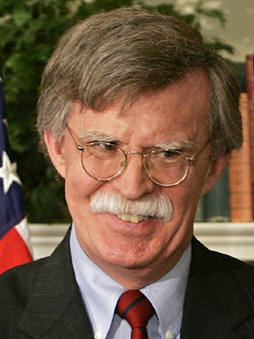
Most insiders viewed John Bolton's nomination as Ambassador to the U.N. as a move primarily to get him out of the State Department to limit the damage he could do, not as a reward. Still, the idea that an UN Ambassador could or would need to be "handled," as the Bush administration asserted, appalled many Senators such as Voinovich (R-OH). A good diplomat is someone skilled at handling others, not someone who requires it! And who would nominate such an individual? (Hmm…)
While the infamously pugnacious Bolton may have been briefly cowed and humbled by the prospect of losing the nomination process, this article by Mark Leon Goldberg in The American Prospect shows that he quickly regressed to form. In addition to alienating foreign allies, he continues his pattern of undermining colleagues and picking needless, counterproductive fights. Different management styles can prove effective, but it's hard to see Bolton as much more than yet another ideologue woefully unsuited for a position of true importance, uninterested in effectiveness. (Meritocracy remains among the most radical, revolutionary ideas in the world.)
Bolton has always seemed proud of his tactlessness, likely with the affectation that it makes him "blunt" or a "straight-shooter." When he proclaimed that if the UN building lost 10 of its 38 floors, it wouldn’t make a difference, he gave many politicians and career diplomats concern… but gained cheerleaders elsewhere. Colin Powell apparently thought quite poorly of Bolton, and this no doubt won Bolton further favor with Cheney and Rumsfeld. Thus, moving Bolton from State to UN Ambassador was not just a matter of limiting damage as new realism crept back into Bush's foreign policy. Condeleeza Rice wanted to get rid of Bolton, but Cheney strongly backed him for the ambassador position. The stated rationale was that as a fervent critic of the UN, Bolton was just the man to instigate much needed reform. This always smacked a little of the "It took Nixon to go to China" defense (an argument I've always viewed as rather simplistic and silly anyway). In Bolton's case, however, it may prove to be more like sending David Duke to speak to the NAACP. It is one thing to want to reform an institution, but if one despises the institution, the results ain't likely to be pretty.
In truth, Bolton's nomination really seemed like just another assertion of the bullying, arrogant cowboy diplomacy that still dominates in much of the Bush administration. Jeffrey Goldberg's recent major New Yorker article on George H.W. Bush's National Security Advisor Brent Scowcroft delivers one of the most incisive portraits of this mindset yet:
Scowcroft suggested that the White House was taking the wrong advice, and listening to a severely limited circle. He singled out the Princeton Middle East scholar Bernard Lewis, who was consulted by Vice-President Cheney and others after the terror attacks of September 11, 2001. Lewis, Scowcroft said, fed a feeling in the White House that the United States must assert itself. “It’s that idea that we’ve got to hit somebody hard,” Scowcroft said. “And Bernard Lewis says, ‘I believe that one of the things you’ve got to do to Arabs is hit them between the eyes with a big stick. They respect power.’ ” Cheney, in particular, Scowcroft thinks, accepted Lewis’s view of Middle East politics.
Macho rhetoric might be impressive to the True Believers as part of a public performance, but it tends not to be effective in the actual diplomacy that occurs in closed rooms. Asking for a favor after you've hit someone in the face never works that well.
I had not known that Bolton worked for Jesse Helms, but it makes a great deal of sense, considering their shared hostility toward the UN. Mark Leon Goldberg reports:
Helms was a key booster of Bolton early in his career: Bolton began his public service as Helms’ aide, and the two share a warm -- some might say eternal -- relationship. During Bolton’s 2001 confirmation hearing as undersecretary of state for arms control and international security, Helms famously referred to him as “the kind of man with whom I would want to stand at Armageddon.”
Helms neglected to mention that he and Bolton seek to instigate that same Armageddon. The final paragraph of the article suggests Bolton actively looks for fights:
After listening to a tirade from Bolton against inefficiency, corruption, and supposed anti-Americanism at the UN during a private dinner, a Sunday Telegraph reporter in the audience asked him what he enjoyed most about the UN, to which Bolton replied, “It’s a target-rich environment.”
When Christmas is Outlawed, Only Outlaws Will Celebrate Christmas
Will it surprise anyone to learn that Fox News, the network which concocted the false "War on Christmas," actually invited its employees to a "holiday party?" What happened to the fight-to-the-last-man ethos that we should all say "Merry Christmas?" Why was happy, er, angry, Christian warrior Bill O'Reilly originally offering "holiday ornaments" before the web site was changed? Why have George and Laura Bush wished folks "Happy Holidays" and "Season's Greetings?" Didn't they get the memo?
I blame the liberal media.
A few stupidity checks are in order. Calling a Christmas tree a "holiday tree" is stupid, unless it's within your own home and you're definitely not Christian but you and your kids enjoy the whole tree thing (even then it's pretty silly). Insisting that "Happy Holidays" is offensive is asinine, since most Christians celebrate Christmas and New Year's and the phrase covers both… as well as Chanukah and Kwanzaa and the Winter Solstice for all those, y'know, pagans. Claiming that institutions must call "winter break" "Christmas break" is stupid, offensive, and discriminatory… not to mention, inaccurate. My "winter break" in college lasted six weeks, starting just before Thanksgiving and ending just after New Year's. Many high school kids and college kids have a week or so off before Christmas lasting until just after New Year's (see the "Happy Holidays" discussion). Yes, at one time Christians could claim persecution… back when they were being fed to lions under the Roman Empire. But does any sane, honest person believe that an American cannot find a safe haven to celebrate Christmas in this country? Who is likely to feel more comfortable during the Christmas season, a Christian or a Jew?
I would argue that, far from there being a war against people of faith, there is a concerted movement against empiricism, science, and religious tolerance. You see, atheists as a whole are not a rowdy bunch, other than perhaps the Bolsheviks in 1914, but the majority of Trotskyites now seem to be Republicans anyway (the "neocons").
So here’s the latest salvos about Fox’s faux war.
By far the funniest (but substantial) performance to date comes from Sam Seder on CNN, who starts with the premise that the “War on Christmas” is the same as the Iraq war and quickly moves to Santa’s al-Qaeda connection and elf torture. To say Seder mops the floor with his opponent is to be too kind to the hapless Bob Knight of the Culture and Family Institute. Oh, and it’s become a general principle of the blogosphere (and debate in general) that when you invoke the Nazis, you’re losing (by the way, while Seder doesn’t mention it, having Knight, a proclaimed “Christian” invoke the Nazis to complain about religious persecution to a Jew is the height of bad taste.) Thanks to Crooks and Liars for posting this gem.
But the funnies don’t stop there. Ruth Marcus penned a nice op-ed in The Washington Post. Over at the Poyter Institute, a former Fox News producer reveals the strategy employed by the station. It’s a must-read.
Bill O’Reilly emerges as the uncontested champion of boobs, however. He wins this honor with a hat trick. He scores his first point by proclaiming that he shall “bring horror” upon the “oppressive, totalitarian and anti-Christian forces in this country”... Because nothing captures the spirit of Christmas like intolerance, hatred, and threats. (As long as Bill wants to fight phantoms, can we have him go off and say, protect the Easter Bunny from the commies in an isolated bunker somewhere?)
For his second point, Bill continues to make friends by casually accusing Madison, Wisconsin of Satan-worship. I wish I was making this up. (I would be surprised if O'Reilly's ratings weren’t eroding... unless folks are tuning in out of a Network-esque morbid curiosity to see if his head will finally explode.)
Still, he really outdoes himself for point three when he claims that a school district in Texas has embraced “fascism” by banning students from wearing red and green clothing. My god, and in the liberal bastion of Texas! Could it be that O’Reilly was... absolutely wrong? Nawh! Why bother to fact-check when there are rational people to slur? Poynter’s Jim Romensko posted the school district’s response here. I’m particularly fond of the polite understatment of the paragraph:
Media Matters has the video here.
The Daily Show sums up much of Fox’s absurdity nicely, spotlighting O’Reilly further here and here. The second, longer item nicely captures a deceptive attack by O'Reilly on... The Daily Show.
Meanwhile, Saturday Night Live was actually funny in a Bill O’Reilly sketch that played on his disdain for fact-checking. You can see it if you hit their website, click on videos, and find the Jason Lee episode... the segment is listed as: “White House leak... Political operative... treason... Who cares?!”
(A final, brief anecdote… in my high school, it feel to the art classes to design the annual school Christmas card, but my art teacher understandably got sick of being caught in between the administration's demand that the card must say "Happy Holidays," "Season's Greetings," not feature a Christmas tree, and so on, while the kids drawing the things didn't really see what the big fuss was about (about 15-20% of the school was Jewish, I'd say, with most kids, regardless of denomination, celebrating Christmas.) One year, my teacher decided to just post all the card designs on a bulletin board and have the school vote for their choice, democratically. I submitted at least one traditional design, but to mix it up, I also drew one featuring a meditating Buddha with the logo, "Enter into the Kingdom of Bliss." (I actually had to redraw it because in my rush I left the "g" out of "kingdom.") Most people got a good laugh out of the Buddha card, but of course it didn't win. As I recall, the winner (by administrative decree versus vote) was something bland and inoffensive... but at least better drawn than mine.)
I blame the liberal media.
A few stupidity checks are in order. Calling a Christmas tree a "holiday tree" is stupid, unless it's within your own home and you're definitely not Christian but you and your kids enjoy the whole tree thing (even then it's pretty silly). Insisting that "Happy Holidays" is offensive is asinine, since most Christians celebrate Christmas and New Year's and the phrase covers both… as well as Chanukah and Kwanzaa and the Winter Solstice for all those, y'know, pagans. Claiming that institutions must call "winter break" "Christmas break" is stupid, offensive, and discriminatory… not to mention, inaccurate. My "winter break" in college lasted six weeks, starting just before Thanksgiving and ending just after New Year's. Many high school kids and college kids have a week or so off before Christmas lasting until just after New Year's (see the "Happy Holidays" discussion). Yes, at one time Christians could claim persecution… back when they were being fed to lions under the Roman Empire. But does any sane, honest person believe that an American cannot find a safe haven to celebrate Christmas in this country? Who is likely to feel more comfortable during the Christmas season, a Christian or a Jew?
I would argue that, far from there being a war against people of faith, there is a concerted movement against empiricism, science, and religious tolerance. You see, atheists as a whole are not a rowdy bunch, other than perhaps the Bolsheviks in 1914, but the majority of Trotskyites now seem to be Republicans anyway (the "neocons").
So here’s the latest salvos about Fox’s faux war.
By far the funniest (but substantial) performance to date comes from Sam Seder on CNN, who starts with the premise that the “War on Christmas” is the same as the Iraq war and quickly moves to Santa’s al-Qaeda connection and elf torture. To say Seder mops the floor with his opponent is to be too kind to the hapless Bob Knight of the Culture and Family Institute. Oh, and it’s become a general principle of the blogosphere (and debate in general) that when you invoke the Nazis, you’re losing (by the way, while Seder doesn’t mention it, having Knight, a proclaimed “Christian” invoke the Nazis to complain about religious persecution to a Jew is the height of bad taste.) Thanks to Crooks and Liars for posting this gem.
But the funnies don’t stop there. Ruth Marcus penned a nice op-ed in The Washington Post. Over at the Poyter Institute, a former Fox News producer reveals the strategy employed by the station. It’s a must-read.
Bill O’Reilly emerges as the uncontested champion of boobs, however. He wins this honor with a hat trick. He scores his first point by proclaiming that he shall “bring horror” upon the “oppressive, totalitarian and anti-Christian forces in this country”... Because nothing captures the spirit of Christmas like intolerance, hatred, and threats. (As long as Bill wants to fight phantoms, can we have him go off and say, protect the Easter Bunny from the commies in an isolated bunker somewhere?)
For his second point, Bill continues to make friends by casually accusing Madison, Wisconsin of Satan-worship. I wish I was making this up. (I would be surprised if O'Reilly's ratings weren’t eroding... unless folks are tuning in out of a Network-esque morbid curiosity to see if his head will finally explode.)
Still, he really outdoes himself for point three when he claims that a school district in Texas has embraced “fascism” by banning students from wearing red and green clothing. My god, and in the liberal bastion of Texas! Could it be that O’Reilly was... absolutely wrong? Nawh! Why bother to fact-check when there are rational people to slur? Poynter’s Jim Romensko posted the school district’s response here. I’m particularly fond of the polite understatment of the paragraph:
Dr. Otto said that our attorney requested of Mr. O'Reilly that, in the future, he ask his fact checkers to do a more thorough job of confirming the facts before he airs them.
Media Matters has the video here.
The Daily Show sums up much of Fox’s absurdity nicely, spotlighting O’Reilly further here and here. The second, longer item nicely captures a deceptive attack by O'Reilly on... The Daily Show.
Meanwhile, Saturday Night Live was actually funny in a Bill O’Reilly sketch that played on his disdain for fact-checking. You can see it if you hit their website, click on videos, and find the Jason Lee episode... the segment is listed as: “White House leak... Political operative... treason... Who cares?!”
(A final, brief anecdote… in my high school, it feel to the art classes to design the annual school Christmas card, but my art teacher understandably got sick of being caught in between the administration's demand that the card must say "Happy Holidays," "Season's Greetings," not feature a Christmas tree, and so on, while the kids drawing the things didn't really see what the big fuss was about (about 15-20% of the school was Jewish, I'd say, with most kids, regardless of denomination, celebrating Christmas.) One year, my teacher decided to just post all the card designs on a bulletin board and have the school vote for their choice, democratically. I submitted at least one traditional design, but to mix it up, I also drew one featuring a meditating Buddha with the logo, "Enter into the Kingdom of Bliss." (I actually had to redraw it because in my rush I left the "g" out of "kingdom.") Most people got a good laugh out of the Buddha card, but of course it didn't win. As I recall, the winner (by administrative decree versus vote) was something bland and inoffensive... but at least better drawn than mine.)
Wednesday, December 14, 2005
Bizarre Web Ads

Okay, this first one is not that bizarre... just transparent. Hmmm, what might MSNBC be selling here? This ad was all over the web the past few days. Shame on you, porn makers! Shame on you, insidious porn buyers! And, uh... shame on you, viewer, if you miss our titillating, sensationalist (and likely shallow) coverage!

Nothing promises romantic love like a hydrocephalic blonde chick! Everytime I've seen this fairly common ad, all I can focus on is how, through the magic of Photoshop, this woman's head is abnormally large (most likely transplanted onto someone else's body). I mean, I'm sure she's got a great personality and all, and Match.com's apparent policy of accepting folks of all sorts and sizes is cool, but who the hell thought mutant was sexy?

I have dubbed this the "Rasta Grinch" or the "Rasta Home Mortgage Grinch." While this mortgage company runs some weeeeeeird ads in its attempt to be eye-catching, this is the most bizarre. Bah humbug to Christmas, but smoke it up as we gouge your pocketbook with a horrible refinancing deal! Perhaps that's the message... after you're broke, you won't have any money for presents, so to hell with Christmas and toke up so you don't mind so much.
Or maybe he just caught sight of the neon porn silhouette at MSNBC.
Wednesday, December 07, 2005
Because Jesus Died for My Sins, Not Yours, Ya Damn Hippie!
(Hmm, slow news week. Need to fill the airtime here at Fox News. What to talk about? The burgeoning Republican scandals? Nawh! How about a manufactured crisis? Okay, it’s worked in the past, but what can we talk about? Well, it’s almost Christmas... and we know that liberals are the enemy of all that is good and holy... Hell, this stuff just writes itself!)
Neil Postman wrote in his brilliant essay “Silent Questions” that the questions we ask determine the answers we get. Check out the Fox News topic question here, as submitted to Crooks and Liars by a reader:

If you can’t read it clearly, it says, “ECONOMIC DISASTER IF LIBERALS WIN THE “WAR ON CHRISTMAS”?
I mean, come on. Pretending this question isn’t loaded and biased is like pretending Rush Limbaugh actually does research or Josef Stalin was a humanitarian. The bold shamelessness makes me laugh. “Fair and balanced,” indeed.
As Postman would note, this question is constructed to be answered with a simple yes or no; no complexity or nuance allowed here. Furthermore, the question’s weight is slanted toward a “yes” answer because in classic alarmist fashion, it poses a (fake) crisis. As with manipulative news show teasers, such as “the five signs of cancer that could save your life! The news at eleven!” this is a cheap ploy to create much sound and fury to get people to watch, in this case, idle and vapid chatter about a non-issue.
The question also presupposes several factors. The most glaring and biased idea is that liberals, apparently a monolithic entity, are waging a war on Christmas. They aren’t. (Can one even wage a war on Christmas? Postman would surely ask.)
The second presupposition is that economic disaster looms ahead. Yes, many businesses, most of all toy stores, do the bulk of their business in the Christmas season (I believe 25-30% is fairly common for retail businesses). As I recall, Christmas shopping did fall somewhat in 2001 after 9/11, but all the conservatives crow about how great the economy is now! Has there been some major article plausibly predicting economic disaster I’ve missed?
(Ah. But you see, the liberals want to ruin all that prosperity, because it will make Bush look bad! Liberals hate a strong economy. And they hate Christmas! And we are but their willing slaves unless we throw off their oppressive yoke and reclaim all three branches of government! Er, wait. Let me think of something about those damn hippie atheist teachers. That might play better.)
I know I won’t do any Christmas shopping because of those damn liberals. I’ll stay away from the stores and not even shop online just to spite them for practicing their so-called “religious tolerance," which we all know is nothing more than anti-Christian bigotry! When my mother looks at me with surprised and hurt eyes on Christmas morning, wondering where her gift is, I’ll shout, “Ask Howard Dean about your Christmas present!”
Does anyone truly feel Christmas is threatened? Sure, there may be isolated incidents of politically correct excess on the one hand, or overbearing religious intrusion on the other, but this just ain’t a burning issue. One of my Jewish roommates in college asserted that Chanukah, while celebrating a small miracle chiefly about tradition, cultural identity and not assimilating, was a minor holiday elevated to major status just to compete with Christmas (the big Jewish holidays being Yom Kippur and Rosh Hashanah instead, or even Passover). Still, most folks will take the care to wish Jewish friends Happy Chanukah versus Merry Christmas (or Happy Kwanzaa if they know one of the comparatively few people who practices it). What’s the big deal? I’ve never known a non-Christian to take offense at being wished a “Merry Christmas,” nor would anyone other than a zealot get outraged at being told, “Happy holidays.” Most devout Christian folks I know object to the crass commercialism of the season more than they fret over a choice of words; getting upset over a “Happy holidays” makes about as much sense as getting angry at someone who wishes you to “Have a nice day.”
(Instead of this focus on a non-issue, how about pressuring the airline companies not to jack up holiday airfare instead?)
But never let the lack of an actual crisis get in the way of hard-hitting news. Even if Fox did the “War on Christmas” story last year too, 'tis the seasonal gift that keeps on giving!
In this Fox News segment (you may have to scroll down a few), Neal Gabler make the point, citing an article by Michelle Goldberg, that the “War on Christmas” goes back at least to 1921 and Henry Ford and is a sham. Notice in this clip how Jane Hall is just yelled over (real gentlemanly behavior, fellas... a great job especially by the host for allowing it, and cutting off Jane Hall from responding to an ad hominem attack from Pinkerton). Pinkerton tries to argue that there is a war on Christmas, between the liberal media elites and the Christian masses; nevermind that you won't find a single major news outlet campaigning against Christmas! Meanwhile, Cal Thomas gets special mention not only for quipping that secularists worship April 1st as their holiday (what an intolerant, dismissive ass), but also for brazenly trying to argue that Jesus was intolerant! (Bravo. Try arguing that at a good seminary.)
The only reason to watch Fox News is those rare moments when the truth breaks through by a guest calling “bullshit” on the Fox crew. Jane Hall and Neal Gabler do just that:
What makes all this hysteria from Fox News so much funnier is that Laura Bush said “Happy holidays” just last week, and the conservative commentators only seem to have caught up with this now, as the White House cards celebrating the “holiday season” arrive. The Washington Post reports:
Wow! Now that’s Christian! How dare you wish me well in a way that does not proclaim your religion is the same as mine!
Because, let’s face it, what the Christmas season is really about is intolerance. Keith Olbermann picks up on the ludicrousness of "Christian" intolerance as he names Fox News’ intellectual lightweight John Gibson his “worst person in the world” for 12/2/05. Olbermann explains, after discussing the runners-up:
Amen. I also read one blog comment that pointed out that's it rather funny that supposed "Christians" are so up in arms over a "Christmas tree" being called a "holiday tree," when it's just an adopted pagan tradition anyway: "Maybe I need to re-read the Bible, but I don't remember a big evergreen next to the manger."
There will be a lot of heathens burning this winter — Wait! Burning this Christmas! — I can promise you that! (Film at eleven!)
Neil Postman wrote in his brilliant essay “Silent Questions” that the questions we ask determine the answers we get. Check out the Fox News topic question here, as submitted to Crooks and Liars by a reader:

If you can’t read it clearly, it says, “ECONOMIC DISASTER IF LIBERALS WIN THE “WAR ON CHRISTMAS”?
I mean, come on. Pretending this question isn’t loaded and biased is like pretending Rush Limbaugh actually does research or Josef Stalin was a humanitarian. The bold shamelessness makes me laugh. “Fair and balanced,” indeed.
As Postman would note, this question is constructed to be answered with a simple yes or no; no complexity or nuance allowed here. Furthermore, the question’s weight is slanted toward a “yes” answer because in classic alarmist fashion, it poses a (fake) crisis. As with manipulative news show teasers, such as “the five signs of cancer that could save your life! The news at eleven!” this is a cheap ploy to create much sound and fury to get people to watch, in this case, idle and vapid chatter about a non-issue.
The question also presupposes several factors. The most glaring and biased idea is that liberals, apparently a monolithic entity, are waging a war on Christmas. They aren’t. (Can one even wage a war on Christmas? Postman would surely ask.)
The second presupposition is that economic disaster looms ahead. Yes, many businesses, most of all toy stores, do the bulk of their business in the Christmas season (I believe 25-30% is fairly common for retail businesses). As I recall, Christmas shopping did fall somewhat in 2001 after 9/11, but all the conservatives crow about how great the economy is now! Has there been some major article plausibly predicting economic disaster I’ve missed?
(Ah. But you see, the liberals want to ruin all that prosperity, because it will make Bush look bad! Liberals hate a strong economy. And they hate Christmas! And we are but their willing slaves unless we throw off their oppressive yoke and reclaim all three branches of government! Er, wait. Let me think of something about those damn hippie atheist teachers. That might play better.)
I know I won’t do any Christmas shopping because of those damn liberals. I’ll stay away from the stores and not even shop online just to spite them for practicing their so-called “religious tolerance," which we all know is nothing more than anti-Christian bigotry! When my mother looks at me with surprised and hurt eyes on Christmas morning, wondering where her gift is, I’ll shout, “Ask Howard Dean about your Christmas present!”
Does anyone truly feel Christmas is threatened? Sure, there may be isolated incidents of politically correct excess on the one hand, or overbearing religious intrusion on the other, but this just ain’t a burning issue. One of my Jewish roommates in college asserted that Chanukah, while celebrating a small miracle chiefly about tradition, cultural identity and not assimilating, was a minor holiday elevated to major status just to compete with Christmas (the big Jewish holidays being Yom Kippur and Rosh Hashanah instead, or even Passover). Still, most folks will take the care to wish Jewish friends Happy Chanukah versus Merry Christmas (or Happy Kwanzaa if they know one of the comparatively few people who practices it). What’s the big deal? I’ve never known a non-Christian to take offense at being wished a “Merry Christmas,” nor would anyone other than a zealot get outraged at being told, “Happy holidays.” Most devout Christian folks I know object to the crass commercialism of the season more than they fret over a choice of words; getting upset over a “Happy holidays” makes about as much sense as getting angry at someone who wishes you to “Have a nice day.”
(Instead of this focus on a non-issue, how about pressuring the airline companies not to jack up holiday airfare instead?)
But never let the lack of an actual crisis get in the way of hard-hitting news. Even if Fox did the “War on Christmas” story last year too, 'tis the seasonal gift that keeps on giving!
In this Fox News segment (you may have to scroll down a few), Neal Gabler make the point, citing an article by Michelle Goldberg, that the “War on Christmas” goes back at least to 1921 and Henry Ford and is a sham. Notice in this clip how Jane Hall is just yelled over (real gentlemanly behavior, fellas... a great job especially by the host for allowing it, and cutting off Jane Hall from responding to an ad hominem attack from Pinkerton). Pinkerton tries to argue that there is a war on Christmas, between the liberal media elites and the Christian masses; nevermind that you won't find a single major news outlet campaigning against Christmas! Meanwhile, Cal Thomas gets special mention not only for quipping that secularists worship April 1st as their holiday (what an intolerant, dismissive ass), but also for brazenly trying to argue that Jesus was intolerant! (Bravo. Try arguing that at a good seminary.)
The only reason to watch Fox News is those rare moments when the truth breaks through by a guest calling “bullshit” on the Fox crew. Jane Hall and Neal Gabler do just that:
Neal: ...I want to talk about the media angle because we have avoided it-it's the elephant in the room. It's Fox News. Come on-It's Bill O'Reilly, it's Sean Hannity, it's Gibson. They're demogogues who realized that in Christmas time you can-(garbled)- rouse the masses on this issue. They'll do it every Christmas. They did it last Christmas, they'll do it next Christmas.
Neal: We're at war, there's Darfur, there's an AIDS crisis and you're worried about whether people should say Merry Christmas? What world do you live in?
What makes all this hysteria from Fox News so much funnier is that Laura Bush said “Happy holidays” just last week, and the conservative commentators only seem to have caught up with this now, as the White House cards celebrating the “holiday season” arrive. The Washington Post reports:
"This clearly demonstrates that the Bush administration has suffered a loss of will and that they have capitulated to the worst elements in our culture," said William A. Donohue, president of the Catholic League for Religious and Civil Rights.
Bush "claims to be a born-again, evangelical Christian. But he sure doesn't act like one," said Joseph Farah, editor of the conservative Web site WorldNetDaily.com. "I threw out my White House card as soon as I got it."
Wow! Now that’s Christian! How dare you wish me well in a way that does not proclaim your religion is the same as mine!
Because, let’s face it, what the Christmas season is really about is intolerance. Keith Olbermann picks up on the ludicrousness of "Christian" intolerance as he names Fox News’ intellectual lightweight John Gibson his “worst person in the world” for 12/2/05. Olbermann explains, after discussing the runners-up:
But the winner, and this one comes with great personal pain because we were friends when he worked here and thereafter: John Gibson. Selling his new book about this phony-baloney war on Christmas, John revealed a very ugly side to himself. He is one of those people who think all religions but his are mistaken. You know, the way a lot of these religious nutbag terrorists think. "I would think," Gibbie said on a syndicated radio show, "if somebody is going to be -- have to answer for following the wrong religion, they are not going to have to answer to me. We know who they're going to have to answer to."
I'd tell you which religion John thinks is the only one that's right, but what's the difference? It's not the faith that's the issue; it's the intolerance.
Amen. I also read one blog comment that pointed out that's it rather funny that supposed "Christians" are so up in arms over a "Christmas tree" being called a "holiday tree," when it's just an adopted pagan tradition anyway: "Maybe I need to re-read the Bible, but I don't remember a big evergreen next to the manger."
There will be a lot of heathens burning this winter — Wait! Burning this Christmas! — I can promise you that! (Film at eleven!)
Thursday, December 01, 2005
Who's Driving the Car?
Cartoonist Tom Tomorrow's latest entry for This Modern World offers an especially pithy and trenchant perspective on Iraq.
Hindsight is not always 20/20. It is possible, and tragically in some cases all too likely, to learn a bad lesson (I will not say wrong) from a momentous occasion, especially a traumatic one. I would argue that one of the essential lessons to learn from 9/11 is the value of human connections and international cooperation, not that a nation should act unilaterally against all advice and invade another country whose threat is already contained. Legitimate arguments existed in favor of invading Iraq and deposing Saddam Hussein. However, those arguments were, by and large, not made (probably because it would raise our country's own spotty history with Iraq). I'm currently reading The Assassin's Gate, which shows, as others have before, that the neoconservatives had long wanted to invade Iraq. One school of thought is that 9/11 was merely an excuse for them to take action. Certainly many if not all of the neocons believed that Saddam Hussein was a genuine threat. Some of them even likely believed he was an imminent threat. However, the sincerity of the belief does not excuse the intellectual poverty of the philosophy, nor the manipulation of the Iraq intelligence, nor the skewing of the public debate, nor the lack of a postwar plan, nor the staggering and deadly incompetence of the actions taken. Finally, the sincerity of the belief does not excuse the inability to learn, adjust, and improve, as the neocons stubbornly stick with the same myopic hubris that got us into this mess to begin with.
Al Franken's offered a version of the following analogy: If someone drives a car into a ditch, throws away the tires, and then sets the car on fire, it doesn't make much sense to turn to the passenger and say, "Oh yeah? What's your bright idea for getting us out of this mess?" First thing you do is get rid of the driver. He's obviously not making good decisions, and time has shown that's just not going to change.
If only hindsight were 20/20.
Hindsight is not always 20/20. It is possible, and tragically in some cases all too likely, to learn a bad lesson (I will not say wrong) from a momentous occasion, especially a traumatic one. I would argue that one of the essential lessons to learn from 9/11 is the value of human connections and international cooperation, not that a nation should act unilaterally against all advice and invade another country whose threat is already contained. Legitimate arguments existed in favor of invading Iraq and deposing Saddam Hussein. However, those arguments were, by and large, not made (probably because it would raise our country's own spotty history with Iraq). I'm currently reading The Assassin's Gate, which shows, as others have before, that the neoconservatives had long wanted to invade Iraq. One school of thought is that 9/11 was merely an excuse for them to take action. Certainly many if not all of the neocons believed that Saddam Hussein was a genuine threat. Some of them even likely believed he was an imminent threat. However, the sincerity of the belief does not excuse the intellectual poverty of the philosophy, nor the manipulation of the Iraq intelligence, nor the skewing of the public debate, nor the lack of a postwar plan, nor the staggering and deadly incompetence of the actions taken. Finally, the sincerity of the belief does not excuse the inability to learn, adjust, and improve, as the neocons stubbornly stick with the same myopic hubris that got us into this mess to begin with.
Al Franken's offered a version of the following analogy: If someone drives a car into a ditch, throws away the tires, and then sets the car on fire, it doesn't make much sense to turn to the passenger and say, "Oh yeah? What's your bright idea for getting us out of this mess?" First thing you do is get rid of the driver. He's obviously not making good decisions, and time has shown that's just not going to change.
If only hindsight were 20/20.
Subscribe to:
Posts (Atom)