Occasional blogging, mostly of the long-form variety.

Monday, September 25, 2006

Sven Nykvist 1922-2006


My “three gods of cinematography” have always been Vittorio Storaro, Sacha Vierny, and Sven Nykvist. (That’s not to slight the work of at least twenty other superb cinematographers I could name.)

Sven Nykvist died last week on Wednesday, September 20th, 2006. He won two Oscars, for his extraordinary work on Cries and Whispers and Fanny and Alexander, and won numerous other awards as well. He can be seen at work in the documentaries The Making of Fanny & Alexander (1986) Directed by Andei Tarkovsky (1988), and Light Keeps Me Company (1999), this final piece being made by his son, Carl-Gustaf Nyvkvist. He also directed a handful of films himself and wrote three books about his craft.

Sven Nykvist’s imdb page lists 121 films, and has a pretty good biography here. His Wikipedia page isn’t bad either, and provides links to good obituaries from The Daily Telegraph and The New York Times, a brief write-up from CNN. and a good piece on him for his award from The American Society of Cinematographers.


Nykvist is probably best known for his use of a soft “Northern light” similar to what one sees in Vermeer paintings or a Rembrandt. To achieve this, he sometimes employed a “light globe” or similar device, basically a sphere of silk lit from inside and hanging from a crane. He tried to light most scenes from a single source to avoid double shadows and achieve a greater realism. He did not want to draw attention to his work. (In my Cinematography II class, one assignment involved us recreating a scene from a film. Three of us picked films shot by Nykvist – all for different directors!)

Although Nykvist worked with many great directors, his name is almost synonymous with Ingmar Bergman. The two worked on (by my count) an impressive eighteen films together. For Winter Light, the second installment in Bergman’s “faith” trilogy, supposedly Bergman and Nykvist spent an entire day in a church, watching how the light shifted across the interior of the building as the hours passed.

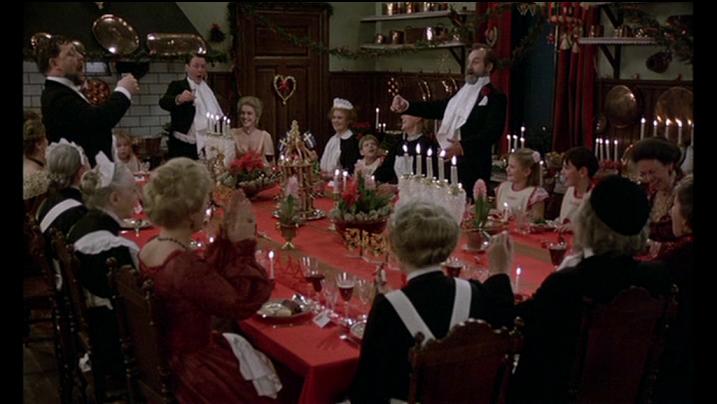
While I am in awe of much of Nykvist’s work, Fanny and Alexander may be his most impressive for me. Not only do Bergman and Nykvist employ a broad palette of color to paint the different locales and moods, they also employ some astounding camera moves – but none of the work draws attention to itself . Unless you’re watching for it, you’re not likely to notice that certain scenes are filmed in one take. The opening of the film starts near Christmas time, with rich reds and greens and a sinuous dance of characters and camera. A middle section at the Bishop’s house is stark, bleak and grey. And near the end, the film employs a mystical, dream-like feel – evoking the daydream of the opening sequence (the original miniseries version is now finally out on DVD, thank goodness!).

While Fanny and Alexander, Hour of the Wolf and The Silence employ some rather horrific images to powerful effect, it’s really the love of face and hands that Bergman and Nykvist excel at. The extraordinary, sometimes painful intimacy of Scenes from a Marriage and Cries and Whispers, for instance, just would not work without a deep commitment to capturing human emotion on film in a naturalistic way.

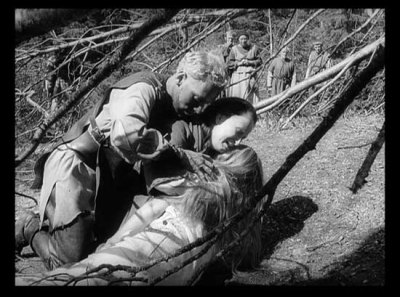
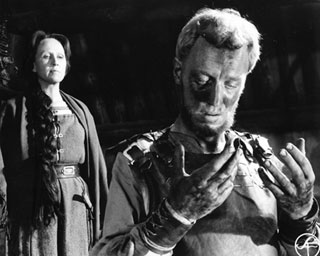
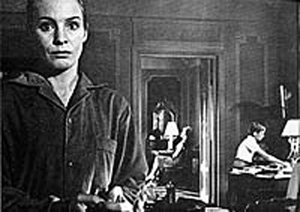
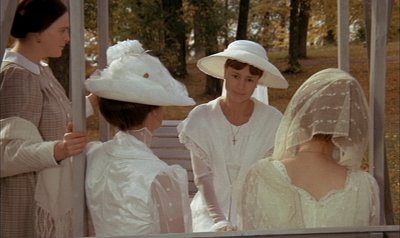
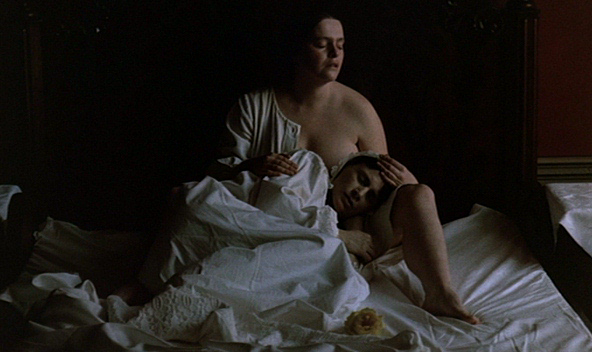
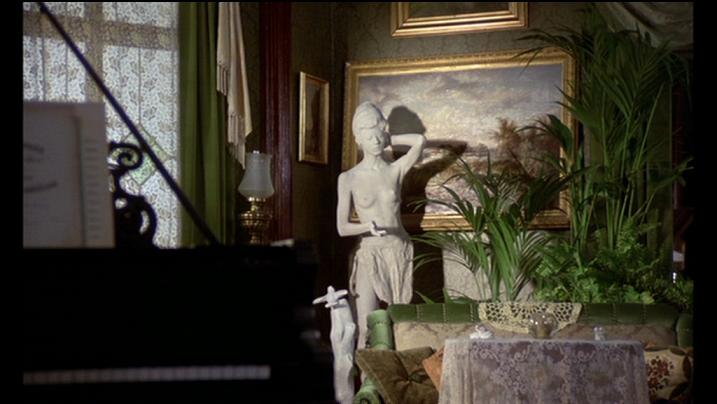
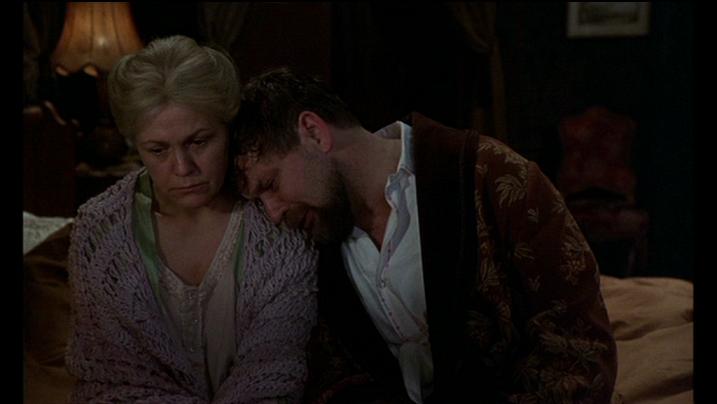
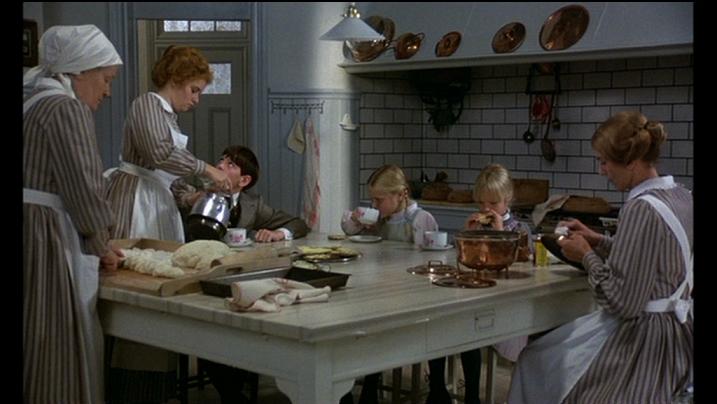
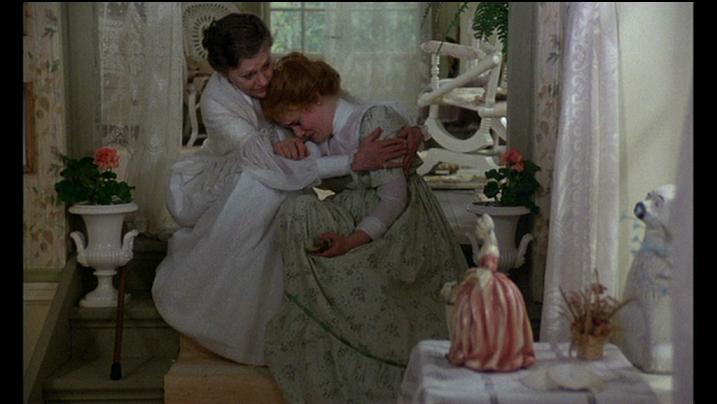
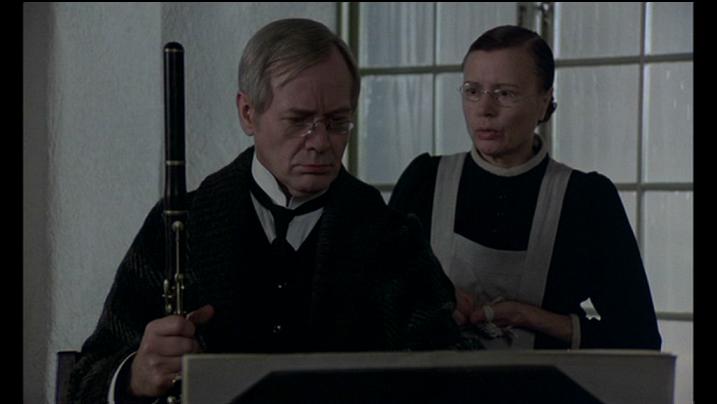
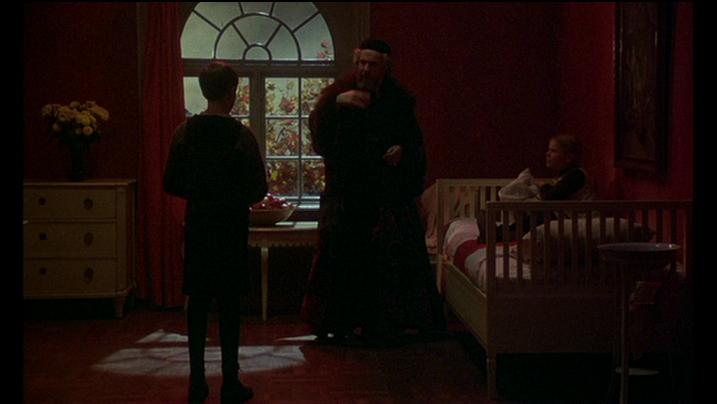
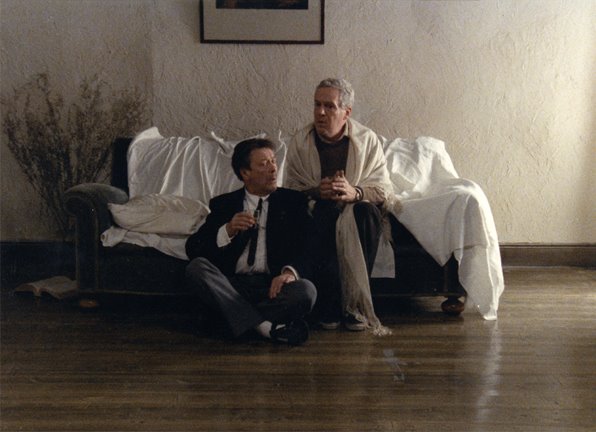
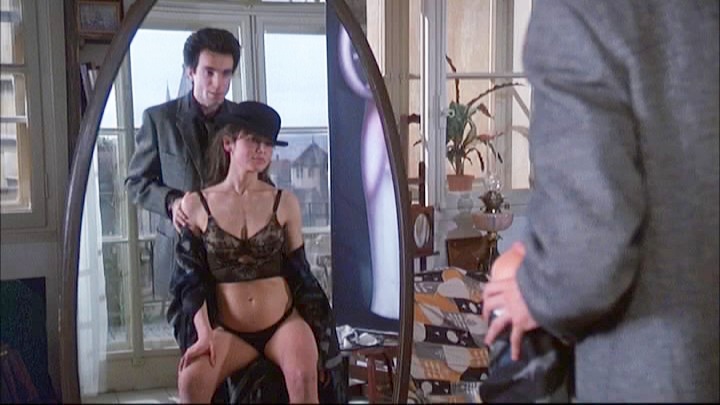
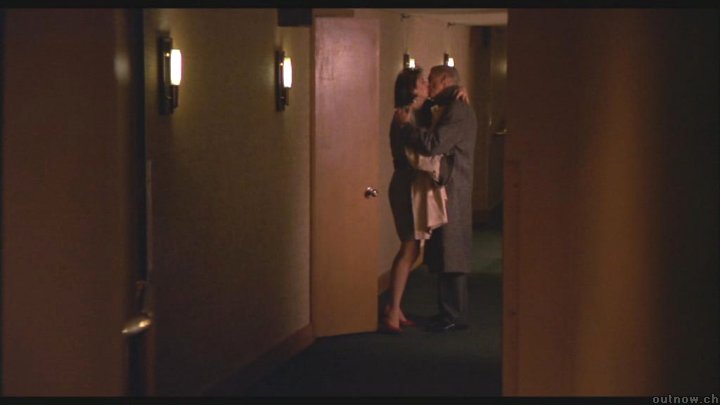
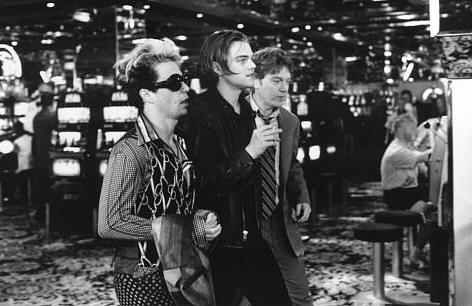
The best testimony to Sven Nykvist’s work is, of course, his work itself. While the following screenshots are of varying quality, and can’t compare to actually seeing one of the films he shot, they offer a taste of the craftsmanship and artistry of this true master.

The Virgin Spring (1960)


Through A Glass Darkly (1961)


Winter Light (1962)


The Silence (1963)


Persona (1966)


Hour of the Wolf (1968)


Shame (1968)


Cries and Whispers (1972)


Scenes from a Marriage (1973)


The Magic Flute (1975)


Fanny and Alexander (1982)


The Sacrifice (1986)


The Unbearable Lightness of Being (1988)


Crimes and Misdemeanors (1989)


Sleepless in Seattle (1993)


Celebrity (1998)


Sunday, September 24, 2006

Faux News – The McLobster of Journalism!


In Maine and parts of Canada, McDonald’s seasonally offers a sandwich called the “McLobster.” I kid you not. While these days they apparently advertise it sometimes as a “lobster roll” and “100% real lobster” (I would be shocked if that claim was not misleading in some fashion), back when I first saw it advertised in 1988, McDonald’s proudly claimed – again, I kid you not - that the McLobster was “made with flecks of real lobster!” Yes, that’s right, “flecks.” The only person I know who actually admitted to trying it was, shall we say, underwhelmed.

There’s a lot of buzz currently about Chris Wallace’s interview with Bill Clinton, where Wallace sandbagged the former President – namely, Clinton was told he was going to be asked about his Global Policy Initiative, and Wallace pulled a bait-and-switch by asking Clinton about his record on catching or killing bin Laden. Is Clinton’s terrorism record a fair subject? Of course. But it’s completely dishonest to misrepresent an interview to one’s subject beforehand. It’s also standard practice for Fox News.

The Washington Post has a brief write-up here (and Howard Kurtz is sure to cover it tomorrow). Questiongirl has the video posted here. ThinkProgress has a full transcript here.

While the Post article notes that Wallace is “not usually accused of being part of the network’s conservative commentariat” at Fox News, and he in fact spoke out against the distortions of ABC’s propaganda piece The Path to 9/11, there’s little question of what this segment was about. Besides being a typical Fox News sandbag job, its other goal is of course trying to rewrite history and paint the Democrats as weak and Bush as responsible on national security before the election.

Of course Fox has a commercial agenda as well a rightwing one — they’ve been selling this interview as “Clinton Gets Crazed!” — not far off from “Presidents Gone Wild!”

But just imagine if Clinton hadn’t responded so forcefully? Conservatives will doubtlessly sell this as “Clinton gets defensive about his lousy record on terrorism.” But I think Chris Wallace has gotten so used to Faux Dems (“I’m not a liberal, but I play one on Fox News!”) he forgot what it was like to try to sandbag someone who would fight back. (Imagine if Kerry has responded to the Swifites with this sort of fire!)

Hmm... I just caught the tail end of Wallace on Fox with Brit Hume and the gang. Wallace lifts two quotations from Clarke's book - the second one could be used to criticize Clinton's critics, but is used to criticize only Clinton. (I’ll try to get some more links up later.)

Almost all of them talk about how "touchy" Clinton was, and speculate it's because he's "sensitive" about his legacy. No one points out that Clinton was sandbagged, with Wallace misrepresenting the interview before hand! NPR’s Juan Williams and Mara Liasson make a few points, but they know what Fox is paying them for - and again, why the hell do you have non-partisan, neutral reporters representing the left on a talk show? Hume trots out some standard GOP talking points about Clinton after cutting him a little slack - basically, he and the other GOP folk acknowledge Clinton was dealt a tough hand, but also imply had he been a real man he'd still have done precisely what they were arguing against him to do at the time!

This is Fox News’ typical seasonal offering for imminent elections; same BS as usual, but piled higher and deeper. Fox News is the McLobster of journalism — if you dig through it you can find “flecks” of real news in there, but overall, it’s an over-processed, artificial sham that’ll have you rushing for the toilet.

(crossposted at The Blue Herald)

Friday, September 22, 2006

What's A Gutting of Essential Human Rights Between Friends?

(crossposted at The Blue Herald)

As predicted, the GOP “dissidents” have reached an accord with the White House. They’ve now proved their independence to their constituents back home, but will join forces again to screw the Democrats and the U.S. Constitution before November. Perhaps that analysis is too cynical, and perhaps some shred of conscience will flicker to light and burst into glorious reality. Perhaps the law is actually an improvement on existing conditions — some of its provisions actually seem to be good. But if the typical GOP trend continues, basic human rights and justice will instead be drowned in a bathtub.

The big question is – what about habeas corpus? Currently we only have early reports, so perhaps later versions of these stories, or follow-up pieces will delve into this. But how can this be missed? The AP story doesn’t mention it. The usually excellent Washington Post doesn’t mention it. And The New York Times only touches on it at the end:

Still, Senator Carl Levin of Michigan, the senior Democrat on the Armed Services Committee, said he would press to change a provision in the proposal that would deny detainees a right to challenge their captivity in court.

Over at Hullabaloo, Digby is all over this with ”Punked” and " Tough and Smart", and Tristero contributes "Outrage and Shame".

Here’s the link they provide for supporting the Specter-Levin amendment protecting habeas corpus. The current GOP move is get this passed before Congress recesses. This demands action, and if the amendment fails, a filibuster. It’s time to write everyone with a shred of conscience and feed that flame.

Whiter Iran?

(crossposted at The Blue Herald)

Many a news story, many an expert interview, and of course many a neocon op-ed (for several months now) indicate that the Bush administration wants to go to war with Iran.

Regardless of what one thinks about the rationale of going to war with Iraq, it would be almost impossible to argue that the Bush administration did not want to go to war with Iraq. It was obvious they did.

And thus it is with Iran. If we avoid war with Iran – and possibly Syria as well – it will not be because of the Bush administration. It will not be due to wisdom or sound judgment or common sense on their part. It will only be due to another behind-the-scenes revolt by the top military brass or some external factor the Bushies don’t choose to dismiss as is their usual wont.

The Bush administration is stupid. It is mean. And it is powerful. Those three factors make for an absolutely deadly combination. Their learning curve is almost non-existent, worse than a long-time crack addict who is not even close to trying to kick the habit, let alone in the last throes of struggling to recover. But what else can we expect from an untreated, dry drunk (Bush) and a power-mad bastard (Cheney) who has been unerringly wrong about virtually everything for the past six years? What can we expect from an administration that always wants to act tough but cannot be bothered with thinking through even the most elementary consequences of its actions? (Beyond their political ramifications, of course.)

It would be nice to think that “cooler heads will prevail.” And perhaps they will. But it seems highly unlikely those “cooler heads” will come from inside Bush’s inner circle. The Bushies will act out of macho insecurity, or a desire for more power, or because God spoke to them, or because they are assured they are right and good and true. But they will not act with the best interests of America or the world in mind.

Between the Bush administration’s “diplomacy” with Iran, and the very real possibility of the suspension of habeas corpus - Whither America?

Thursday, September 21, 2006

Political Football Theater

(crossposted at The Blue Herald)


Bush cheerleaders are a funny breed. If Bush were the CEO of a company they invested in, or the coach of their favorite football team, and delivered the same quality of performance he has as president, they would have been screaming for his head on a pike long ago. In the spirit of this observation comes: Political Football Theater!!!
____________________________________________

Lights up on the press room of the NFL team the Republican Crusaders. Coach George W. Bush swaggers to the mike to answer questions.

BUSH: All right. Bring it on.

Q: Coach Bush, what are your feelings on the latest loss?

BUSH: What loss? What are you talking about?

Q: Uh… sir, you just lost another game.

BUSH: (fixing the reporter with a steely gaze) It's irresponsible talk like that that gives aid and comfort to the enemy. Next question. You, Stretch.

Q: Coach Bush, could you comment on the, err, unusual strategy you employed with your running back this game?

BUSH: (beaming) Yeah, how about that.

Q: It seems like he was just running in place.

BUSH: We're lulling the enemy into a false sense of security. Our crack offensive coordinator, Dick Cheney, came up with it.

Q: But sir, how do you expect to win the game if you don't advance the ball? He wasn't gaining any ground. In fact, he often lost yardage.

BUSH: You need to take the long view. Success is relative. When we turned over the ball on our 15 yard line late in the 1st quarter, just think – in the 2nd quarter, that's their 15 yard line. Next question - Poncho.

Q: Coach Bush, many people are calling for you to replace quarterback Donny Rumsfeld, who threw another five interceptions today. Is there any truth to the rumours that you may call Joey "Joementum" Lieberman in off the bench?

BUSH: (bristling) Look, I'm the decider. I decide. And Donny Rummy is the quarterback for this team, period. Look at what he's done to date.

Q: (reluctantly) Coach, on that point –

BUSH: (glowering) Yes?

Q: Back in 2003, when you started, you started the season strong, 4-1. A month later, you said it was "mission accomplished" and guaranteed a Super Bowl victory. By the end of the season, you had gone 7-9 and missed the playoffs.

BUSH: I don't think anyone could have anticipated that the other teams wouldn't let us win.

Q: Then in 2004, you went 5-11. In 2005, 3-13. In 2006 to date, you're 2-12 with two games to go, and you're not favored in either of them. Doesn't it seem as if things aren’t getting better, and you might need a change?

BUSH: Look, I don't pay attention to the polls.

Q: Coach, it's not a question of polls, it's your record –

BUSH: Listen, I go with my gut. I know other coaches might go without sleep studying film on their opponents, and drafting up elaborate plans, and practicing hours and hours with their team in preparation, and what not. That's not my style. We're the better team. We know that. We will prevail. Next question – Slim.

Q: Coach, your team is currently losing over 100 yards a game due to penalties, breaking all sorts of NFL records in the process. Any comment?

BUSH: The enemy fights dirty and we need to fight dirty.

Q: Including biting?

BUSH: Our team does not bite!

Q: Coach, you've petitioned the NFL Rules Committee to allow not only cut-blocking and holding – for your team only, I might add – but biting.

BUSH: (impatient) Our team does not bite. But there may come a time in the future when we may need to bite.

Q: Rumsfeld bit a tackle on the opposing team last Sunday.

BUSH: There's no proof of that! The film was inconclusive! Next question!

Q: Coach Bush, some of your former star players - Powell, Whitman, O'Neill and Shinseki - have been very critical about your performance. In particular, Powell came out strong against biting – your proposed "mastication legislation."

BUSH: Powell's confused. And while we do not bite, without the option of – extreme chewing – we cannot win the game. Those who are opposed to biting – I mean, extreme chewing - want us to lose. Oh, and before you start going off again on whether I should resign, or fire anyone, remember that I have a guaranteed contract through January 2009. Next question – Curly!

Q: Coach Bush, I couldn't help but notice that the field was looking rather – lackluster. In particular, there were tons of divets and a large crater near one of the end zones. One of your wide receivers twisted his ankle badly today.

BUSH: I don't think anyone could have anticipated these groundskeeping problems.

Q: But sir, you have repeatedly petitioned the city for unprecedented funds to fix the field, on top of your existing tax breaks!

BUSH: Halliburton can only do so much with a mere 256 million. Next question – gotta wrap this up.

Q: Coach, Donny Rummy has been widely criticized for insisting that your team take to the field with less players than the standard 11 on a side. Former veteran QBs, such as Shinseki, who you let go, have spoken out repeatedly about this. One veteran QB said that Rummy's plan seemed "more about proving a pet theory than about winning the game." Your comment?

BUSH: (indignant) Look, this is a different sort of game than it was a few years ago. People have to understand that. The enemy expects us to advance the ball in the usual ways, the ways that have always worked in the past. Running. Throwing and catching. They expect us to play to win. To learn from our mistakes. To adapt. And we can't do what the enemy expects.

Q: But sir, why have you repeatedly left two defensive players on the bench?

BUSH: (with a slight smirk) Just watch what we do with the Iran game coming up. It'll be an eye-opener.

Q: Sir, be that as it may, why would you deliberately go out on the field without two of your players?

BUSH: It's a very successful scheme called the 9/11 defense.

That’s all.

Bush walks off stage, as usual ignoring the questions shouted at him.

Wednesday, September 20, 2006

~ QUESTIONING HUCK FINN ~

I realize I’ve been remiss in not writing more on one of the subjects most dear to my heart: education. Following is an essay I wrote to spur discussion in May 2001, back when I was teaching.

I. HUCK FINN

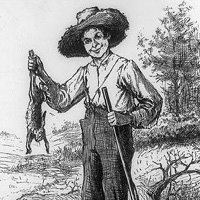
Of all the figures in American culture, the most enduring remains the rebel. The maverick, the entrepreneur, the explorer, the bold seeker of new, unexplored territories, the inventor, the cowboy, the slightly cocky, self-assured (but ultimately good-natured) pioneer... whether it be John Wayne as an obsessive cowboy in The Searchers , Thomas Alva Edison tinkering away with revolutionary ideas in his shop as the Wizard of Menlo Park, or Huck Finn saying ‘to hell with your rules!’ the rebel proves a key figure in the American psyche. Dorthea Dix, James Dean, Susan B. Anthony... the list goes on and on. There’s something still bold and exciting about reading those first daring lines penned by Jefferson in the Declaration of Independence that “all men are created equal” and the moral imperative to rebel against injustice. Jumping forward almost two hundred years, it’s hard not to be moved by the stirring words of Martin Luther King, Jr. in his famous “I have a dream” speech. King’s words speak of honoring a promise made by Jefferson and the other founding fathers — and while King’s words challenge us as a society, there’s something profoundly exciting — and hopeful — about his subtext: injustice exists; we can do better. The American hero is often that man or woman who blazes his or her own path (or perhaps reclaims a good path from accumulated debris).

When we speak of America in terms of novels, doubtless one of the most “American” is Mark Twain’s The Adventures of Huckleberry Finn. It boasts humour, adventure, drama, features issues of race, loyalty and friendship, and stars an anti-hero who bucks all the rules — and we love him for it. Just as the squabbling couples in Shakespeare’s comedies are far more interesting than the “perfect” couples of the same plays, (1) aspiring delinquent Huck Finn proves far more fascinating than Tom Sawyer.

Something profoundly American lies in Huck Finn saying to hell with school and going off with his friend Jim on the river. As the saying goes, “Never let your schooling interfere with your education.” Huck Finn seems to be saying something very similar — I’ll get a real education here on the river, thank you very much, and learn things far more valuable than I can in your schoolhouse. Sure enough, everything is quite peaceful for Huck and Jim on the river — it is only when they land and have to deal with the craziness of civilization that things go bad for them. Floating along with the natural flow of the river, the duo are allowed a separation from the everyday and can gain a new, fresh perspective.

Huckleberry Finn also features one of the great moments in American Literature. In chapter thirty-one, Huck wrestles with his conscience over whether to turn in Jim or not as a runaway slave. While the two hundred dollar reward is not a factor for Huck, everything his society has ever told him says he must turn Jim in: “The more I studied about this, the more my conscience went to grinding me, and the more wicked and low-down and ornery I got to feeling.” (2) Huck winds up writing a letter turning Jim in, and feels relieved for a while. But then he thinks back on his relationship with Jim and can feel nothing but deep warmth. He spies the letter:

It was a close place. I took it up, and held it in my hand. I was a trembling, because I’d got to decide, forever, betwixt two things, and I knowed it. I studied a minute, sort of holding my breath, and then says to myself:

“All right, then, I’ll go to hell” — and tore it up. (3)

This is no simple act on Huck Finn’s part. He feels horrible, even damned by his choice. Yet at the same time his choice is profoundly exciting. Similar to Hamlet when he remarks “Thus conscience does make cowards of us all” [3.1, 84], Huck mistakenly thinks he is going against his conscience when in fact he is following it. It is this startling boldness that makes Huck’s decision so very inspiring — almost everything he has ever been told tells him to do one thing, yet something deep inside himself, so deep he cannot come close to articulating it, compels him to act to save Jim.

Huck Finn is without question a rebel, yet he also reveals a deep moral core. He experiences an amazing moment of truth. However, he does so outside of the classroom. America has always had an anti-intellectual bent, which normally acts to our detriment as a culture. However, the journey of Huck Finn points to the positive path this impulse can take us if we are striving towards a deeper truth. The moral challenge for an uniquely American education is to provide students with the opportunity for these moments of conscientious rebellion, moments of truth, in the classroom. Huck Finn can and should continue to take journeys down the river in his life. But the classroom must provide a comparably meaningful experience. In America, this meaningful experience must come from nurturing the rebel spirit and guiding it in a positive direction.

Emerson, Thoreau, Rosseau, Dewey, and Freire have all said something similar. Huck Finn might well be a difficult student to have in class; these days he no doubt would be seen as rambunctious, unfocused, “ADD,” potentially a real handful — perhaps a younger version of McMurphy from One Flew Over the Cuckoo’s Nest. Still, Huck Finn’s spirit should not be smothered by relentless indoctrination, nor do we ever want to take part in an educational system that would perpetrate such an act. Education and life should never be at odds. Anyone teaching Huck Finn must be willing to embrace not only questioning his or her students in probing fashion, but also must welcome being questioned by them.

It is important to remember that Huck Finn already has the potential for moral choices before he steps in the classroom. However, he still lacks some of the tools to help him examine his life and the world around him. Huck will face other moral dilemmas as he grows older. Perhaps the greatest gift we can give Huck, then, is the capacity to name what is going on both around him and inside him, to aid him in walking his true path.

II. SOCRATES

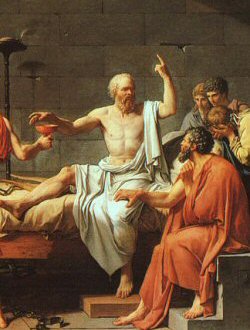
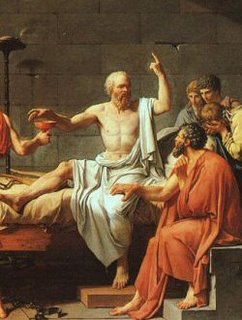
Socrates, what have you done to me? I no longer know who I am!
— Alcibiades

Alcibiades, one of Socrates’ most notable students, was a man who was very wont to “easily make many fine speeches to large audiences” (4) about topics such as virtue. The popular, charismatic Alcibiades would be quite well-received in the process, and think himself quite wise based on his accolades — until he offered the same arguments to Socrates. Suddenly, cross-examined through Socrates’ probing, thorough questioning, Alcibiades found that he no longer was sure of being right — indeed, he found himself as “perplexed and numb as the torpedo fish does” to its victims. (5)

Educator Mortimer J. Adler — an avid student of Socrates, Plato, and Aristotle — poses that “pain and work are irremovable and irreducible accompaniments of genuine learning.” (6) While pain might overstate the case somewhat, certainly when it comes to discomfort Adler is correct. How can one learn without being open to learning and questioning one’s views, and how can one be truly open without some element of risk? Yet American teachers are notorious for not letting students struggle — similar to overprotective parents, several studies have shown that American teachers tend to swoop in to save students from discomfort. The perceived trauma of not being able to arrive without struggle to the right answer in a math class is judged to be just too much for the fragile Huck Finns in our classrooms. However, such a rescue ultimately says more about our discomfort watching students’ struggle. While the impulse to save our students is certainly born in part out of compassion, it also sends a powerful implicit message to our students that they cannot handle the matter on their own. Many students, deep down if not consciously, are hungry for just such challenges — but while we often supply those challenges on the athletic field, we often rob them of the same experience when it comes to intellectual and spiritual growth. Thus, while we might not force him to drink hemlock, we force Socrates to remain mute if he is allowed in the classroom at all.

“Real Art has the capacity to make us nervous,” (7) challenges critic Susan Sontag. Similarly, Anatoly Smeliansky, the vice-rector of the famous Moscow Art Theater, once observed that “American Theater is like the sign on hotel rooms — Do Not Disturb.” (8) We can see the same impulse in education, where discomfort is often not allowed to enter. Alcibiades experiences extreme distress after being questioned by Socrates, to the point that he exclaims he no longer knows who he is. However, he also comes out of this experience a better person, as he later acknowledges in other Socratic tales — and looks on Socrates with not only respect, but affection. Socrates has given Alcibiades a moment of truth — and Alcibiades has grown as a result.

Meno, after seeing Socrates question a young boy, comes to a similar conclusion about the wisdom of Socrates’ approach.

Socrates: You realize, Meno, what point [the boy] has reached in his recollection. At first he did not know what the basic line of the eightfoot square was; even now he does not yet know, but [earlier] he thought he knew, and answered confidently as if he did know, and he did not think himself at a loss, but now does think himself at a loss, and as he does not know, neither does he think he knows.

Meno: That is true.

Socrates: So he is now in a better position with regard to the matter he does not know?

Meno: I agree with that too.

Socrates: Have we done him any harm by making him perplexed and numb as the torpedo fish does?

Meno: I do not think so.

Socrates: Indeed, we have probably achieved something relevant to finding out how matters stand, for now, as he does not know, he would be glad to find out, whereas before he thought he could easily make many fine speeches to large audiences about the square of double size and said it must have a base twice as long.

Meno: So it seems.

Socrates: Do you think that before he would have tried to find out that which he thought he knew though he did not, before he fell into perplexity and realized he did not know and longed to know?

Meno: I do not think so, Socrates.

Socrates: Has he then benefited from being numbed?

Meno: I think so. (9)

A popular quip states that “education is the process of moving from cocksure ignorance to thoughtful uncertainty.” The above exchange, repeated with variations throughout the Socratic dialogues, reveals the key to the Socratic ideal — that one must know one’ self, but most especially one most know the limits of one’s knowledge, of both one’s self and the world. Only then can true learning occur. While strong convictions can be wonderful, we must remember both MLK and Hitler possessed strong convictions. As the passage from Pope’s Essay on Criticism goes:

A little knowledge is a dangerous thing.
Drink deep, or taste not, the Pierian Spring:
There shallow draughts intoxicate the brain,
And drinking largely sober us again.

It must also be noted that Socrates is supportive of his students — and many of his “victims” come back to him. If he was merely harsh or cruel, such loyalty would be unlikely. Socrates can be sarcastic and cutting at times, puckish and playful, but ultimately he proves devoted to his students’ true well-being. Socrates is no sadist. After “numbing” the boy in front of Meno, Socrates moves to the next stage in his style of teaching. As Socrates tells Meno:

Look then how [the boy] will come out of his perplexity while searching along with me. I shall do nothing more than ask questions and not teach him. Watch whether you find me teaching and explaining thing to him instead of asking for his opinions. (10)

Nurturing and support play an essential role in good teaching. The actress Brenda Blethyn (from Mike Leigh’s film Secrets & Lies) once said that what she wanted most from a director was his trust, his support — “if he gives me that, I’m willing to go anywhere.” (11) Teaching works similarly — the student must trust the teacher to serve as a competent guide facilitating the search, and the teacher must pose good questions. And, as Neil Postman observes in his superb essay “Silent Questions,” the questions we ask almost always determine the answers we receive. (12) Notice also, however, that Socrates acts as a facilitator, not a dispenser of knowledge. The best teaching often seems almost invisible; Socrates’ technique forces his students to articulate their own thoughts, refine them, discard bad ideas, and eventually arrive at the answer themselves. True learning often proves a joyful process, but true learning embraces risk, especially the risk of discomfiture.

As Tennessee Williams once put it, “once you fully apprehend the vacuity of a life without struggle, you are equipped with the basic means of salvation.” A true education, one that touches the lives of its students and teachers, embodies this struggle. As teachers and parents we must ask hard, challenging questions of our students (and ourselves), not for the sole purpose of discomfort, but to pursue deeper truths. Deep down, the Huck Finns in our classrooms want nothing less.

III. CONNECTIONS

Where is the Life we have lost in living?
Where is the wisdom we have lost in knowledge?
Where is the knowledge we have lost in information?
— T.S. Eliot, Choruses From ‘The Rock’

A few months back I was riding in the car of a recent acquaintance who was very concerned about not having a cell phone. He possessed a surprising degree of anxiety about the issue, and said something about wanting to be “connected.” It’s a phrase tossed around these days with wild abandon, and I had to wonder — “connected” with what? Would this be a connection to a boss, a job, clients, to work obligations? A connection to friends, family, a significant other? Surely this would not be a connection to nature, to a tree, a stream, a mountain, a beach? Doubtless it would not be a connection to literature, to art, to deeper questions about his identity and his life?

I do not mean to be cavalier — e-mail is wonderful thing, and cell phones can be very useful if not invaluable. Yet, as T.S. Eliot suggests above, it is all too easy to speak while saying nothing, to communicate on a shallow level without saying anything of meaning. One can make fine speeches like Alcibiades, or never have a meaningful, honest conversation with one’s parents — one can speak “words, words, words” “full of sound and fury, / Signifying nothing.” (13)

It has been observed that if facts alone constituted knowledge, one could merely read an encyclopedia and possess all the education one could ever need. Similarly, the internet is a wonderful tool, but ultimately it is merely a tool — one still needs to learn how to sift through all that (often suspect) information, to pick and choose from various sources, to ask, like Socrates, the hard, probing questions.

One of Socrates’ most exciting lines is that “the truth about reality is always in our soul.” (14) Socrates is not merely clever, but wise — his questions are not merely parlor tricks, but push his students towards a deeper, spiritual truth. This is real connection. Socrates also inspires through his genuine hunger for learning — he does not want to rest on his laurels, but prefers to keep searching:

Meno: Somehow, Socrates, I think what you say is right.

Socrates: I think so too, Meno. I do not insist that my argument is right in all other respects, but I would contend at all costs both in word and deed as far as I could that we will be better men, braver and less idle, if we believe that one must search for the things one does not know, rather than if we believe that it is not possible to find out what we do not know and that we must not look for it. (15)

Even a seeming anti-intellectual such as Huck Finn could get excited by a teacher like this, who embraces the search, and honors the pioneering, maverick spirit. Because it is all too easy to slip into complacency and pick the easy familiar answer over the hard truth, to pursue the truth without limitations shall always be rebellious and revolutionary in the very best sense. The Zen Buddhist tradition pursues a similar goal to that of rebellious Socrates; Zen masters often give their students koans, riddles with no simple, rational answer. This forces the students to strive for a deeper truth beyond the familiar or obvious, and to achieve this, they must not only look more openly at the world about them, but also within themselves. Regardless of the tradition, questioning is key, but it must connect with something deeper versus dealing with the superficial.

IV. BETTER GLASSES

Perhaps the greatest scene in Spike Lee’s film Malcolm X occurs when Elijah Muhammad teaches Malcolm a principle by using two glasses. Muhammad first fills one glass with water and then dumps in ashes, so that the water is horribly filthy. He says that if that glass is all the people have, they’ll drink it, and drink it gladly. Muhammad next pours a glass of clear water — it looks wonderful, especially in contrast to the glass of ashes. Muhammad observes if people are offered the glass of clear water, they will pick it instead.

Malcolm shows a flash of concern, (16) as if to ask— what if people don’t pick the right glass? But as Elijah Muhammad explains it:

Here is a glass. Dirty. Water - Foul. You offer this to the people, they have no choice. They’ll drink from it. If they’re thirsty.

You offer them this glass and let ‘em make their own decision, they will choose the pure vessel.

Malcolm’s task is merely to offer the choice. If people but see the choice clearly, they will always pick the better glass.

Removing this lesson from the religious bent of the scene, (17) it remains a powerful metaphor. All people pick the path they feel is best, even if they find out they are mistaken later on. The trick is seeing this. Most every student I have questioned about his or her dreams possesses some sort of vision for him or herself. Deep down, that dream, while varying wildly from person to person, almost always involves giving back to others or leaving the world a better place. No one has ever had a vision of his or herself that has not involved other people in some fashion, whether it be a family, friends, or co-workers. This is another sort of dialogue, or connection. Martin Luther King, in a quotation used at the end of Spike Lee’s Do The Right Thing, speaks of the need for dialogue, versus monologue; violence is a monologue of power, and prohibits true dialogue. (18) In the same vein, Socratic teaching is opposed to indoctrination; indoctrination (like censorship) is violence.

We need our heroes. We need rebellious students and revolutionary teachers. There is also a necessary cost, a sacrifice to made in nurturing these heroes — as teachers we must be willing to suffer the discomfort of watching our students occasionally make poor choices, and learn for themselves. Good teaching will, per Malcolm X’s dictum, use almost “any means necessary.” One of these tools is engaging students in the Socratic dialogue. Another tool is tapping into that Huck Finn rebel spirit rather than squelching it. And still another is presenting students with a choice, but allowing them to choose. We must merely offer them better glasses to see.

Take a student; couple a healthy, restless curiosity with a sense of vision in that student, aid that student in developing the critical thought and expression to name what he or she sees and feels, honor and nurture the spirit that drives that vision — and we are close to what education should be. “I have a dream,” spoke King so powerfully not so very long ago. We must arm Huck Finn to articulate questions of himself and the world, asking him to keep us honest — if we do, perhaps he can grow up from being a Lord of the River to another King.


_______________________________________________

The two quotations from at the end of Do the Right Thing are:

Violence as a way of achieving racial justice is both impractical and immoral. It is impractical because it is a descending spiral ending in destruction for all. The old law of an eye for an eye leaves everyone blind. It is immoral because it seeks to humiliate the opponent rather than win his understanding. It seeks to annihilate rather than convert. Violence is immoral because it thrives on hatred rather than love. It destroys community and makes brotherhood impossible. It leave society in a monologue rather than dialogue. Violence ends by defeating itself. It creates bitterness in the survivors and brutality in the destroyers.

-MLK

I think there are plenty of good people in America, but there are also plenty of bad people in America and the bad ones are the one who seem to have all the power and be in the positions to block things that you and I need. Because this is the situation, you and I have to preserve the right to do what is necessary to bring an end to that situation, and that doesn’t mean I advocate violence, but at the same time I am not against using violence in self-defense. I don’t even call it violence when it’s self-defense, I call it intelligence.

-Malcolm X

Tuesday, September 19, 2006

The Blue Herald

(Not cross-posted at The Blue Herald!)


That, umm, small group of folks that check in on this modest blog with any regularity may have noticed that I've cross-posted the last passel of entries over at The Blue Herald (formerly News You Can Abuse, but now with a .com address and a sleek new WordPress design by Buck). About a month ago now I was invited to join the gang over at The Blue Herald. I will continue to post any substantial work here at Vagabond Scholar, but for most posts I'll cross-post them over at Blue Herald as well.

One can debate the relative merits and demerits of Blogger versus WordPress for page design and all that. Regardless, I must give great credit to Blogger for allowing free bandwidth to nascent bloggers such as myself. Talk about democracy in action! As Howard Kurtz noted this Monday:

What YouTube and social networking sites like MySpace.com and Facebook have in common is that they eliminate the media middleman. Musicians, comedians and other artists (not to mention the date-deprived) can sell themselves to other people without having to convince a journalist that they are worthy of ink or airtime. Unfortunately, the old media establishment too often paints this world as dark and dangerous -- "What Parents Need to Know About MySpace," says a U.S. News cover story -- while playing down its fun and creative aspects.

Meanwhile, there’s something neat about a group blog. Those of us who work day jobs (and sometimes night jobs as well!) cannot possibly hope to keep up with the big bloggers for whom it’s a full-time gig. Thus, a small blog like this can highlight a few important stories, but is better suited for the occasional op-ed, essay, or arts review. One thing I like about Blue Herald is that I can read a news story and think, “that’s important,” and more often than not, someone else at the site will have found it as well and linked it! Then there’s the fun of discovering some story you might have missed otherwise.

This site will likely never receive much traffic, but now that I’m done with the latest play, I hope to catch up on some other writing, both for the blogs and otherwise. Thanks to those of you that check in from time to time, and be sure to check out The Blue Herald as well!

Democratic Campaign Slogans

(crossposted at The Blue Herald)

One area that the netroots can excel at is brainstorming new slogans and talking points, because the conventional wisdom of the Beltway tends to return the same old tired, ineffectual answers. It's something the Democratic Leadership Council would do well to remember, and it's encouraging that net-friendly folks such as Howard Dean, Al Gore, and the Clintons are big players (regardless of what one thinks of Hillary Clinton, she made a smart move in nabbing Peter Daou as a consultant).

I intend to write more on this subject in the coming weeks before the election, but channeling the passion of the excellent Budowsky article Mirth posted on recently, perhaps we can all give it some thought, generate some new ideas, or at the very least find the best material and promote it. The Democrats have much better ideas than the Republicans, and they have better candidates as well. But they also need better words, and better slogans.

To kick it off (or build off earlier posts!) here's a great piece from Josh Marshall from last Friday, 9/15/06:

"The president wants us to forget the mistakes he's made in Iraq. He says capturing bin Laden isn't a priority for him. And now he's off caught up in a fight with senators of his own party about which kinds of torture we should use. This president just can't or won't keep his eye on the ball. President Bush took his eye off the ball in Afghanistan when bin Laden was in our grasp because he wanted to hurry up and get into Iraq. And now he wants us to forget about Iraq because he doesn't want to take responsibility for all the mistakes he's made in Iraq. The American people have a choice on November 7th. If you think our country is going in the right direction, if you think Iraq is making us safer, vote Republican. If you've had enough and thinks it's time for a change, vote Democratic."

-- quoted from a (fictional) congressional candidate