Occasional blogging, mostly of the long-form variety.
Showing posts with label Comics. Show all posts

Thursday, January 27, 2022

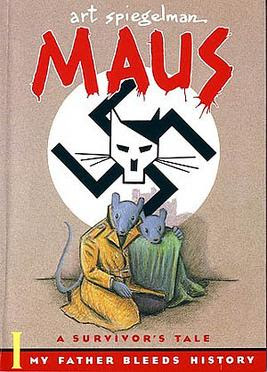
Maus Banned

Just in time for International Holocaust Remembrance Day, a Tennessee school district has banned Maus, an amazing, Pulitzer-winning graphic novel by Art Spiegelman about his family but especially his father, Vladek, who survived the Holocaust. The Associated Press reports that the ban was...

...due to "inappropriate language" and an illustration of a nude woman, according to minutes from a board meeting. . . .

In an interview, Spiegelman told CNBC he was "baffled" by the school board's decision and called the action "Orwellian."

"It's leaving me with my jaw open, like, 'What?'" he said.

The decision comes as conservative officials across the country have increasingly tried to limit the type of books that children are exposed to, including books that address structural racism and LGBTQ issues. The Republican governors in South Carolina and Texas have called on superintendents to perform a systemic review of "inappropriate" materials in their states' schools.

The minutes from the school board meeting indicate objections over some of the language used in "Maus." At first, Director of Schools Lee Parkison suggested redacting it "to get rid of the eight curse words and the picture of the woman that was objected to."

The nude woman is drawn as a mouse. In the graphic novel, Jews are drawn as mice and the Nazis are drawn as cats. . . .

Randi Weingarten, the president of the American Federation of Teachers, which does not play a role in McMinn County, noted the timing of the news on Twitter. Weingarten, who is Jewish, pointed out that Thursday is International Holocaust Remembrance Day.

"Yes it is uncomfortable to talk about genocide, but it is our history and educating about it helps us not repeat this horror," Weingarten said.

The U.S. Holocaust Museum tweeted that "Maus has played a vital role in educating about the Holocaust through sharing detailed and personal experiences of victims and survivors. . . .

"Teaching about the Holocaust using books like Maus can inspire students to think critically about the past and their own roles and responsibilities today."

The Tennessee school board emphasized in the minutes that they did not object to teaching about the Holocaust but some were concerned the work was not age-appropriate.


This is a stunningly bad if not entirely surprising decision. It sure seems to be yet another case of conservatives rejecting good art (and accurate history) out of prudishness and a desire to control their children. But such attempts, in addition to being harmful, rarely succeed in the long run.

As I've written before, Maus is a good introduction to the Holocaust. I used excerpts from it when I was teaching high school, at least one other colleague taught the entire series, and I knew some students read it on their own. I wouldn't give Maus to elementary school kids, but it's completely appropriate for high school students and many junior high students as well.

When I first saw the cover of Maus and heard the pitch – Jews as mice and Nazis as cats?!? – my concern was that it seemed like a cartoonish, oversimplified approach to the Holocaust. But I heard from several people who read Maus and assured me it was not simplistic, and was actually really good. That's all true, and the series is well worth checking out if you haven't yet.

Maus recounts, in detail, what happened to Art Spiegelman's father Vladek and how he survived in Nazi-occupied Poland and later Auschwitz, through luck but also ingenuity and courage. Spiegelman also depicts his fraught relationship with his father in the present day and Vladek's failings, as well as his own. Spiegelman even interrogates the creation of Maus itself and questions if depicting Jews, Nazis, and other groups as animals trivializes the Holocaust, and whether the series' success means he's exploiting a great tragedy. Maus is a complex, multilayered work, suitable for younger readers, and interesting and instructive as a Holocaust survivor's story, but it also raising some pretty significant questions about the nature of history, art, memory, and judgment. It's an engaging read, and can also be a bit emotionally exhausting, as pretty much any good, honest Holocaust tale is.

Something positive has come out of the ban, because a number of people – some famous, some not – are buying copying of Maus and donating them to Tennessee libraries. And the news stories about the ban is introducing new people to the existence of Maus. Maybe they'll check it out to see what all the fuss is about. Conservative attempts to ban something can backfire.

Years ago I lent my copies of Maus to my father, who had introduced me to comics, and he was impressed by the series as well. From where I'm sitting, I can glance over to a bookcase and see those same copies of Maus, sitting atop a copy of Primo Levi's The Drowned and the Saved. That's also an amazing work, but should only be read when someone's well-acquainted with the Holocaust already. Maus has a great track record in that regard, introducing people to the Holocaust. Let students read it, and may the efforts to provide more copies in Tennessee libraries and elsewhere flourish.

Tuesday, July 27, 2010

Harvey Pekar (1939-2010)


Harvey Pekar, the creator of alternative comic book American Splendor, died a couple of weeks ago. As he described it:

I was sort of on a mission with American Splendor. I wanted to try to prove that comics could do things. I wanted to expand them beyond superheroes and talking animals. And I knew that was going to take a long time. But I just started writing an autobiography about my quotidian life. Because I think everybody's life is interesting, and I just kept on going at it.


I grew up with those superhero and talking animal comics (some of them excellent), and only discovered Pekar's work later. He did slice-of-life pieces, something like Anton Chekhov's serious stories and plays, or Eric Rohmer's films, or many a good documentary. (As I write this, 49 Up is playing on PBS, and it really captures the shape of a life.) But Pekar's work was more akin in tone to that of Woody Allen, Spalding Gray, or Larry David - neurotic, obsessive, philosophical, self-doubting, but also self-reflective and occasionally profound. Oh, and also infused with a wry, dark sense of humor.

Pekar also described American Splendor as:

...An autobiography written as it's happening. The theme is about staying alive. Getting a job, finding a mate, having a place to live, finding a creative outlet. Life is a war of attrition. You have to stay active on all fronts. It's one thing after another. I've tried to control a chaotic universe. And it's a losing battle. But I can't let go. I've tried, but I can't.


Cartoonist Seth explained Harvey's contribution this way:

The underground cartoonists were a generation — a group of artists who knocked down the walls between art and commerce, shattering the traditional shape and meaning of a comic book. Later, the 'alternative' cartoonists came along — or whatever you wish to call my generation of cartoonists — who wanted to produce comics as a legitimate art medium. But in-between these two generations there was Harvey. A generation of one. Probably the first person who wanted to use the comics medium seriously as a writer. Certainly the first person to toss every genre element out the window and try to capture something of the genuine experience of living: not just some technique of real life glossed onto a story — not satire, or sick humor or everyday melodrama — but the genuine desire to transmit from one person to another just what life feels like.


A friend of my dad's, when asked what she did for a living, would give her occupation, but said she always wanted to add (and sometimes did, almost in protest), "Oh, but there's so much more!" Her life outside of work was far more rich and interesting and reflective of who she was, and she didn't want to be defined by her day job. Harvey Pekar worked as a file clerk for the V.A., not a glamorous gig (although surely it did some good). And his work life did make it into his comics. But his life was so much more besides. There was his love of jazz, and his keen eye for everyday interactions, frustrations and triumphs. There were his experiences with his wife Joyce, and his struggles with cancer, all chronicled in his comics. Many of his pieces focus on just a single conversation, some exchange that Pekar thought was funny or telling.

There have been a number of good remembrances. Fresh Air re-ran parts of two Pekar interviews. He was also on The Treatment before the film American Splendor came out. (My local station KCRW did a cool Pekar special re-run, but won't post the audio online, unfortunately.)

"Harvey Pekar, Cleveland comic-book legend, dies at age 70" from the Cleveland Plain Dealer features video of two of his Letterman appearances.

Jill at Brilliant at Breakfast has nice piece on Pekar (and Steinbrenner). There's also:

Jeet Heer, National Post: "The legacy of the every-man’s hero"

Anthony Bordain: "The Original (Goodbye Splendor)"

Richard Greenwald, In These Times: "Losing Another Working-Class Hero: Graphic Novelist Harvey Pekar Dies at 70"

Lisa Hix, Collector's Weekly: "Harvey Pekar: The Splendor of an Ordinary Life"

T. Holder, Comics Comics: "Another Side of Splendor"

Leave Me Alone!, the Harvey Pekar opera.

(I'm sure there are many more good pieces I missed.)

Finally, Roy Edroso wrote a nice remembrance:

Crumb, who can be very astute about these things, said Pekar's work could be "so staggeringly mundane it verges on the exotic," which is only almost right, because the mundane is exotic, always, if you know how to look at it. Pekar knew.


Friday, July 23, 2010

Geeks 1, Homophobes 0


Actually, "homophobes" is too tame a word for Fred Phelps and the hate-filled gang of the Westboro Baptist Church. But when they showed up to protest at Comic-Con, they were met by some counter-protesters:

Unbeknownst to the dastardly fanatics of the Westboro Baptist Church, the good folks of San Diego's Comic-Con were prepared for their arrival with their own special brand of superhuman counter protesting chanting "WHAT DO WE WANT" "GAY SEX" "WHEN DO WE WANT IT" "NOW!" while brandishing ironic (and some sincere) signs.


The Phelps crowd might think they have God on their side, but do they really want to get into a stamina war with folks who can wait hours in line for a sneak peek at The Green Hornet or an autograph from Stan Lee or Ray Bradbury? Mess with fanboys and fangirls on Star Wars Day and the Force will not be with you.

Major style points to the counter-protesters on this one. There's a short video and more photos at the first link. (Via.)


Fox News immediately announced an investigation – where is the liberal media on robot-on-human violence? Why the double-standard?

(Cross-posted at Hullabaloo.)


Thursday, May 07, 2009

Carl Barks


One of the most important things parents can do is share their loves and joys with their children. My brothers and I grew up in a home where both our parents were voracious readers. (We continued nighttime read-alongs past the age when it was really needed mainly to humor our mother because she enjoyed it.) Our dad introduced us to soccer and took us to films (including a remarkable number of art house flicks). He also shared his comic book collection with us.

He hadn't cared much for the Marvel line, but had a solid number of DC titles, mainly Batman, Superman and some crossovers. He also had plenty of EC horror comics and some early Mad books and comics. The real treasure, though, was his old Disney comics, most of them written and drawn by Carl Barks.

Back then, many comic book writers and artists were not credited, at least not at Disney, so our dad and his friends only knew Barks as "the good artist." Barks' artwork was a cut above, but he was an even better storyteller. His stories were funny, creative, and often stealthily educational while being very entertaining. For instance, rich Uncle Scrooge decided he needed a new coat befitting his wealth, so he hired his nephew Donald Duck and Huey, Dewey and Louie to help him locate the fabled Golden Fleece to make his coat. They encountered harpies, the minotaur and other creatures from Greek Mythology along the way. Huey, Dewey and Louie often saved the day, aided by the ridiculously invaluable Junior Woodchuck Handbook (boy, we wanted one of those – the Boy Scout Handbook isn't nearly as extensive). The stories of Carl Barks fall into the same category as the various muppet movies, Pixar films, and The Simpsons - they're just good stories that kids and adults can enjoy at the same time. (Floyd Gottfredson's Mickey Mouse comic strips are also superb, with some great yarns, although I'd give the edge to Barks. I also shouldn't slight Tintin, Asterix, and in a somewhat different vein, Pogo.)

Carl Barks had Uncle Scrooge, Donald and the boys search for the Fountain of Youth, the Seven Cities of Cibola, Shangri-La, a lost Incan city, the lost crown of Genghis Khan, the Flying Dutchman, head deep below the earth's crust and visit many other exotic and fantastical locales. One of the classics, Donald Duck and the Golden Helmet, has Donald and the gang racing rivals to archeological sites to find the titular item, and fighting for ownership of… North America. Come to think of it, the story hits the same themes of greed and the intoxication of power found in Treasure of the Sierra Madre, only it's comedic, and features one of the most memorably slimy, suck-up lawyers you'll ever see. Another tale had Donald, who often made horrible decisions, inventing "Flippism," flipping a coin to make choices. Part one of the story had Huey, Dewey and Louie playing hooky from school (Barks had several stories like that). Despite their best efforts to shake Donald, he continued to hunt them down, aided by his uncannily accurate coin flips. Uncle Scrooge and Donald were often vain, greedy and prideful, but lovable despite that, while the kids were generally much more sensible. Carl Barks had a great feel for the kid point of view.

Many characters in the Disney duck-verse were created by Barks (who was born in 1901 and died in 2000). I only ever saw a few episodes of the Duck Tales animated series, but some episodes were based on Barks' stories and many of its characters were originally created by him. As the quite good Wikipedia entry on Barks explains:

He surrounded Donald Duck and nephews Huey, Dewey and Louie with a cast of eccentric and colorful characters, such as the aforementioned Scrooge McDuck, the wealthiest duck in the world; Gladstone Gander, Donald's obscenely lucky cousin; inventor Gyro Gearloose; the persistent Beagle Boys; the sorceress Magica De Spell; Scrooge's rivals Flintheart Glomgold and John D. Rockerduck; Daisy's nieces April, May and June; Donald's neighbor Jones, and The Junior Woodchucks organization.

People who work for Disney generally do so in relative anonymity; the stories only carry Walt Disney's name and (sometimes) a short identification number. However, through the sheer quality of his work, people started realizing that a lot of the stories were written by one person, whom they started referring to as the Good Duck Artist. Later it was discovered that the Good Duck Artist went by the name of Carl Barks.

Barks' stories (whether humorous adventures or domestic comedies) often exhibited a wry, dark irony born of hard experience. The 10 pagers showcased Donald as everyman, struggling against the cruel bumps and bruises of everyday life with the nephews often acting as a Greek chorus commenting on the unfolding disasters Donald wrought upon himself. Yet while seemingly defeatist in tone the humanity of the characters shines through in their persistence despite the obstacles. These stories found popularity not only among young children but adults as well. Despite the fact that Barks had done little traveling his adventure stories often had the duck clan globe trotting to the most remote or spectacular of locations. This allowed Barks to indulge his penchant for elaborate backgrounds that hinted at his thwarted ambitions of doing realistic stories in the vein of Harold Foster's Prince Valiant.


Here's a few things I didn't know:

Barks' Donald Duck stories were rated #7 on Comic's Journal list of 100 top comics; his Uncle Scrooge stories were rated #20.

For the opening scene of Raiders of the Lost Ark, Steven Spielberg and George Lucas have acknowledged the rolling boulder booby trap was inspired by the 1954 Carl Barks Uncle Scrooge adventure the Seven Cities of Cibola (Uncle Scrooge #7). Lucas and Spielberg have also made comments that some of Barks' stories regarding space travel and the depiction of aliens had an influence on them. [3] Lucas wrote the foreword to the 1982 "Uncle Scrooge McDuck: His Life and Times." In it he calls Barks’ stories "cinematic" and "a priceless part of our literary heritage."


(The boulder in the Cibola story, scanned by Kit's Comics. Click for a larger view.)

Gladstone Publishing reprinted many of Carl Barks' stories starting in the 80s, and also printed some superb new stories in the Barks tradition by Don Rosa and others. They're out of business now, unfortunately. (The story I heard at the time was that Disney didn't want to renew their license when they realized the cash to be made directly.) Apparently, this Gladstone site still offer back issues, collections and lithographs, both the Barks library and reprints of the old EC comics. Some editions are pricey and aimed more for collectors. Me, I just liked the stories as a kid, and was excited to find some new tales as a teenager through Gladstone (including an elaborate and funny spy story set in Europe, where Donald and the boys were on vacation) Like other readers of Carl Barks, I remember his work fondly, and appreciate being introduced to it. So thanks to Carl Barks, and thanks to all the parents out there who pass on good stories, encourage imagination, and share their joys with their kids.