If you missed it, Gary Trudeau ran an exceptional series of strips for Doonesbury not long ago. If you haven't been following the strip for a while, the strip's most staunchly conservative character, B.D. (they guy who previously always wore a helmet), lost part of his leg in Iraq. In addition to dealing with physical therapy, B.D. has been struggling with Post-Traumatic Stress Disorder. He's reluctantly been seeing a vet counselor, Elias (Trudeau provides links for vets seeking similar services). Trudeau's managed to broach some very delicate subjects with great sensitivity and humour. It's easy to argue the humour makes the subject matter more palatable, but striking the right balance with the humour is anything but easy.
This latest storyline, on PTSD, starts up on April, Monday, 4/17/06, but really takes off with the Wednesday strip, running for two weeks up to Saturday, 4/29. There's a related stand-alone Sunday strip the next day, 4/30 (it won the WaPo humour columnist Gene Weingarten's Comic Pick of the Week).
Personal note: Once upon a time, I wanted to be a cartoonist or comic book artist, and even took a few no-credit classes as a kid in the summer at the Smithsonian. Walt Kelly's Pogo for me is still probably the pinnacle for its blend of great artwork, good gags even a kid can appreciate, and deeper sophistication for adults. His political satire on McCarthy remains one of the triumphs of the medium. But Doonesbury is without question one of the all-time greats. Trudeau was in the running for a Pulitzer for a moving, tasteful AIDS-death storyline years ago. I hope the Pulitzer board recognizes his work soon.

Showing posts sorted by relevance for query doonesbury. Sort by date Show all posts
Showing posts sorted by relevance for query doonesbury. Sort by date Show all posts
Friday, May 12, 2006


Wednesday, February 28, 2007
Dreams of a Sunni Kansas
(Cross-posted at The Blue Herald)

(Click the cartoon for a larger image.)
This Doonesbury strip, reprinted on 4/5/06, is one of my favorites from Trudeau in the past two years. Even among terrorists such as Al-Qaeda, while there are aspects of American culture they hate, it’s not so much that they hate our “freedom,” they hate our foreign policy. Furthermore, in Iraq, even the Pentagon estimates that Al-Qaeda comprises a mere sliver of the population. The majority of the Iraqi populace wants us out, they may want their faction to be dominant, and most of them probably want to be able to live their lives and raise their families in relative peace and prosperity. It’s not as if the entire populace of Iraq, let alone a significant percentage, has the will, interest, training or resources to travel to America, trick customs, gather dangerous materials and fashion a plot to attack the Mall of America.

(Click the cartoon for a larger image.)
This Doonesbury strip, reprinted on 4/5/06, is one of my favorites from Trudeau in the past two years. Even among terrorists such as Al-Qaeda, while there are aspects of American culture they hate, it’s not so much that they hate our “freedom,” they hate our foreign policy. Furthermore, in Iraq, even the Pentagon estimates that Al-Qaeda comprises a mere sliver of the population. The majority of the Iraqi populace wants us out, they may want their faction to be dominant, and most of them probably want to be able to live their lives and raise their families in relative peace and prosperity. It’s not as if the entire populace of Iraq, let alone a significant percentage, has the will, interest, training or resources to travel to America, trick customs, gather dangerous materials and fashion a plot to attack the Mall of America.
Sunday, June 01, 2008
Doonesbury, 5-29-08

(Click for a larger view.)
Taking one of the most despicable of many despicable moves by the Bushies, making ya laugh, but in a way that highlights the dark absurdity of it all and doesn't making light of human cruelty... Damn. Look at what Garry Trudeau does in just four panels. Brilliant.
The official site is here.
(Cross-posted at The Blue Herald)
Monday, February 26, 2007
All is Vanity
(Cross-posted at The Blue Herald)

(Click on the cartoon for a larger image)
Apologies for partially recapping a previous blog title, but I love this Doonesbury strip from Sunday, 10-9-05, and that line from Ecclesiastes really, really fits both this strip and Bush. This strip wonderfully articulates, with satire, an idea I remember struggling to express clearly back in a college piece. The stupidity of leaders or the pointlessness of a mission do not diminish the heroism of the troops themselves. Troops only die in vain if we are too stupid to learn from our mistakes or face our own vanities. Having the courage to admit someone acted heroically, but died unnecessarily, can be essential for preventing more unnecessary deaths. No one should die for pride and image alone, and the pain of facing the harsh truth of a given mistake is as nothing to the pain of actually dying or the pain of mourning a loved one. To pretend otherwise is dreadful, deadly vanity.

(Click on the cartoon for a larger image)
Apologies for partially recapping a previous blog title, but I love this Doonesbury strip from Sunday, 10-9-05, and that line from Ecclesiastes really, really fits both this strip and Bush. This strip wonderfully articulates, with satire, an idea I remember struggling to express clearly back in a college piece. The stupidity of leaders or the pointlessness of a mission do not diminish the heroism of the troops themselves. Troops only die in vain if we are too stupid to learn from our mistakes or face our own vanities. Having the courage to admit someone acted heroically, but died unnecessarily, can be essential for preventing more unnecessary deaths. No one should die for pride and image alone, and the pain of facing the harsh truth of a given mistake is as nothing to the pain of actually dying or the pain of mourning a loved one. To pretend otherwise is dreadful, deadly vanity.
Wednesday, October 25, 2006
Garry Trudeau and The Sandbox
(crossposted at The Blue Herald)

Earlier this year I did a brief post on Garry Trudeau’s remarkable series in Doonesbury on B.D. struggling with Post-Traumatic Stress Disorder.
Trudeau now has a great new feature for military service people and their families called The Sandbox. It already has some striking entries. (Here is the full cartoon excerpted above. Trudeau has a more general response section called Blowback).
Trudeau has a new book out centering on the B.D. cartoons. The War Within. Here is the link. The proceeds benefit Fisher House. Their mission: “Supporting America's military in their time of need, we provide ”a home away from home” that enables family members to be close to a loved one at the most stressful time -- during hospitalization for an illness, disease or injury.”
Finally, Gene Weingarten of The Washington Post has an absolutely exceptional profile of the reclusive, shy Trudeau here, and discussed it with readers here. It’s worth spending some time with this one.
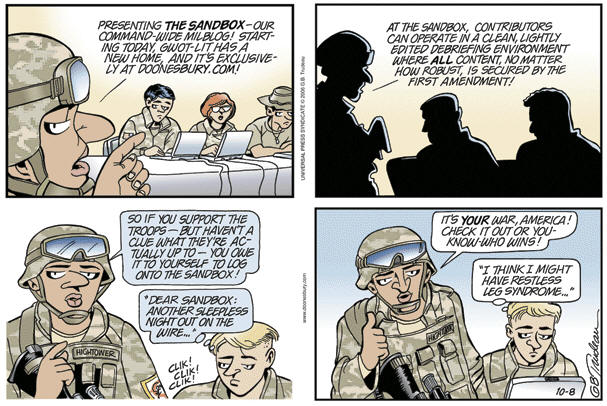
Earlier this year I did a brief post on Garry Trudeau’s remarkable series in Doonesbury on B.D. struggling with Post-Traumatic Stress Disorder.
Trudeau now has a great new feature for military service people and their families called The Sandbox. It already has some striking entries. (Here is the full cartoon excerpted above. Trudeau has a more general response section called Blowback).
Trudeau has a new book out centering on the B.D. cartoons. The War Within. Here is the link. The proceeds benefit Fisher House. Their mission: “Supporting America's military in their time of need, we provide ”a home away from home” that enables family members to be close to a loved one at the most stressful time -- during hospitalization for an illness, disease or injury.”
Finally, Gene Weingarten of The Washington Post has an absolutely exceptional profile of the reclusive, shy Trudeau here, and discussed it with readers here. It’s worth spending some time with this one.
Thursday, October 27, 2005
Irresponsible Speculation and Predictions
We’ll set thee to school to an ant, to teach thee there’s no laboring i’ th’ winter. All that follow their noses are led by their eyes but blind men, and there’s not a nose among twenty but can smell him that’s stinking. Let go thy hold when a great wheel runs down a hill, lest it break thy neck with following. But the great one that goes upward, let him draw thee after.
— The Fool to Kent in the stocks, King Lear, 2.4, 66-72
(The Fool’s words are incredibly ironic, and demand a fuller post, but he’d still make one hell of a political advisor.)
While pundits and commentators exist who clearly embrace their apparent ideology, when it comes to the “chattering class,” their true love is almost always for a good political storyline above all else. Some tale or angle or event that will yield a strong column or some witty bon mots on the talk show circuit, that’s where it’s really at. Don’t you think Jay Leno wept when he had to say goodbye to Clinton and another thousand Lewinsky blow job jokes? (He still tromps them out from time to time.) Reagan might have argued that trees caused pollution and that ketchup and relish should count as vegetables in children’s school lunches, but even his detractors in the press would say he was a colorful character to write about. After George H.W. Bush was elected, Gary Trudeau in Doonesbury announced that political cartoonists were giving Bush a honeymoon week of no negative panels, “to give him a chance to get a handle on that ‘vision thing,’” and “as a way of formally thanking him for Dan Quayle.”
Many liberal bloggers are referring to tomorrow, the latest likely day for Fitzgerald to announce indictments, as Fitzmas. However, the truth is that it’s a bonanza for chatterers everywhere, with juicy material to last many a news cycle, to yield many a column or book, and to allow plenty of opportunity to posture as a sage insider on a news program. Granted, it’s a more fun time for liberals than conservatives (at least until Bush nominates another candidate for The Supreme Court). Consider the situation. Republicans hold power in all three branches of government. However, currently, the top aide to the President and the Vice President are facing possible indictment, the Vice President may face trouble as well, and at the least he appears to have publicly lied yet again. The House Majority Leader, Tom Delay, has been indicted. The Senate Majority Leader, Bill Frist, is being investigated for impropriety with his not-so-blind trust and has publicly lied. This is not to mention the indictments of Republicans Bob Noe in Ohio, super lobbyist Jack Abramoff (tight with Delay), and David Safavian. Add to this the Harriet Miers debacle and the truly shocking, shameful way Hurricane Katrina was mishandled. Oh yeah, and then there’s Iraq.
Howard Kurtz of The Washington Post aptly observed that the passions about Plamegate run so high because “We're re-fighting the war through this case.” (Slate’s Mickey Kaus agrees somewhat but adds several other reasons). Previous details of the path to war are coming out as a result of Fitzgerald’s inquiry. Normally the real story of an administration takes time to unveil. We know much more about Nixon now than we did even five years ago, and similarly, the full truth of the Bush administration may not come out until a decade or two later. However, we may now get to know much more, much sooner than anyone anticipated. While many of the statements and rationales for the war are currently being re-examined by chatterers, now the general public seems to be taking a greater interest as well.
Kurtz’s column of Thursday, 10/27/05 did a fantastic job of providing a timeline of some key leaks in the Plamegate case, and touches on why many of these leaks likely occurred. As he observes:
...virtually every bit of information, confirmed and alleged, comes from unnamed sources -- ironically, in an investigation of who anonymously outed a CIA operative -- who are trying to shape public understanding of a complicated narrative to someone's advantage.
The result is that after two years of near-total secrecy about the CIA leak investigation, a steady stream of sometimes-conflicting information is now flowing, invariably attributed to "lawyers close to the case" or similarly opaque sources.
As special prosecutor Patrick J. Fitzgerald nears a decision on whether to seek indictments of top White House officials, lawyers involved in the inquiry are using the news media to float bits of evidence or interpretations that are favorable to their high-level clients. The maneuvering makes clear that these lawyers are fighting a two-front war, trying simultaneously to avert criminal charges while seeking acquittal in the court of public opinion.
The rush of disclosures in the closing days of an investigation is a time-tested ritual of Washington scandals, and each time the questions are the same: Who leaked and for what reason?
As a mere blogger (and a tardy, intermittent one at that), currently ranked 775,745 by Technorati in terms of influence (sorry, I find it very funny), I can’t yet pretend to full membership in the chattering class. However, I certainly can join in the chatterer tradition of wild speculation and completely off-base predictions. In fact, this is an area where bloggers often outstrip the feeble Mainstream Media (tm), or MSM, as all oh-so-hip bloggers call it. The key word in opinion journalism is not journalism, it’s opinion. Did Novak admit he was wrong about his authoritative yet wildly incorrect statement on the exact date Rehnquist would announce his retirement? No! He came up with a new opinion for a new deadline. With chatterers chaffing at the bit for Fitzgerald’s likely announcement tomorrow, now is the deadline for irresponsible prognostication, and I cannot shirk my duty. (Until, of course, there’s a new deadline and we can all shamelessly offer new opinions.)
PLAMEGATE
Most chatterers think it likely that Libby will be indicted on two to three counts: perjury, obstruction to justice, and possibly conspiracy. I’ll agree. He appears to have lied at least twice, but they are also likely compound lies. If news accounts are to be believed, it appears he lied to the grand jury about divulging Valerie Plame Wilson’s status as a CIA operative to reporters... he spoke about the matter three times with The New York Times’ Judy Miller. Most importantly, he spoke with her on the matter on June 23, 2003, before Novak’s now infamous column. Libby apparently claimed he learned of Plame’s identity from reporters, specifically NBC’s Tim Russert. Russert has publicly stated that there’s no way that could be the case, because he didn’t know Plame’s name until Novak’s column. While this is bad enough, The New York Times reported this week that Libby learned Plame’s identity from none other than Dick Cheney, about a month before Novak’s column. While Libby and Cheney would of course have the security clearance to discuss a CIA agent, they’re both experienced enough to at least say, wait, is she undercover or not? Unless, of course, anger clouded their judgment. Regardless, this would involve a compound lie from Libby... the obvious storyline would be, he tried to cover for his boss and blamed the leak on those irresponsible liberal reporters. If Cheney lied as well, then Libby had a clear motive for such action, and he wasn’t innocently mistaken... not that I find the massive memory lapses that have been claimed by many parties plausible in the first place.
In an online chat, Washington Post national political editor John F. Harris responded to a poster:
On this point, I tend to be more believing of the White House line. It has always seemed clear to me--and the evidence coming out over time has strengthened the point--that the White House motive in talking about Plame was not "to get back at Wilson." This was not about revenge. It was about trying to persuade reporters not to write about Wilson's allegations or take them seriously, because his mission to Niger was a low-level endeavor that had been cooked up lower down in the bureaucracy (with the assistance of his wife) and was not something that was done with White House knowledge. Remember, at the time, Wilson's suggestion was that of course the vice president knew about the results of his trip to Niger, because he had ordered it.
In the course of trying to knock down a damaging story--a routine activity in Washington--they obviously stepped over a line...quite possibly without fully appreciating that they were stepping across.
I think Harris nails one of the key reasons for the leak, but I feel he discounts the revenge angle too quickly. Judy Miller reports Libby as irate about Wilson. The current leaks about Libby also paint him as very upset, even obsessed. Many key members of the Bush administration, notably Rove and Cheney, are very much into the politics of revenge and retribution. If Rove did indeed tell Chris Matthews that Wilson’s wife was “fair game” (and was Matthews even subpoenaed?), then there’s a very different picture (Harris is also a bit imprecise above; Wilson never said that Cheney ordered his trip, he said that Cheney's request for more information was the reason the CIA sent him... but hey, it's a chat).
My take has always been that the Plame leak, in addition to being damage control as usual, was dirty politics as usual from the Bush administration. The problem this time is that, in addition to being unethical, this time their actions were actually illegal as well, and they got caught.
Rove. This one’s trickier. News reports state that on his fourth trip to the grand jury he told them he may well have heard Plame’s name from Libby. While this clearly seems like a move to save his own ass, this may also be a White House strategy... Libby is doomed, so let’s make him the fall guy, and blame everything on him. I would not be surprised if Rove was indicted for perjury and obstruction of justice. He did in fact reveal Plame’s identity to Time’s Matt Cooper, but I think at least a false statement charge is looming. Some folks feels he’s flipped on everyone, while others say he’s fighting the charges furiously and refused a plea bargain. Some say he won’t be indicted but he will continue to be investigated by Fitzgerald. Rove can claim faulty memory, but I don’t find that plausible... does the grand jury buy it? I feel one indictment at least is likely, but if indictments do not come, I would be surprised if he was not investigated further. I don’t think he sails through this clean legally (not in the short term, at least).
Rove has made many enemies over the years, who have dared not cross him further for fear of not working in the party anymore. If he topples, there will be a lot of buzzards. Large amounts of dirty laundry will come out if he is seen as through, or vulnerable. (And I’m sure I could mix in another overused metaphor if it weren’t so late now.) It sure would be nice to know if Rove was indeed directly involved with events such as the slanderous push-polling in South Carolina against John McCain.
Cheney. Some folks feel Cheney may be named as an unindicted co-conspirator. I find it hard to believe that Libby would undertake anything major without Cheney’s knowledge, but I also find it hard to believe that Cheney, despite his repeated disregard for the truth, would knowingly lie under oath if he knew he could get caught. News sources disagree as to whether his interview with Fitzgerald was under oath or not, and they also disagree about whether he met with Tenet or not. One story, from The New York Times, has Tenet telling Cheney about Plame, which would almost certainly mean Cheney requested the information. But MSNBC reported that Tenet denies he told Cheney this. So, my take is that Cheney’s hands are dirty, but may not be filthy, and he will likely not face any serious legal action. I do think his past misstatements will get some new scrutiny from the press, however.
There are other figures such as John Hannah, Stephen Hadley, Wurmer and the usual gang of Rice, Bolton, and all who also may be indicted, but this is all murkier. If someone flipped and went for a plea, it’s most likely a lower-rung (but perhaps central) person.
I would guess that one or two more people beside Libby and Rove would be indicted, although if reports are to be believed, they will not be in the White House proper, but instead from the Pentagon or even the State Department.
Is there further damning or exonerating evidence we don’t know about? Most definitely. It’ll be interesting to see how everything plays out, but more importantly... what the truth is.
To bring it back to Shakespeare, and fools and knaves... I have no doubt that while Cheney is a knave, Libby will fall on his sword to save him (as folks as Halliburton did for him before when it was discovered they were illegally dealing with America’s sworn enemy Iran). I’m less sure of Rove, and the next days, weeks, and months will be revealing. He’s always seemed like something of a craven bully to me. Supposedly he’s vicious when cornered, but would he go down for Bush? Maybe. But for Libby or Cheney? I don’t know, but I think that’s less likely. And I think Bush especially would want to save Rove, and other folks of course know that.
Regardless, no one seems "foolish" enough to be an "honest broker" with Bush, who accounts depict as increasingly angry and frustrated, blaming everyone around him. No one has said to him what he has so sorely needed, something in the spirit of:
See better Lear, and let me still remain
The true blank of thine eye.
— Kent to Lear, King Lear, 1.1, 161-162
(Wild Miers replacement speculation to follow shortly!)
Saturday, August 22, 2009
Serving King Grassley
Via Sadly, No comes an atrocious Washington Post article on Grassley, Boehner and the Republicans on health care. Check out the whole thing, but this will give you the flavor of the piece:
We must give the reasonable Lord Grassley his way! (Later on, Boehner accuses Obama and the Democrats of refusing to work with them.)
Goddam, this article is obtuse and ridiculously credulous. Grassley wasn't just pressed to debunk death panel rumors. He was asked to repudiate them and perhaps apologize. That's because he was spreading them, as in telling his constituents, "…You have every right to fear… . We should not have a government program that determines if you're going to pull the plug on grandma." That was before he called the death panel propaganda he's been pimping "nothing more than a distortion coming from far-left," and pivoted to attack Pelosi and other Democrats. Grassley has said he probably won't support his own bill even if he gets everything he wants from it. Meanwhile, he and other Republicans have floated their 80 vote bullshit earlier in the year – it's funny how the same rules never apply to Republicans in power.
It's appalling that Montgomery and Bacon actually present Grassley, Boehner and the gang as acting in good faith and never question it. If these reporters are too gutless to call them out, they could at least find a Democrat or pundit who isn't. (That's how it's often done.) But at the least, they could note Grassley's many other public statements and how they directly undermine his credibility. By not doing that, they deny their readers essential context. There's plenty to be found from the New York Times, MSNBC, Steve Benen, the Huffington Post, Media Matters and other outlets. (Hell, Doonesbury ran the "distortion of the far left" line as its featured quotation.) Matthew Yglesias comments on the same article and points out the super-supermajority idiocy, but that's but one angle the article could have taken. How about a poll of Grassley's constituents and their views? How about a poll of their views before and after he worked to scare them? How about national polls and support for the public option, or a discussion of what policies might actually work well? How about some recognition that Grassley's one senator in the minority party representing an extremely small state? How about pushing him to defend his claims? What about at least focusing on Grassley himself? The WaPo article is sorta like guilelessly quoting an arsonist who's blaming someone else for burning the house down when he's standing there with an empty gas can and the other news stations have been running footage of him torching the place. Glaring contradictions, hypocrisy, suspect claims and possibly outright lies by the subject of the piece are somehow not relevant, not newsworthy, and don't make a good headline?
It's highly unlikely Montgomery and Bacon were unaware of the high bullshit factor to Grassley's claims. The only values in writing a story like this versus a more accurate and skeptical one are a) not pissing off Republicans, and b) helping sink health care reform. Given the conspicuous omissions, this article doesn't even rise to the level of stenography. It's more of a Republican press release.
My favorite bit is probably their shilling of Grassley's tale of suddenly opposing health care reform based on the feedback of constituents (after he's lied to them). It made me start thinking of analogies:
After consulting with the American people, Joseph McCarthy is convinced Edward Murrow is a dirty commie.
After many town halls, John McCain is convinced that the American people really wanted him to be president last November.
After shilling an argument that has never been made in such detail or with such care, Jonah Goldberg is convinced that liberals are the real fascists. (Also, that he is brilliant.)
After a careful examination of her own butt after tequila shots, Pam Atlas is convinced that Barack Obama is Malcolm X's love child - and born in Kenya.
After an exhaustive search for the real killers, O.J. Simpson is convinced of his own innocence.
Make your own…
As DDay and others have noted, "The only way you can really get to a Max Baucus or a Charles Grassley is by threatening their job security." The Democrats can strip Baucus of his chairmanship, and Grassley is up for re-election next year. A strong Democratic challenger could do for Grassley what conscience and basic shame have not.
Key Senator Calls for Narrower Health Reform Measure
Republican Grassley Cites Town Hall Anger
By Lori Montgomery and Perry Bacon Jr.
Washington Post Staff Writers
Thursday, August 20, 2009
Sen. Charles E. Grassley, a key Republican negotiator in the quest for bipartisan health-care reform, said Wednesday that the outpouring of anger at town hall meetings this month has fundamentally altered the nature of the debate and convinced him that lawmakers should consider drastically scaling back the scope of the effort.
After being besieged by protesters at meetings across his home state of Iowa, Grassley said he has concluded that the public has rejected the far-reaching proposals Democrats have put on the table, viewing them as overly expensive precursors to "a government takeover of health care."
Grassley said he remains hopeful that he and five other members of the Senate Finance Committee can draft a better, less costly plan capable of winning broad support from Democrats and Republicans. But as the group, known as the Gang of Six, prepared to continue talking via teleconference late Thursday, Grassley said the members may be forced to reassess the breadth of their efforts in light of public concerns.
"Not just on health care, but on a lot of other things Congress has done this year, people are signaling that we ought to slow up and find out where we are and don't spend so much money and don't get us so far into debt," he said in a telephone interview between stops in Iowa Falls and Ames, where he has been leading foreign diplomats on a week-long tour of the state. The Finance Committee group is still discussing a "comprehensive" plan for extending coverage to millions of uninsured families, he said, but revisiting that approach would be "a natural outcome of what people may be getting from the town hall meetings."
As the senior Republican on the Finance Committee, Grassley has the potential to attract GOP votes by giving his blessing to a bill, and congressional Democrats and the White House consider him the key to winning bipartisan support for President Obama's top domestic priority. In recent days, however, some Democrats have accused Grassley of trying to undermine the reform effort, for example by refusing to debunk rumors that the Democratic health bills would create "death panels" empowered to decide whether the infirm live or die.
On Wednesday, he denied those claims and fired back at Obama, saying the president should publicly state his willingness to sign a bill without a controversial government-run insurance plan. Such a statement, he said, is "pretty important . . . if you're really interested in a bipartisan bill."
"It's not about getting a lot of Republicans. It's about getting a lot of Democrats and Republicans," Grassley said. "We ought to be focusing on getting 80 votes."
On Wednesday, Grassley made clear that he remains committed to pursuing a health-care bill, provided it does not "make things worse" for people who are happy with their insurance or add to swollen budget deficits. His remarks echoed those of other key Republicans -- including Sens. Olympia J. Snowe (Maine) and Mike Enzi (Wyo.), the other GOP negotiators on the finance panel -- as well as some Democrats, who are quietly urging Obama and congressional leaders to lower their expectations for what can be accomplished this year in the interest of building momentum for future reform.
We must give the reasonable Lord Grassley his way! (Later on, Boehner accuses Obama and the Democrats of refusing to work with them.)
Goddam, this article is obtuse and ridiculously credulous. Grassley wasn't just pressed to debunk death panel rumors. He was asked to repudiate them and perhaps apologize. That's because he was spreading them, as in telling his constituents, "…You have every right to fear… . We should not have a government program that determines if you're going to pull the plug on grandma." That was before he called the death panel propaganda he's been pimping "nothing more than a distortion coming from far-left," and pivoted to attack Pelosi and other Democrats. Grassley has said he probably won't support his own bill even if he gets everything he wants from it. Meanwhile, he and other Republicans have floated their 80 vote bullshit earlier in the year – it's funny how the same rules never apply to Republicans in power.
It's appalling that Montgomery and Bacon actually present Grassley, Boehner and the gang as acting in good faith and never question it. If these reporters are too gutless to call them out, they could at least find a Democrat or pundit who isn't. (That's how it's often done.) But at the least, they could note Grassley's many other public statements and how they directly undermine his credibility. By not doing that, they deny their readers essential context. There's plenty to be found from the New York Times, MSNBC, Steve Benen, the Huffington Post, Media Matters and other outlets. (Hell, Doonesbury ran the "distortion of the far left" line as its featured quotation.) Matthew Yglesias comments on the same article and points out the super-supermajority idiocy, but that's but one angle the article could have taken. How about a poll of Grassley's constituents and their views? How about a poll of their views before and after he worked to scare them? How about national polls and support for the public option, or a discussion of what policies might actually work well? How about some recognition that Grassley's one senator in the minority party representing an extremely small state? How about pushing him to defend his claims? What about at least focusing on Grassley himself? The WaPo article is sorta like guilelessly quoting an arsonist who's blaming someone else for burning the house down when he's standing there with an empty gas can and the other news stations have been running footage of him torching the place. Glaring contradictions, hypocrisy, suspect claims and possibly outright lies by the subject of the piece are somehow not relevant, not newsworthy, and don't make a good headline?
It's highly unlikely Montgomery and Bacon were unaware of the high bullshit factor to Grassley's claims. The only values in writing a story like this versus a more accurate and skeptical one are a) not pissing off Republicans, and b) helping sink health care reform. Given the conspicuous omissions, this article doesn't even rise to the level of stenography. It's more of a Republican press release.
My favorite bit is probably their shilling of Grassley's tale of suddenly opposing health care reform based on the feedback of constituents (after he's lied to them). It made me start thinking of analogies:
After consulting with the American people, Joseph McCarthy is convinced Edward Murrow is a dirty commie.
After many town halls, John McCain is convinced that the American people really wanted him to be president last November.
After shilling an argument that has never been made in such detail or with such care, Jonah Goldberg is convinced that liberals are the real fascists. (Also, that he is brilliant.)
After a careful examination of her own butt after tequila shots, Pam Atlas is convinced that Barack Obama is Malcolm X's love child - and born in Kenya.
After an exhaustive search for the real killers, O.J. Simpson is convinced of his own innocence.
Make your own…
As DDay and others have noted, "The only way you can really get to a Max Baucus or a Charles Grassley is by threatening their job security." The Democrats can strip Baucus of his chairmanship, and Grassley is up for re-election next year. A strong Democratic challenger could do for Grassley what conscience and basic shame have not.
Tuesday, May 29, 2007
How to Hear a True War Story
(Cross-posted at The Blue Herald)

Joe Haldeman, a Vietnam vet and award-winning science fiction writer, told the following story in the introduction to a 1986 sci-fi anthology:
I love this story, which I view as three stories in one. The first story is what really happened. The second is the fictitious story. And the third story is about how and why someone decided the first story should be changed.
Veterans will likely appreciate the true story of Haldeman’s buddy. Some of them might take the fatalistic view, but regardless, the story’s ironic, and captures the absurdity of war — poor spelling and dumb luck saved the guy. Other people clearly prefer the second story. For them, it might be hopeful, but it also posits the existence of a God and an order to the universe, even in war. It feels like a reward for faith and trusting some higher power. Personally, I’ve always loved the third story the most, because I feel it encompasses both of the others, and I’m fascinated by the mindset that feels the need to essentially improve on the truth. (When I’ve told someone the "first" story, then told them it was re-written, it doesn’t take much prodding for them to guess the book became the Bible.)
Last year's Letters From Iwo Jima was a stronger film than its complimentary film, Flags of Our Fathers, but both tried to tell true war stories. Flags of Our Fathers especially mirrors Haldeman's tale. Examining the truth and mythology behind the famous photo at Iwo Jima, Flags... tried to tell all “three" stories. Whether it's a war, a specific event, or a film or story about an event, some people definitely prefer that second story to the first, true one.
Haldeman’s tale touches on the nature of truth and storytelling. It’s a theme woven throughout the work of another Vietnam vet, Tim O’Brien. In his extraordinary collection of interrelated short stories, The Things They Carried, he has a piece called “How to Tell a Real War Story.” It relates several striking tales. O’Brien writes:
Throughout the story and the book, O’Brien struggles to convey all the complexities and contradictions of war — and the unwillingness of people back home to really listen to the true stories. Near the end of the piece, he writes:
There are at least three reasons why civilians don’t hear true war stories. The obvious, first reason is that some don’t want to. The second reason is they don’t have the experience to understand them. The third reason, most pernicious, is that other people don’t want the greater public to hear true war stories.
The Washington Post has an excellent section called "In Their Own Words." The Post compiles its news on Iraq and Afghanistan, profiles several active duty military personnel, interviews returning vets, and shows "Faces of all the Fallen," all the servicemen and women killed to date in the present conflicts. One of their best pieces, "Back From Iraq," from May 2006, delves into those first and second reasons civilians don't hear true war stories and the complex relationship between war veterans and their old lives:
Vets don't always know what to share and what not to. Civilians often don't know what to say beyond a certain depth:
Still, a complete understanding is much less vital than a kind attitude:
Truly understanding may be impossible, but trying to understand and a willingness to connect and be supportive remain important. Given the prevalence of post-traumatic stress disorder, it's all the more crucial:
Support for a human being doesn't necessarily have anything to do with supporting a military mission, which brings us to the third reason civilians don't always hear true war stories. Throughout history, there have always been those that don't want them to. Consider the words of White House Press Secretary Tony Snow last November that:
Snow's comments sharply contrast those of Captain Tanner above, who pointed out that most of the troops don't have any choice in what their mission will be. Steve Benen remarked on Snow's assertion:
-
Consider Representative Duncan Hunter (R-CA) accusing CNN of being "the publicist for an enemy propaganda film" and then continuing to defend his statements when appearing on CNN's The Situation Room, even though he still hadn't actually seen the full segment in question. Hunter closed the segment by saying:
The irony of Hunter invoking the Iwo Jima image is especially rich, given that Flags of Our Fathers had just opened wide and challenges Hunter's arguments. He doubtless knew the film was out, and knew the flag-raising image it centered on, which is why he mentioned it. But he probably hadn't seen it, either.
Consider also political operative Lynn Cheney defending torture and echoing some of Hunter's most inflammatory and ludicrous charges:
Before airing the original video, CNN discussed the matter with one of their military analysts, Retired Brigadier General David Grange, and blacked out the actual sniper shots. CNN also contacted the Pentagon to allow them to comment on the footage, and in the segment they interview a trooper in the field about sniper attacks. The goal was to tell an important aspect of being stationed in Iraq without showing a snuff film and without being overly sensational about it. A visceral reaction to footage such as this is only natural. I found the segment disturbing, but valuable. Isn't it important to know what the troops are going through and what they're facing? Someone else might feel similarly disturbed, but feel angry at CNN as well. The press is fallible, of course, and asking, "Why did they air this?" is fair. However, accusing CNN of essentially being traitors is over the top.
It'd be nice to ignore politics in discussing the occupations in Iraq and Afghanistan, the situation of our troops in the field, and the care of our vets returning home. However, that too would be telling a false war story. Life and death, war and peace should be beyond politics, but sadly, they're not, and probably rarely have been. There's certainly place for honest disagreement about war in general and our current occupations. Yet Hunter's "You can't be on both sides" line is not a plea for more blunt coverage. If anything, our media coverage of Iraq underplays how bad things are. Given this, and the extreme, demagogic nature of Hunter and Cheney's language, even if they care about the troops, it certainly seems their main concern is that accurate reporting will diminish support for a war of choice started and supported by their party. Theirs seems to be a calculated outrage in the same vein as other fear-mongering. It wasn't long ago that George Bush and Dick Cheney were claiming we were winning in Iraq, and they still claim things are improving. To do so, they often contradict their own military's analysis. Given this situation, a near refusal by the key political officials to even try to describe what's actually going on, it's really rather silly to complain about the media's coverage. That's not to mention the record number of journalists who have been killed or injured during these conflicts. Serious discussion of the challenges of media coverage is always welcome, but attempts to shut down coverage are not. The truth is not partisan, nor should it be treated as such.
 Shutting down inquiry and giving simplistic and misleading assessments is repellent, but there's also outright fabrication. Jessica Lynch is the most blatant, infamous example of rewriting a war story for public consumption in recent memory. The sad story of Pat Tillman and the cover-up surrounding his untimely and avoidable death also springs to mind. Many members of the press do a fine job, but many of the media's most prestigious outlets were nothing short of embarrassing in their eager gullibility over the Pentagon's manufactured Lynch story (and local news stations plunged to new lows, perhaps only recently surpassed with non-stop Anna Nicole coverage). The rightwingers who first lauded Tillman and then turned on him and his family also puts the lie to their "support the troops" rhetoric. "Support the troops who don't question us" would be more accurate. What's important, telling the true story or what's effective for one's cause? It's essential that the first, real version of a war story gets told properly, and that the second, officially sanctioned version, about Bibles and hearts and peace, isn't the only one out there.
It's important to note that the stupidity and venality of the Pentagon, the administration, the press, war supporters or war opponents do nothing to diminish the honor of troops in the field (a dynamic considered in more detail here). It's also important to remember that military personnel possess a wide range of political leanings and opinions. Some are certainly unhappy with media coverage of Iraq, some support Bush, and some also support Bush's current policy. Others support the idea of military service but don't support the current Iraq occupation any longer. The crackdown on military blogging and diverse military voices is discouraging, but "milbloggers" have vowed to continue, as well they should. It'd be a shame to be deprived of powerful pieces such as "Did we do everything we could?" (via House of the Rising Sons). Other outlets, such as The Sandbox, from Doonesbury artist Garry Trudeau, also allow a place for troopers to speak out.
In a similar vein, Operation Homecoming is an extraordinary project aiding understanding of what war and coming home entails. As their website explains:
In addition to the book, there's a 15-CD set of readings. National Public Radio has a good piece on it. For Veteran's Day 2006, Dan Froomkin provided a key excerpt from an Operation Homecoming piece titled "The Circle," by Sergeant Sharon D. Allen:
Allen's piece presents a military of diverse opinions in a shared situation. It also possesses a complexity missing from ready-for-consumption tales such as the Pentagon's version of the Jessica Lynch story. There's no reason the thoughtfulness Sergeant Allen supplies couldn't be provided by public officials or average political talk shows, but of course most of them don't. Simplistic bullshit is often preferable to nuance and complex truths. Perhaps one rule of thumb for a true war story is, if it goes down too easy, if it doesn't provoke thought, it might not be real. As Tim O'Brien observed, "A true war story is never moral… it does not instruct, nor encourage virtue…"
Having served in the military or being a combat veteran does not automatically mean someone will be a wise leader or politician. Still, it certainly counts to know what it's like. It definitely would benefit us if more politicians had a grasp of what war entails when considering military action. The same is true of the public.
The popularity of pieces such as The New York Times' "Iraq War Ends Silently for One American Soldier" and Time magazine's "The Secret Letter From Iraq" suggest the public does want to understand, even if their attention drifts or their understanding is imperfect. National Public Radio and other outlets continue to cover important war stories, such as the struggle to obtain mental health care in the military, which still tends to view such issues as a lack of character on the part of the soldier or marine (hat tip to Mike Finnigan).
Of course, what the hell do I know? I haven't seen combat. I haven't been over in Iraq. I do know people serving over there. I do worry about them. I do have a former colleague whose husband was killed over there, and I feel for her every time I think of it. We all experience loss, but to lose a loved one to violence is something especially horrific. I might have read a fair amount of history books, biographies and newspapers and spoken with a fair amount of vets over the years, but of course others have a much more direct perspective than I do. Others have suffered and will suffer more.
I do feel it's important to try to pay attention, though. There's a saying that one death is a tragedy, but a hundred deaths is a statistic. It's sadly all too easy to lose perspective on the human costs of war, whether or not one feels the cause is justified or necessary. The folks I know currently over there don't like to talk about it much. I never bring up politics with them. Supporting the troops has nothing to do with their or my political leanings. It's important, I think, to try to know what's going on and to be willing to listen if and when they're ready. Not every returning vet wants to talk right away, but they should be able to talk to somebody, whether it's their friends, family or a compassionate stranger. In cases of post-traumatic stress disorder and similar situations, returning vets and active duty personnel definitely need someone to talk to. There has to be at least one person willing to hear a true war story.
It's ironic that on Memorial Day so many military personnel need to work while most Americans get the day off. It's be nice if somehow we could reverse that. It's an entirely impractical suggestion, of course, but it's good to honor that spirit when possible, regardless of one's feelings about the current occupations, any future or past conflicts, or war in general. To expand on an earlier section of the "Back From Iraq" piece:


Joe Haldeman, a Vietnam vet and award-winning science fiction writer, told the following story in the introduction to a 1986 sci-fi anthology:
A friend of mine in Vietnam took a sniper’s bullet in the back but his life was saved, at least for the time being, by his inability to spell: the bullet lodged in the dictionary he kept in his rucksack to help with letters home. The incident was written up in the Pacific Stars and Stripes, but somehow the dictionary had become a Bible; it was over his heart, not his spine; and the bullet had stopped on the world “peace.”
I love this story, which I view as three stories in one. The first story is what really happened. The second is the fictitious story. And the third story is about how and why someone decided the first story should be changed.
Veterans will likely appreciate the true story of Haldeman’s buddy. Some of them might take the fatalistic view, but regardless, the story’s ironic, and captures the absurdity of war — poor spelling and dumb luck saved the guy. Other people clearly prefer the second story. For them, it might be hopeful, but it also posits the existence of a God and an order to the universe, even in war. It feels like a reward for faith and trusting some higher power. Personally, I’ve always loved the third story the most, because I feel it encompasses both of the others, and I’m fascinated by the mindset that feels the need to essentially improve on the truth. (When I’ve told someone the "first" story, then told them it was re-written, it doesn’t take much prodding for them to guess the book became the Bible.)
Last year's Letters From Iwo Jima was a stronger film than its complimentary film, Flags of Our Fathers, but both tried to tell true war stories. Flags of Our Fathers especially mirrors Haldeman's tale. Examining the truth and mythology behind the famous photo at Iwo Jima, Flags... tried to tell all “three" stories. Whether it's a war, a specific event, or a film or story about an event, some people definitely prefer that second story to the first, true one.
Haldeman’s tale touches on the nature of truth and storytelling. It’s a theme woven throughout the work of another Vietnam vet, Tim O’Brien. In his extraordinary collection of interrelated short stories, The Things They Carried, he has a piece called “How to Tell a Real War Story.” It relates several striking tales. O’Brien writes:
A true war story is never moral. It does not instruct, nor encourage virtue, nor suggest models of proper human behavior, nor restrain men from doing the things men have always done. If a story seems moral, do not believe it. If at the end of a war story you feel uplifted, or if you feel that some small bit of rectitude has been salvaged from the larger waste, then you have been made the victim of a very old and terrible lie. There is no rectitude whatsoever. There is no virtue. As a first rule of thumb, therefore, you can tell a true war story by its absolute and uncompromising allegiance to obscenity and evil.
Throughout the story and the book, O’Brien struggles to convey all the complexities and contradictions of war — and the unwillingness of people back home to really listen to the true stories. Near the end of the piece, he writes:
You can tell a true war story by the questions you ask. Somebody tells a story, let’s say, and afterward you ask, “Is it true?” and if the answer matters, you’ve got your answer.
For example, we’ve all heard this one. Four guys go down a trail. A grenade sails out. One guy jumps on it and takes the blast and saves his three buddies.
Is it true?
The answer matters.
You’d feel cheated if it never happened. Without the grounding reality, it’s just a trite bit of puffery, pure Hollywood, untrue in the way all such stories are untrue. Yet even if it did happen — and maybe it did, anything’s possible — even then you know it can’t be true, because a true war story does not depend on that kind of truth. Absolute occurrence is irrelevant. A thing may happen and be a total lie; another thing may not happen and be truer than truth. For example: Four guys go down a trail. A grenade sails out. One guy jumps on it and takes the blast, but it’s a killer grenade and everyone dies anyway. Before they die, though, one of the dead guys says, “The fuck you do that for?” and the other guy starts to smile but he’s dead.
That’s a true story that never happened.
There are at least three reasons why civilians don’t hear true war stories. The obvious, first reason is that some don’t want to. The second reason is they don’t have the experience to understand them. The third reason, most pernicious, is that other people don’t want the greater public to hear true war stories.
The Washington Post has an excellent section called "In Their Own Words." The Post compiles its news on Iraq and Afghanistan, profiles several active duty military personnel, interviews returning vets, and shows "Faces of all the Fallen," all the servicemen and women killed to date in the present conflicts. One of their best pieces, "Back From Iraq," from May 2006, delves into those first and second reasons civilians don't hear true war stories and the complex relationship between war veterans and their old lives:
After three years, there are at least 550,000 veterans of the Iraq war. The Washington Post interviewed 100 of them -- many of whom were still in the service, others who weren't -- to hear about what their war was like and how the transition home has been.
Their answers were as varied as their experiences. But a constant theme through the interviews was that the American public is largely unaffected by the war, and, despite round-the-clock television and Internet exposure, doesn't understand what it's like.
You can't understand unless you were there.
It's a timeless refrain sounded by generation after generation of soldiers returning from combat. But what sets Iraq war veterans apart is not just the kind of war they are fighting but the mood of the country they are coming home to. It is not a United States unified behind the war effort, such as in World War II. There's no rationing, no sacrifice, no Rosie the Riveter urging, "We Can Do it!" Nor is it the country that protested Vietnam and derided many vets as baby killers.
The United States that Iraq veterans are returning to is relatively indifferent, many said. One that without fear of a draft seems more interested in the progression of "American Idol" than the bombings in Baghdad. Sure, there are the homecoming parades, the yellow-ribbon bumper stickers, the pats on the back -- they continue as troops arrive back home.
But for many vets, those moments of gratitude were short-lived or limited to close friends and family. Soon they were joined by bitter impressions of a society that seems to forget that it is living through the country's largest combat operation in more than 30 years.
When Army Reserve Warrant Officer Mark Rollings got home to Wylie, Tex., he didn't expect anyone to treat him any differently because he was a vet. But he couldn't help but notice that the only one to say anything about the newly installed Purple Heart license plate on his Chevy Blazer was the kid who changed his oil at the Wal-Mart.
"For having a global war on terrorism," he said, "everything looks like business as usual to me."
Vets don't always know what to share and what not to. Civilians often don't know what to say beyond a certain depth:
The questions people ask about the war usually don't probe too far, the sort that can be satisfied with rote responses that keep the truth at a safe distance.
But sometimes, people push. What was it like?
"You just try to give a softball answer," said Garett Reppenhagen, who has been out of the Army for a year. "Yeah, it was horrible -- whatever. Or you don't answer the question. You say it was hot. You don't tell them what it's like to kill a man or to have one of your buddies blown up. You just don't go there."
But if they were not sated by the polite demurral and continued to press, he would go there, sparing no detail. Then he'd look up and see an expression that made him think they didn't really want to know after all.
"The look on their face: This is not the light conversation I want to hear at a party," he said.
Sometimes people would say maddening things, antagonistic things, even if they had never set foot in Iraq or been in combat. They didn't have to leave their spouses, miss the births of their children or see their best friend blown to pieces.
Civilians. After the war, they seemed so different, no matter how many war movies or how much CNN they had watched.
Sometimes, they'd ask something so crazy there just wasn't any way to respond, such as when a friend asked Monika Dyrcakz, "Did you go clubbing in Iraq?"
"Some people have no idea," she said.
Sometimes they said: I support the troops but not the war. Or: Do you think we should be over there?
Which is such a dumb question, Tanner, the Army captain, would think. Soldiers don't make those decisions. They do what they're told. They bitch and moan, sure. But when the call comes, they pack their bags and go, knowing they may not come back.
But Tanner doesn't say all that. Instead, he responds this way: "Oh, so you were over there? Because you said, ' We .' Because, I mean, I know I was over there."
Still, a complete understanding is much less vital than a kind attitude:
People may not understand the war, but that doesn't mean they're not grateful, said Master Sgt. Shawn Peno of the Air National Guard. "The support, the comments," he said, "that's real."
Truly understanding may be impossible, but trying to understand and a willingness to connect and be supportive remain important. Given the prevalence of post-traumatic stress disorder, it's all the more crucial:
Col. Charles W. Hoge, chief psychiatrist at the Walter Reed Army Institute of Research, recently told Congress that 10 to 15 percent of soldiers returning from Iraq have post-traumatic stress disorder and a similar number have symptoms of PTSD, depression or anxiety. The rates are higher for reservists, a distinction that appears to emerge months after troops return home.
Wentworth, who has taken calls from panicked wives and distraught Marines, said: "There's no timeline for anybody to get over this. You look at Vietnam vets -- some of these guys didn't have problems until they retired from their civilian careers. And all of a sudden 20, 30 years later, it all came back to haunt them."
Support for a human being doesn't necessarily have anything to do with supporting a military mission, which brings us to the third reason civilians don't always hear true war stories. Throughout history, there have always been those that don't want them to. Consider the words of White House Press Secretary Tony Snow last November that:
You can’t say, ‘I support the troops, but I hate the cause,’ because that’s why they signed up. And you’ve got men and women who are risking their lives for what they consider a noble cause, which is not only defeating al Qaeda and defeating terrorists abroad, but also creating conditions that are going to allow people in that part of the world to brush aside terror as an unnecessary distraction to building a better life through free and democratic society.”
Snow's comments sharply contrast those of Captain Tanner above, who pointed out that most of the troops don't have any choice in what their mission will be. Steve Benen remarked on Snow's assertion:
-
It’s almost amazing in the scope of its demagoguery, isn’t it?
Think about the implications. Every man and woman who volunteers to wear the uniform necessarily supports the mission to which they’ve been sent. As such, it’s necessarily true that if you criticize a war, you’re criticizing servicemen and women.
Consider Representative Duncan Hunter (R-CA) accusing CNN of being "the publicist for an enemy propaganda film" and then continuing to defend his statements when appearing on CNN's The Situation Room, even though he still hadn't actually seen the full segment in question. Hunter closed the segment by saying:
I think that -- I think the question I asked when I saw this, Wolf, is, does CNN want America to win this thing?
And, if I was a platoon leader there, as I once was, and I had a -- and I had a news organization which had shown, had -- had taken film from the enemy, showing them killing one of my soldiers, and they asked if they could be embedded in my platoon, my answer would be no.
I go back to the -- to the -- the days of guys like Joe Rosenthal, who filmed the raising of the flag at Iwo Jima, and Ernie Pyle, who was a soldier's reporter, the guys who were on our side -- even though they reported the rough and the tough of the war, they were on our side.
You can't be on both sides. And I would say, if I was that platoon leader, I would say, absolutely not. Take CNN out of there. You can't be on both sides.
The irony of Hunter invoking the Iwo Jima image is especially rich, given that Flags of Our Fathers had just opened wide and challenges Hunter's arguments. He doubtless knew the film was out, and knew the flag-raising image it centered on, which is why he mentioned it. But he probably hadn't seen it, either.
Consider also political operative Lynn Cheney defending torture and echoing some of Hunter's most inflammatory and ludicrous charges:
CHENEY: Well, right, but what is CNN doing running terrorist tapes of terrorists shooting Americans? I mean, I saw Duncan Hunter ask you a very good question and you didn’t answer it. Do you want us to win?
BLITZER: The answer is, of course, we want the United States to win. We are Americans. There’s no doubt about that. Do you think we want terrorists to win?
CHENEY: Then why are you running terrorist propaganda?
BLITZER: With all due respect — with all due respect, this is not terrorist propaganda.
CHENEY: Oh, Wolf.
BLITZER: This is reporting the news.
Before airing the original video, CNN discussed the matter with one of their military analysts, Retired Brigadier General David Grange, and blacked out the actual sniper shots. CNN also contacted the Pentagon to allow them to comment on the footage, and in the segment they interview a trooper in the field about sniper attacks. The goal was to tell an important aspect of being stationed in Iraq without showing a snuff film and without being overly sensational about it. A visceral reaction to footage such as this is only natural. I found the segment disturbing, but valuable. Isn't it important to know what the troops are going through and what they're facing? Someone else might feel similarly disturbed, but feel angry at CNN as well. The press is fallible, of course, and asking, "Why did they air this?" is fair. However, accusing CNN of essentially being traitors is over the top.
It'd be nice to ignore politics in discussing the occupations in Iraq and Afghanistan, the situation of our troops in the field, and the care of our vets returning home. However, that too would be telling a false war story. Life and death, war and peace should be beyond politics, but sadly, they're not, and probably rarely have been. There's certainly place for honest disagreement about war in general and our current occupations. Yet Hunter's "You can't be on both sides" line is not a plea for more blunt coverage. If anything, our media coverage of Iraq underplays how bad things are. Given this, and the extreme, demagogic nature of Hunter and Cheney's language, even if they care about the troops, it certainly seems their main concern is that accurate reporting will diminish support for a war of choice started and supported by their party. Theirs seems to be a calculated outrage in the same vein as other fear-mongering. It wasn't long ago that George Bush and Dick Cheney were claiming we were winning in Iraq, and they still claim things are improving. To do so, they often contradict their own military's analysis. Given this situation, a near refusal by the key political officials to even try to describe what's actually going on, it's really rather silly to complain about the media's coverage. That's not to mention the record number of journalists who have been killed or injured during these conflicts. Serious discussion of the challenges of media coverage is always welcome, but attempts to shut down coverage are not. The truth is not partisan, nor should it be treated as such.
 Shutting down inquiry and giving simplistic and misleading assessments is repellent, but there's also outright fabrication. Jessica Lynch is the most blatant, infamous example of rewriting a war story for public consumption in recent memory. The sad story of Pat Tillman and the cover-up surrounding his untimely and avoidable death also springs to mind. Many members of the press do a fine job, but many of the media's most prestigious outlets were nothing short of embarrassing in their eager gullibility over the Pentagon's manufactured Lynch story (and local news stations plunged to new lows, perhaps only recently surpassed with non-stop Anna Nicole coverage). The rightwingers who first lauded Tillman and then turned on him and his family also puts the lie to their "support the troops" rhetoric. "Support the troops who don't question us" would be more accurate. What's important, telling the true story or what's effective for one's cause? It's essential that the first, real version of a war story gets told properly, and that the second, officially sanctioned version, about Bibles and hearts and peace, isn't the only one out there.
 It's important to note that the stupidity and venality of the Pentagon, the administration, the press, war supporters or war opponents do nothing to diminish the honor of troops in the field (a dynamic considered in more detail here). It's also important to remember that military personnel possess a wide range of political leanings and opinions. Some are certainly unhappy with media coverage of Iraq, some support Bush, and some also support Bush's current policy. Others support the idea of military service but don't support the current Iraq occupation any longer. The crackdown on military blogging and diverse military voices is discouraging, but "milbloggers" have vowed to continue, as well they should. It'd be a shame to be deprived of powerful pieces such as "Did we do everything we could?" (via House of the Rising Sons). Other outlets, such as The Sandbox, from Doonesbury artist Garry Trudeau, also allow a place for troopers to speak out.
In a similar vein, Operation Homecoming is an extraordinary project aiding understanding of what war and coming home entails. As their website explains:
The first book of its kind, Operation Homecoming: Iraq, Afghanistan, and the Home Front in the Words of U.S. Troops and Their Families (Random House; September 12, 2006) is the result of a major initiative launched by the National Endowment for the Arts to inspire U.S. Marines, soldiers, sailors, and airmen and their families to write down and share their personal wartime experiences.
In addition to the book, there's a 15-CD set of readings. National Public Radio has a good piece on it. For Veteran's Day 2006, Dan Froomkin provided a key excerpt from an Operation Homecoming piece titled "The Circle," by Sergeant Sharon D. Allen:
The camp is under red-lens light discipline, which means we can't use an unfiltered flashlight. It severely lessens our evening entertainment options. So, soon after we arrived, we began our strange nightly gatherings. You won't find it on any schedule, but you can set your watch by it. As the sun nudges the horizon and the gravel cools, some of us give up our battle with the ambient light and surrender our reading until the morning. Others collect up their poker winnings or grumble about their losses. And we all drag our chairs and cigarettes and joylessly warm water out to the gravel and talk. We call it "the circle." In the Army there is an incredibly varied cross section of society, and we are a diverse group. We have a couple kids straight out of high school, who'd either joined to get a little excitement out of life or to get a leg up on it so that they could go to college. We have older guys, who've already put in their time. They tend to be either jaded or genial, both in reaction to the accumulated bullshit slung at most soldiers who've been in the service for years. We have everyone from idealists to realists to fatalists, more than a few who began at one end of the spectrum and eventually meandered their way to the other.
I always find it amusing when people talk about "the military" vote, perspective, or whatever. My company has 170-some soldiers, and 170-some opinions. We might have more invested in foreign policy than people back home, but that doesn't mean we all agree on exactly what those policies should be. Two of the guys, Jeff and Sam, are brothers serving together here but in different platoons. They are both slightly to the left of extremely conservative, yet also very anti-Iraq war. Their father threatened to cut off his own head and send it in to Al-jazeera if his sons aren't returned home soon.
Jake is one of my best friends out here, and one of the most infuriating people I've ever known. Jake's a former Marine who comes from a Marine family and whose biggest regret is that this isn't "a real war," something on the scale of World War II or Vietnam. I usually point out to him that we didn't lose many people in the first few years of Vietnam, either. And then I say something about how I'm really [expletive deleted by washingtonpost.com] sorry that not enough of us have died for him to consider this a real war. If I had met Jake in a bar in the States and he had said half the bullshit he says here, well, we definitely would not have become friends. But he's here, too, so I guess he's entitled to his opinion. His son, Joey, will be joining us when he gets out of Basic. I wonder if his opinion will change then.
In the circle, we talk for hours not only about the reasons for this war, but for the previous one, too, and if we were ever justified in coming to this part of the world in the first place. At least in Desert Storm, some members of the circle argue, Iraq was the aggressor. Also, the whole world seemed to support us. Several of the soldiers in my platoon are former Marines and more than a few had been in the Gulf War. Desert Storm, they say, was to keep Iraq from taking over Kuwait. Naked aggression that had to be stopped. Simple as that.
Others shoot back that even so, we have no right to get involved in a situation that was a fiscal, not physical, threat, to us. Now we're trying to change an entire culture? And aren't we being naive or arrogant to think that we will make any long-term difference here, anyway? Tempers can get heated, and on some days, it probably isn't a good idea that we are all armed. Unfortunately, two of the guys, Jeff and Jake, are too big for me to punch.
One night we started arguing the hierarchy of evil world leaders, and where Saddam stood on that list. There are obviously worse men, so why Iraq? Why now? For every Saddam, there are ten more vicious dictators, and we can't get rid of them all. Of course, then we had to delve into Saddam's motivations, and if he's really such a bad guy. For the record, I was on the "yes, he's an inexcusable piece of shit" side of this argument.
Jake, of course, wonders if the country is really less dangerous now than under Hussein. He doesn't think there would be suicide bombers and IEDs littering the roads without our impetus. Haven't we made everything worse? the question is inevitably asked.
You mean worse than when hundreds of thousands of people were executed, gassed, and tortured? the inevitable answer comes.
At least there wasn't so much random violence and bloodshed.
No, under Hussein it was all well-organized violence and bloodshed. People were scared to death to say the wrong thing.
Well, now they're scared to death to walk outside without getting blown up.
If we leave, this place will erupt into a civil war.
It probably will anyway. And it'll be our fault for lighting the fuse. . . .
And around and around we go.
[…]
Jeff and others don't think we're here to build a democracy or "make the world safer from terrorism." This led to a heated discussion about Bush's motivations. Halliburton, retribution (for Hussein's attempted assassination of Bush's dad), oil -- they all came up. I refuse to believe that we're only here for oil. A logical, removed argument could outline the reality that Americans do consume oil and need a friendly government in charge of reserves. But Canada and Mexico have oil, and it'd be a hell of a lot easier to invade them.
If we're here for humanitarian reasons, Jeff asked, then why didn't we go into Rwanda?
Yeah, but there's no oil in Bosnia or Kosovo either, someone countered. And we went in there.
I cannot believe that Bush or Cheney are risking hundreds of thousands of American lives so they or their friends can make a little money. Rumor has it they're both pretty well off anyway. Jeff rarely allows any benefit of the doubt when it comes to Bush. I don't think Jeff could say a good word about Bush with a gun to his head -- and some of us have, trust me, entertained the thought.
It gets pretty exhausting after a while. Things would be a lot less complicated if our government was totally innocent and Saddam's was totally guilty. Or if we hadn't been so buddy-buddy with him all those years before Desert Storm.
And speaking of old friends, someone asked if they thought we'd ever find Osama bin Laden. That was the whole point, right -- 9/11? There's hardly ever any mention in the news or by politicians about Afghanistan, and it's like the troops over there have been forgotten.
This last point we could all agree on. Maybe those of us in Iraq would be forgotten too, or worse. The public supported Vietnam for the first few years, too, then it changed. We don't know how we're going to be treated when we get home, but I think most people realize that you can be for the troops even if you're against the war.
Everyone says they are supporting us, but sometimes it seems that civilians have no idea about who soldiers really are. This, too, we all agreed on, that people back home have no concept of what troops go through. We're not robotic killing machines. We're regular Americans, just doing our jobs. This war has really tapped the National Guard, so the average soldier out here could be your mechanic or your plumber. Maybe your dentist. Or the girl at the cash register. I think we're all pretty proud of what we do, and, at heart, we're all patriotic. But we're not brainwashed, and we have differing opinions. And we realize that there wasn't only one reason for starting this war.
At least certainly not one obvious reason.
Because I honestly believe if there had been, in one of our endless discussions in the circle, we would have found it.
Allen's piece presents a military of diverse opinions in a shared situation. It also possesses a complexity missing from ready-for-consumption tales such as the Pentagon's version of the Jessica Lynch story. There's no reason the thoughtfulness Sergeant Allen supplies couldn't be provided by public officials or average political talk shows, but of course most of them don't. Simplistic bullshit is often preferable to nuance and complex truths. Perhaps one rule of thumb for a true war story is, if it goes down too easy, if it doesn't provoke thought, it might not be real. As Tim O'Brien observed, "A true war story is never moral… it does not instruct, nor encourage virtue…"
Having served in the military or being a combat veteran does not automatically mean someone will be a wise leader or politician. Still, it certainly counts to know what it's like. It definitely would benefit us if more politicians had a grasp of what war entails when considering military action. The same is true of the public.
The popularity of pieces such as The New York Times' "Iraq War Ends Silently for One American Soldier" and Time magazine's "The Secret Letter From Iraq" suggest the public does want to understand, even if their attention drifts or their understanding is imperfect. National Public Radio and other outlets continue to cover important war stories, such as the struggle to obtain mental health care in the military, which still tends to view such issues as a lack of character on the part of the soldier or marine (hat tip to Mike Finnigan).
Of course, what the hell do I know? I haven't seen combat. I haven't been over in Iraq. I do know people serving over there. I do worry about them. I do have a former colleague whose husband was killed over there, and I feel for her every time I think of it. We all experience loss, but to lose a loved one to violence is something especially horrific. I might have read a fair amount of history books, biographies and newspapers and spoken with a fair amount of vets over the years, but of course others have a much more direct perspective than I do. Others have suffered and will suffer more.
I do feel it's important to try to pay attention, though. There's a saying that one death is a tragedy, but a hundred deaths is a statistic. It's sadly all too easy to lose perspective on the human costs of war, whether or not one feels the cause is justified or necessary. The folks I know currently over there don't like to talk about it much. I never bring up politics with them. Supporting the troops has nothing to do with their or my political leanings. It's important, I think, to try to know what's going on and to be willing to listen if and when they're ready. Not every returning vet wants to talk right away, but they should be able to talk to somebody, whether it's their friends, family or a compassionate stranger. In cases of post-traumatic stress disorder and similar situations, returning vets and active duty personnel definitely need someone to talk to. There has to be at least one person willing to hear a true war story.
It's ironic that on Memorial Day so many military personnel need to work while most Americans get the day off. It's be nice if somehow we could reverse that. It's an entirely impractical suggestion, of course, but it's good to honor that spirit when possible, regardless of one's feelings about the current occupations, any future or past conflicts, or war in general. To expand on an earlier section of the "Back From Iraq" piece:
Coming home was like one big party.
They were welcomed with parades, with family members waving signs and flags and waiting with open arms. World War II vets greeted them at the airport, making sure to shake all of their hands. Thanking them. There were firetrucks on the tarmac, their lights twirling, a celebratory fountain spraying from their hoses.
"People cheering, handing me their cellphones and telling me to call my family," Army Capt. Fred Tanner remembered. "Random people coming up and shaking my hand."
Greg Seely came home on leave in October 2004 with 200 fellow soldiers. They were walking through the Atlanta airport, when, one by one, travelers dropped their bags and started clapping. Soon there was a spontaneous crescendo. The applause of strangers. A moment he will never forget.
"The media talked so much about how the American people don't support us," he said. "But they do."
People may not understand the war, but that doesn't mean they're not grateful, said Master Sgt. Shawn Peno of the Air National Guard. "The support, the comments," he said, "that's real."
They met generals and were thanked by congressmen. Some even shook hands with Defense Secretary Donald H. Rumsfeld and President Bush. Waitresses and gas station attendants refused their money.
Army Reservist Chris Bain threw out the first pitch of the Little League World Series.
On the airplane home, wearing his Navy uniform, Clint Davis sat in the same row as a 5-year-old boy who got out his crayons and drew a picture of the American flag. "It says, 'Thank you for fighting for our country,' " Davis said. "I'll hang it up on my refrigerator till I die."

Subscribe to:
Posts (Atom)