This was passed on by one of my former teaching colleagues:
This version has clearer audio, but is more subdued. Here's Taylor Mali's webpage and YouTube channel.
I haven't watched all of his stuff yet, but "The Impotence of Proofreading" is great, and seems to owe a debt to Richard Lederer's World According to Student Bloopers.
(There are also those teachers who try too hard to be cool.)

Showing posts with label Education. Show all posts
Showing posts with label Education. Show all posts
Sunday, August 29, 2010


Wednesday, April 07, 2010
Hot for Teachers
This one was passed on by a friend of mine - it was shot, directed and produced by the parents and kids at her son's school here in the Los Angeles area. (That's the real principal at the start.) You can see the full credits if you click the tab here.
As Robert Cruickshank notes at Calitics:
What the video shows, once again, is that Californians do not support Arnold Schwarzenegger or his budget cuts. They just don't. The polls that have been done so far indicate that the public prefers higher taxes to cutting K-12 budgets, and while nobody seems to have asked "do you support the $17 billion in education cuts made since 2008?" such a poll would likely find widespread public opposition and outrage. There's a reason Arnold's disapproval rating is at a record level of over 70%.
David Dayen has a few more California stories.
In California, two-thirds of the legislature is needed to raise taxes, and a zealous minority won't, regardless of the circumstances. Meanwhile, many in the same crowd are always eager to cut education, the arts and social services. I heard from another friend about cuts at UCLA, and people who'd worked there for 30 years being let go. It's horrible. Ask any police chief about the value of after-school programs, and how they're much cheaper than prisons. Ask the experts on the value of a good education on brain development, life skills, earning potential, citizenship and creativity. The K-12 years are the most important, but Californians used to take a great deal of justifiable pride in the state university system. These cuts will cost California a great deal in the future.
The Republican candidates for governor are running non-stop TV ads decrying "liberal failure" in Sacramento. While California Democrats certainly have their faults, California is basically Reaganomics in action – deficit spending and decreased taxes on the wealthy. Everyone tightening their belts would be one thing, but for the most part, it's those who can least afford it that are getting hit the hardest.
Here's the Say No to Cuts petition.
Monday, May 07, 2007
Leif Erikson, Anti-Authoritarian
(Cross-posted at The Blue Herald)

Back in December when I was visiting back east, I prompted my dad to tell a favorite story. When he was in “grammar school," his class was given a test that asked who discovered America (this was back in the late forties or early fifties). My father had recently read a pamphlet about the Viking Leif Erikson, so he put him down for his answer. He was marked wrong, because the official answer was “Christopher Columbus.”
My father had also retold this incident to a friend who had recently started teaching, and she replied she’d have done the same thing. Her reason? “Christopher Columbus” was what the material taught.
As I told my father (yet again), I strongly disagreed. I had to shake my head at the first teacher, but was horrified by his friend’s answer. Now, I never met the woman, and perhaps she was a nice person otherwise, and a novice teacher (I would hope so!). My stance remains that, first of all, while elementary school teachers typically must be generalists, a teacher should know his or her subject area. The first teacher should have known that Christopher Columbus was not the right answer or the only answer. Much more importantly is that if anything, a student who answered “Leif Erikson” (or even penned a short answer about Native Americans and the funny notion of "discovering" America!) should have been rewarded, not punished. Rather than encouraging independent thought and research, these two teachers asserted that authority trumped empirical truth, and that obedience was more important than honesty and accuracy.
Elliot Eisner has captured this dynamic well in his writings about “the three curricula all schools teach,” namely the explicit, implicit, and null curricula. Basically, the explicit curriculum is the specific knowledge set of a given class, such as the mathematics covered in an Algebra I class. The implicit curriculum is everything the class or school teaches without necessarily stating it outright, such as: “Be quiet, sit in your seats, and do as you’re told.” The null curriculum is whatever the school deems not important by not covering it.
The clash between the explicit and null curricula can be seen in battles in English and History Departments about what belongs in the canon or what perspectives deserve the most weight. However, the implicit curriculum can be just as important, yet is not as often discussed. What sort of conduct is really desired, and what sort of students is the school trying to produce? For high school students and younger pupils, basic discipline is important, and sadly, in some schools, achieving the basic classroom discipline necessary to even broach the explicit curriculum is a major struggle. However, it’s also true that some teachers really want obedience over discipline, teach dogma over knowledge, and favor parroted answers over independent thought. In the aforementioned case of Columbus v. Leif Erikson, the implicit curriculum was that the teacher is always right, even when she's wrong, and do what you're told, kid. The best teachers, certainly at the higher levels, seek to make themselves somewhat redundant by aiding students in developing their critical thinking and other skills, all building towards a greater independence. Similarly, the best teachers of younger students encourage creativity, initiative, and curiosity. A wide gulf separates an indoctrination approach from a true education.
Children and young adults always remember important victories and injustices, and quickly and sometime painfully learn what various adults truly value. Over fifty years later, my father still remembered his Leif Erikson incident. Years ago, I read an article by a woman who “dumbed down her vocabulary” and hid her intelligence after a succession of teachers discouraged her (one told her that “abysmal” was not a real word). I have a friend who tells a story of being in junior high where all the kids involved in a certain incident who told the truth were suspended and all the kids who lied got off scot-free (I imagine the adults were more interested in meting out punishment and "setting an example" than the getting the whole picture). The lesson he learned? Don't tell authority figures the truth. The implicit lesson contradicted the explicit one. I know many people have similar stories. While some such incidents may ultimately prove minor irritants, they can be significant, formative experiences if the overall social system and implicit curriculum consistently punishes curiosity and honesty in favor of blind obedience to dumb and intolerant authority. At the very least, a teacher owes a discussion to any student who ventures outside the approved lines, rather than outright squelching creativity, initiative, and independent thought.
Some teachers can only deal with a certain type of student. Teachers exist who excel with traditionally "good" students but are lost when it comes to reaching those with skill deficiencies or attitude problems. I've also seen hard-nosed teachers who are quite good at developing discipline in “problem” students, but are sadly unable to deal with students who already possess self-discipline and motivation. Such teachers can enforce a “bottom line,” but they rarely inspire. Good students (and potentially good students) starve from too much bad teaching.
In a philosophy course I taught several years ago, our ethics section dealt in part with the Holocaust. One of the students had grandparents who were concentration camp survivors and had fought in the Dutch resistance. The grandfather had done an interview with his local TV station, and I had the student teach class one day. He showed a few clips from the interview, added some more details, and we discussed it as a class. His grandfather said one thing that was particularly striking. He said when he visited classrooms today, he saw students asking teachers all sorts of questions, and in some cases challenging their authority as well. The stereotype of an elderly person is that he or she will complain that 'the kids today have no respect' or some such thing. Instead, he was very excited and encouraged by this dynamic. He said that his generation and the one before him had been brought up to be very obedient to authority, any authority. Consequently, he said — and I still remember his exact words — "when they Nazis came, we were... ill-equipped to resist them."
I'm also reminded of seeing a van of nuns drive by with a bumper sticker that said “Question Authority,” which as a teenager I thought was pretty cool. I have an earlier essay, "Questioning Huck Finn" that touches on many of these themes. As with all things, there's balance, of course. Teachers do need to keep some basic level of order, but a teacher should consider what his or her implicit curriculum is and what it should be. An education that discourages curiosity and crushes spirit is a bad education. A true education is diametrically opposed to indoctrination.
The explicit, implicit and null curricula model has parallels in many other disciplines. In cinema, mise-en-scène literally refers to how a director places people and objects in a scene and how he or she shoots them, but it also refers more generally to what appears in the frame and what's left out, what appears in the story and what's left out, and the director's general approach, style and worldview. In journalism, editors make choices all the time about what to include and what to exclude, and how much focus to give an issue and with what perspectives (these choices obviously are a key focus of political bloggers, most of whom engage in media and news analysis). Meanwhile, these same dynamics can be seen in many a political struggle. Indoctrination is overwhelmingly the purview of authoritarians, every political group has its own assumptions or implicit guidelines, and subtext can be read in most every political speech or debate.
I would hope everyone has had at least one good teacher in his or her life, whether it be a classroom teacher, coach, parent, sibling, friend or mentor. As of 1964, October 9th was declared Leif Erikson Day in the United States (which is a much bigger deal in the Midwest). I think this year, in addition to raising a glass to Leif Erikson, I'll honor grammar school kids who dared to buck the system to tell the truth, and the good teachers out there who honor that spirit of bold exploration.


Back in December when I was visiting back east, I prompted my dad to tell a favorite story. When he was in “grammar school," his class was given a test that asked who discovered America (this was back in the late forties or early fifties). My father had recently read a pamphlet about the Viking Leif Erikson, so he put him down for his answer. He was marked wrong, because the official answer was “Christopher Columbus.”
My father had also retold this incident to a friend who had recently started teaching, and she replied she’d have done the same thing. Her reason? “Christopher Columbus” was what the material taught.
As I told my father (yet again), I strongly disagreed. I had to shake my head at the first teacher, but was horrified by his friend’s answer. Now, I never met the woman, and perhaps she was a nice person otherwise, and a novice teacher (I would hope so!). My stance remains that, first of all, while elementary school teachers typically must be generalists, a teacher should know his or her subject area. The first teacher should have known that Christopher Columbus was not the right answer or the only answer. Much more importantly is that if anything, a student who answered “Leif Erikson” (or even penned a short answer about Native Americans and the funny notion of "discovering" America!) should have been rewarded, not punished. Rather than encouraging independent thought and research, these two teachers asserted that authority trumped empirical truth, and that obedience was more important than honesty and accuracy.
Elliot Eisner has captured this dynamic well in his writings about “the three curricula all schools teach,” namely the explicit, implicit, and null curricula. Basically, the explicit curriculum is the specific knowledge set of a given class, such as the mathematics covered in an Algebra I class. The implicit curriculum is everything the class or school teaches without necessarily stating it outright, such as: “Be quiet, sit in your seats, and do as you’re told.” The null curriculum is whatever the school deems not important by not covering it.
The clash between the explicit and null curricula can be seen in battles in English and History Departments about what belongs in the canon or what perspectives deserve the most weight. However, the implicit curriculum can be just as important, yet is not as often discussed. What sort of conduct is really desired, and what sort of students is the school trying to produce? For high school students and younger pupils, basic discipline is important, and sadly, in some schools, achieving the basic classroom discipline necessary to even broach the explicit curriculum is a major struggle. However, it’s also true that some teachers really want obedience over discipline, teach dogma over knowledge, and favor parroted answers over independent thought. In the aforementioned case of Columbus v. Leif Erikson, the implicit curriculum was that the teacher is always right, even when she's wrong, and do what you're told, kid. The best teachers, certainly at the higher levels, seek to make themselves somewhat redundant by aiding students in developing their critical thinking and other skills, all building towards a greater independence. Similarly, the best teachers of younger students encourage creativity, initiative, and curiosity. A wide gulf separates an indoctrination approach from a true education.
Children and young adults always remember important victories and injustices, and quickly and sometime painfully learn what various adults truly value. Over fifty years later, my father still remembered his Leif Erikson incident. Years ago, I read an article by a woman who “dumbed down her vocabulary” and hid her intelligence after a succession of teachers discouraged her (one told her that “abysmal” was not a real word). I have a friend who tells a story of being in junior high where all the kids involved in a certain incident who told the truth were suspended and all the kids who lied got off scot-free (I imagine the adults were more interested in meting out punishment and "setting an example" than the getting the whole picture). The lesson he learned? Don't tell authority figures the truth. The implicit lesson contradicted the explicit one. I know many people have similar stories. While some such incidents may ultimately prove minor irritants, they can be significant, formative experiences if the overall social system and implicit curriculum consistently punishes curiosity and honesty in favor of blind obedience to dumb and intolerant authority. At the very least, a teacher owes a discussion to any student who ventures outside the approved lines, rather than outright squelching creativity, initiative, and independent thought.
Some teachers can only deal with a certain type of student. Teachers exist who excel with traditionally "good" students but are lost when it comes to reaching those with skill deficiencies or attitude problems. I've also seen hard-nosed teachers who are quite good at developing discipline in “problem” students, but are sadly unable to deal with students who already possess self-discipline and motivation. Such teachers can enforce a “bottom line,” but they rarely inspire. Good students (and potentially good students) starve from too much bad teaching.
In a philosophy course I taught several years ago, our ethics section dealt in part with the Holocaust. One of the students had grandparents who were concentration camp survivors and had fought in the Dutch resistance. The grandfather had done an interview with his local TV station, and I had the student teach class one day. He showed a few clips from the interview, added some more details, and we discussed it as a class. His grandfather said one thing that was particularly striking. He said when he visited classrooms today, he saw students asking teachers all sorts of questions, and in some cases challenging their authority as well. The stereotype of an elderly person is that he or she will complain that 'the kids today have no respect' or some such thing. Instead, he was very excited and encouraged by this dynamic. He said that his generation and the one before him had been brought up to be very obedient to authority, any authority. Consequently, he said — and I still remember his exact words — "when they Nazis came, we were... ill-equipped to resist them."
I'm also reminded of seeing a van of nuns drive by with a bumper sticker that said “Question Authority,” which as a teenager I thought was pretty cool. I have an earlier essay, "Questioning Huck Finn" that touches on many of these themes. As with all things, there's balance, of course. Teachers do need to keep some basic level of order, but a teacher should consider what his or her implicit curriculum is and what it should be. An education that discourages curiosity and crushes spirit is a bad education. A true education is diametrically opposed to indoctrination.
The explicit, implicit and null curricula model has parallels in many other disciplines. In cinema, mise-en-scène literally refers to how a director places people and objects in a scene and how he or she shoots them, but it also refers more generally to what appears in the frame and what's left out, what appears in the story and what's left out, and the director's general approach, style and worldview. In journalism, editors make choices all the time about what to include and what to exclude, and how much focus to give an issue and with what perspectives (these choices obviously are a key focus of political bloggers, most of whom engage in media and news analysis). Meanwhile, these same dynamics can be seen in many a political struggle. Indoctrination is overwhelmingly the purview of authoritarians, every political group has its own assumptions or implicit guidelines, and subtext can be read in most every political speech or debate.
I would hope everyone has had at least one good teacher in his or her life, whether it be a classroom teacher, coach, parent, sibling, friend or mentor. As of 1964, October 9th was declared Leif Erikson Day in the United States (which is a much bigger deal in the Midwest). I think this year, in addition to raising a glass to Leif Erikson, I'll honor grammar school kids who dared to buck the system to tell the truth, and the good teachers out there who honor that spirit of bold exploration.

Monday, April 02, 2007
April is National Poetry Month!
(Cross-posted at The Blue Herald)

The Vagabond Scholar poetry category isn't as large as I'd like, but I wrote a fairly extensive post for National Poetry Month last year. I've also added a few poetry sites to the VS blogroll since. They can be found on the bottom left. Get yer verse on!
If political poetry is your thing, it's hard to keep up with the creative output over at Poetic Justice.
I will be adding a few more poetry posts this month, and please feel free to link or add any favorite poems. But to kick things off properly, here's one of my favorites:

The Vagabond Scholar poetry category isn't as large as I'd like, but I wrote a fairly extensive post for National Poetry Month last year. I've also added a few poetry sites to the VS blogroll since. They can be found on the bottom left. Get yer verse on!
If political poetry is your thing, it's hard to keep up with the creative output over at Poetic Justice.
I will be adding a few more poetry posts this month, and please feel free to link or add any favorite poems. But to kick things off properly, here's one of my favorites:
This Is Just to Say
I have eaten
the plums
that were in
the icebox
and which
you were probably
saving
for breakfast
Forgive me
they were delicious
so sweet
and so cold
— William Carlos Williams
Thursday, March 29, 2007
The Case for Writing More Accurately About Religion in America
(Cross-posted at The Blue Herald)

(Click for a larger image.)
A recent "Holy Crap" installment of Mike's Blog Round-Up links the Time magazine cover story, "The Case for Teaching The Bible," by their senior religion writer, David van Biema. (The cover, as you can see above, says "Why We Should Teach the Bible in Public School (But very, very carefully).")
To expand on my comments in the post thread, the article was actually better than I expected, but reminded me of why I cancelled my subscription to Time as a teenager (heading to college) after trying it for a year. I remember a piece on religion they did back then that simply assumed that a decline in church attendance was a bad thing, that outward displays of religiosity actually meant those people were spiritual, and that morality could not exist separate from religion. In another piece, it was an unchallenged given that getting a tattoo was scandalous — that was in fact the article's entire point. A film review condescendingly derided the 'cesspool that is the teenage mind' (not a great way of winning over a teenager reader, and surely written by a out-of-touch parent). If van Biema's Bible piece is representative, sadly not that much has changed. Time does occasionally feature some good articles, but as a rule it's shallow and frankly, bourgeois. The perceived social norm and conventional wisdom are the guiding lights, not accuracy. False or misleading assumptions are deep-rooted and rarely examined. The point-of-view is relatively fixed and unreflective, with dismissive, inaccurate and imprecise characterizations the rule rather than the exception. (Hehe. I realize the Time rant belongs in its own post, with more detailed examples.)
Here's what David van Biema does well. He tries to be even-handed, and spends a great deal of time with teacher Jennifer Kendrick and her high school Bible literacy class. While most of the article is anecdotal, the main point of the piece is to show how the Bible can be taught in an educational, non-proselytizing manner. None of this is news to those in the teaching profession, but it may be useful to his readers.
Of course teaching the Bible is fine and legal in a public school, in an elective course or as part of a comparative religion course. (I wouldn't think that would be news, either.) Frankly, if you're an English major in college and don't have some basic knowledge of the Bible, you're going to be at a disadvantage. (I knew an English major in college who was advised to read the Bible by a professor, because her only knowledge of Genesis came from Paradise Lost!) A basic knowledge of mythology, particularly Greek, is also pretty important in most of the arts. However, courses involving the Bible need to be designed for non-Christians and in a way that does not entail proselytizing. Jennifer Kendrick really seems to do a fine job (but then, teachers almost always do a better job than the people so intent on telling them what and how to teach).
Sadly, van Biema also goes seriously off-track. He first quotes Stephen Prothero, "chair of the Boston University religion department" and author of a new book, Religious Literacy. Shortly thereafter, van Biema writes:
Van Biema then rattles off poll numbers about Americans and their professed love for, yet demonstrated ignorance of, the Bible. All that's fine, but his ability to breeze over this incident and completely miss the central point is astonishing, and frankly, troubling. Whatever its faults or merits, Time has a large readership and this is their cover story (in the United States).
Where to begin? First of all, van Biema should have written "any non-religious person who didn't know enough to bring it up." His use of "liberal" betrays a false assumption that liberals don't know the Bible! It also suggests, falsely, that all atheists are liberals, that atheists don't know the Bible, and that liberals are non-religious while conservative are. Sloppy, prejudicial, and typical of Time. "Know enough" also assumes that there's some moral, cultural or intellectual failing in not knowing the "turn the other cheek" phrase. (I actually agree most people should know Jesus said to "turn the other cheek" as part of their cultural literacy, but van Biema's assumptions are interesting.)
I agree that's it's very sad if a group of self-professed Christians, both the jurors and the Focus for the Family spokesman, aren't familiar with "turn the other cheek," and rather than turning to the Gospels, they're digging into Exodus. I have to wonder if the Focus spokesman is just taking a bloodthirsty stance, or raising a groundless stink about the Court being anti-religious for political effect.
However, the big, blatant issue is staring van Biema right in the face, and he even reports the crucial elements before traipsing right past them. America is not a theocracy. Jurors are supposed to render judgments based on the law, not a favorite religious text. What van Biema bemoans as a lack of knowledge of the Bible is actually a much more troubling lack of knowledge about our legal system, as well as a failure of civic duty. No juror should have to refute a religious argument with another one in any relation to a court of law!
Van Biema also ignores another glaring point. Even if the jurors knew the Bible passage in question, the appeal would still have succeeded. The grounds for appeal were not "They quoted Exodus, not Matthew!" It was that they violated the law, and I would presume, directions from the judge. Even assuming that the death penalty is preferable (and that's an awfully big assumption, and a whole other discussion) this kidnapper-rapist-murderer was spared the death penalty not because of ignorance of the Bible, but because some religious people decided to inject their religion into the legal process. Why is it that van Biema doesn't consider this central, dangerous issue for even a second?
This is precisely why I don't like Time as a general rule. Van Biema is trying to be a peacemaker, and that's fine, but boy, is he stuck in his own bourgeois sensibilities. Religion's role in our society is primarily a social issue or challenge. The legal issues are pretty much settled, and the existing laws are quite sensible. The educational issues are pretty much settled, and sensibly handled. I suspect van Biema is trying to make Christian folks comfortable that not everyone hates the Bible or something, and is trying to make the folks who value our society's laws about the separation of church and state (that includes many Christians) comfortable with the Bible being taught in public schools. That's a worthy cause, but you know what? I really don't care, if he can't be accurate and pertinent first, last and always. This isn't "let's chat about religion with Uncle Fluffy" time, after all. Van Biema is a reporter for one America's major newsweeklies, writing a cover story. America is not a theocracy. Nowhere does van Biema state that, or anything approaching that. To his credit, he does mention the Constitution, and case law, but presents the separation of church and state more as part of an ongoing legal and social dispute than as a defining characteristic of our nation's founding. If van Biema were more responsible, he would write something such as:
America is not a theocracy, was expressly founded not to be one, and the separation of church and state is inviolate. However, America is a predominantly Christian nation by demographics, and recent polls show that for all their professed love of the Bible, the majority of Americans are startlingly ignorant about its contents. Because the Bible has played such an important role in Western Civilization, some organizations have suggested an increased emphasis on teaching the Bible in a non-sectarian way in public schools. This raises pedagogical challenges — and strong emotions.
There. That wasn't so hard, was it?
Van Biema has decent ideas about guidelines for teaching the Bible, but then ends the piece by writing:
Who, exactly, is preventing "access" to the Bible? Anyone with an access to a library or the internet can read it. Many organizations offer free copies, and most hotels and motels have them. You can find fellows on street corners will give you one.
Digby recently considered the whole "Bible literacy" issue in the post What's Wrong With This Picture?
Really, if the public schools are teaching kids how to read, write, perform mathematical equations and develop critical thinking skills, can't the churches do their part? Especially if religious folk are unhappy with the state of "Bible literacy" or what not.
For what it's worth, I certainly received plenty of Bible study in Sunday School as a kid, and also had an excellent, highly educational unit on comparative religion in the 6th grade (we studied the Five Pillars of Islam and the Noble Eightfold Path of Buddhism, and had to demonstrate knowledge of all five major world religions, along with some knowledge of a few smaller ones such as Taoism, Zen Buddhism and Shinto). I haven't seen anyone rail against a comparative religion unit (except perhaps the religious right!) or an elective on the Bible. Even Van Biema can't seem to find any "secularists" who do so (he cites some folks' "concerns," but does not cite a single instance of someone challenging such a curriculum).
Really, who is trying to deny anyone's "access" to the Bible? I suspect van Biema is a well-intentioned Christian trying to play peacemaker, but he completely ignores the glaring theocracy issue of the court incident he cites, and also declines to give any larger context for the American theocracy movement lead by religious authoritarian conservatives, no doubt to avoid "offending" someone. However, the context remains essential. As we explored in The Social Tolerance Charts and The Religion-in-Society Charts, it's important to remember that in American culture, members of the religious right are the aggressors, not the other way around. The religious right is not interested in better cultural literacy. They have the ability to pursue that, easily, if they want. They're interested in social control.
What rankles me is that this article touches on line-in-the-sand issues, but van Biema is either ignorant of the line or happy to ignore it. Why then does he deserve any trust? In this respect, I really can't view him much differently than the reporters who refused to ask the Bush administration tough questions in the run-up to war, or all the chattering idiots in the MSM who prefer gossipy (and often inaccurate) coverage over factual, accountability reporting. These avoidable failings hurt our national discourse.
You know what's even more important in America than knowledge of the Bible? Some basic knowledge of the United States Constitution.
Update 4/14/07: "Some religious people decided to inject their religion into the legal process" is imprecise on my part, although I would hope my meaning was clear in context. There's nothing wrong per se about bringing religion into a jury room. Of course a juror can say, I'm opposed to the death penalty, or I'm in favor of it, and I feel this way because of The Bible or some other holy text, just as someone can favor or oppose the death penalty for non-religious reasons. What's not cool in the jury room is saying, "We must execute this man because the Bible says so," or that he must be allowed to live or even be freed for similar reasons. The Bible may be the ultimate authority in an individual's life, but part of jury instruction is that jurors will render their decisions according to the law. There's a difference between one bringing one's religious beliefs into a jury room and bringing in a theocratic value system that (however well-intended) supplants our civil justice system. There's a frustrating lack of detail in van Biema's piece, but it's an anecdote versus the main focus of his article. I would imagine (or hope) Prothero's book offers more context, since I have many questions after van Biema's account.

(Click for a larger image.)
A recent "Holy Crap" installment of Mike's Blog Round-Up links the Time magazine cover story, "The Case for Teaching The Bible," by their senior religion writer, David van Biema. (The cover, as you can see above, says "Why We Should Teach the Bible in Public School (But very, very carefully).")
To expand on my comments in the post thread, the article was actually better than I expected, but reminded me of why I cancelled my subscription to Time as a teenager (heading to college) after trying it for a year. I remember a piece on religion they did back then that simply assumed that a decline in church attendance was a bad thing, that outward displays of religiosity actually meant those people were spiritual, and that morality could not exist separate from religion. In another piece, it was an unchallenged given that getting a tattoo was scandalous — that was in fact the article's entire point. A film review condescendingly derided the 'cesspool that is the teenage mind' (not a great way of winning over a teenager reader, and surely written by a out-of-touch parent). If van Biema's Bible piece is representative, sadly not that much has changed. Time does occasionally feature some good articles, but as a rule it's shallow and frankly, bourgeois. The perceived social norm and conventional wisdom are the guiding lights, not accuracy. False or misleading assumptions are deep-rooted and rarely examined. The point-of-view is relatively fixed and unreflective, with dismissive, inaccurate and imprecise characterizations the rule rather than the exception. (Hehe. I realize the Time rant belongs in its own post, with more detailed examples.)
Here's what David van Biema does well. He tries to be even-handed, and spends a great deal of time with teacher Jennifer Kendrick and her high school Bible literacy class. While most of the article is anecdotal, the main point of the piece is to show how the Bible can be taught in an educational, non-proselytizing manner. None of this is news to those in the teaching profession, but it may be useful to his readers.
Of course teaching the Bible is fine and legal in a public school, in an elective course or as part of a comparative religion course. (I wouldn't think that would be news, either.) Frankly, if you're an English major in college and don't have some basic knowledge of the Bible, you're going to be at a disadvantage. (I knew an English major in college who was advised to read the Bible by a professor, because her only knowledge of Genesis came from Paradise Lost!) A basic knowledge of mythology, particularly Greek, is also pretty important in most of the arts. However, courses involving the Bible need to be designed for non-Christians and in a way that does not entail proselytizing. Jennifer Kendrick really seems to do a fine job (but then, teachers almost always do a better job than the people so intent on telling them what and how to teach).
Sadly, van Biema also goes seriously off-track. He first quotes Stephen Prothero, "chair of the Boston University religion department" and author of a new book, Religious Literacy. Shortly thereafter, van Biema writes:
HERE IS ONE OF PROTHERO'S FAVORITE stories of Bible ignorance. In 1995 a federal appeals court upheld the overturn of a death sentence in a Colorado kidnap-rape-murder case because jurors had inappropriately brought in extraneous material--Bibles--for an unsanctioned discussion of the Exodus verse "an eye for eye, tooth for tooth ... whoever ... kills a man shall be put to death." The Christian group Focus on the Family complained, "It is a sad day when the Bible is banned from the jury room." Who's most at fault here? The jurors, who perhaps hadn't noticed that in the Gospel of Matthew Jesus rejects the eye-for-an-eye rule, word for word, in favor of turning the other cheek? The Focus spokesman, who may well have known of Jesus' repudiation of the old law but chose to ignore it? Or any liberal who didn't know enough to bring it up?
Van Biema then rattles off poll numbers about Americans and their professed love for, yet demonstrated ignorance of, the Bible. All that's fine, but his ability to breeze over this incident and completely miss the central point is astonishing, and frankly, troubling. Whatever its faults or merits, Time has a large readership and this is their cover story (in the United States).
Where to begin? First of all, van Biema should have written "any non-religious person who didn't know enough to bring it up." His use of "liberal" betrays a false assumption that liberals don't know the Bible! It also suggests, falsely, that all atheists are liberals, that atheists don't know the Bible, and that liberals are non-religious while conservative are. Sloppy, prejudicial, and typical of Time. "Know enough" also assumes that there's some moral, cultural or intellectual failing in not knowing the "turn the other cheek" phrase. (I actually agree most people should know Jesus said to "turn the other cheek" as part of their cultural literacy, but van Biema's assumptions are interesting.)
I agree that's it's very sad if a group of self-professed Christians, both the jurors and the Focus for the Family spokesman, aren't familiar with "turn the other cheek," and rather than turning to the Gospels, they're digging into Exodus. I have to wonder if the Focus spokesman is just taking a bloodthirsty stance, or raising a groundless stink about the Court being anti-religious for political effect.
However, the big, blatant issue is staring van Biema right in the face, and he even reports the crucial elements before traipsing right past them. America is not a theocracy. Jurors are supposed to render judgments based on the law, not a favorite religious text. What van Biema bemoans as a lack of knowledge of the Bible is actually a much more troubling lack of knowledge about our legal system, as well as a failure of civic duty. No juror should have to refute a religious argument with another one in any relation to a court of law!
Van Biema also ignores another glaring point. Even if the jurors knew the Bible passage in question, the appeal would still have succeeded. The grounds for appeal were not "They quoted Exodus, not Matthew!" It was that they violated the law, and I would presume, directions from the judge. Even assuming that the death penalty is preferable (and that's an awfully big assumption, and a whole other discussion) this kidnapper-rapist-murderer was spared the death penalty not because of ignorance of the Bible, but because some religious people decided to inject their religion into the legal process. Why is it that van Biema doesn't consider this central, dangerous issue for even a second?
This is precisely why I don't like Time as a general rule. Van Biema is trying to be a peacemaker, and that's fine, but boy, is he stuck in his own bourgeois sensibilities. Religion's role in our society is primarily a social issue or challenge. The legal issues are pretty much settled, and the existing laws are quite sensible. The educational issues are pretty much settled, and sensibly handled. I suspect van Biema is trying to make Christian folks comfortable that not everyone hates the Bible or something, and is trying to make the folks who value our society's laws about the separation of church and state (that includes many Christians) comfortable with the Bible being taught in public schools. That's a worthy cause, but you know what? I really don't care, if he can't be accurate and pertinent first, last and always. This isn't "let's chat about religion with Uncle Fluffy" time, after all. Van Biema is a reporter for one America's major newsweeklies, writing a cover story. America is not a theocracy. Nowhere does van Biema state that, or anything approaching that. To his credit, he does mention the Constitution, and case law, but presents the separation of church and state more as part of an ongoing legal and social dispute than as a defining characteristic of our nation's founding. If van Biema were more responsible, he would write something such as:
America is not a theocracy, was expressly founded not to be one, and the separation of church and state is inviolate. However, America is a predominantly Christian nation by demographics, and recent polls show that for all their professed love of the Bible, the majority of Americans are startlingly ignorant about its contents. Because the Bible has played such an important role in Western Civilization, some organizations have suggested an increased emphasis on teaching the Bible in a non-sectarian way in public schools. This raises pedagogical challenges — and strong emotions.
There. That wasn't so hard, was it?
Van Biema has decent ideas about guidelines for teaching the Bible, but then ends the piece by writing:
And, oh yes, there should be one faith test. Faith in our country. Sure, there will be bumps along the way. But in the end, what is required in teaching about the Bible in our public schools is patriotism: a belief that we live in a nation that understands the wisdom of its Constitution clearly enough to allow the most important book in its history to remain vibrantly accessible for everyone.
Who, exactly, is preventing "access" to the Bible? Anyone with an access to a library or the internet can read it. Many organizations offer free copies, and most hotels and motels have them. You can find fellows on street corners will give you one.
Digby recently considered the whole "Bible literacy" issue in the post What's Wrong With This Picture?
I agree that it's a little bit odd that the vast majority of people in a country that prides itself as the most religious in the world can't name the writers of the gospel, but really, whose fault is that? The last I heard, there were tens of thousands of churches in this country. Is it too much to ask that they be in charge of religious instruction? Isn't that their specialty?
I know that many of the conservative mega-churches spend most of their time instructing their parishioners on Republican politics and holding Christian rock extravaganzas so they don't have time for actual religious teaching. Understood. But maybe they could send their kids to the mainline and liberal churches once a month so they can get some actual Bible teachings. With all the pressure on public schools to find a way to teach biology that doesn't offend the Christian Right, they just don't have the resources to spend on special classes about Biblical references in pop songs and presidents 'n stuff.
I'm sure there are many churches that would be happy to accommodate those who want their kids (or themselves) to learn about religion.
Really, if the public schools are teaching kids how to read, write, perform mathematical equations and develop critical thinking skills, can't the churches do their part? Especially if religious folk are unhappy with the state of "Bible literacy" or what not.
For what it's worth, I certainly received plenty of Bible study in Sunday School as a kid, and also had an excellent, highly educational unit on comparative religion in the 6th grade (we studied the Five Pillars of Islam and the Noble Eightfold Path of Buddhism, and had to demonstrate knowledge of all five major world religions, along with some knowledge of a few smaller ones such as Taoism, Zen Buddhism and Shinto). I haven't seen anyone rail against a comparative religion unit (except perhaps the religious right!) or an elective on the Bible. Even Van Biema can't seem to find any "secularists" who do so (he cites some folks' "concerns," but does not cite a single instance of someone challenging such a curriculum).
Really, who is trying to deny anyone's "access" to the Bible? I suspect van Biema is a well-intentioned Christian trying to play peacemaker, but he completely ignores the glaring theocracy issue of the court incident he cites, and also declines to give any larger context for the American theocracy movement lead by religious authoritarian conservatives, no doubt to avoid "offending" someone. However, the context remains essential. As we explored in The Social Tolerance Charts and The Religion-in-Society Charts, it's important to remember that in American culture, members of the religious right are the aggressors, not the other way around. The religious right is not interested in better cultural literacy. They have the ability to pursue that, easily, if they want. They're interested in social control.
What rankles me is that this article touches on line-in-the-sand issues, but van Biema is either ignorant of the line or happy to ignore it. Why then does he deserve any trust? In this respect, I really can't view him much differently than the reporters who refused to ask the Bush administration tough questions in the run-up to war, or all the chattering idiots in the MSM who prefer gossipy (and often inaccurate) coverage over factual, accountability reporting. These avoidable failings hurt our national discourse.
You know what's even more important in America than knowledge of the Bible? Some basic knowledge of the United States Constitution.
Update 4/14/07: "Some religious people decided to inject their religion into the legal process" is imprecise on my part, although I would hope my meaning was clear in context. There's nothing wrong per se about bringing religion into a jury room. Of course a juror can say, I'm opposed to the death penalty, or I'm in favor of it, and I feel this way because of The Bible or some other holy text, just as someone can favor or oppose the death penalty for non-religious reasons. What's not cool in the jury room is saying, "We must execute this man because the Bible says so," or that he must be allowed to live or even be freed for similar reasons. The Bible may be the ultimate authority in an individual's life, but part of jury instruction is that jurors will render their decisions according to the law. There's a difference between one bringing one's religious beliefs into a jury room and bringing in a theocratic value system that (however well-intended) supplants our civil justice system. There's a frustrating lack of detail in van Biema's piece, but it's an anecdote versus the main focus of his article. I would imagine (or hope) Prothero's book offers more context, since I have many questions after van Biema's account.
Tuesday, March 27, 2007
A Way to Talk About Religion
Back when I was teaching a philosophy class, some animated classroom discussions spurred an assignment: write a paper proving or disproving the existence of God. (The course involved an introduction to the major philosophers and major concepts, but was also designed to prod students to examine, articulate and re-think their own beliefs. Students became extremely engaged in this course.)
Of course, it’s impossible to prove the non-existence of God. We also went over such philosophical classics as cogito ergo sum and the ontological, cosmological and teleological arguments for the existence of a supreme being. However, students quickly ran into dead ends, which was part of the point of the assignment — realizing what one can prove versus what one believes.
I suggested to the students they’d be better off arguing for the “use-value” of a belief in God, or disbelief in God. (“Use-value” is not the most poetic term, I know.) In other words, “I believe in God, and this makes me do [X],” or “My atheism leads me to do [Y].” It became an interesting enough assignment, with some great discussions, that we decided to have everyone re-write their papers, circulate them and perform an oral defense of them.
Two of the best jobs were delivered by Charles, a Southern young man who was quietly devout, and Mark, a young man from New York City who was a committed atheist. Each made a point of couching their papers and defenses in terms of his own personal beliefs and how it affected the way he lived his life. It was actually Charles’ best work to date, very well thought-out, consistent, coherent, and honestly, humble. Mark delivered a passionate, compelling piece about how his atheism made him a more moral person than he had been when he was younger and going to temple. Charles’ belief in the Golden Rule made him be much more considerate, he felt. Mark’s belief in mortality and no afterlife made him dedicated to fighting for justice for others in this life on Earth. In both their cases, self-reflection and choice played key roles in their philosophies.
Not every classroom would be ready for this sort of thing, but this was an elective for upperclassmen. They were a pretty bright, rough and tumble group, but also mature enough not to make any personal attacks (we had already completed a fun unit on logical fallacies, including ad hominem attacks). Were I to assign something similar again, I certainly would do a far more careful job setting the whole thing up.
It’s said that in polite society, one should never discuss politics or religion. It’s a wise warning, but it can also make for very boring small talk. Most social interactions don’t require much depth, but I personally prefer company that can respectfully if passionately disagree about issues that really matter to them.
Of course, it’s impossible to prove the non-existence of God. We also went over such philosophical classics as cogito ergo sum and the ontological, cosmological and teleological arguments for the existence of a supreme being. However, students quickly ran into dead ends, which was part of the point of the assignment — realizing what one can prove versus what one believes.
I suggested to the students they’d be better off arguing for the “use-value” of a belief in God, or disbelief in God. (“Use-value” is not the most poetic term, I know.) In other words, “I believe in God, and this makes me do [X],” or “My atheism leads me to do [Y].” It became an interesting enough assignment, with some great discussions, that we decided to have everyone re-write their papers, circulate them and perform an oral defense of them.
Two of the best jobs were delivered by Charles, a Southern young man who was quietly devout, and Mark, a young man from New York City who was a committed atheist. Each made a point of couching their papers and defenses in terms of his own personal beliefs and how it affected the way he lived his life. It was actually Charles’ best work to date, very well thought-out, consistent, coherent, and honestly, humble. Mark delivered a passionate, compelling piece about how his atheism made him a more moral person than he had been when he was younger and going to temple. Charles’ belief in the Golden Rule made him be much more considerate, he felt. Mark’s belief in mortality and no afterlife made him dedicated to fighting for justice for others in this life on Earth. In both their cases, self-reflection and choice played key roles in their philosophies.
Not every classroom would be ready for this sort of thing, but this was an elective for upperclassmen. They were a pretty bright, rough and tumble group, but also mature enough not to make any personal attacks (we had already completed a fun unit on logical fallacies, including ad hominem attacks). Were I to assign something similar again, I certainly would do a far more careful job setting the whole thing up.
It’s said that in polite society, one should never discuss politics or religion. It’s a wise warning, but it can also make for very boring small talk. Most social interactions don’t require much depth, but I personally prefer company that can respectfully if passionately disagree about issues that really matter to them.
Wednesday, September 20, 2006
~ QUESTIONING HUCK FINN ~
I realize I’ve been remiss in not writing more on one of the subjects most dear to my heart: education. Following is an essay I wrote to spur discussion in May 2001, back when I was teaching.
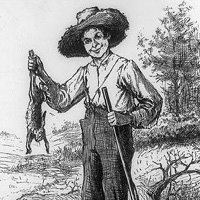
I. HUCK FINN
Of all the figures in American culture, the most enduring remains the rebel. The maverick, the entrepreneur, the explorer, the bold seeker of new, unexplored territories, the inventor, the cowboy, the slightly cocky, self-assured (but ultimately good-natured) pioneer... whether it be John Wayne as an obsessive cowboy in The Searchers , Thomas Alva Edison tinkering away with revolutionary ideas in his shop as the Wizard of Menlo Park, or Huck Finn saying ‘to hell with your rules!’ the rebel proves a key figure in the American psyche. Dorthea Dix, James Dean, Susan B. Anthony... the list goes on and on. There’s something still bold and exciting about reading those first daring lines penned by Jefferson in the Declaration of Independence that “all men are created equal” and the moral imperative to rebel against injustice. Jumping forward almost two hundred years, it’s hard not to be moved by the stirring words of Martin Luther King, Jr. in his famous “I have a dream” speech. King’s words speak of honoring a promise made by Jefferson and the other founding fathers — and while King’s words challenge us as a society, there’s something profoundly exciting — and hopeful — about his subtext: injustice exists; we can do better. The American hero is often that man or woman who blazes his or her own path (or perhaps reclaims a good path from accumulated debris).
When we speak of America in terms of novels, doubtless one of the most “American” is Mark Twain’s The Adventures of Huckleberry Finn. It boasts humour, adventure, drama, features issues of race, loyalty and friendship, and stars an anti-hero who bucks all the rules — and we love him for it. Just as the squabbling couples in Shakespeare’s comedies are far more interesting than the “perfect” couples of the same plays, (1) aspiring delinquent Huck Finn proves far more fascinating than Tom Sawyer.
Something profoundly American lies in Huck Finn saying to hell with school and going off with his friend Jim on the river. As the saying goes, “Never let your schooling interfere with your education.” Huck Finn seems to be saying something very similar — I’ll get a real education here on the river, thank you very much, and learn things far more valuable than I can in your schoolhouse. Sure enough, everything is quite peaceful for Huck and Jim on the river — it is only when they land and have to deal with the craziness of civilization that things go bad for them. Floating along with the natural flow of the river, the duo are allowed a separation from the everyday and can gain a new, fresh perspective.
Huckleberry Finn also features one of the great moments in American Literature. In chapter thirty-one, Huck wrestles with his conscience over whether to turn in Jim or not as a runaway slave. While the two hundred dollar reward is not a factor for Huck, everything his society has ever told him says he must turn Jim in: “The more I studied about this, the more my conscience went to grinding me, and the more wicked and low-down and ornery I got to feeling.” (2) Huck winds up writing a letter turning Jim in, and feels relieved for a while. But then he thinks back on his relationship with Jim and can feel nothing but deep warmth. He spies the letter:
This is no simple act on Huck Finn’s part. He feels horrible, even damned by his choice. Yet at the same time his choice is profoundly exciting. Similar to Hamlet when he remarks “Thus conscience does make cowards of us all” [3.1, 84], Huck mistakenly thinks he is going against his conscience when in fact he is following it. It is this startling boldness that makes Huck’s decision so very inspiring — almost everything he has ever been told tells him to do one thing, yet something deep inside himself, so deep he cannot come close to articulating it, compels him to act to save Jim.
Huck Finn is without question a rebel, yet he also reveals a deep moral core. He experiences an amazing moment of truth. However, he does so outside of the classroom. America has always had an anti-intellectual bent, which normally acts to our detriment as a culture. However, the journey of Huck Finn points to the positive path this impulse can take us if we are striving towards a deeper truth. The moral challenge for an uniquely American education is to provide students with the opportunity for these moments of conscientious rebellion, moments of truth, in the classroom. Huck Finn can and should continue to take journeys down the river in his life. But the classroom must provide a comparably meaningful experience. In America, this meaningful experience must come from nurturing the rebel spirit and guiding it in a positive direction.
Emerson, Thoreau, Rosseau, Dewey, and Freire have all said something similar. Huck Finn might well be a difficult student to have in class; these days he no doubt would be seen as rambunctious, unfocused, “ADD,” potentially a real handful — perhaps a younger version of McMurphy from One Flew Over the Cuckoo’s Nest. Still, Huck Finn’s spirit should not be smothered by relentless indoctrination, nor do we ever want to take part in an educational system that would perpetrate such an act. Education and life should never be at odds. Anyone teaching Huck Finn must be willing to embrace not only questioning his or her students in probing fashion, but also must welcome being questioned by them.
It is important to remember that Huck Finn already has the potential for moral choices before he steps in the classroom. However, he still lacks some of the tools to help him examine his life and the world around him. Huck will face other moral dilemmas as he grows older. Perhaps the greatest gift we can give Huck, then, is the capacity to name what is going on both around him and inside him, to aid him in walking his true path.
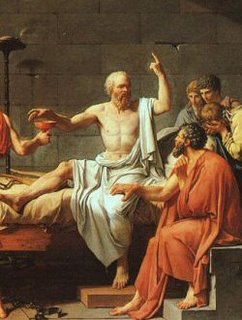
II. SOCRATES
Alcibiades, one of Socrates’ most notable students, was a man who was very wont to “easily make many fine speeches to large audiences” (4) about topics such as virtue. The popular, charismatic Alcibiades would be quite well-received in the process, and think himself quite wise based on his accolades — until he offered the same arguments to Socrates. Suddenly, cross-examined through Socrates’ probing, thorough questioning, Alcibiades found that he no longer was sure of being right — indeed, he found himself as “perplexed and numb as the torpedo fish does” to its victims. (5)
Educator Mortimer J. Adler — an avid student of Socrates, Plato, and Aristotle — poses that “pain and work are irremovable and irreducible accompaniments of genuine learning.” (6) While pain might overstate the case somewhat, certainly when it comes to discomfort Adler is correct. How can one learn without being open to learning and questioning one’s views, and how can one be truly open without some element of risk? Yet American teachers are notorious for not letting students struggle — similar to overprotective parents, several studies have shown that American teachers tend to swoop in to save students from discomfort. The perceived trauma of not being able to arrive without struggle to the right answer in a math class is judged to be just too much for the fragile Huck Finns in our classrooms. However, such a rescue ultimately says more about our discomfort watching students’ struggle. While the impulse to save our students is certainly born in part out of compassion, it also sends a powerful implicit message to our students that they cannot handle the matter on their own. Many students, deep down if not consciously, are hungry for just such challenges — but while we often supply those challenges on the athletic field, we often rob them of the same experience when it comes to intellectual and spiritual growth. Thus, while we might not force him to drink hemlock, we force Socrates to remain mute if he is allowed in the classroom at all.
“Real Art has the capacity to make us nervous,” (7) challenges critic Susan Sontag. Similarly, Anatoly Smeliansky, the vice-rector of the famous Moscow Art Theater, once observed that “American Theater is like the sign on hotel rooms — Do Not Disturb.” (8) We can see the same impulse in education, where discomfort is often not allowed to enter. Alcibiades experiences extreme distress after being questioned by Socrates, to the point that he exclaims he no longer knows who he is. However, he also comes out of this experience a better person, as he later acknowledges in other Socratic tales — and looks on Socrates with not only respect, but affection. Socrates has given Alcibiades a moment of truth — and Alcibiades has grown as a result.
Meno, after seeing Socrates question a young boy, comes to a similar conclusion about the wisdom of Socrates’ approach.
A popular quip states that “education is the process of moving from cocksure ignorance to thoughtful uncertainty.” The above exchange, repeated with variations throughout the Socratic dialogues, reveals the key to the Socratic ideal — that one must know one’ self, but most especially one most know the limits of one’s knowledge, of both one’s self and the world. Only then can true learning occur. While strong convictions can be wonderful, we must remember both MLK and Hitler possessed strong convictions. As the passage from Pope’s Essay on Criticism goes:
It must also be noted that Socrates is supportive of his students — and many of his “victims” come back to him. If he was merely harsh or cruel, such loyalty would be unlikely. Socrates can be sarcastic and cutting at times, puckish and playful, but ultimately he proves devoted to his students’ true well-being. Socrates is no sadist. After “numbing” the boy in front of Meno, Socrates moves to the next stage in his style of teaching. As Socrates tells Meno:
Nurturing and support play an essential role in good teaching. The actress Brenda Blethyn (from Mike Leigh’s film Secrets & Lies) once said that what she wanted most from a director was his trust, his support — “if he gives me that, I’m willing to go anywhere.” (11) Teaching works similarly — the student must trust the teacher to serve as a competent guide facilitating the search, and the teacher must pose good questions. And, as Neil Postman observes in his superb essay “Silent Questions,” the questions we ask almost always determine the answers we receive. (12) Notice also, however, that Socrates acts as a facilitator, not a dispenser of knowledge. The best teaching often seems almost invisible; Socrates’ technique forces his students to articulate their own thoughts, refine them, discard bad ideas, and eventually arrive at the answer themselves. True learning often proves a joyful process, but true learning embraces risk, especially the risk of discomfiture.
As Tennessee Williams once put it, “once you fully apprehend the vacuity of a life without struggle, you are equipped with the basic means of salvation.” A true education, one that touches the lives of its students and teachers, embodies this struggle. As teachers and parents we must ask hard, challenging questions of our students (and ourselves), not for the sole purpose of discomfort, but to pursue deeper truths. Deep down, the Huck Finns in our classrooms want nothing less.
III. CONNECTIONS
A few months back I was riding in the car of a recent acquaintance who was very concerned about not having a cell phone. He possessed a surprising degree of anxiety about the issue, and said something about wanting to be “connected.” It’s a phrase tossed around these days with wild abandon, and I had to wonder — “connected” with what? Would this be a connection to a boss, a job, clients, to work obligations? A connection to friends, family, a significant other? Surely this would not be a connection to nature, to a tree, a stream, a mountain, a beach? Doubtless it would not be a connection to literature, to art, to deeper questions about his identity and his life?
I do not mean to be cavalier — e-mail is wonderful thing, and cell phones can be very useful if not invaluable. Yet, as T.S. Eliot suggests above, it is all too easy to speak while saying nothing, to communicate on a shallow level without saying anything of meaning. One can make fine speeches like Alcibiades, or never have a meaningful, honest conversation with one’s parents — one can speak “words, words, words” “full of sound and fury, / Signifying nothing.” (13)
It has been observed that if facts alone constituted knowledge, one could merely read an encyclopedia and possess all the education one could ever need. Similarly, the internet is a wonderful tool, but ultimately it is merely a tool — one still needs to learn how to sift through all that (often suspect) information, to pick and choose from various sources, to ask, like Socrates, the hard, probing questions.
One of Socrates’ most exciting lines is that “the truth about reality is always in our soul.” (14) Socrates is not merely clever, but wise — his questions are not merely parlor tricks, but push his students towards a deeper, spiritual truth. This is real connection. Socrates also inspires through his genuine hunger for learning — he does not want to rest on his laurels, but prefers to keep searching:
Even a seeming anti-intellectual such as Huck Finn could get excited by a teacher like this, who embraces the search, and honors the pioneering, maverick spirit. Because it is all too easy to slip into complacency and pick the easy familiar answer over the hard truth, to pursue the truth without limitations shall always be rebellious and revolutionary in the very best sense. The Zen Buddhist tradition pursues a similar goal to that of rebellious Socrates; Zen masters often give their students koans, riddles with no simple, rational answer. This forces the students to strive for a deeper truth beyond the familiar or obvious, and to achieve this, they must not only look more openly at the world about them, but also within themselves. Regardless of the tradition, questioning is key, but it must connect with something deeper versus dealing with the superficial.
IV. BETTER GLASSES
Perhaps the greatest scene in Spike Lee’s film Malcolm X occurs when Elijah Muhammad teaches Malcolm a principle by using two glasses. Muhammad first fills one glass with water and then dumps in ashes, so that the water is horribly filthy. He says that if that glass is all the people have, they’ll drink it, and drink it gladly. Muhammad next pours a glass of clear water — it looks wonderful, especially in contrast to the glass of ashes. Muhammad observes if people are offered the glass of clear water, they will pick it instead.
Malcolm shows a flash of concern, (16) as if to ask— what if people don’t pick the right glass? But as Elijah Muhammad explains it:
Malcolm’s task is merely to offer the choice. If people but see the choice clearly, they will always pick the better glass.
Removing this lesson from the religious bent of the scene, (17) it remains a powerful metaphor. All people pick the path they feel is best, even if they find out they are mistaken later on. The trick is seeing this. Most every student I have questioned about his or her dreams possesses some sort of vision for him or herself. Deep down, that dream, while varying wildly from person to person, almost always involves giving back to others or leaving the world a better place. No one has ever had a vision of his or herself that has not involved other people in some fashion, whether it be a family, friends, or co-workers. This is another sort of dialogue, or connection. Martin Luther King, in a quotation used at the end of Spike Lee’s Do The Right Thing, speaks of the need for dialogue, versus monologue; violence is a monologue of power, and prohibits true dialogue. (18) In the same vein, Socratic teaching is opposed to indoctrination; indoctrination (like censorship) is violence.
We need our heroes. We need rebellious students and revolutionary teachers. There is also a necessary cost, a sacrifice to made in nurturing these heroes — as teachers we must be willing to suffer the discomfort of watching our students occasionally make poor choices, and learn for themselves. Good teaching will, per Malcolm X’s dictum, use almost “any means necessary.” One of these tools is engaging students in the Socratic dialogue. Another tool is tapping into that Huck Finn rebel spirit rather than squelching it. And still another is presenting students with a choice, but allowing them to choose. We must merely offer them better glasses to see.
Take a student; couple a healthy, restless curiosity with a sense of vision in that student, aid that student in developing the critical thought and expression to name what he or she sees and feels, honor and nurture the spirit that drives that vision — and we are close to what education should be. “I have a dream,” spoke King so powerfully not so very long ago. We must arm Huck Finn to articulate questions of himself and the world, asking him to keep us honest — if we do, perhaps he can grow up from being a Lord of the River to another King.
_______________________________________________
The two quotations from at the end of Do the Right Thing are:

I. HUCK FINN
Of all the figures in American culture, the most enduring remains the rebel. The maverick, the entrepreneur, the explorer, the bold seeker of new, unexplored territories, the inventor, the cowboy, the slightly cocky, self-assured (but ultimately good-natured) pioneer... whether it be John Wayne as an obsessive cowboy in The Searchers , Thomas Alva Edison tinkering away with revolutionary ideas in his shop as the Wizard of Menlo Park, or Huck Finn saying ‘to hell with your rules!’ the rebel proves a key figure in the American psyche. Dorthea Dix, James Dean, Susan B. Anthony... the list goes on and on. There’s something still bold and exciting about reading those first daring lines penned by Jefferson in the Declaration of Independence that “all men are created equal” and the moral imperative to rebel against injustice. Jumping forward almost two hundred years, it’s hard not to be moved by the stirring words of Martin Luther King, Jr. in his famous “I have a dream” speech. King’s words speak of honoring a promise made by Jefferson and the other founding fathers — and while King’s words challenge us as a society, there’s something profoundly exciting — and hopeful — about his subtext: injustice exists; we can do better. The American hero is often that man or woman who blazes his or her own path (or perhaps reclaims a good path from accumulated debris).
When we speak of America in terms of novels, doubtless one of the most “American” is Mark Twain’s The Adventures of Huckleberry Finn. It boasts humour, adventure, drama, features issues of race, loyalty and friendship, and stars an anti-hero who bucks all the rules — and we love him for it. Just as the squabbling couples in Shakespeare’s comedies are far more interesting than the “perfect” couples of the same plays, (1) aspiring delinquent Huck Finn proves far more fascinating than Tom Sawyer.
Something profoundly American lies in Huck Finn saying to hell with school and going off with his friend Jim on the river. As the saying goes, “Never let your schooling interfere with your education.” Huck Finn seems to be saying something very similar — I’ll get a real education here on the river, thank you very much, and learn things far more valuable than I can in your schoolhouse. Sure enough, everything is quite peaceful for Huck and Jim on the river — it is only when they land and have to deal with the craziness of civilization that things go bad for them. Floating along with the natural flow of the river, the duo are allowed a separation from the everyday and can gain a new, fresh perspective.
Huckleberry Finn also features one of the great moments in American Literature. In chapter thirty-one, Huck wrestles with his conscience over whether to turn in Jim or not as a runaway slave. While the two hundred dollar reward is not a factor for Huck, everything his society has ever told him says he must turn Jim in: “The more I studied about this, the more my conscience went to grinding me, and the more wicked and low-down and ornery I got to feeling.” (2) Huck winds up writing a letter turning Jim in, and feels relieved for a while. But then he thinks back on his relationship with Jim and can feel nothing but deep warmth. He spies the letter:
It was a close place. I took it up, and held it in my hand. I was a trembling, because I’d got to decide, forever, betwixt two things, and I knowed it. I studied a minute, sort of holding my breath, and then says to myself:
“All right, then, I’ll go to hell” — and tore it up. (3)
This is no simple act on Huck Finn’s part. He feels horrible, even damned by his choice. Yet at the same time his choice is profoundly exciting. Similar to Hamlet when he remarks “Thus conscience does make cowards of us all” [3.1, 84], Huck mistakenly thinks he is going against his conscience when in fact he is following it. It is this startling boldness that makes Huck’s decision so very inspiring — almost everything he has ever been told tells him to do one thing, yet something deep inside himself, so deep he cannot come close to articulating it, compels him to act to save Jim.
Huck Finn is without question a rebel, yet he also reveals a deep moral core. He experiences an amazing moment of truth. However, he does so outside of the classroom. America has always had an anti-intellectual bent, which normally acts to our detriment as a culture. However, the journey of Huck Finn points to the positive path this impulse can take us if we are striving towards a deeper truth. The moral challenge for an uniquely American education is to provide students with the opportunity for these moments of conscientious rebellion, moments of truth, in the classroom. Huck Finn can and should continue to take journeys down the river in his life. But the classroom must provide a comparably meaningful experience. In America, this meaningful experience must come from nurturing the rebel spirit and guiding it in a positive direction.
Emerson, Thoreau, Rosseau, Dewey, and Freire have all said something similar. Huck Finn might well be a difficult student to have in class; these days he no doubt would be seen as rambunctious, unfocused, “ADD,” potentially a real handful — perhaps a younger version of McMurphy from One Flew Over the Cuckoo’s Nest. Still, Huck Finn’s spirit should not be smothered by relentless indoctrination, nor do we ever want to take part in an educational system that would perpetrate such an act. Education and life should never be at odds. Anyone teaching Huck Finn must be willing to embrace not only questioning his or her students in probing fashion, but also must welcome being questioned by them.
It is important to remember that Huck Finn already has the potential for moral choices before he steps in the classroom. However, he still lacks some of the tools to help him examine his life and the world around him. Huck will face other moral dilemmas as he grows older. Perhaps the greatest gift we can give Huck, then, is the capacity to name what is going on both around him and inside him, to aid him in walking his true path.
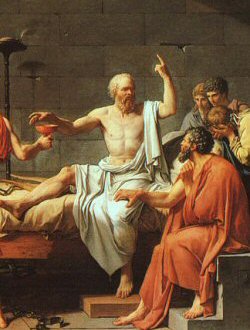
II. SOCRATES
Socrates, what have you done to me? I no longer know who I am!
— Alcibiades
Alcibiades, one of Socrates’ most notable students, was a man who was very wont to “easily make many fine speeches to large audiences” (4) about topics such as virtue. The popular, charismatic Alcibiades would be quite well-received in the process, and think himself quite wise based on his accolades — until he offered the same arguments to Socrates. Suddenly, cross-examined through Socrates’ probing, thorough questioning, Alcibiades found that he no longer was sure of being right — indeed, he found himself as “perplexed and numb as the torpedo fish does” to its victims. (5)
Educator Mortimer J. Adler — an avid student of Socrates, Plato, and Aristotle — poses that “pain and work are irremovable and irreducible accompaniments of genuine learning.” (6) While pain might overstate the case somewhat, certainly when it comes to discomfort Adler is correct. How can one learn without being open to learning and questioning one’s views, and how can one be truly open without some element of risk? Yet American teachers are notorious for not letting students struggle — similar to overprotective parents, several studies have shown that American teachers tend to swoop in to save students from discomfort. The perceived trauma of not being able to arrive without struggle to the right answer in a math class is judged to be just too much for the fragile Huck Finns in our classrooms. However, such a rescue ultimately says more about our discomfort watching students’ struggle. While the impulse to save our students is certainly born in part out of compassion, it also sends a powerful implicit message to our students that they cannot handle the matter on their own. Many students, deep down if not consciously, are hungry for just such challenges — but while we often supply those challenges on the athletic field, we often rob them of the same experience when it comes to intellectual and spiritual growth. Thus, while we might not force him to drink hemlock, we force Socrates to remain mute if he is allowed in the classroom at all.
“Real Art has the capacity to make us nervous,” (7) challenges critic Susan Sontag. Similarly, Anatoly Smeliansky, the vice-rector of the famous Moscow Art Theater, once observed that “American Theater is like the sign on hotel rooms — Do Not Disturb.” (8) We can see the same impulse in education, where discomfort is often not allowed to enter. Alcibiades experiences extreme distress after being questioned by Socrates, to the point that he exclaims he no longer knows who he is. However, he also comes out of this experience a better person, as he later acknowledges in other Socratic tales — and looks on Socrates with not only respect, but affection. Socrates has given Alcibiades a moment of truth — and Alcibiades has grown as a result.
Meno, after seeing Socrates question a young boy, comes to a similar conclusion about the wisdom of Socrates’ approach.
Socrates: You realize, Meno, what point [the boy] has reached in his recollection. At first he did not know what the basic line of the eightfoot square was; even now he does not yet know, but [earlier] he thought he knew, and answered confidently as if he did know, and he did not think himself at a loss, but now does think himself at a loss, and as he does not know, neither does he think he knows.
Meno: That is true.
Socrates: So he is now in a better position with regard to the matter he does not know?
Meno: I agree with that too.
Socrates: Have we done him any harm by making him perplexed and numb as the torpedo fish does?
Meno: I do not think so.
Socrates: Indeed, we have probably achieved something relevant to finding out how matters stand, for now, as he does not know, he would be glad to find out, whereas before he thought he could easily make many fine speeches to large audiences about the square of double size and said it must have a base twice as long.
Meno: So it seems.
Socrates: Do you think that before he would have tried to find out that which he thought he knew though he did not, before he fell into perplexity and realized he did not know and longed to know?
Meno: I do not think so, Socrates.
Socrates: Has he then benefited from being numbed?
Meno: I think so. (9)
A popular quip states that “education is the process of moving from cocksure ignorance to thoughtful uncertainty.” The above exchange, repeated with variations throughout the Socratic dialogues, reveals the key to the Socratic ideal — that one must know one’ self, but most especially one most know the limits of one’s knowledge, of both one’s self and the world. Only then can true learning occur. While strong convictions can be wonderful, we must remember both MLK and Hitler possessed strong convictions. As the passage from Pope’s Essay on Criticism goes:
A little knowledge is a dangerous thing.
Drink deep, or taste not, the Pierian Spring:
There shallow draughts intoxicate the brain,
And drinking largely sober us again.
It must also be noted that Socrates is supportive of his students — and many of his “victims” come back to him. If he was merely harsh or cruel, such loyalty would be unlikely. Socrates can be sarcastic and cutting at times, puckish and playful, but ultimately he proves devoted to his students’ true well-being. Socrates is no sadist. After “numbing” the boy in front of Meno, Socrates moves to the next stage in his style of teaching. As Socrates tells Meno:
Look then how [the boy] will come out of his perplexity while searching along with me. I shall do nothing more than ask questions and not teach him. Watch whether you find me teaching and explaining thing to him instead of asking for his opinions. (10)
Nurturing and support play an essential role in good teaching. The actress Brenda Blethyn (from Mike Leigh’s film Secrets & Lies) once said that what she wanted most from a director was his trust, his support — “if he gives me that, I’m willing to go anywhere.” (11) Teaching works similarly — the student must trust the teacher to serve as a competent guide facilitating the search, and the teacher must pose good questions. And, as Neil Postman observes in his superb essay “Silent Questions,” the questions we ask almost always determine the answers we receive. (12) Notice also, however, that Socrates acts as a facilitator, not a dispenser of knowledge. The best teaching often seems almost invisible; Socrates’ technique forces his students to articulate their own thoughts, refine them, discard bad ideas, and eventually arrive at the answer themselves. True learning often proves a joyful process, but true learning embraces risk, especially the risk of discomfiture.
As Tennessee Williams once put it, “once you fully apprehend the vacuity of a life without struggle, you are equipped with the basic means of salvation.” A true education, one that touches the lives of its students and teachers, embodies this struggle. As teachers and parents we must ask hard, challenging questions of our students (and ourselves), not for the sole purpose of discomfort, but to pursue deeper truths. Deep down, the Huck Finns in our classrooms want nothing less.
III. CONNECTIONS
Where is the Life we have lost in living?
Where is the wisdom we have lost in knowledge?
Where is the knowledge we have lost in information?
— T.S. Eliot, Choruses From ‘The Rock’
A few months back I was riding in the car of a recent acquaintance who was very concerned about not having a cell phone. He possessed a surprising degree of anxiety about the issue, and said something about wanting to be “connected.” It’s a phrase tossed around these days with wild abandon, and I had to wonder — “connected” with what? Would this be a connection to a boss, a job, clients, to work obligations? A connection to friends, family, a significant other? Surely this would not be a connection to nature, to a tree, a stream, a mountain, a beach? Doubtless it would not be a connection to literature, to art, to deeper questions about his identity and his life?
I do not mean to be cavalier — e-mail is wonderful thing, and cell phones can be very useful if not invaluable. Yet, as T.S. Eliot suggests above, it is all too easy to speak while saying nothing, to communicate on a shallow level without saying anything of meaning. One can make fine speeches like Alcibiades, or never have a meaningful, honest conversation with one’s parents — one can speak “words, words, words” “full of sound and fury, / Signifying nothing.” (13)
It has been observed that if facts alone constituted knowledge, one could merely read an encyclopedia and possess all the education one could ever need. Similarly, the internet is a wonderful tool, but ultimately it is merely a tool — one still needs to learn how to sift through all that (often suspect) information, to pick and choose from various sources, to ask, like Socrates, the hard, probing questions.
One of Socrates’ most exciting lines is that “the truth about reality is always in our soul.” (14) Socrates is not merely clever, but wise — his questions are not merely parlor tricks, but push his students towards a deeper, spiritual truth. This is real connection. Socrates also inspires through his genuine hunger for learning — he does not want to rest on his laurels, but prefers to keep searching:
Meno: Somehow, Socrates, I think what you say is right.
Socrates: I think so too, Meno. I do not insist that my argument is right in all other respects, but I would contend at all costs both in word and deed as far as I could that we will be better men, braver and less idle, if we believe that one must search for the things one does not know, rather than if we believe that it is not possible to find out what we do not know and that we must not look for it. (15)
Even a seeming anti-intellectual such as Huck Finn could get excited by a teacher like this, who embraces the search, and honors the pioneering, maverick spirit. Because it is all too easy to slip into complacency and pick the easy familiar answer over the hard truth, to pursue the truth without limitations shall always be rebellious and revolutionary in the very best sense. The Zen Buddhist tradition pursues a similar goal to that of rebellious Socrates; Zen masters often give their students koans, riddles with no simple, rational answer. This forces the students to strive for a deeper truth beyond the familiar or obvious, and to achieve this, they must not only look more openly at the world about them, but also within themselves. Regardless of the tradition, questioning is key, but it must connect with something deeper versus dealing with the superficial.
IV. BETTER GLASSES
Perhaps the greatest scene in Spike Lee’s film Malcolm X occurs when Elijah Muhammad teaches Malcolm a principle by using two glasses. Muhammad first fills one glass with water and then dumps in ashes, so that the water is horribly filthy. He says that if that glass is all the people have, they’ll drink it, and drink it gladly. Muhammad next pours a glass of clear water — it looks wonderful, especially in contrast to the glass of ashes. Muhammad observes if people are offered the glass of clear water, they will pick it instead.
Malcolm shows a flash of concern, (16) as if to ask— what if people don’t pick the right glass? But as Elijah Muhammad explains it:
Here is a glass. Dirty. Water - Foul. You offer this to the people, they have no choice. They’ll drink from it. If they’re thirsty.
You offer them this glass and let ‘em make their own decision, they will choose the pure vessel.
Malcolm’s task is merely to offer the choice. If people but see the choice clearly, they will always pick the better glass.
Removing this lesson from the religious bent of the scene, (17) it remains a powerful metaphor. All people pick the path they feel is best, even if they find out they are mistaken later on. The trick is seeing this. Most every student I have questioned about his or her dreams possesses some sort of vision for him or herself. Deep down, that dream, while varying wildly from person to person, almost always involves giving back to others or leaving the world a better place. No one has ever had a vision of his or herself that has not involved other people in some fashion, whether it be a family, friends, or co-workers. This is another sort of dialogue, or connection. Martin Luther King, in a quotation used at the end of Spike Lee’s Do The Right Thing, speaks of the need for dialogue, versus monologue; violence is a monologue of power, and prohibits true dialogue. (18) In the same vein, Socratic teaching is opposed to indoctrination; indoctrination (like censorship) is violence.
We need our heroes. We need rebellious students and revolutionary teachers. There is also a necessary cost, a sacrifice to made in nurturing these heroes — as teachers we must be willing to suffer the discomfort of watching our students occasionally make poor choices, and learn for themselves. Good teaching will, per Malcolm X’s dictum, use almost “any means necessary.” One of these tools is engaging students in the Socratic dialogue. Another tool is tapping into that Huck Finn rebel spirit rather than squelching it. And still another is presenting students with a choice, but allowing them to choose. We must merely offer them better glasses to see.
Take a student; couple a healthy, restless curiosity with a sense of vision in that student, aid that student in developing the critical thought and expression to name what he or she sees and feels, honor and nurture the spirit that drives that vision — and we are close to what education should be. “I have a dream,” spoke King so powerfully not so very long ago. We must arm Huck Finn to articulate questions of himself and the world, asking him to keep us honest — if we do, perhaps he can grow up from being a Lord of the River to another King.
_______________________________________________
The two quotations from at the end of Do the Right Thing are:
Violence as a way of achieving racial justice is both impractical and immoral. It is impractical because it is a descending spiral ending in destruction for all. The old law of an eye for an eye leaves everyone blind. It is immoral because it seeks to humiliate the opponent rather than win his understanding. It seeks to annihilate rather than convert. Violence is immoral because it thrives on hatred rather than love. It destroys community and makes brotherhood impossible. It leave society in a monologue rather than dialogue. Violence ends by defeating itself. It creates bitterness in the survivors and brutality in the destroyers.
-MLK
I think there are plenty of good people in America, but there are also plenty of bad people in America and the bad ones are the one who seem to have all the power and be in the positions to block things that you and I need. Because this is the situation, you and I have to preserve the right to do what is necessary to bring an end to that situation, and that doesn’t mean I advocate violence, but at the same time I am not against using violence in self-defense. I don’t even call it violence when it’s self-defense, I call it intelligence.
-Malcolm X
Sunday, April 30, 2006
National Poetry Month

Whan that April with his showres soote
The droughte of March hath perced to the roote,
And bathed every veine in swich licour,
Of which vertu engendred is the flowr...
— The opening lines of The Canterbury Tales by Chaucer
April is the cruellest month, breeding
Lilacs out of the dead land, mixing
Memory and desire, stirring
Dull roots with spring rain.
— The opening lines of “The Waste Land” by T.S. Eliot
Considering April is National Poetry Month and the month is nearly over, I’d be remiss if I didn’t post at least one poetry entry!
The blogroll to the left features several good poetry sites. Poetry Daily offers, shockingly, a new poem every day. Poetry 180 offers a poem a day for the typical high school year.
The Academy of American Poets spotlights a few poems and an essay on poetry every week. It also hosts a poetry database. The Library of Congress’ Poetry site is full of resources (Poetry 180 is actually a subset of it). Bartleby.com also features a wealth of great poems. The Dover Thrift series provides a cheap way to obtain some great poetry, although in that category it can’t compete with a good public library!
Former National Poet Laureate Robert Pinsky picks a poem per week for Slate. This year, one of his essays for National Poetry Month focuses on insult poetry. It’s a fun read. Pinsky also recently participated in a Washington Post chat online that you can read here.
 Robert Pinsky and Maggie Dietz founded the wonderful Favorite Poem Project. Longtime viewers of The News Hour with Jim Lehrer will remember seeing some of the videos shot for the series (you can view them on their site). They’ve also published several excellent poetry anthologies (one, two and three). Each summer, Boston University, where Pinsky teaches, hosts a week-long program currently called The Poetry Institute (or Summer Poetry Institute) for educators. It also features readings by prominent poets that are open to the general public. This year’s application deadline is May 30th. The original plan was to start similar programs at major universities in other regions of the country, and I hope at some point that comes to pass.
 Somehow, I was lucky enough to scam my way into the first annual Poetry Institute, and it remains one of the great, life-enriching experiences I’ve had. While we all have our favorite poems, and poems we may feel we know intimately, studying with Pinsky, several other prominent poets and a set of inspired fellow teachers gave me a new love for and insight into poetry.
 There’s a saying that if you want to have a good conversation about education, ask someone about the best teacher he or she’s ever had. Anyone who thinks public education is dead should meet the teachers I had the privilege of working with that summer (almost all were on the high school, middle school or elementary school level). About a year after our session, Boston University hosted a reunion for us to compare notes and share new lesson plans. I went in thinking, “my class is pretty good,” but in the face of the amazing lesson plans I heard, I wound up thinking, my god, I have the most boring class ever! Honestly, it was a great feeling. The most dangerous pitfall of teaching is getting burnt out, and listening to an enthusiastic colleague or sitting in on a good class is inspiring. Hearing a good poem read by someone who really loves it does much the same thing.
 Pinsky himself is of course incredibly bright and well-read, but is also a superb teacher with a great sense of humor. He puts a premium on choice for students when assembling a “favorite poem portfolio” or working on other poetry-related projects. He also stresses reading poetry aloud. (And any National Poet Laureate who’s appeared on The Simpsons and loves South Park can’t be all bad!)
I’ve become convinced that the Favorite Poem Project is one of those Unqualified Goods that is worthy of a life’s work. The Project can take many different forms in a school setting, but as a community event it typically takes a very simple and effective form. Everyone who wishes to brings in a favorite poem, something not written by him or herself. People read their poems aloud and explain why it means something to them. Formal analysis is discouraged; the emphasis is on the personal. Of course in a school setting students will discuss, at some point, meter, method, and the different sonnet forms, but these ground rules have proved to be the most successful for community events.
At the schools where I taught, everyone got to know students, teachers and parents ridiculously well, but nevertheless, there’s a special insight and intimacy one gains from hearing someone read their favorite poem and explain what it means to them. I know I barely scratched the surface of what can be done with the Favorite Poem Project, but a few memories stand out. For a family weekend the April after I had attended the Poetry Institute, I asked students and parents to bring in their favorite poems. Students split up and met with other students’ parents to read and discuss their poems in small groups. I’ll never forget listening in on the animated discussion of a baby boomer parent with a student who read a selection from “Howl.” Earlier that school year, after 9/11/01, I handed out a copy of William Ernest Henley’s poem ”Invictus.” Two students from New York City really took to it, and I’ll always remember one of them reading it in front of the school and how she spoke that line, “My head is bloody, but unbowed.”
Studying a fine poem with a good poet or great teacher makes one appreciate its art and craft all the more. Still, as Robin Williams’ character John Keating says in Dead Poets Society, the reason many a poem was written was to “woo women.” Studying the craft is essential, but as with most human endeavor, it’s often best to start with the love. Otherwise, it’s easy to veer into the territory described in Billy Collins’ brilliant ”Introduction to Poetry”:
I ask them to take a poem
and hold it up to the light
like a color slide
or press an ear against its hive.
I say drop a mouse into a poem
and watch him probe his way out,
or walk inside the poem's room
and feel the walls for a light switch.
I want them to waterski
across the surface of a poem
waving at the author's name on the shore.
But all they want to do
is tie the poem to a chair with rope
and torture a confession out of it.
They begin beating it with a hose
to find out what it really means.
The Favorite Poem Project anthologies linked above, culled from thousands of submissions, really are superb. But I’ll end with links to two of my favorites poems, T.S. Eliot’s well-known ”Love Song of J. Alfred Prufrock” and Pablo Neruda’s lesser known ”Ode to My Socks.” Oh hell, since I mentioned Neruda, despite the fact that like “Socks” it’s a translation, let me throw in a third, and end with Neruda’s poem “Your Laughter”:
Take bread away from me, if you wish,
take air away, but
do not take from me your laughter.
Do not take away the rose,
the lance flower that you pluck,
the water that suddenly
bursts forth in joy,
the sudden wave
of silver born in you.
My struggle is harsh and I come back
with eyes tired
at times from having seen
the unchanging earth,
but when your laughter enters
it rises to the sky seeking me
and it opens for me all
the doors of life.
My love, in the darkest
hour your laughter
opens, and if suddenly
you see my blood staining
the stones of the street,
laugh, because your laughter
will be for my hands
like a fresh sword.
Next to the sea in the autumn,
your laughter must raise
its foamy cascade,
and in the spring, love,
I want your laughter like
the flower I was waiting for,
the blue flower, the rose
of my echoing country.
Laugh at the night,
at the day, at the moon,
laugh at the twisted
streets of the island,
laugh at this clumsy
boy who loves you,
but when I open
my eyes and close them,
when my steps go,
when my steps return,
deny me bread, air,
light, spring,
but never your laughter
for I would die.
Subscribe to:
Comments (Atom)