Occasional blogging, mostly of the long-form variety.

Thursday, February 08, 2007

Death Eaters of the GOP

(crossposted at The Blue Herald)


(Hmm. Cheney's lost a little weight, hasn't he?)

My favorite item of the week so far comes from a “Literary Metaphor Watch” category in a Dan Froomkin column. He reports:

Nicholas Kristof asked readers to offer literary or historical parallels to the Bush administration and Iraq. He writes in his New York Times opinion column (subscription required): "A reader named Melissa S. e-mailed to say that she explains Iraq policy to her 8-year-old son in terms of Harry Potter characters: 'Dick Cheney is Lord Voldemort. George W. Bush is Peter Pettigrew.' Don Rumsfeld is Lucius Malfoy, while Cornelius Fudge represents administration supporters who deny that anything is wrong. And, she concludes, 'Daily Prophet reporter Rita Skeeter is Fox News.'"

Donkey O.D. has the full text here.

On a more serious note, to match the core of Kristof’s piece, the Bush administration has shown a lethal inability to learn from history, most tragically, the costs of war and the mistakes to avoid when waging one (top of the list would be not to start a war of choice). However, as Kristof reminds us, the Bush administration and the neocons also seem to be ignorant of essential themes raised in the arts (more on this to come in a later post).

When Gorbachev was in power, not long before the break-up the Soviet Union, he arranged to see the production of Chekhov’s Uncle Vanya in repertory at the famed Moscow Art Theater. Afterwards, he called up the Artistic Director of the theater to talk about the play, saying something like, “Vanya is just like me,” and proceeded to talk about himself in relation to the play for anywhere from twenty minutes to an hour. How amazing.

Personally, I don’t care what Bush reads or sees, Shakespeare, Chekhov, Harry Potter or the Bible, I just want him to think and to truly reflect. Most accounts indicate he rarely if ever does. I would also like to see him feel, specifically, feel compassion for others and to have the imagination to consider the consequences of his frighteningly powerful actions and inactions. Bush “read three Shakespeares,” including Hamlet, last year, and if it’s true, good for him. What was really needed was to ask him what he took away from them, to discuss the works with him. I suspect reporters were wary of embarrassing Bush, but it could be done with tact and it would have been very revealing. In the meantime, if Bush is to grapple with some of the complexities of the modern world and moral quandaries, it might be a step in the right direction for him to read a little Harry Potter.


"Mr. Vice-President, if you could just stop devouring that baby for the photo - we're trying to show your lighter side."

Wednesday, February 07, 2007

Froomkin: How the Press Can Prevent Another Iraq

(crossposted at The Blue Herald)


Over at Nieman Watchdog, where he is Deputy Editor, Dan Froomkin (also of The Washington Post) has a fantastic list of guidelines for the press. Frankly, this list shouldn't be necessary, but it undeniably is. If only all of the press took them to heart! However, bloggers certainly can practice these principles (as many already do), and press mainstream journalists to do the same.

Given their track record, every time a member of the Bush administration makes a claim, at this point how can any journalist not question whether it's a lie? It boggles the mind. They have not credibility, which means the burden of proof is on them. Some reporters are very good at fact-checking public statements, but it's hardly an universal value. Access does not equal accuracy, and frankly, it often seems to hurt it. Knowledgeable sources are one thing, but why court a shill or a proven liar? It's not as if D.C. lacks in opinions to pad out a column! It often seems that, when it comes to the mainstream press, the rule of thumb is "Fool me once, shame on you - fool me twenty-seven times, shame on - hey, will you come on my show this Sunday?" It's true that "Politics is the blood sport of Washington," but among the chattering class, softball runs a very close second.

Here's Froomkin's short, essential piece, in its entirety:
________________________________
How the press can prevent another Iraq
COMMENTARY | February 02, 2007

Journalists, and through us the public, have a grave responsibility to not be complicit in another march to war on false pretenses. So what lessons should we have learned from Iraq?
By Dan Froomkin


Lessons we thought had been learned from Vietnam were forgotten in the rush to invade Iraq. And now, as we cover President Bush’s ratcheting up of the rhetoric against Iran, it’s looking like the lessons we should have learned from Iraq may not have been learned at all. So at the risk of stating the obvious, here are some thoughts about what those lessons were. (Feel free to add more in comments.)

You Can’t Be Too Skeptical of Authority
• Don’t assume anything administration officials tell you is true. In fact, you are probably better off assuming anything they tell you is a lie.
• Demand proof for their every assertion. Assume the proof is a lie. Demand that they prove that their proof is accurate.
• Just because they say it, doesn’t mean it should be make the headlines. The absence of supporting evidence for their assertion -- or a preponderance of evidence that contradicts the assertion -- may be more newsworthy than the assertion itself.
• Don’t print anonymous assertions. Demand that sources make themselves accountable for what they insist is true.

Provocation Alone Does Not Justify War
• War is so serious that even proving the existence of a casus belli isn’t enough. Make officials prove to the public that going to war will make things better.
• Demand to know what happens if the war (or tactical strike) doesn’t go as planned?
• Demand to know what happens if it does? What happens after “victory”?
• Ask them: Isn’t it possible this will make things worse, rather than better?

Be Particularly Skeptical of Secrecy
• Don’t assume that these officials, with their access to secret intelligence, know more than you do.
• Alternately, assume that they do indeed know more than you do – and are trying to keep intelligence that would undermine their arguments secret.

Watch for Rhetorical Traps
• Keep an eye on how advocates of war frame the arguments. Don’t buy into those frames unless you think they’re fair.
• Keep a particular eye out for the no-lose construction. For example: If we can’t find evidence of WMD, that proves Saddam is hiding them.
• Watch out for false denials. In the case of Iran, when administration officials say “nobody is talking about invading Iran,” point out that the much more likely scenario is bombing Iran, and that their answer is therefore a dodge.

Don’t Just Give Voice to the Administration Officials
• Give voice to the skeptics; don’t marginalize and mock them.
• Listen to and quote the people who got it right last time: The intelligence officials, state department officials, war-college instructors and many others who predicted the problem we are now facing, but who were largely ignored.
• Offer the greatest and most guaranteed degree of confidentiality to whisteblowers offering information that contradicts the official government position. (By contrast, don’t offer any confidentiality to administration spinners.)

Look Outside Our Borders
• Pay attention to international opinion.
• Raise the question: What do people in other countries think? Why should we be so different?
• Keep an eye out for how the international press is covering this story. Why should we be so different?

Understand the Enemy
• Listen to people on the other side, and report their position.
• Send more reporters into the country we are about to attack and learn about their views, their politics and their culture.
• Don’t allow the population of any country to be demonized. All humans deserve to be humanized.
• Demand to know why the administration won’t open a dialogue with the enemy. Refusing to talk to someone you are threatening to attack should be considered inherently suspect behavior.

Encourage Public Debate
• The nation is not well served when issues of war and peace are not fully debated in public. It’s reasonable for the press to demand that Congress engage in a full, substantial debate.
• Cover the debate exhaustively and substantively.

Write about Motives
• Historically, the real motives for wars have often not been the public motives. Try to report on the motivations of the key advocates for war.
• Don’t assume that the administration is being forthright about its motives.
• If no one in the inner circle will openly discuss their motives, then encourage reasonable speculation about their motives.

Talk to the Military
• Find out what the military is being told to prepare for.

_____________________

Incidentally, Froomkin’s column today, 2/6/07, ”Bush Daring Dems on Iraq” has a splendid “Iran Watch” section (it also links the Fallows piece I liked earlier).

Fallows on War with Iran

(crossposted at The Blue Herald)


(Americans can rest easy that wise leaders are at the wheel of their foreign policy.)

Atlantic Monthly editor and writer James Fallows penned a series of articles on Iraq often described as “prescient.” Starting with “The Fifty-First State?” in November 2002, his five feature articles are collected in Blind Into Baghdad: America’s War in Iraq. It’s a quick and excellent read that puts the lie to the notion that the Bush administration wasn’t strenuously and accurately warned about the dangers of invading Iraq. Written before and during the war, Fallows’ research undercuts many other pieces of propaganda and revisionist history. Exactly how prescient was Fallows? The December 2004 piece in the book is titled “Will Iran be Next?”

Here it is, February 2007, and the Bush administration and the neocons are still angling for war with Iran, as they have for years if not decades. The saber-rattling from the most dangerously inept political movement in American history has been loud, for months now, perhaps because it’s a harder sell. Many a commenter has noted that the Bush administration mistakenly believes that what they think is best for Bush is also what’s best for America. And haven’t we been here before?

Back on September, I wrote:

Regardless of what one thinks about the rationale of going to war with Iraq, it would be almost impossible to argue that the Bush administration did not want to go to war with Iraq. It was obvious they did.

And thus it is with Iran. If we avoid war with Iran – and possibly Syria as well – it will not be because of the Bush administration. It will not be due to wisdom or sound judgment or common sense on their part. It will only be due to another behind-the-scenes revolt by the top military brass or some external factor the Bushies don’t choose to dismiss as is their usual wont.

[...]

It would be nice to think that “cooler heads will prevail.” And perhaps they will. But it seems highly unlikely those “cooler heads” will come from inside Bush’s inner circle. The Bushies will act out of macho insecurity, or a desire for more power, or because God spoke to them, or because they are assured they are right and good and true. But they will not act with the best interests of America or the world in mind.

If anything, the situation has gotten worse since September. The saber-rattling has grown into a din at this point, as cacophonous as the cognitive dissonances in the Bush-Cheney-neocon ideology. They fear history’s harsh judgment over Iraq and are clamoring for one more shot at glory. No sacrifice by others, of others, is too great for their ignoble goals. To them, recklessness is courage, hubris is vision, and the systematic denigration of rational decision-making is the height of wisdom. Their desire to bomb Iran is so obvious even the mainstream media is picking up on it.

It’s appropriate that Fallows published this on Groundhog Day, since it really does seem like we’re reliving the same events. From his 2/2/07 piece “Where Congress Can Draw the Line: No war with Iran,” Fallows writes (emphasis mine)

Deciding what to do next about Iraq is hard — on the merits, and in the politics. It’s hard on the merits because whatever comes next, from “surge” to “get out now” and everything in between, will involve suffering, misery, and dishonor. It’s just a question of by whom and for how long. On a balance-of-misery basis, my own view changed last year from “we can’t afford to leave” to “we can’t afford to stay.” And the whole issue is hard in its politics because even Democrats too young to remember Vietnam know that future Karl Roves will dog them for decades with accusations of “cut-and-run” and “betraying” troops unless they can get Republicans to stand with them on limiting funding and forcing the policy to change.

By comparison, Iran is easy: on the merits, in the politics. War with Iran would be a catastrophe that would make us look back fondly on the minor inconvenience of being bogged down in Iraq. While the Congress flounders about what, exactly, it can do about Iraq, it can do something useful, while it still matters, in making clear that it will authorize no money and provide no endorsement for military action against Iran.

Read the rest here. James Fallows’ site is here.

When wise men and women face a crisis, they often look inward. However, Bush and his movement want to create this crisis, and when Bush looks inward, he surely doesn’t see a narcissistic, petulant, obtuse man, but only a great, misunderstood man, touched by God simply because he is entitled to be so. When our president is as obstinately, proudly unreflective as Bush, the only salvation is external. He can never be trusted to make the right decision of his own free will. As Fallows says, Congress must act immediately to block the Bush administration, and it’s up to their constituents to pressure them to make sure it happens.

Sunday, February 04, 2007

Are You Ready for Some... Caliendo?


To prep for the Super Bowl, I have some of Frank Caliendo's work, including his Madden impressions, up over at Blue Herald here.

U.S. Think Tank Offering Cash to Dispute U.N. Climate Panel

(crossposted at The Blue Herald)


LONDON (AFP) - A right-wing American think tank is offering 10,000 dollars (7,700 euros) to scientists and economists to dispute a climate change report set to be released by the UN's top scientific panel, media reported.

The American Enterprise Institute (AEI), which receives funding from oil giant ExxonMobil according to the Guardian, sent letters to scientists in the United States, Britain and elsewhere offering the payments in exchange for articles emphasising the shortcoming of the UN's report.

AEI also reportedly offered additional payments, and to reimburse travel expenses.

The report, due to be released Friday in Paris by the UN's Intergovernmental Panel for Climate Change (IPCC), is likely to give a bleak assessment of the damage to the future of the environment.

It is the culmination of four days of debate between more then 500 scientists at a closed-door meeting in Paris, who have been poring over the first review of the scientific evidence for global warming in six years.

AEI's letters characterize the IPCC report as "resistant to reasonable criticism and dissent and prone to summary conclusions that are poorly supported by the analytical work" and request articles that "thoughtfully explore the limitations of climate model outputs," The Guardian said.

Kenneth Green, the AEI visiting scholar who sent the letters, confirmed to The Guardian that the thinktank had approached scientists and analysts to pen essays that would be compiled into an independent review of the IPCC's report.

"Right now, the whole debate is polarized," Green was quoted as saying by the newspaper.

"One group says that anyone with any doubts whatsoever are deniers and the other group is saying that anyone who wants to take action is alarmist. We don't think that approach has a lot of utility for intelligent policy."

Of course, lying doesn't have a lot of utility for intelligent policy, either.

Here's the original article. It's so short I just posted the whole thing. (And how ironic his name is "Green!") This move is hardly surprising, nor an isolated incident. Conservative think tanks (almost all are conservative) are normally a bit more subtle, and have actually fired some "scholars" who have shilled in columns for direct corporate pay and a specific quid pro quo. However, all conservative think tank "scholars" do get paid indirectly by large corporations anyway, through massive general donations to their think tank. While nominally that does give some independence to the think tank, in actual practice very few conservative think tanks ever criticize their funders, let alone any corporation (unless perhaps it was to go green or something). The primary purpose of conservative think tanks is to make respectable the indefensible. In many cases, conservative think tank "scholars" could never hack it in academia, because they can't form coherent, compelling arguments based on empirical facts and actual research. AEI and Heritage are probably the worst of the lot, although Hoover is currently giving them a run for their money (in more ways than one!), thanks to the hate-mongering pseudo-scholarship of Dinesh D'Souza (a more detailed post on him is in the works).

I've been meaning to do a post on conservative think tanks for some time as part of a brief series, but this story is an important catch. This move is not an aberration. It is the purest expression of the conservative think tank's purpose. Man-made climate change is a scientific fact. There is no "debate" about it in the scientific community, and there's hasn't been for some time. The evidence on climate change is so overwhelming, so unimpeachable, and knowledge of the issue is finally becoming so mainstream, that the corporations that oppose the dissemination of this information must resort to outright bribery to try to swat it down. The American public good is not helped by AEI. The world populace is not helped by AEI. The climate sure as hell isn't helped by AEI. Considering that compliance with CAFE standards is not unduly expensive and can actually lead to increased profits (and some sort of compliance is likely inevitable), AEI's bribe doesn't even really help industry, ultimately. This move only helps, in the short run, some of AEI's benefactors. (That's not to mention the key roles AEI and Heritage played in selling the war on Iraq.)

One of the central lies in the manufacture of "experts" by conservative think tanks is that these are smart and disinterested people engaging in honest research, exploration and discussion. They are definitely not disinterested (and rarely smart, for that matter!), and news programs should not treat them as such. They are paid shills who accept money to purposefully mislead the public. As Al Gore quotes in An Inconvenient Truth, Upton Sinclair observed, ""It is difficult to get a man to understand something when his salary depends on his not understanding it."

There's a serious exploration and discussion to be had for many issues in America and the larger world. However, we should never forget that, with only a handful of exceptions, conservative think tank "scholars" are not part of those honest and important endeavors.

Update: Here's The Guardian article, with a few key excerpts (emphasis mine):

Climate scientists described the move yesterday as an attempt to cast doubt over the "overwhelming scientific evidence" on global warming. "It's a desperate attempt by an organisation who wants to distort science for their own political aims," said David Viner of the Climatic Research Unit at the University of East Anglia.

"The IPCC process is probably the most thorough and open review undertaken in any discipline. This undermines the confidence of the public in the scientific community and the ability of governments to take on sound scientific advice," he said.

[...]

Lord Rees of Ludlow, the president of the Royal Society, Britain's most prestigious scientific institute, said: "The IPCC is the world's leading authority on climate change and its latest report will provide a comprehensive picture of the latest scientific understanding on the issue. It is expected to stress, more convincingly than ever before, that our planet is already warming due to human actions, and that 'business as usual' would lead to unacceptable risks, underscoring the urgent need for concerted international action to reduce the worst impacts of climate change. However, yet again, there will be a vocal minority with their own agendas who will try to suggest otherwise."

Ben Stewart of Greenpeace said: "The AEI is more than just a thinktank, it functions as the Bush administration's intellectual Cosa Nostra. They are White House surrogates in the last throes of their campaign of climate change denial. They lost on the science; they lost on the moral case for action. All they've got left is a suitcase full of cash."

On Monday, another Exxon-funded organisation based in Canada will launch a review in London which casts doubt on the IPCC report. Among its authors are Tad Murty, a former scientist who believes human activity makes no contribution to global warming. Confirmed VIPs attending include Nigel Lawson and David Bellamy, who believes there is no link between burning fossil fuels and global warming.

I would prefer "confused VIPs Nigel Lawson and David Bellamy," but that "intellectual Cosa Nostra" line is a keeper!

(NOTE: I posted thison Friday, 2/2/07 over at Blue Herald. Blogger's upgrade has just become mandatory, and that delayed me cross-posting. Google owning Blogger will doubtlessly help blog searches, but here's hoping they good a good job with everything.)

Thursday, February 01, 2007

Thursday, January 25, 2007

Vanity of Vanities! All is Vanity

(crossposted at The Blue Herald)


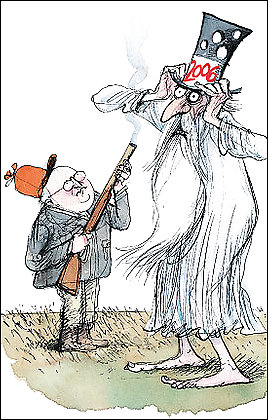
A cartoon by Steve Sack (but I can't blame the post's title on him).

How Much Wank Would A Wingnut Wank...

(crossposted at The Blue Herald)


Assuming you haven’t been permanently blinded by the frightening (and frighteningly apt!) photo above... we’ll proceed!

The Editors over at The Poor Man Institute periodically hand out “Golden Wingnut” awards for impressive feats of wingnuttery and wankery. (And as this handy chart shows, “You can have wanking without the wingnuttery, but not wingnuttery without wanking.”) Now it’s time for the 2006 Kippie Awards for Excellence in Wingnuttery, with five finalists in each category. Vote before it’s too late! Read and let your mind recoil! The main post is here. As for their description of each award:

The Chickenhawk of the Year — One lucky wingnut will be awarded for recklessly and heroically putting someone else’s ass on the line for what he believes.

The Fluffy — Honoring the most egregious fluffing of a Bush administration official and/or mouthpiece.

The Purple Teardrop with Clutched Pearls Cluster— Awarded to honor the sacrifices of those who suffered hurt feelings when someone was just frightfully uncouth.

The Soggy Biscuit— The year’s most pathetic right-wing circle jerk.

Wank of the Year— Lots of wanks embarrass the wanker; but, for Wank of the Year, that’s not enough. A truly outstanding wank should humiliate the audience, shame the human race, and really raise some serious questions about whether this whole “Big Bang” enterprise was really such a hot idea.

The Palme d’Haire— Why celebrate wanking? Why not just note it in passing, and then let it go, as more immediate matters demand our attention? Why indeed. Once, we had never existed; a bit later, and we have passed away, to be no more. Our lives are but a fevered moment in the endless black night of Being; so easily tossed off, so easily ignored, so easily forgotten. For, indeed, are we not, you and I, merely tiny wanks in oceanic Eternity? I think, in a way, that we are. Some more than others, obviously.

So many wingnuts, so little time...

Tuesday, January 02, 2007

Dave Barry's Year in Review for 2006

Dave Barry always produces a fun year in review:

THAT BLASTED YEAR

IT WAS A MOMENTOUS YEAR, a year of events that will echo in the annals of history the way a dropped plate of calamari echoes in an Italian restaurant with a tile floor. Decades from now, our grandchildren will come to us and say, "Tell us, Grandpa or Grandma, as the case may be, what it was like to be alive in the year that Angelina Jolie, Tom Cruise, Brad Pitt, Britney Spears and Katie whats-hername all had babies, although not necessarily in those combinations." And we will smile wisely and emit a streamer of drool, because we will be very old and unable to hear them.

And that will be a good thing, because there are many things about 2006 that we will not want to remember. This was the year in which the members of the United States Congress, who do not bother to read the actual bills they pass, spent weeks poring over instant messages sent by a pervert. This was the year in which the vice president of the United States shot a lawyer, which turned out to be totally legal inTexas. This was the year in which -- as clearly foretold in the Bible as a sign of the Apocalypse -- Howie Mandel wound up with a hit TV show.

Also, there were many pesky problems left over from 2005 that refused to go away in 2006, including Iraq, immigration, high gas prices, terrorism, global warming, avian flu, Iran, North Korea and Paris Hilton. Future generations are going to look back at this era and ask us how we could have allowed Paris Hilton to happen, and we are not going to have a good answer.

Read the rest of here.

Monday, January 01, 2007

Froomkin’s Year in Review

(crossposted at The Blue Herald)

Dan Froomkin of White House Briefing and Nieman Watchdog makes it look deceptively easy. He’s a blogger’s blogger, offering a wide-ranging, comprehensive round-up of political news along with trenchant, no-BS analysis most weekdays of the year. He’s also a tireless advocate of accountability, champions all the positive aspects of the blogosphere, and has significantly aided the popularity of WashingtonPost.com (he’s also very good about returning e-mails).

His column from 12/20/06, ”White House Year in Review: Bush Loses His Parade,” recaps many of his best columns of 2006, thus serving as a valuable resource for digging up articles on key events and figures of the previous year. I already highlighted one of my favorite Froomkin columns, ”Bush’s Imaginary Foes,” in a post called “Dance of the Straw Men.”

Also on 12/20/06, Froomkin participated in his last discussion of the calendar year. Since he had asked readers about their favorite columns of the year, I dashed off a quick comment (which is the last comment of the chat, but not listed below). I found myself much more intrigued by the following interchanges.

On the only thing that seems to change for the Bush administration, rhetoric:

Winston-Salem, N.C.: I listened today to both the President's and SecDef Gate's press conferences. Is it unfair to say that this whole idea of a "surge" of troops has now evolved into a concept in search of a mission?

Dan Froomkin: What an interesting comment. I sort of got that impression, too.

Bush didn't actually confirm that he's planning a "surge" -- or expansion, as some would put it. But he said that such a surge would need a "specific mission." And I, too, suddenly got the image of a ton of Pentagon people spending their Christmas break trying to come up with one.

On Rumsfeld:

Las Vegas, Nev.: Did anyone make anything out of the Pres'. comment referring to Rumsfeld that they "have been through war together"?

That made me scream at the radio. What war has Bush seen? I was and am incredibly offended by this comment and am surprised it hasn't gotten more travel.

Thanks.

Dan Froomkin: You know, that went right past me. But -- goodness! -- it does seem pretty outrageous.

Here's what Bush said last week, at Rumsfeld's retirement bash: "Don Rumsfeld has been at my side from the moment I took office. We've been through war together."

I think everyone was in so much of a rush to see Rumsfeld go, we didn't pay much attention. But you would think that people who really *have* been through a war might find the comment highly inappropriate.

——————————————————————

San Francisco, Calif.: People remember "I'm the decider," but the rest of the quote is "and I decide what is best. And what's best is for Don Rumsfeld to remain as the secretary of defense." So did President Bush decide what's best was for Rumsfeld to leave? Of course he did, but why didn't anyone ask him this when Rumsfeld "resigned"?

Dan Froomkin: I have savoured that irony. Thanks for sharing.

On the role of the press:

Honolulu, HI: Aloha Dan,
Thanks for your column and chats. Sometimes it seems as though you're the only one in print who is willing to speak the obvious.

On that note, your yearly round-up of columns made me think of how short-sighted most news coverage is. So many news reports have focused on President Bush being in 'listening mode' when the long view shows that this is just another step in the President's deliberate ignorance of both the will of the public and the advice of his generals. Why hasn't the MSM taken a longer view of this, and why are the President's talking points taken at face value by so many, even now?

Dan Froomkin: Thank you. I love that. "Speak the truth" has always struck me as terribly pretentious, and hard to defend. "Speak the obvious" -- that's my goal.

The White House has taken great advantage of the traditional media's short attention span. Daily newspapers, for instance, have a predisposition to write about what happened yesterday -- rather than put it in endless, boring (but in this case, essential) context.

In general, why isn't there more skepticism? I don't know. I think a lot of reporters are indeed skeptical -- but it somehow rarely makes it into their copy. That's the big mystery.

On the unique events that produced Bush’s conduct in the White House (besides Florida 2000):

Durham, N.C.: Here's to another great year of Froomkin-ness!

Dan, isn't this unprecedented in U.S. and possibly world history--the way this President avoids reality and the way his party and the media has supported him?

I think the voters, especially some Democrats, were onto this a long time ago--but couldn't be taken seriously. What did they call us? Cowards? Unpatriotic? Quitters?

Can this happen again?

Dan Froomkin: Thanks!

Unprecedented in U.S. history, yes. In world history? I'm sure there have been many totalitarian dictators who have enjoyed even greater insulation from reality. And of course there was that emperor -- the one who had no clothes.

I think the rare confluence of a president like Bush and an event like 9/11 allowed this to occur. I can't imagine it happening again. But you never know.

Here’s hoping that Bush’s underachievements will never be matched. Happy New Year!