Occasional blogging, mostly of the long-form variety.

Wednesday, July 21, 2010

The Social Contract

Sorely lacking from the chattering class' discussions on national politics is the concept of the Social Contract. There have been different takes on it throughout history, but the basic idea of creating a fair society, one 'ruled by laws not men,' of checks and balances on power, and of shared, basic prosperity, was central to the founding of the United States. The plutocrats, Randians and neo-feudalists preaching today about the pressing need to give more money to the super-wealthy, to cut regulations on powerful corporations and to slash the social safety net seem to have forgotten that the United States began by overthrowing a monarch.

America's origins are far from perfect of course, given our history of slavery and conquest, and the long denial of voting rights to women and minorities. But as E.J. Dionne wrote for Independence Day, 2006:

...The true genius of America has always been its capacity for self-correction. I'd assert that this is a better argument for patriotism than any effort to pretend that the Almighty has marked us as the world's first flawless nation.

One need only point to the uses that Abraham Lincoln and Martin Luther King Jr. made of the core ideas of the Declaration of Independence against slavery and racial injustice to show how the intellectual and moral traditions of the United States operate in favor of continuous reform.


If you were to create a fair society from scratch, what would it look like? What mechanisms would you put in place to keep it fair? How would you encourage it to self-correct or progress, as Dionne describes? What rights would be guaranteed, how would abuses and excesses be curbed, and what resources would be shared? What if you didn't know what class or position you'd have in this new society? How might that change your design? How would you help the least fortunate? (Build on the ideas of your favorite "Social Contract" philosopher, or imaginative author, or dip into anthopology if you like.) John Rawls approached these questions by way of the "original position" and the "veil of ignorance," nicely discussed by driftglass and Blue Gal in one of their June podcasts. But there are many ways to approach these issues.

If we try to visualize what this might be in America – a Social Contract for a fair, sustainable, dynamic system - I think we get something like this:


In this model, individuals, groups and companies have an enormous amount of freedom, but there are certain common sense parameters. The U.S. is a democratic republic, and in theory at least, we have majority rule, and the governing approach should benefit the majority of Americans. However, there are certain fundamental rights such as due process that all Americans possess, and the majority cannot strip these from any minority group or individual (again, in theory for all of this). Companies can pursue their goals, produce goods and make profits, but they face certain restrictions and can't infringe unduly on the public good. For example, marketing a dangerous, unsafe product or massively polluting public air and water might boost a corporation's bottom line, but harms the public. That's a bad, unnecessary tradeoff. Meanwhile, the American Dream rests on the idea that the U.S. is at least partially a meritocracy. If one works hard and plays by the rules, one can achieve some basic prosperity. If one's particularly talented and industrious, one can excel. Not everyone will start with the same resources, opportunities and support, but everyone deserves some basic tools, otherwise the promise of "freedom" rings hollow. Society as a whole benefits from investment in basic prosperity and opportunity, in public works and services, such as basic education, public libraries, public parks and public roads and transportation.

It's possible to be extremely individualistic (or even personally misanthropic) and still see the value of public goods such as basic education, after-school programs and a city fire department. Public works and services generally exist for moral, practical and economic reasons. For instance, universal health care tends to deliver better results and be much cheaper than other systems, leads to a healthier workforce, and greatly facilitates job changes and entrepreneurship. (Also, fewer people die unnecessarily.) In some arenas, private enterprise might work better, or coexist well with public equivalents. This model allows for all of that, and for initiative of all sorts. But only individuals of royal wealth could afford to own the equivalent of a national park, the public library system of a major city, the art collection of a local museum, or a state highway network. Public access to these clearly benefits individuals, communities, and the nation as a whole. (It's also silly to extol Wall Street profits as a the pinnacle of human achievement, de-fund scientific research, the arts and humanities, and then complain about a lack of creativity.)

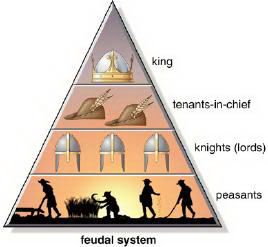
The model above stands in stark contrast to the hierarchical model of feudalism or modern authoritarian regimes, where any degree of freedom, justice or prosperity depends almost entirely on the whims of those in power. However, this diagram represents more a philosophy of governing than a socioeconomic pecking order. There's also room for considerable debate within its framework. (What's the right level of regulation? What's the right amount of infrastructure investment? What civil liberties are essential?)

I'd say most modern democracies follow something like this model, even if the execution or mix varies significantly. It can work extremely well. America has employed some version of it, and we still have some vestiges, but obviously many of the principles behind it have been under assault in this past decade, and really the past 40-some years. As explored in much greater depth in "Attack of the Plutocrats," America has staggering income and wealth inequity. Progressive taxation, social spending and other factors (represented by the red and blue parts of the diagram) helped close those gaps from the New Deal up until the onslaught of Reaganomics. Since at least Reagan, those gaps have widened again, and now income and wealth inequity are back to Gilded Age levels. Meanwhile, it's disturbingly common to hear rich pundits express disinterest in or active disgust at the idea of helping their fellow Americans. This isn't a coincidence. As Bill Moyers puts it, "Plutocracy and democracy don't mix."

There's really nothing that new about that diagram – half the point is that these are very old principles. It's just that these days, it's not uncommon to hear the red, blue and even gray elements attacked as radical, socialist or un-American. The Social Contract in America has been badly torn by incompetent and corrupt governance, by selfish and reckless ideology, and by plutocrats eager to destroy any social safety net for their fellow Americans. Randians and neo-feudalists have no interest in the "self-correction" or improvement mentioned by Dionne. Some aggressively seek to impose a more regressive system on America, while others simply pursue personal gain and power, damn the consequences. Given this situation, restoring, honoring and improving the Social Contract is kinda the height of patriotism. After all, the concept is intrinsic to our origin as a nation.

Foundations

Some Social Contract philosophers were suspicious foreigners with funny-sounding names like you might find on some artsy TV show, and unlikely to pass muster with the flag-wavin' Texas State Board of Education. However, America was founded with basic ideas about core rights and balancing principles in mind. Let's start with the gray foundation of the diagram. On the rights of individuals, and the potential tyranny of the majority over the minority, Thomas Jefferson stated:

All, too, will bear in mind this sacred principle, that though the will of the majority is in all cases to prevail, that will to be rightful must be reasonable; that the minority possess their equal rights, which equal law must protect, and to violate would be oppression.


Moving on the red part of the diagram, in terms of regulations and restrictions, Thomas Paine asserted that "government even in its best state is but a necessary evil," but also that:

Society is produced by our wants, and government by wickedness; the former promotes our happiness positively by uniting our affections, the latter negatively by restraining our vices.


James Madison expressed similar thoughts in The Federalist No. 51:

If men were angels, no government would be necessary. If angels were to govern men, neither external nor internal controls on government would be necessary. In framing a government which is to be administered by men over men, the great difficulty lies in this: you must first enable the government to control the governed; and in the next place oblige it to control itself. A dependence on the people is, no doubt, the primary control on the government; but experience has taught mankind the necessity of auxiliary precautions.


This also speaks to the "freedom" section of the diagram. A key concept throughout all these passages and most of the founding documents is balance. Freedom is the overall goal, but realistically, this requires a balance of power, sometimes countervailing forces, and often wise judgment. Liberty and equality can clash at times, and how do you balance one person's freedom with another person's rights?

When it comes to basic prosperity and opportunity (the blue part of the diagram), the Founding Fathers and later generations of Americans have argued about the details, but most have supported the general concept. The Declaration of Independence's most famous words are probably: "We hold these truths to be self-evident, that all men are created equal, that they are endowed by their Creator with certain unalienable Rights, that among these are Life, Liberty and the pursuit of Happiness." The preamble to the Constitution includes the term "promote the general welfare." Thomas Jefferson, who founded the University of Virginia, was a fierce advocate for publicly-supported education; he saw it as an unqualified good. First, it was a basic right:

I have indeed two great measures at heart, without which no republic can maintain itself in strength: 1. That of general education, to enable every man to judge for himself what will secure or endanger his freedom. 2. To divide every county into hundreds, of such size that all the children of each will be within reach of a central school in it.


Second, it was a means of spurring activity and innovation:

The object [of my education bill was] to bring into action that mass of talents which lies buried in poverty in every country for want of the means of development, and thus give activity to a mass of mind which in proportion to our population shall be the double or treble of what it is in most countries.


And third, an educated, informed electorate is a necessity for a healthy democracy:

...Whenever the people are well-informed, they can be trusted with their own government; that, whenever things get so far wrong as to attract their notice, they may be relied on to set them right.


Jefferson also assumed that local governments would care for the poor in some manner. Later Americans have fleshed out the idea of public works and support. Teddy Roosevelt was a champion of national parks. Eisenhower created the national highway system. Franklin Delano Roosevelt introduced the New Deal and Lyndon Baines Johnson had his Great Society. Activists such as Dorothea Dix, Frederick Douglass, Susan B. Anthony, Elizabeth Cady Stanton, Martin Luther King and many others worked both to secure fundamental rights for all Americans and to let them share in some basic prosperity.

Some of these measures have more contentious than others, of course. But in terms of finding "common ground" with one's opponents, I feel it's possible to work with people who differ on the details but agree with this basic model, who believe in a social contract and actually want to run things well. The wonks and sincere, responsible adults have plenty to discuss within this basic framework.

Recent History and the Current Day

Unfortunately, if we limit discussion today to those who "want to run things well," it disqualifies some politicians from one major political party, and almost everyone in the other. As Misty at Shakesville recently pointed out, the Republican Party platform of 1956 expressed many of the values espoused above, but as Digby's pointed out, they'd be denounced as socialists by today's GOP. Paul Krugman shows in The Conscience of a Liberal that during most of America's post-war boom from the mid 40s to about the mid 60s, the Democratic and Republican Parties were far more bipartisan than they are today in terms of voting on each others' measures. However, this wasn't blind Broderism; it was because they generally were working together on shared goals such as investing in the middle class and national infrastructure. (Not coincidentally, this more "liberal" economic approach was highly successful, and a huge improvement on the approach of previous eras.) Eisenhower, a Republican, made his peace with the New Deal and built on parts of it rather than trying to repeal it. The New Deal worked, and it was popular, so why not? Of course, not everyone shared in that national prosperity or had the same freedoms, particularly women and minorities. Thus, the Civil Rights Movement hit its full stride in the 60s out of necessity. With LBJ pushing civil rights legislation, Nixon developed the Southern Strategy in response, and the party of Lincoln started exploiting racial resentments to win elections. Reagan further perfected the conservative shell game, telling voters that it was minorities and the cultural elite who were oppressing them, rather than the wealthy elite. He then cut taxes to give massive amounts to the super-rich and ramped up military spending, making the deficit and debt skyrocket. His attacks on unions and business regulations didn't help, either. He might have seemed avuncular to the middle class citizens who voted for him, but he was screwing them over.

During the Bush administration, Dick Cheney remarked privately that "Reagan proved deficits don't matter." It's this statement, this attitude, that encapsulates movement conservatism and the modern Republican Party: Who cares about running the country well if we win elections? Who cares about the country as a whole if we can enrich ourselves and our donors? Thom Hartmann provides a good brief history in "Two Santa Clauses, or How The Republican Party Has Conned America for Thirty Years," but the conservative approach results in spending huge sums of money to give tax cuts to the wealthiest Americans and to increase military spending, all while attacking social spending. It's not exactly a secret, but you'll rarely hear Beltway reporters put it all in context. Meanwhile, certainly no one could have predicted that crony capitalism, horrible governance, fantasy-based policy, abandonment of the rule of law, a drowned city and two wars under Bush would make things disastrously worse.

The Republican Party has not been run by responsible adults for decades now. Their leaders have no interest whatsoever in running the country competently. They don't give a damn about the consequences of their reckless decisions – deficits are things to be balanced during Democratic administrations, if at all. The same goes for ending wars and any of a number of other problems. Conservative pundits - who cover politics for a living, after all - get paid for pretending not to notice any of this, most of all their own side's damning culpability. (While the Democrats aren't stellar, at least they occasionally do things for their average constituents.) None of these dynamics will be revelatory to political news junkies. For just one glaring example, check out Talking Points Memo's piece "It's Unanimous! GOP Says No To Unemployment Benefits, Yes To Tax Cuts For The Rich." Read the piece, and you'll see, for the umpteenth time, leading Republicans spout outrageous falsehoods about important matters. Some of them may know better and are lying, some may be zealous true believers, but as a whole, it's that they simply don't give a damn whether what they say is true or not.

Realistic Models versus Dogmatic Demands

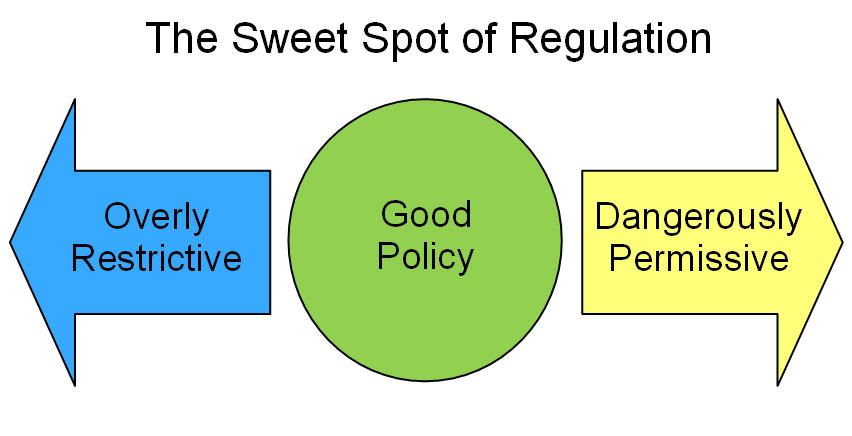
National political news would benefit immensely from fact-checking, but also from some degree of nuance. Issues are also often framed in an overly simplistic, prejudicial and sometimes downright juvenile way. Consider regulation, covered in the red part of the diagram above. Continuing our theme of balance (and not in the "he said-she said" reporting sense), regulation can be visualized like this:


(Update: Here's an alternative graphic.)

Looked at one way, "regulation" itself is a public good that requires balance and good judgment. Looked at another way, "regulation" itself is neither good nor bad, it's a necessity. The sweet spot of regulation is optimal, while on either side, overly restrictive and dangerously permissive regulations need to be adjusted. If, for example, a specific financial regulation is silly or ineffectual, get rid of it or rework it, but eliminating financial regulation altogether makes no sense.

This is a simple, pretty common-sense model, with the aim of running things well. But many politicians and pundits, especially among conservatives, reject any model this accurate or complex in both their rhetoric and their voting. Newt Gingrich isn't interested in making government effective, or as Bill Scher puts it, "representative, responsive and responsible." Gingrich isn't aiming to make government as large as it needs to be, but as small as possible. He only wants to shrink government (often by privatizing or eliminating effective public services). Grover Norquist isn't interested in finding the optimal tax rate. He's working hard only to lower taxes, regardless of the circumstances, and eventually to eliminate taxes altogether. John Boehner and many other Republicans aren't trying to find the right level of regulation. They're aiming to halt regulations, or eliminate them altogether.

In the same vein, libertarian John Stossel can, like Rand Paul, argue that private businesses should be able to racially discriminate. The idea of good or necessary regulation, or finding a balance, seems to be entirely beyond his vocabulary (whether for cognitive or profitable reasons, or both). In any case, Stossel can also decide to ignore the near collapse of the world economy from lack of financial regulation, to argue instead that the main problem with government is – it over-regulates. His proof? Ayn Rand decried regulation, and banning fish pedicures is silly! (Seriously, that's about all he's got. Follow the link.) Therefore, all regulation is bad, or something. Never mind about the global financial meltdown, or any of a hundred other examples! If you merely ignore world events and human nature, and instead cherry-pick minutia and cite really crappy fiction, you, too, can become the proud, smug, intellectual giant that is the dogmatic libertarian. (To be fair, Stossel has a point - when fish pedicures are outlawed, only outlaws will get fish pedicures.)

For freedom to really flourish and society to function – and not in a fantasy realm or feudal state - there needs to be some sense of balance and some sort of healthy social contract. Anonymous Liberal summed this up nicely in a piece on Rand Paul's views:

While libertarians claims to be driven by a goal of maximizing freedom, what they mean by "freedom" is not what most people take that word to mean. To a libertarian, the only freedom that really matters is freedom from government intrusion. But often, meaningful freedom can only be created through government intervention.

Take education, for example. The existence of a public school system greatly enhances freedom by giving everyone the opportunity to get at least a basic education and opening the doors that go along with that. Similarly, without a social safety net (government programs like Social Security, Medicaid, Medicare, unemployment insurance, etc.) people would literally starve or die of from lack of medical care and extreme poverty would be epidemic. This isn't conjecture. This was the reality before these programs were put in place. That's not "freedom" in any meaningful sense.

Indeed, in the health care context, I am continually perplexed by the suggestion that universal health care somehow inhibits freedom, rather than enhancing it. How liberating would it be to know that you could do whatever you choose from an employment perspective and not have to worry that you or your family will be denied access to health care? How liberating would it be to know that there's no risk that illness or injury will unexpectedly derail your dreams and bankrupt you? Even if the only freedom you care about is entrepreneurial freedom, how can it be denied that lack of universal health care discourages people from taking entrepreneurial risks, that there are people out there who would love to quit their jobs and start a business but can't because they would lose access to affordable health insurance?

Similarly, government spending on roads, transportation systems, and other infrastructure increases our physical freedom to move around and enjoy our physical environment. Government spending on law enforcement reduces crime and enhances our freedom from a physical security standpoint. Government regulation of industry keeps the air that we breath and the water we drink clean and the food and drugs we ingest safe. It gives us the freedom to enjoy our physical environment and partake of the myriad of products and services available to us without fear and without significant risk to our well-being. These are all very liberating things. I don't know about you, but my conception of freedom is not a world where I can't get a breath of fresh air, can't swim, fish or enjoy the outdoors because of pollution, and am constantly playing Russian roulette every time I go to the grocery store.

I realize there are tradeoffs with everything, that in exchange for these freedom-enhancing benefits, I have to pay a little more in taxes and deal with a little more red tape if I want to do business. But libertarians seem to deny that there is any tradeoff going on; they seem to think that freedom is only a factor on one side of the equation. The reality is that lawmaking involves balancing freedoms...


Yup. That's well put, but the core ideas are pretty much common sense.

For some issues, it might be useful to modify the original diagram:


Here, government and major forces are in the frame versus outside it and implied. And better models can certainly be devised, but one virtue of the first diagram is that it depicts a healthy society and good governance as a balancing act versus using an overly simplistic, black-and-white paradigm.

Competing Icons

One last way of looking at the Social Contract is through competing political icons.

We'll start with Ronald Reagan. In his successful 1980 presidential campaign, he said, "Are you better off than you were four years ago? Is it easier for you to go and buy things in the stores than it was four years ago?" In one sense, it was a fair, basic question, and Reagan did mention unemployment and other national issues. However, Reagan was also presenting the election as a referendum on Carter, not really as a contrast in policies and governing styles, with true evaluation of the consequences. Reality-based conservative Andrew Bacevich, no fan of Carter, nevertheless finds fault in Reagan's pitch:

Reagan did not call on Americans to tighten their belts. He saw no need for sacrifice. He rejected Carter’s dichotomy between quantity and quality. Above all, he assured his countrymen that they could have more...

To call Reagan a hypocrite is to miss the point. The Reagan Revolution was never about fiscal responsibility or small government. Far more accurately than Carter, Reagan understood what made Americans tick: they wanted self-gratification, not self-denial. Although always careful to embroider his speeches with inspirational homilies and testimonials to old-fashioned virtues, Reagan mainly indulged American self-indulgence.


Reagan ignored the energy issues Carter highlighted, and that was just the beginning. George H.W. Bush called Reagan's policies voodoo economics; Reagan was always selling a fairy tale. Rather than asking "Are you better off than you were four years ago?" or "Am I not better off today?" Reagan could have have asked, "Are we better off today? Is America? What do we need to improve it, and fix these problems?" But Reagan didn't, nor was this accidental. The Reagan method is one approach to governing, and we've seen its harmful effects over the past 30 years. In a similar vein, after 9/11, rather than issuing a national call to service, or fostering a new sense of community, or working toward energy independence, Bush told Americans - to go shopping. (Oh, and also to attack Iraq.)

In sharp contrast, John Kennedy famously said, "Ask not what your country can do for you; ask what you can do for your country." (He continued, "My fellow citizens of the world: ask not what America will do for you, but what together we can do for the freedom of man.") This sentiment absolutely hinges on the idea of the Social Contract. (Predictably, the speech disgusted Ayn Rand.) Kennedy's plea rings hollow if the government is oppressive, if society gives nothing to the individual, and if public institutions don't fulfill their part of the contract and provide basic rights, basic protections and basic opportunities. Government should be "representative, responsive and responsible." However, if one is given these things, what's the rationale for opposing Kennedy's words? It's a stirring call to action. Don't most human endeavors that don't screw over one's fellow human beings contribute in some small way to the nation as a whole? Doesn't doing something well, and fairly - running a small business or a medical center or a school or a library or a community center or creating a work of art - make the world a better place?

Zealots like Ayn Rand see the world in black and white, in paranoid terms of domination and submission, as a zero-sum game. Control and power are their aims, not running things well. They cannot truly grasp any idea of balance, equality or sharing of power. Nor can they acknowledge the value of public goods, or that investing in basic prosperity for everyone has a positive ripple effect throughout the entire nation.

The same dynamics hold true for Glenn Beck and his teabagger groupies, screaming about "taking our country back." Taking it back from whom? The party that fairly won the last two major national elections? Their fellow Americans? (And were they comatose for the past decade?)

Meanwhile, Michelle Malkin could hear 12-year old Graeme Frost speak about how a government health care program for kids helped save his life and his sister's after a horrific accident. Malkin's response was to say, How dare you presume that I would care about a fellow human being! I refuse to, even for a child! What America really needed, in her view, was the launching of a spiteful War on Compassion. The Social Contract is a fool's game, you see. Not acting like a complete and total asshole would play right into the liberals' hands.

"Ask not what your country can do for you; ask what you can do for your country." Ayn Rand saw this as a threat. She couldn't hear its poetry. That's sad, but it's okay. There's plenty of room in the country for those who can't hear America singing, or can't sing the body electric, or those who churn out 2000 plus pages of tedious agitprop grunting out "the song of myself, and only my glorious, superior self, you goddam moochers." It's just that such people can't be trusted with power. There are far better ways to run a country that the Randian, plutocrat or neo-feudal models. There are more wonderful things in America and humanity than are dreamt of in Rand's dogma. Kennedy's words were never about some ridiculous, absolute self-denial or martyrdom. They were a renewal of the Social Contract, an invitation to cooperate, to work together to improve the America we all share.


Slightly revised for clarity. Cross-posted at Hullabaloo.


Tuesday, July 20, 2010

Peasants, Sell Your Yachts


Alan Grayson continues to be one of the most refreshing things about Congress. Conscience and being nice haven't budged conservatives, so why not just call the bastards out? (Via Digby.)

Sunday, July 18, 2010

Attack of the Plutocrats

Plutocracy and democracy don't mix.
- Bill Moyers

There’s class warfare, all right - but it’s my class, the rich class, that’s making war, and we’re winning.
- Warren Buffet


Check out any mainstream news outlet, and before long you'll encounter some rich person claiming that extending unemployment benefits makes people lazy or that the social safety net needs to be slashed. Others will whine that (despite historically low tax rates) the rich are overtaxed or that (despite under-regulation almost destroying the world economy) business is overregulated. Still others will claim that spending on the middle class and poor needs to be off-set, but tax cuts for the wealthy don't need to be paid for. Among the ruling class, austerity is all the rage - not for themselves, but to impose on the lower orders. Almost every discussion by the chattering class is heavily skewed by the fact that America is increasingly becoming a plutocracy, and most of the chatters themselves are members of the ruling class. This has been the norm for over a decade, and quite common for the past thirty years of Reaganomics, which have massively enriched the wealthiest Americans while squeezing the middle class.

It doesn't need to be this way, and capitalism can be done much better in America. In fact, it has been in the past. From the New Deal up to the Reagan administration, a variety of factors helped reduce wealth inequity and created a large, prosperous middle class, which in turn bolstered the overall economy. While correlation isn't cause, in The Conscience of a Liberal Paul Krugman makes a persuasive case that more liberal economic policies are much better for the majority of the population and also benefit the national economy. Roughly speaking, what's good for the middle class is good for America. Being able to achieve basic prosperity has always been a key part of the American Dream. Restraining the abuses of the rich and powerful is also an essential component of a healthy economy, though. While "trickle-up" policies typically work well, "trickle-down" approaches have proved ineffective, harmful or outright disastrous. "The past decade was the worst for the U.S. economy in modern times," with zero net job creation and the middle class making less than they did in 1999, when adjusted for inflation. Meanwhile, the wealthiest Americans grew even richer, and wealth inequity has grown even more pronounced, back to "Gilded Age" levels.

Despite conservative accusations of class envy or class warfare, the reality is what Warren Buffet described back in 2006: The rich have been waging an aggressive class war, and they've been winning. It's foolhardy to ignore this, and a sucker's move to buy the scolding of upper class warriors given this reality. It's not necessary to believe that all the rich are evil, even if the old saw is true: power corrupts, and absolute power corrupts absolutely. Beyond any proclivity toward greed or other faults, it's simply that the rich and powerful – due to being (duh) rich and powerful - can cause far more damage, and with far smaller effort. Consider: the campaign to repeal the estate tax has been lead most aggressively by a mere 18 families, comprising some of the wealthiest people in the country. They can easily spend millions every year to potentially net them billions more (and cut into the U.S. Treasury). A dozen or so wealthy Wall Street firms and corporations, greedy for even more, acted recklessly and almost destroyed the entire world economy. Any populist anger at Wall Street pales in comparison to the narcissism, spite, recklessness and grandiose sense of entitlement from some Wall Street players.

For any policy, it's wise to ask, what are the consequences? Who benefits? (And how much? And compared to whom?) Also, who holds the power, and how will this policy affect those dynamics? On almost every domestic issue (and foreign policy issue) currently before the American people, the GOP, the Blue Dogs, and many in the chattering class are pushing policies that benefit the rich and powerful much, much more than the middle class. Sadly, that's become increasingly common over the past thirty years. Moreover, it's become increasing common in the past ten years for the same forces to push for policies that only benefit the rich and powerful and screw over the middle class (not to mention the poor). It's difficult to think of a single Republican measure in the past 10 to 20 years that has favored average Americans over the ruling class. Often, the Democrats haven't been that much better, vying for corporate backers themselves. It's not solely due to greed - ideology has played a major role, too, especially on the conservative side. As Digby's remarked, the Republican Party of 1956 would be denounced as socialists by today's GOP. If both parties merely competitively pandered to the middle class (as they often did during the middle of the 20th century), they'd be far more responsible and responsive than they presently are, and America would greatly benefit. The current assaults on (perfectly fine) Social Security and the resistance to expanding much-needed (and economically stimulative) unemployment benefits are utterly appalling. But as has been noted for millennia, members of an entrenched ruling class often lack a conscience.

Plutocracy and democracy don't mix. Ever-increasing wealth inequity is one of several key factors making America into more of a plutocracy, and endangering American democracy. We'll take a look at several factors in more depth.

Widening Income and Wealth Inequity


(Click any image for a larger view.)

As the Center on Budget and Policy Priorites (CBPP) documents:

The gaps in after-tax income between the richest 1 percent of Americans and the middle and poorest fifths of the country more than tripled between 1979 and 2007 (the period for which these data are available), according to data the Congressional Budget Office (CBO) issued last week. Taken together with prior research, the new data suggest greater income concentration at the top of the income scale than at any time since 1928.

This has led to staggering income inequity:


(Read their full post for much more.) Moreover, while most Americans are facing economic woes, most of the rich have quickly recovered.

The picture is even more imbalanced if one looks not just at income, but at net worth and overall wealth, as Professor G. William Domhoff does in "Wealth, Income, and Power" (graphics used with permission):


This is mind-boggling. (Domhoff's piece, which he continues to update, is well worth reading in its entirety.) Let's simplify this data slightly and look at it through a more feudal lens, befitting America's ruling class:


Given this reality, basically, when anyone claims that the rich are overtaxed or put-upon, and that the American middle class and poor are the ones who need to sacrifice – they are completely full of shit.

Paul Krugman's 2006 piece "The Great Wealth Transfer" is still an excellent read on these dynamics, including the widening gap between executive pay and that for the average worker:

According to the federal Bureau of Labor Statistics, the hourly wage of the average American non-supervisory worker is actually lower, adjusted for inflation, than it was in 1970. Meanwhile, CEO pay has soared -- from less than thirty times the average wage to almost 300 times the typical worker's pay.

The widening gulf between workers and executives is part of a stunning increase in inequality throughout the U.S. economy during the past thirty years. To get a sense of just how dramatic that shift has been, imagine a line of 1,000 people who represent the entire population of America. They are standing in ascending order of income, with the poorest person on the left and the richest person on the right. And their height is proportional to their income -- the richer they are, the taller they are.

Start with 1973. If you assume that a height of six feet represents the average income in that year, the person on the far left side of the line -- representing those Americans living in extreme poverty -- is only sixteen inches tall. By the time you get to the guy at the extreme right, he towers over the line at more than 113 feet.

Now take 2005. The average height has grown from six feet to eight feet, reflecting the modest growth in average incomes over the past generation. And the poorest people on the left side of the line have grown at about the same rate as those near the middle -- the gap between the middle class and the poor, in other words, hasn't changed. But people to the right must have been taking some kind of extreme steroids: The guy at the end of the line is now 560 feet tall, almost five times taller than his 1973 counterpart.

What's useful about this image is that it explodes several comforting myths we like to tell ourselves about what is happening to our society...


Domhoff provides several other useful charts. For instance, here's CEO pay as a multiple of the average worker's pay over 27 years:


And here's CEO's average pay compared to production workers' pay and several other factors:


That top line pretty much tracks the top line of the first CBPP diagram (no surprise).

We won't cover every angle in this post, but comparatively low taxes on capital gains and other assets predominantly owned by the rich further contribute to widening wealth inequity.

Squeezing the Middle Class

Income and wealth inequity by themselves wouldn't be so bad if there were a healthy baseline of prosperity for the vast majority of Americans. However, that isn't the case at all, and hasn't been for some time, thanks again to Reaganomics. Furthermore, squeezing the middle class, bad enough on its own, carries other perils for the economy as a whole. Robert Reich summarizes these problems well in "The root of economic fragility and political anger":

Missing from almost all discussion of America’s dizzying rate of unemployment is the brute fact that hourly wages of people with jobs have been dropping, adjusted for inflation. Average weekly earnings rose a bit this spring only because the typical worker put in more hours, but June’s decline in average hours pushed weekly paychecks down at an annualized rate of 4.5 percent.

In other words, Americans are keeping their jobs or finding new ones only by accepting lower wages.

Meanwhile, a much smaller group of Americans’ earnings are back in the stratosphere: Wall Street traders and executives, hedge-fund and private-equity fund managers, and top corporate executives. As hiring has picked up on the Street, fat salaries are reappearing. Richard Stein, president of Global Sage, an executive search firm, tells the New York Times corporate clients have offered compensation packages of more than $1 million annually to a dozen candidates in just the last few weeks.

We’re back to the same ominous trend as before the Great Recession: a larger and larger share of total income going to the very top while the vast middle class continues to lose ground.

And as long as this trend continues, we can’t get out of the shadow of the Great Recession. When most of the gains from economic growth go to a small sliver of Americans at the top, the rest don’t have enough purchasing power to buy what the economy is capable of producing.

America’s median wage, adjusted for inflation, has barely budged for decades. Between 2000 and 2007 it actually dropped. Under these circumstances the only way the middle class could boost its purchasing power was to borrow, as it did with gusto. As housing prices rose, Americans turned their homes into ATMs. But such borrowing has its limits. When the debt bubble finally burst, vast numbers of people couldn’t pay their bills, and banks couldn’t collect.

Each of America’s two biggest economic downturns over the last century has followed the same pattern. Consider: in 1928 the richest 1 percent of Americans received 23.9 percent of the nation’s total income. After that, the share going to the richest 1 percent steadily declined. New Deal reforms, followed by World War II, the GI Bill and the Great Society expanded the circle of prosperity. By the late 1970s the top 1 percent raked in only 8 to 9 percent of America’s total annual income. But after that, inequality began to widen again, and income reconcentrated at the top. By 2007 the richest 1 percent were back to where they were in 1928—with 23.5 percent of the total.

We all know what happened in the years immediately following these twin peaks—in 1929 and 2008...


Concentrating wealth among a few and not investing in the middle class is a horrible strategy for both the long term and short term.

On a related note, socioeconomic mobility is America simply isn't good, especially when compared to other countries. While the landscape doesn't look great for middle class families, it's particularly bleak for the poor. It's all the worse given that, rather than leveling the playing field, "government subsidies and new regulations have quietly funneled money from the poor and the middle class to the rich and politically connected." This strikes at the heart of the American Dream, which is that our country is a meritocracy, and if you work hard and play by the rules, you can prosper. As Jonathan Chait observed in "Wealthcare," (a piece on that sociopath high priestess of selfishness, Ayn Rand):

The association of wealth with virtue necessarily requires the free marketer to play down the role of class. Arthur Brooks, in his book Gross National Happiness, concedes that "the gap between the richest and poorest members of society is far wider than in many other developed countries. But there is also far more opportunity... there is in fact an amazing amount of economic mobility in America." In reality, as a study earlier this year by the Brookings Institution and Pew Charitable Trusts reported, the United States ranks near the bottom of advanced countries in its economic mobility. The study found that family background exerts a stronger influence on a person’s income than even his education level. And its most striking finding revealed that you are more likely to make your way into the highest-earning one-fifth of the population if you were born into the top fifth and did not attain a college degree than if you were born into the bottom fifth and did. In other words, if you regard a college degree as a rough proxy for intelligence or hard work, then you are economically better off to be born rich, dumb, and lazy than poor, smart, and industrious.


Fairness and a Sustainable System

While I'll look at this issue in more depth in future posts, just consider the prospects of children born in present-day America. Take 100 children, spread across the wealth spectrum by percentage. Using Domhoff's calculations, one child would be born to an extraordinarily wealthy family, another 19 would born to very well-off families, and the remaining 80 would be born to families likely facing financial insecurity, stagnant wages, and possibly outright poverty. Nor, based on the mobility studies cited above, would those 80 children have much hope of improving their situation by much. It's impossible to argue credibly that that situation is in any sense "fair." Every argument for a flat tax (a favorite cause of billionaire Steve Forbes) ignores that Americans do not all begin at the same starting line, with the same resources, opportunities and support. Even if wealth and income were zero-sum games, money could be much more fairly distributed in the United States – and the rich could even stay obscenely wealthy. However, wealth and income are not zero-sum games, because economic activity is often synergistic. More liberal economic policies, such as those discussed by Robert Reich above and in far greater depth by Paul Krugman in The Conscience of a Liberal, generate far more economic growth than do conservative trickle-down policies. Investing in the middle class, in "trickle up," is in a sense just good, basic portfolio advice – diversify.

There is such a thing as excessive levels of taxation on the rich and powerful, but overall, we are nowhere near that in America. When a self-described libertarian assails progressive taxes, or taxes altogether, and preaches about the virtues of the free market, this ignores both the starting line issue, and that wealth and power tend to concentrate among a very few over time – unless there are strong countervailing forces. This concentration is not good for freedom - except the "freedom" of the powerful to impose their will on others. Shockingly enough, those with largely unchecked power often do not wield it virtuously. Government (of the people, by the people, for the people) can be one of the strongest checks against such abuses. Meanwhile, when government allies itself with the plutocrats, and further tilts an already rigged game in their favor, it can inflict great damage.

For the rich, a more liberal economic approach would mean the gap between them and the lower orders would shrink. (Judging from indignant pieces from Wall Street players and other plutocrats, this upsets them a great deal, their own central culpability in the economic meltdown notwithstanding.) However, they would still be extremely rich, and they would continue to prosper - along with their fellow Americans. The main challenge facing America economically and fiscally is not whether or not the middle class and poor must sacrifice even more than they already have for the past 30 years. The main challenge is whether the rich and powerful will forsake some small measure of greed – and more realistically, whether they'll be forced to do so.

The Clueless, the Callous and the Downright Evil

The plutocrats shaping our discourse generally break down into the clueless, the callous, and the downright evil. Many mainstream reporters on TV fall into the clueless and cloistered category. Charlie Gibson is a prime example. To quote from an earlier post:

While the mainstream media's stories on social issues can be quite superficial, they tend to be better than their pieces on economic matters, which generally are told from a rich, corporate angle. Some of the problem is simply who's reporting. It's not an accident that ABC's millionaire Charlie Gibson, during the 2008 primary debates, thought $200,000 was a middle class income for a married couple, and repeated debunked claims about capital gains taxes that affect the rich the most. Nor is it surprising that during ABC's town hall with Obama on health care this June, Gibson and Diane Sawyer asked most of their questions from a "Shouldn't we be scared?" insurance industry perspective that ignored major problems with the status quo. They also weren't about to compare America's much higher health costs to those of other industrialized nations, or hammer Obama to justify why it wouldn't be wiser just to go straight to a single-payer system.


On Gibson's $200,000 gaffe, it's unlikely he wanted to look that clueless in front of a national audience and have the auditorium audience laugh at him. Many rich TV stars cultivate a "regular folks" image and emphasize humble roots (Tim Russert put great effort into this, and Brian Williams is always quick to mention his volunteer fireman stint). Of course, humble pasts don't matter much if the same people push a rich, corporate perspective in the present day. The cloistered perspective of many journalists is a serious problem, but in theory, some of the clueless chattering class can actually be reached and persuaded.

What of our elected representatives? A study in 2009 from the Center on Responsive Politics found that:

Two-hundred-and-thirty-seven members of Congress are millionaires. That’s 44 percent of the body – compared to about 1 percent of Americans overall...

All told, at least seven lawmakers have net worths greater than $100 million, according to the Center’s 2008 figures.

“Many Americans probably have a sense that members of Congress aren’t hurting, even if their government salary alone is in the six figures, much more than most Americans make,” said CRP spokesman Dave Levinthal. “What we see through these figures is that many of them have riches well beyond that salary, supplemented with securities, stock holdings, property and other investments.”

The CRP numbers are somewhat rough estimates – lawmakers are required to report their financial information in broad ranges of figures, so it’s impossible to pin down their dollars with precision. The CRP uses the mid-point in the ranges to build its estimates.

Senators’ estimated median reportable worth sunk to about $1.79 million from $2.27 million in 2007. The House’s median income was significantly lower and also sank, bottoming out at $622,254 from $724,258 in 2007.

But CRP’s analysis suggests that some lawmakers did well for themselves between 2007 and 2008, even as many Americans lost jobs and saw their savings and their home values plummet.


Given this, it's not surprising that members of Congress would reflect the plutocratic attitudes of many members of their class. Politicians may easily become cloistered and clueless without regular reality-checks from average constituents.

Some politicians are far worse, though. For decades now, Republican politicians have shown no interest in acknowledging fiscal realities. (See "The Persistence of Ideology" for more on this general dynamic.) Here's part of TPM's "It's Unanimous! GOP Says No To Unemployment Benefits, Yes To Tax Cuts For The Rich":

For weeks, Senate Republicans have filibustered an extension of unemployment benefits on the grounds that Democrats aren't willing to cut spending or raise taxes to pay for them. At the same time, the Bush tax cuts are set to expire, and Republicans want them to be renewed. For two days, Senate Minority Whip Jon Kyl has raised eyebrows by insisting that emergency aid to unemployed people -- what he called a "necessary evil" -- be paid for through either tax hikes or spending cuts, while the tax cuts (which mostly benefit wealthy people) not be offset in any way. Yesterday claimed that this view is shared by "most of the people in my party."

He was correct.

"That's been the majority Republican view for some time," Minority Leader Mitch McConnell told TPMDC this afternoon after the weekly GOP press conference. "That there's no evidence whatsoever that the Bush tax cuts actually diminished revenue. They increased revenue, because of the vibrancy of these tax cuts in the economy. So I think what Senator Kyl was expressing was the view of virtually every Republican on that subject."

The CBO and other budget experts strongly disagree. And Democrats want to preserve the Bush tax cuts for people making less than $200,000-$250,000 a year -- but only for them. Allowing them to expire for wealthier people would raise hundreds of billions of dollars over 10 years, which could allow them to offset the spending Republicans currently decry.


The entire piece deserves a read. In a similar vein, John McCain decries paying teachers as pork, but is all for cutting taxes on corporations and for paying military contractors.

Back in reality, the Bush tax cuts - just like the Reagan tax cuts - lost revenue. Both presidents gave massive tax cuts to the richest Americans and increased military spending. Reagan nearly tripled the national debt and Bush nearly doubled it. This isn't exactly secret information.

So what's the explanation for the GOP's magical thinking? As always, it's the stupid versus evil question, or the hack versus zealot question. Surely some conservative leaders know what they're peddling is complete bullshit. But some others seem to actually believe this crap. I think the best catch-all explanation is that they just don't give a damn whether what they're saying is true or not, making them classic bullshitters, or "callous" as opposed to clueless. Their primary goal is to give more money to the rich, which benefits them personally as well as their most wealthy donors. They simply don't care about any negative consequences of these policies, except perhaps as an afterthought. And what's to make them stop? The press won't fact-check them or call them out. The Democratic Party often doesn't even try. And middle class and poor conservative voters don't know or don't care that they're voting against their own interests.

As Ezra Klein observes, statements like Kyl's about no need to off-set tax cuts is "how you tell people who care about the deficit apart from people who are interested in exploiting fears of the deficit to shrink the size of government." And as Matthew Yglesias points out, conservatives don't care about the deficit: "conservatives care more about making taxes as low as possible than they do about reducing spending or reducing the deficit." (See also "Conservatives Don't Care About the Deficit" #1 and "Revealed Preference and the Deficit.") Yglesias also notes that raising taxes on the rich is the most politically feasible path for reducing the deficit, if that were actually the goal. However, conservative politicians oppose this, voters often don't understand what spending cuts will actually entail, and the press doesn't explain any of it well, if at all.

As for the downright evil, there are several powerful groups who very consciously work to destroy any sort of social safety net, eliminate progressive taxes, or eliminate taxes altogether. It's horrible policy, not to mention heartless in its consequences, but it's the core of movement conservatism on economic and fiscal matters. Thom Hartmann gives a good summary of the history in "Two Santa Clauses, or How The Republican Party Has Conned America for Thirty Years," and explains Starve the Beast and other core conservative strategies. Key figures include Grover Norquist, Pete Peterson and Paul Ryan.

Grover Norquist is the head of Americans for Tax Reform, and sponsors regular conservative lectures in Washington. A friend of Karl Rove and Jack Abramoff, Norquist infamously said, "I don't want to abolish government. I simply want to reduce it to the size where I can drag it into the bathroom and drown it in the bathtub." I've covered him in more depth in previous posts, but Norquist is an anti-tax zealot who wants to get rid of taxes altogether, and pressures Republicans to sign an anti-tax pledge, that they will never support any tax increase ever, even in the face of Armageddon. Norquist was also one of the major forces behind creating the myth of Saint Ronnie Reagan.

The Peterson Foundation, run by former Nixon cabinet member Peter G. Peterson, keeps trying to slash Social Security and Medicare. It has at least one billion dollars to spend toward these ends. Among other things, the Peterson Foundation commissioned a documentary to push its views, and the Texas School Board has echoed Peterson's arguments. The Peterson Foundation recently sponsored "America Speaks" meetings in 19 cities across the country. However, these were very slickly designed events with Peterson's biases enforced on the participant discussions to arrive at pre-determined conclusions. In fact, 86% of Americans wouldn't cut Social Security, and similar majorities oppose cutting Medicare and Medicaid. But what does that matter for Peterson and his allies? What's important is the illusion of public opinion, not the real thing. (The same goes for independent expert opinion.)

Republican Congressman Paul Ryan has been advocating similar measures in the House. Ryan, a huge fan of Ayn Rand, has been pushing a radical budget plan that he claims will balance the budget. In fact, it wouldn't even do that, but would destroy the social safety net, and make taxes far more regressive, raising taxes on the middle class and slashing them on the rich. The Tax Policy Center pointed out the fundamental error that Ryan's budget hinges on and the plan's other consequences. The CBPP provided a detailed analysis of the Ryan "Roadmap," and also dissected his "off-base" response to their analysis. Citizens for Tax Justice came to similar conclusions, remarking that:

It’s difficult to design a tax plan that will lose $2 trillion over a decade even while requiring 90 percent of taxpayers to pay more. But Congressman Paul Ryan has met that daunting challenge. This analysis makes obvious that Congressman Ryan’s budget plan has nothing to do with balancing the budget, but has everything to do with creating a system that takes more from the poor and less from the rich.


Ryan has complained about reality-based criticisms of his highly regressive plan, and is still pushing the same crap, in some cases directly contradicting himself or just lying (the CBO has not proven his case). What Ryan is pushing is evil - although zealotry seems to be his defining characteristic.

Tallying the Bill, and Where to Go Next

Who's really to blame for the debt and the deficit? One way of looking at it would be tally up all the costs by the political parties that incurred them. (Hint: Reagan and Bush the Younger would sink it for the GOP.) However, another way to look at it is to examine who benefited from these deficits. Cui bono?

Here's a revealing diagram from CBPP:


The biggest problem is the Bush tax cuts. After that, it's the ongoing wars in Iraq and Afghanistan, started under Bush, never ended under Bush, and now continuing under Obama. Most of the TARP money went to wealthy Wall Street banks. The middle class and poor who have lost their homes certainly haven't won in this scenario, and the military personnel who get injured and die serving overseas tend to be middle class or poor.

Here's a CBPP diagram that renders the situation more starkly:


This covers 2001-2007, not all the way back to Reagan or earlier. Still, overwhelmingly, our national debt has resulted from funneling money to the rich and to the military-industrial complex. Yet oddly, the plutocrat consensus is that this trend should continue – and that the middle class and poor should sacrifice more to lower the debt. Hmm.

If the debt is such a terrible threat to our national well-being, why not let those who benefited from all that money repay it?

Here's my deal. I'll be willing to look at conservative pet causes, such as cutting Social Security in some fashion, if and only if we try sensible policies first and they don't work. So sure, we can cut Social Security, if first: We make income taxes much more progressive again, at something resembling pre-Reagan levels, and probably with a couple of extra tax margins added at the top. (I defer to the experts on the details, for this measure and all the rest.) Make sure the estate tax continues and is progressive, allowing family farms and small businesses to continue (the argument that they've ever been imperiled is largely conservative propaganda). Examine capital gains taxes and other income that primarily benefit the wealthy. Close tax loopholes for the rich and ensure that corporations actually pay their taxes. Make any tax cuts targeted and jobs programs focused so they actually create jobs, since we have proof that massive, blanket giveaways to the rich don't. Re-examine usury laws and allow mortgage cramdowns to help average consumers. Invest in education, scientific and medical research, the arts and humanities. Invest in infrastructure and in public services and works that benefit everybody. Consider a new New Deal to do that, putting Americans to work. Cut military spending, particularly on obsolete or useless programs, and end the wars in Iraq and Afghanistan.

The short version: tax the rich, cut military spending, end the wars, and invest in the middle class and the country as a whole.

The United States of America was founded by overthrowing a monarch. As Bill Moyers states, plutocracy and democracy don't mix. Ever-increasing wealth inequity is one of several key factors making America into more of a plutocracy. The campaign to increasingly concentrate wealth and power with a tiny few is a dangerous, regressive movement. The ruling class has almost advantage on its side – except the vote. Every measure that pushes us towards a plutocracy and a neo-feudal state is perilous, and every step toward a more egalitarian society is a small but important victory.


(Cartoon by Matt Wuerker.)

Wednesday, July 14, 2010

Woody Guthrie's Birthday

Over at The Inverse Square, Thomas Levenson has a nice, small compilation of Woody Guthrie tunes for Guthrie's birthday, plus a follow-up post. It's neat to hear Woody's "Tom Joad" followed by Bruce Springsteen's underrated, haunting "Ghost of Tom Joad." As Pete Seeger would say, that's part of the folk tradition.

Update: Speaking of Tom Joad, Digby's post "Let Them Eat the Grapes of Wrath" (great title) takes a look at our dismal job situation.


Thursday, July 08, 2010

The Righteous Brothers - "You've Lost That Lovin' Feelin'"


In memory of MD, who took my suggestion to sing this song (with slightly altered lyrics) for a fund-raiser. He had a fine, powerful baritone and a great sense of humor, and sang it with shameless gusto, infectious glee and his characteristic wide grin.

Eclectic Jukebox

Tuesday, July 06, 2010

Blame

Another home run from The Daily Show:

The Daily Show With Jon StewartMon - Thurs 11p / 10c
Blame
www.thedailyshow.com
Daily Show Full EpisodesPolitical HumorTea Party


Steve Benen and other bloggers chronicle this sort of hypocrisy all the time - and Republicans practice it all the goddam time - but ain't nuthin' like The Daily Show treatment!

Andrew Breitbart Owes Skippy $100,000

skippy pens the very funny "andrew breitbart owes skippy $100,000." This is sorta inside blogger baseball stuff; if you didn't catch the Dave Weigel "scandal" and don't know who Breitbart is, you can get some background here.

Sunday, July 04, 2010

Independence Day 2010

Happy Independence Day! This post is cobbled together from previous years, but you'll see why.

We'll kick it off with Jimi:


Next, Marvin Gaye:


The Declaration of Independence:


The Muppets:


Finally, Seeger and Springsteen doing "This Land is Your Land":


Happy 4th!